X-ray Area Image Sensors Market Insights
Global X-ray Area Image Sensors market size was valued at USD 892.4 million in 2025. The market is projected to grow from USD 952.6 million in 2026 to USD 1,876.3 million by 2034, exhibiting a CAGR of 7.8% during the forecast period.
An X-ray area image sensor is a sensor used to capture and record X-ray images for a wide range of applications such as medical imaging and materials testing. They are capable of converting X-ray radiation into a visual digital image, which helps the user in image analysis and diagnosis. These sensors generally consist of multiple detection units that cover a certain area, and are therefore called “area image sensors.” Key product types within this market include High Resolution Detectors and Medium and Low Resolution Detectors, each serving distinct end-use requirements across industrial, medical, safety check, and other application segments.
The market is experiencing steady growth driven by rising demand for advanced diagnostic imaging in healthcare, expanding industrial non-destructive testing (NDT) applications, and increasing adoption of digital X-ray systems over conventional film-based technologies. Furthermore, heightened security screening requirements across transportation hubs and critical infrastructure have amplified demand for high-performance X-ray area image sensors. Key manufacturers operating in Global X-ray Area Image Sensors market include Sony, Hamamatsu, STMicroelectronics, ON Semiconductor (Aptina), ams OSRAM, Teledyne Technologies, PHYWE, and Dexis, among others, collectively shaping the competitive landscape through continuous product innovation and strategic partnerships.
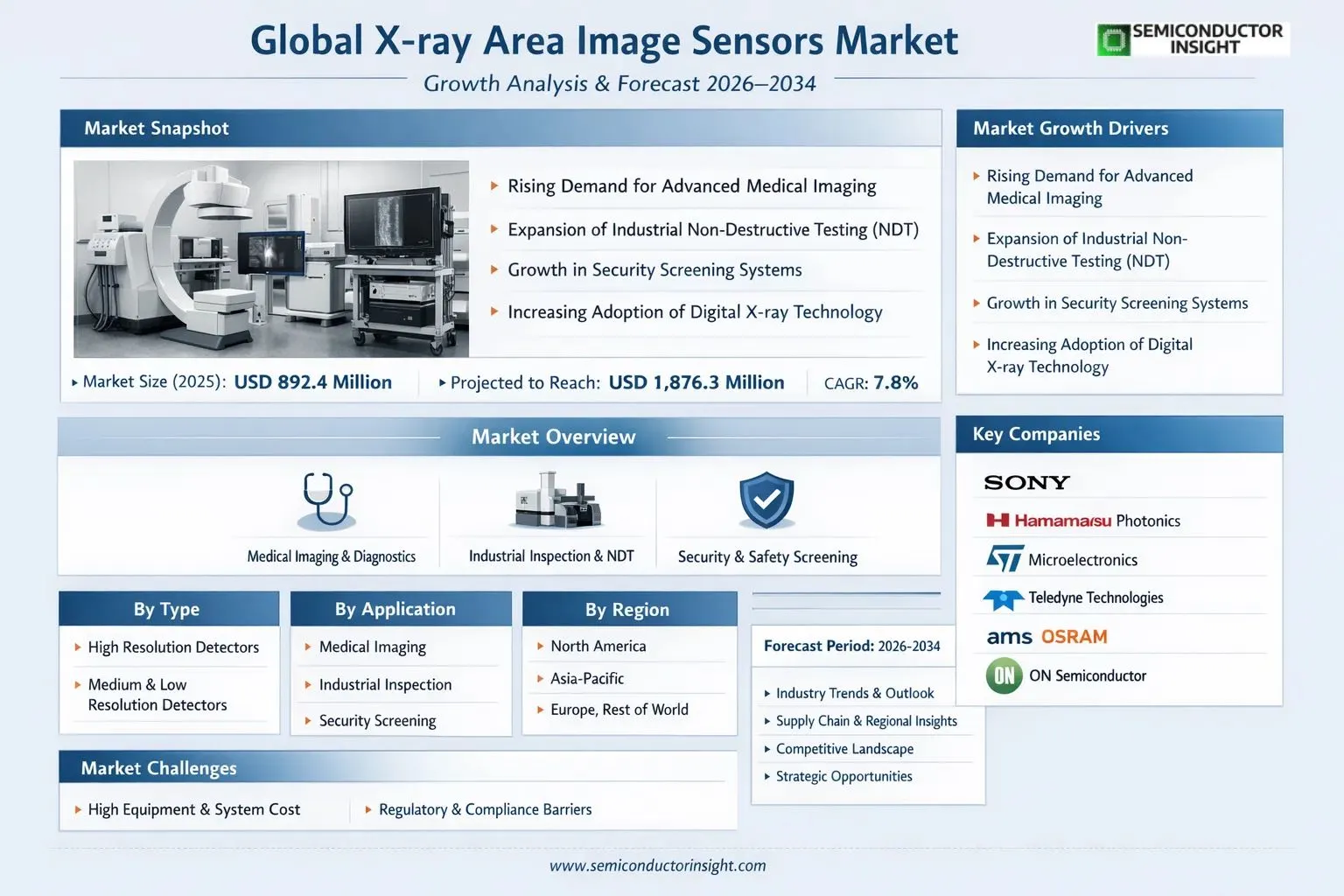
MARKET DRIVERS
Rising Demand for Advanced Medical Imaging Technologies
X-ray Area Image Sensors Market is experiencing robust growth driven by the accelerating adoption of digital radiography systems across hospitals, diagnostic imaging centers, and specialty clinics worldwide. The transition from conventional film-based X-ray systems to flat-panel detectors and complementary metal-oxide-semiconductor (CMOS)-based area image sensors has fundamentally transformed diagnostic imaging workflows. As healthcare providers increasingly prioritize faster image acquisition, reduced radiation exposure, and superior image resolution, demand for high-performance X-ray area image sensors continues to rise. The integration of these sensors into portable and mobile radiography units has further expanded their clinical utility, particularly in emergency care and point-of-care diagnostics.
Expansion of Industrial Non-Destructive Testing Applications
Beyond medical imaging, X-ray Area Image Sensors Market is being significantly propelled by growing demand from industrial non-destructive testing (NDT) sectors. Industries such as aerospace, automotive manufacturing, electronics, and oil and gas are increasingly deploying X-ray area sensors for quality control, structural integrity assessments, and defect detection in complex components. The shift toward automated inspection systems and the integration of X-ray area image sensor technology with artificial intelligence-powered defect recognition platforms has amplified their industrial relevance. Manufacturers are investing in sensors capable of delivering high spatial resolution combined with rapid frame rates to meet stringent industrial inspection standards.
➤ The convergence of AI-driven image analysis with next-generation X-ray area image sensor architectures is redefining inspection accuracy across both medical and industrial verticals, positioning this market for sustained long-term expansion.
Government investments in healthcare infrastructure modernization across emerging economies, coupled with favorable reimbursement policies for digital imaging procedures in developed markets, are creating a strong demand environment. The aging global population, rising incidence of chronic diseases requiring frequent diagnostic imaging, and the post-pandemic emphasis on upgrading hospital infrastructure collectively reinforce the demand trajectory for X-ray Area Image Sensors Market over the forecast period.
MARKET CHALLENGES
High Initial Investment and Cost Constraints Limiting Adoption in Price-Sensitive Markets
One of the most significant challenges facing X-ray Area Image Sensors Market is the substantial capital investment required for the procurement and installation of advanced flat-panel detector systems and CMOS-based sensor technologies. Smaller diagnostic facilities, rural healthcare providers, and institutions in low- and middle-income countries often face considerable budgetary constraints that restrict their ability to transition from legacy imaging systems to modern X-ray area image sensor-enabled platforms. The total cost of ownership, including maintenance, calibration, and periodic hardware upgrades, further compounds financial barriers and slows overall market penetration in cost-sensitive segments.
Other Challenges
Technical Complexity and Integration Issues
The integration of X-ray area image sensors into existing radiology information systems (RIS) and picture archiving and communication systems (PACS) presents notable technical challenges. Compatibility issues between sensor hardware from different manufacturers and legacy software infrastructure can lead to extended implementation timelines and increased IT resource expenditure. Additionally, ensuring consistent image quality across varying dose levels, managing detector calibration drift, and addressing pixel defect management over the sensor’s operational lifespan require specialized technical expertise that is not uniformly available across all healthcare and industrial end-user environments.
Regulatory and Compliance Barriers
Stringent regulatory approval processes governing medical imaging devices across major markets, including the U.S. FDA 510(k) clearance pathway and the European MDR framework, impose lengthy and resource-intensive compliance requirements on manufacturers of X-ray area image sensors. Navigating these regulatory landscapes increases time-to-market and development costs, particularly for smaller manufacturers and start-ups seeking to introduce innovative sensor architectures or novel detector materials into commercial channels.
MARKET RESTRAINTS
Radiation Safety Concerns and Evolving Compliance Requirements
Heightened awareness of radiation exposure risks among patients and healthcare professionals continues to act as a restraint on certain segments of X-ray Area Image Sensors Market. Regulatory bodies in multiple regions are progressively tightening guidelines around permissible radiation dose levels, compelling manufacturers to invest in low-dose sensor technologies and advanced scatter correction algorithms. While this is driving product innovation, it simultaneously increases research and development expenditure and extends development cycles, constraining near-term market scalability for vendors with limited R&D budgets. Compliance with evolving radiation safety standards across different international jurisdictions also adds complexity to global market expansion strategies.
Supply Chain Vulnerabilities and Raw Material Dependencies
X-ray Area Image Sensors Market is exposed to supply chain vulnerabilities associated with the availability of specialized scintillator materials, amorphous silicon substrates, and advanced semiconductor components essential for sensor fabrication. Geopolitical tensions, trade restrictions, and concentration of critical raw material supplies within a limited number of geographic regions have introduced procurement risks for sensor manufacturers. Disruptions in Global semiconductor supply chain, as evidenced by industry-wide shortages in recent years, can lead to production delays, increased component costs, and constrained output capacity, all of which act as meaningful restraints on market growth momentum during periods of supply-demand imbalance.
MARKET OPPORTUNITIES
Emergence of Photon-Counting Detector Technology as a Growth Frontier
The development and commercialization of photon-counting detector (PCD) technology represents a transformative opportunity for X-ray Area Image Sensors Market. Unlike conventional energy-integrating detectors, photon-counting sensors offer superior spectral resolution, enhanced contrast-to-noise ratios, and the capability to simultaneously acquire multi-energy data , enabling advanced material decomposition and quantitative imaging applications. As clinical evidence supporting the diagnostic advantages of PCD-based CT and radiography systems continues to accumulate, healthcare providers are expected to accelerate investment in these next-generation platforms, driving demand for the underlying X-ray area image sensor components across both retrofit and new-installation scenarios.
Expanding Applications in Security Screening and Veterinary Imaging
Diversification of application areas presents a compelling growth opportunity for participants in X-ray Area Image Sensors Market. Global expansion of border security infrastructure, airport passenger screening systems, and cargo inspection platforms is generating substantial incremental demand for high-throughput, large-format X-ray area sensors capable of operating reliably in continuous-use environments. Simultaneously, the rapid professionalization of veterinary medicine and the growing adoption of advanced diagnostic imaging in companion animal care and large-animal veterinary practices are opening new addressable markets. Manufacturers that develop application-specific sensor variants optimized for security and veterinary use cases are well-positioned to capture share in these underpenetrated segments of the broader X-ray area image sensors market.
Trends
Rising Demand for High-Resolution Imaging Drives X-ray Area Image Sensors Market
X-ray Area Image Sensors Market is experiencing a significant transformation driven by the growing need for precise, high-resolution digital imaging across medical, industrial, and security applications. As healthcare institutions increasingly adopt digital radiography systems to improve diagnostic accuracy and patient outcomes, demand for advanced area image sensors capable of capturing detailed X-ray images in real time has surged. These sensors, which convert X-ray radiation into digital visual data, are becoming integral to modern imaging infrastructure. Medical facilities worldwide are transitioning from traditional film-based X-ray systems to fully digital platforms, directly boosting adoption of high-resolution X-ray area image sensors across hospitals, diagnostic centers, and specialized clinics.
Other Trends
Expansion of Industrial Non-Destructive Testing (NDT) Applications
Industrial applications represent one of the fastest-growing segments within X-ray Area Image Sensors Market. Manufacturing sectors,including aerospace, automotive, electronics, and energy,are increasingly utilizing X-ray area image sensors for non-destructive testing and quality control processes. These sensors enable engineers to detect internal structural defects, material inconsistencies, and component failures without physically altering or damaging the inspected parts. As global manufacturing standards become more stringent and product reliability expectations rise, industrial end-users are investing in more sophisticated imaging sensor technologies, fueling steady market expansion in the industrial segment.
Technological Advancements in Sensor Architecture
Continuous innovation in sensor design is reshaping the competitive landscape of X-ray Area Image Sensors Market. Leading manufacturers such as Sony, Hamamatsu, STMicroelectronics, ON Semiconductor (Aptina), ams OSRAM, and Teledyne Technologies are actively investing in the development of next-generation detector architectures. Improvements in pixel density, dynamic range, noise reduction, and frame rate performance are enabling sensors to deliver superior image quality even under low-dose radiation conditions. The integration of complementary metal-oxide-semiconductor (CMOS) technology into X-ray area image sensors has particularly accelerated performance gains while simultaneously reducing overall device size and power consumption, making these solutions more adaptable across diverse deployment environments.
Security Screening and Safety Check Applications Gaining Momentum
The safety check and security screening segment is emerging as a notable growth avenue within X-ray Area Image Sensors Market. Airports, ports, border control facilities, and critical infrastructure sites are increasingly deploying advanced X-ray imaging systems equipped with high-sensitivity area sensors to enhance threat detection capabilities. Governments and regulatory bodies across North America, Europe, and Asia are allocating increased budgets toward security infrastructure modernization, which is directly translating into higher procurement of X-ray area image sensor-based systems. This trend is expected to sustain long-term demand, particularly as global security concerns and passenger traffic volumes continue to rise, creating consistent opportunities for sensor manufacturers and system integrators operating in this space.
COMPETITIVE LANDSCAPE
Key Industry Players
X-ray Area Image Sensors Market , Competitive Intelligence & Strategic Player Profiling
Global X-ray area image sensors market is characterized by a moderately consolidated competitive landscape, with a handful of established technology conglomerates and specialized imaging solution providers commanding significant revenue shares. Sony and Hamamatsu Photonics stand out as dominant forces, leveraging decades of sensor engineering expertise and robust R&D pipelines to maintain leadership in both medical imaging and industrial non-destructive testing (NDT) applications. Sony’s advanced CMOS sensor architectures and Hamamatsu’s deep expertise in photodetector and scintillator integration have enabled both companies to deliver high-resolution, low-noise X-ray area image sensors that meet the increasingly stringent demands of clinical diagnostics and precision manufacturing inspection. Teledyne Technologies further reinforces the competitive intensity through its portfolio of scientific-grade imaging sensors, targeting high-performance industrial and defense-grade X-ray detection systems. The top five global players collectively accounted for a substantial share of total market revenue in 2025, underscoring the strategic importance of scale, IP portfolios, and vertical integration in sustaining competitive advantage.
Beyond the market leaders, several niche and emerging players are carving out meaningful positions by focusing on specialized application segments and regional markets. STMicroelectronics and ON Semiconductor (Aptina) bring broad semiconductor manufacturing capabilities to the X-ray sensor space, offering cost-competitive CMOS-based solutions for safety inspection and lower-resolution diagnostic imaging. ams OSRAM contributes differentiated optical sensing technologies, while PHYWE and Dexis serve highly specialized verticals , scientific education and dental X-ray imaging, respectively , where application-specific design and regulatory compliance are key differentiators. Companies such as Varex Imaging, Canon Medical Systems, Fujifilm, Carestream Health, Analogic Corporation, and Varian Medical Systems continue to expand their footprints through product innovation, strategic partnerships, and geographic diversification, particularly across high-growth markets in Asia-Pacific and the Middle East. The competitive dynamic in this market is increasingly shaped by advancements in flat-panel detector (FPD) technology, AI-assisted image processing integration, and the shift toward portable and wireless X-ray imaging platforms, compelling all participants to accelerate their innovation cycles and form ecosystem alliances.
List of Key X-ray Area Image Sensors Companies Profiled
- Sony
- Hamamatsu Photonics
- STMicroelectronics
- ON Semiconductor (Aptina)
- ams OSRAM
- Teledyne Technologies
- PHYWE
- Dexis
- Varex Imaging Corporation
- Canon Medical Systems
- Fujifilm Holdings Corporation
- Carestream Health
- Analogic Corporation
- Varian Medical Systems (Siemens Healthineers)
- Detection Technology Plc
Segment Analysis:
| Segment Category | Sub-Segments | Key Insights |
| By Type |
|
High Resolution Detectors represent the leading segment within X-ray Area Image Sensors Market, driven by growing demand for precise and detailed imaging across critical end-use sectors.
|
| By Application |
|
Medical stands as the dominant application segment for X-ray Area Image Sensors, underpinned by Global expansion of healthcare infrastructure and the rising prevalence of chronic and lifestyle-related diseases requiring frequent diagnostic imaging.
|
| By End User |
|
Hospitals and Diagnostic Imaging Centers constitute the leading end-user group, reflecting the central role that X-ray area image sensors play in modern clinical practice and patient care pathways.
|
| By Technology |
|
CMOS-Based Sensors are increasingly establishing themselves as the leading technology segment, displacing legacy CCD solutions across a growing number of application areas due to compelling performance and integration advantages.
|
| By Form Factor |
|
Fixed/Stationary Sensors remain the dominant form factor, particularly in high-volume clinical and industrial environments where consistent imaging performance, seamless system integration, and long operational duty cycles are essential.
|
Regional Analysis: X-ray Area Image Sensors Market
North America
North America remains at the forefront of X-ray area image sensor innovation, with major players investing heavily in the development of high-resolution flat-panel detectors, complementary metal-oxide-semiconductor (CMOS) sensors, and amorphous silicon-based technologies. A culture of continuous R&D, supported by strong university-industry partnerships, ensures that the region consistently brings advanced sensor solutions to Global market.
The region’s expansive and well-funded healthcare network creates sustained demand for cutting-edge diagnostic imaging equipment. Hospitals, outpatient imaging centers, and specialty clinics across the United States and Canada continue to invest in digital radiology upgrades, positioning X-ray area image sensors as a cornerstone of modern diagnostic workflows and patient care quality improvement initiatives.
Beyond medical imaging, North America exhibits strong demand for X-ray area image sensors in non-destructive testing, aerospace inspection, and border security applications. The industrial sector’s stringent quality control requirements and government investments in homeland security infrastructure have broadened the commercial scope of X-ray area image sensor deployment across multiple verticals.
A transparent and structured regulatory environment, combined with favorable reimbursement policies for digital diagnostic imaging, enables faster commercialization of X-ray area image sensor products in North America. FDA clearances and established clinical validation pathways give manufacturers confidence to invest in next-generation product development, fostering a healthy competitive market landscape.
Europe
Europe represents one of the most mature and technologically sophisticated regional markets for X-ray area image sensors. Countries such as Germany, France, the United Kingdom, and the Netherlands are home to several globally recognized medical device manufacturers and research institutions that actively contribute to sensor technology advancements. The region’s strong emphasis on patient safety, digitalization of healthcare systems, and compliance with stringent regulatory frameworks , such as the EU Medical Device Regulation (MDR) , ensures that only high-quality, clinically validated imaging solutions enter the market. Public healthcare systems across Europe continue to invest in modernizing their diagnostic imaging capabilities, creating sustained demand for advanced X-ray area image sensors. Additionally, Europe’s robust industrial base, particularly in automotive, aerospace, and electronics manufacturing, drives significant demand for non-destructive testing applications utilizing X-ray area image sensing technologies. The presence of well-funded academic and government research programs further supports regional innovation in sensor design and imaging performance.
Asia-Pacific
The Asia-Pacific region is emerging as the fastest-growing market for X-ray area image sensors, fueled by rapid healthcare infrastructure expansion, rising medical tourism, and increasing government investment in public health systems across China, India, Japan, and South Korea. China, in particular, has made substantial strides in developing domestic imaging sensor manufacturing capabilities, reducing dependence on imported technologies and creating a highly competitive local market. Japan continues to lead in precision sensor engineering, while South Korea’s advanced electronics ecosystem supports the production of high-performance imaging components. India’s growing network of private hospitals and diagnostic centers is driving increased adoption of digital X-ray area image sensor systems. The region also benefits from a large patient population, rising incidence of lifestyle-related diseases, and expanding awareness of early disease detection, all of which contribute to robust and long-term demand for advanced diagnostic imaging solutions.
South America
South America presents a gradually developing market for X-ray area image sensors, with Brazil and Argentina leading regional adoption due to their relatively advanced healthcare systems and industrial sectors. The region is witnessing increased investment in healthcare modernization, supported by both government initiatives and private sector participation, creating growing opportunities for digital imaging technology providers. However, challenges such as economic volatility, limited reimbursement frameworks, and uneven healthcare access across urban and rural areas continue to moderate the pace of market expansion. Despite these constraints, the increasing burden of respiratory diseases, cancer, and orthopedic conditions is compelling healthcare providers in South America to invest in more efficient and accurate diagnostic tools, including advanced X-ray area image sensors. Partnerships with global technology suppliers and growing local distribution networks are expected to support market development across the region in the coming years.
Middle East & Africa
The Middle East and Africa region represents an emerging frontier for X-ray Area Image Sensors Market, characterized by growing healthcare investment, particularly in Gulf Cooperation Council (GCC) nations such as Saudi Arabia and the United Arab Emirates. These countries are actively expanding their healthcare infrastructure as part of broader economic diversification strategies, creating a receptive environment for advanced diagnostic imaging technologies. Africa, while still in the early stages of healthcare digitalization, is witnessing increased donor-funded and government-backed initiatives to improve diagnostic capabilities in urban centers. The demand for portable and cost-effective X-ray area image sensor solutions is particularly relevant in this region, given the need to serve geographically dispersed populations. Industrial applications, including oil and gas pipeline inspection and construction quality assurance, also contribute to regional demand for X-ray area image sensing technologies across the Middle East.
Report Scope
This market research report provides a comprehensive analysis of X-ray Area Image Sensors Market, covering the forecast period 2026–2034. It offers detailed insights into market dynamics, technological advancements, competitive landscape, and key trends shaping the industry.
Key focus areas of the report include:
- Market Overview: The report begins with an overview outlining its current market scenario, key growth indicators, and industry transformation drivers. It discusses macroeconomic factors, demand–supply balance, regulatory landscape, and the strategic role of X-ray area image sensors in powering advancements across industries such as medical imaging, industrial inspection, safety screening, and materials testing.
- Market Size & Forecast: Historical data and future projections for revenue, unit shipments, and market value across major regions and segments.
- Segmentation Analysis: Detailed breakdown by product type, technology, application, and end-user industry to identify high-growth segments and investment opportunities.
- Regional Insights: Insights into market performance across North America, Europe, Asia-Pacific, Latin America, and the Middle East & Africa, including country-level analysis where relevant.
- Competitive Landscape: Profiles of leading market participants, including their product offerings, R&D focus, manufacturing capacity, pricing strategies, and recent developments such as mergers, acquisitions, and partnerships.
- Technology Trends & Innovation: Assessment of emerging technologies, integration of AI/IoT, sensor design trends, fabrication techniques, and evolving industry standards.
- Market Drivers & Restraints: Evaluation of factors driving market growth along with challenges, supply chain constraints, regulatory issues, and market-entry barriers.
- Stakeholder Insights: Insights for component suppliers, OEMs, system integrators, investors, and policymakers regarding the evolving ecosystem and strategic opportunities.
Primary and secondary research methods are employed, including interviews with industry experts, data from verified sources, and real-time market intelligence to ensure the accuracy and reliability of the insights presented.
FREQUENTLY ASKED QUESTIONS:
What is the current market size of X-ray Area Image Sensors Market?
-> X-ray Area Image Sensors Market was valued at USD million in 2025 and is expected to reach USD million by 2034, growing at a CAGR of % during the forecast period.
Which key companies operate in X-ray Area Image Sensors Market?
-> Key players include Sony, Hamamatsu, STMicroelectronics, ON Semiconductor (Aptina), ams OSRAM, Teledyne Technologies, PHYWE, and Dexis, among others. In 2025, Global top five players held a share of approximately % in terms of revenue.
What are the key growth drivers?
-> Key growth drivers include rising demand for advanced medical imaging solutions, expansion of industrial non-destructive testing, increasing adoption of digital X-ray systems in safety screening, and growing need for high-resolution detection in materials analysis.
Which region dominates X-ray Area Image Sensors Market?
-> North America, particularly the United States, represents a significant market, with the U.S. market size estimated at USD million in 2025. Asia-Pacific, led by China, is among the fastest-growing regions, with China projected to reach USD million during the forecast period.
What are the emerging trends in X-ray Area Image Sensors Market?
-> Emerging trends include development of high-resolution detectors, integration of AI-powered image analysis, miniaturization of sensor components, and increasing adoption of digital flat-panel detectors across medical and industrial applications. The High Resolution Detectors segment is projected to reach USD million by 2034, with a % CAGR over the next six years.

Get Sample Report PDF for Exclusive Insights
Report Sample Includes
- Table of Contents
- List of Tables & Figures
- Charts, Research Methodology, and more...
 Download Sample Report PDF