
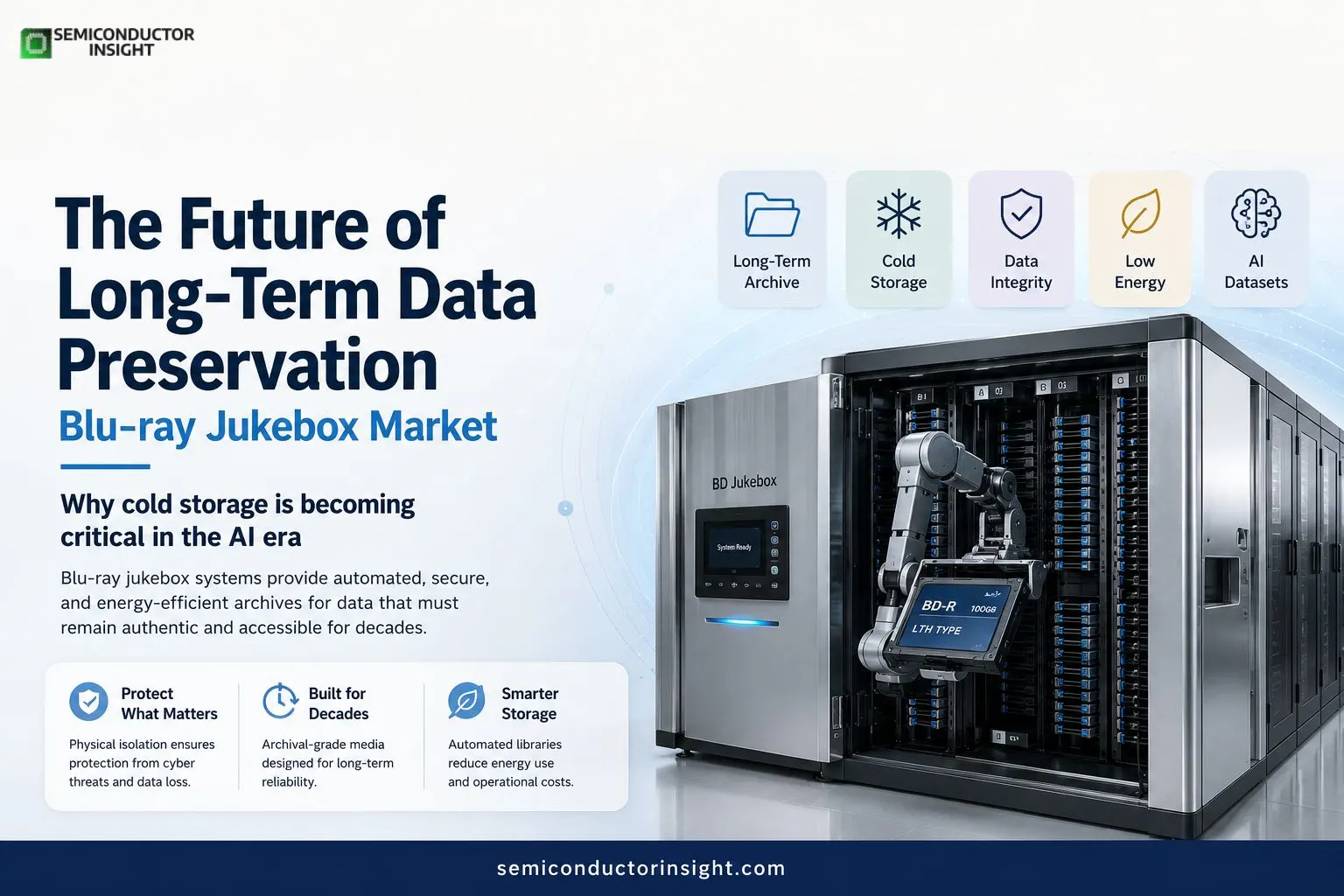
Top 9 Innovations Elevating Blu-ray Jukebox Market beyond Traditional Disc Libraries
Much of today’s discussion around digital infrastructure focuses on speed. Faster processors, higher-bandwidth memory, and AI accelerators dominate technology headlines. Yet an equally important question is emerging across research institutions, governments, healthcare providers, broadcasters, and semiconductor manufacturers: where should critical information be stored for decades without constant migration?
This question is placing renewed attention on Blu-ray Jukebox Market. Rather than competing with high-speed flash storage, automated Blu-ray libraries serve an entirely different purpose preserving information that may remain untouched for years but must remain authentic, readable, and protected when needed.
As organisations generate unprecedented volumes of scientific data, manufacturing records, surveillance footage, and engineering documentation, optical archives are quietly becoming part of modern digital infrastructure.
Cold Storage Is Becoming a Hot Technology Topic
- According to the International Data Corporation (IDC), the world’s datasphere continues to expand into hundreds of zettabytes, with a significant portion classified as ‘cold data’ information that is rarely accessed but cannot be deleted. Keeping this information on active storage consumes unnecessary energy and increases operational costs.
- Blu-ray jukebox systems address this challenge by automatically loading optical discs only when requested. Archived media uses a lot less electricity because it is offline until it is retrieved, unlike constantly spinning hard drives.
- Several enterprise optical libraries now support more than 500 discs in a single automated cabinet, while robotic retrieval mechanisms can locate requested media within seconds, allowing organisations to balance accessibility with long-term preservation.
Semiconductor Manufacturing Needs Records That Outlive Production Cycles
Semiconductor fabrication depends on extensive documentation. Process recipes, inspection images, wafer maps, equipment calibration logs, yield analysis, and quality records must often remain available for many years to satisfy customer requirements and regulatory obligations.
Advanced fabs generate millions of inspection images annually through defect inspection systems and metrology equipment. While production databases continue growing, historical records increasingly require economical storage without sacrificing integrity.
Optical archives provide an additional layer for protecting manufacturing information against accidental modification, ransomware attacks, and hardware degradation because archived discs remain physically isolated from production networks when not in use.
For a more thorough report, please contact us using our most recent report: https://semiconductorinsight.com/report/blu-ray-jukebox-market/
Optical Media Is Quietly Breaking Longevity Records
- Preservation-grade optical media is meant for significantly longer preservation than consumer Blu-ray discs, which are primarily intended for entertainment.
- Research published by the U.S. National Institute of Standards and Technology (NIST) and studies conducted by optical storage manufacturers have explored media stability under accelerated ageing conditions.
- Archival optical formats are frequently designed with projected preservation periods measured in several decades under recommended environmental conditions.
- The capacity of optical media has also evolved. The Blu-ray Disc Association standard includes discs storing 25 GB, 50 GB, 100 GB, and 128 GB on individual cartridges, while large automated libraries combine thousands of discs into petabyte-scale repositories.
- These capabilities are increasingly relevant as engineering simulations, AI training datasets, semiconductor inspection files, and scientific imaging continue expanding.
AI Is Creating a New Archive Problem
Artificial intelligence is often associated with GPUs and advanced semiconductor devices, but AI also creates an unprecedented storage challenge.
Training large language models, autonomous driving systems, and industrial vision platforms requires enormous collections of historical datasets. Even after model development is complete, organisations frequently retain original datasets for compliance, reproducibility, and future model improvements.
Universities, national laboratories, and research organisations increasingly distinguish between high-performance storage used during model training and archival storage reserved for completed datasets. Optical libraries are attracting attention because archived information cannot be overwritten accidentally while remaining accessible when future validation is required.
Libraries Museums and Healthcare Organisations Are Expanding Digital Preservation
The importance of long-term digital preservation extends far beyond enterprise IT.
UNESCO continues encouraging member states to strengthen digital heritage preservation, recognising that photographs, manuscripts, audiovisual collections, and research records increasingly exist only in electronic form.
National libraries, museums, and public archives are digitising millions of historical assets every year. Healthcare organisations also maintain medical imaging records, pathology slides, and diagnostic information that often require extended retention periods under healthcare regulations.
These institutions are adopting diversified storage strategies where optical archives complement cloud infrastructure instead of replacing it.
Engineering Is Shifting Towards Hybrid Archive Architectures
Modern storage design is becoming less about selecting one technology and more about combining multiple layers with distinct responsibilities.
High-speed NVMe drives process active workloads, hard disk arrays support frequently accessed information, and cloud platforms enable collaboration, while optical jukeboxes preserve completed projects and compliance records.
This layered approach is particularly attractive for semiconductor manufacturers, aerospace organisations, scientific laboratories, and industrial research centres that generate valuable datasets with exceptionally long retention requirements.
Rather than disappearing in the flash storage era, Blu-ray jukebox technology is finding a specialised role where permanence, authenticity, and operational efficiency matter more than raw speed.

Comments (0)