
Top 5 Surface and Panel Advances Reshaping 2026 Glossy Monitors Market Clarity
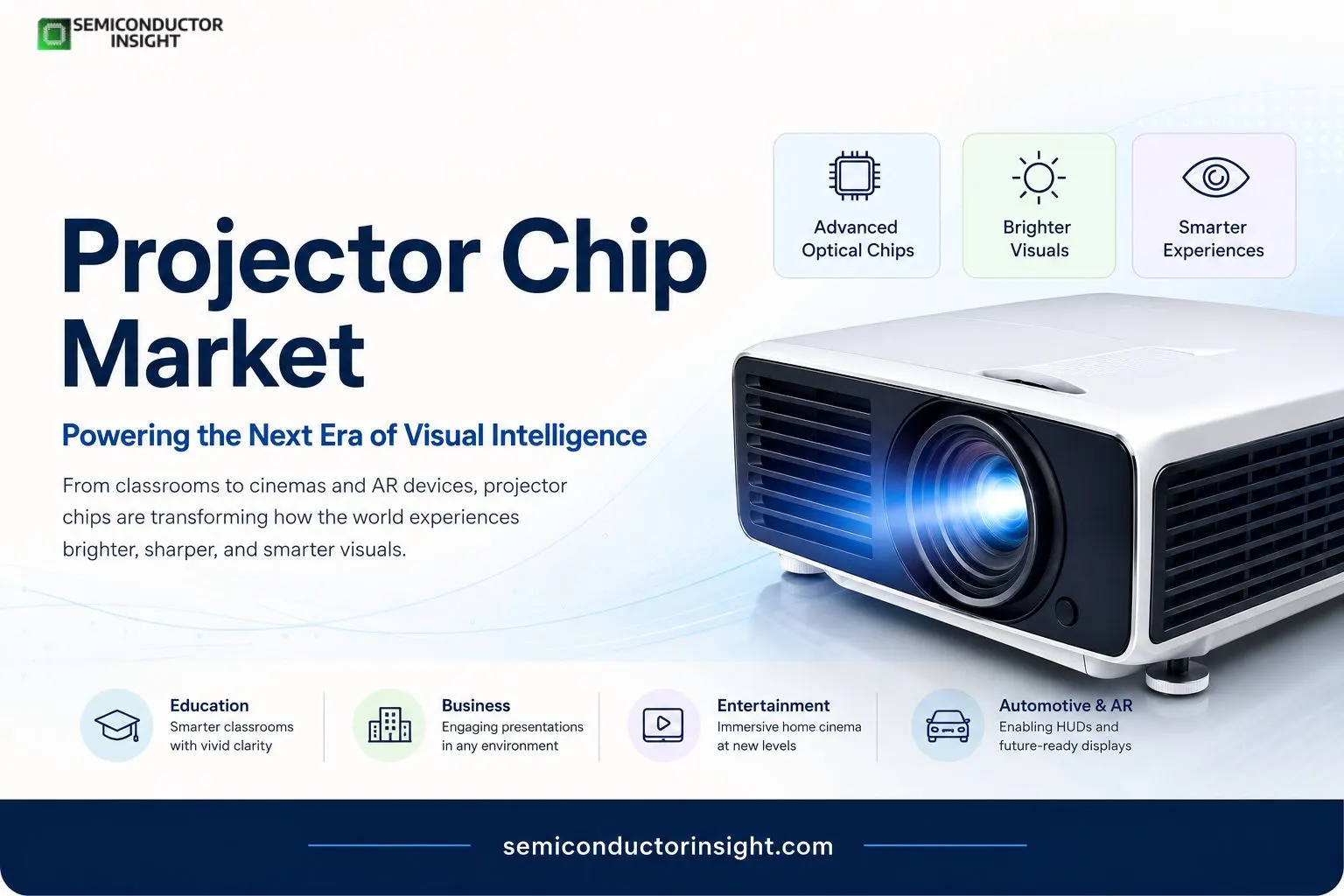
The underlying intelligence that powers contemporary visual experiences is now found in projector chips. These semiconductor components control image quality, brightness, colour accuracy, and energy economy in anything from interactive classrooms and movie theatres to automobile head-up displays (HUDs), augmented reality gadgets, and portable smart projectors.
Projector chips are developing into complex optical processors that can handle billions of pixels per second as screens continue to get smaller while requiring increasing resolution. They now support collaborative workplaces, industrial inspection, engineering visualisation, healthcare imaging, and much more than just entertainment.
Texas Instruments stands at the forefront of the projector chip market through its proprietary Digital Light Processing (DLP) technology, centered on Digital Micromirror Devices (DMDs) that feature arrays of millions of tiny aluminum mirrors tilting to create images.
- The company operates 15 worldwide manufacturing sites and produces tens of billions of chips annually, with recent expansion including a new 300mm wafer fab in Sherman, Texas that began production in late 2025.
- Employing around 33,000 people globally, TI supplies DMD chips in various sizes such as 0.47-inch and newer 4.5-micron pixel architectures used in 4K laser projectors supporting up to 13,000 lumens for applications ranging from home theaters and Laser TVs to professional installation and cinema.
- Insightful advances include high-brightness designs and compact chips enabling smaller portable units, with ongoing investments in 300mm capacity to meet demand for higher frame rates and contrast in current laser and ultra-short-throw systems.
Epson America Inc. (part of Seiko Epson) dominates 3LCD projector technology with high-temperature polysilicon TFT liquid crystal panels that deliver bright, color-rich images across education, business, home entertainment, and projection mapping. The broader Epson Group employs about 75,000 people across 89 companies in Japan and overseas, with manufacturing facilities in locations such as the Philippines and China producing 3LCD projectors and related microdisplay components.
Epson has maintained a long-standing leading position in projectors above 500 lumens for over two decades, offering models with brightness reaching 25,000 lumens in high-end units and supporting applications from classrooms to large venues. Recent focus includes laser light sources and flexible installation options that enhance portability and reliability in mixed lighting environments. Its microdisplay roots trace back to early LCD watch technology, evolving into systems that prioritize eye comfort and vivid color for everyday professional and creative uses.
Sony Corporation leads in high-end native 4K projection through its proprietary SXRD (Silicon X-tal Reflective Display) LCoS chips, which pack 8.3 million pixels onto compact panels as small as 0.61 inches for dense, sharp imagery. These chips power home theater projectors delivering 2,700 to 3,400 lumens with laser sources rated for 20,000 hours of maintenance-free operation, supporting HDR, high contrast ratios, and low input lag down to around 12 milliseconds at 120 Hz.
Sony’s SXRD technology appears in models used for dedicated home cinemas, professional simulation, and cinema applications, with recent designs achieving about 20% smaller volume and 30% lighter weight compared to prior generations. The company’s expertise spans from early Full HD microdisplays to current native 4K panels that minimize pixel structure even on screens over 150 inches. In present conditions, Sony continues refining dynamic tone mapping and compact optics to serve premium installation markets seeking cinematic quality.
Our most recent updated related study is available for free at this link: https://semiconductorinsight.com/report/projector-chip-market/
Jiangsu Huixinchen Technology Co., Ltd. contributes to the Chinese segment of projector optical components and related display technologies, supporting domestic manufacturing of chips and modules for consumer and commercial projection systems. Operating within China’s electronics supply chain, the company focuses on components that enable cost-effective and scalable production for local projector assemblers.
Its work aligns with regional demand for educational, business, and home entertainment projectors that incorporate various imaging technologies. Insights include participation in the growing ecosystem of Chinese suppliers addressing volume needs for mid-range and entry-level units. Current efforts emphasize reliable supply for applications in classrooms, offices, and residential setups amid expanding domestic production capacity.
Himax Technologies, Inc. specializes in LCoS microdisplays and related optics for compact projectors, pico-projectors, AR glasses, and head-up displays, with in-house manufacturing capabilities for color filters and module assembly. The company maintains dedicated fab lines for LCoS and wafer-level optics, supporting applications that require high brightness (up to 400,000 nits in front-lit designs) at low power levels around 300 milliwatts.
Himax’s solutions feature in industrial, consumer, gaming, sports, and emerging AR/VR devices, drawing on over a decade of mass-production experience with major tech partners. Recent front-lit LCoS designs reduce optical engine complexity and weight while delivering full-color performance suitable for see-through displays. In today’s market, Himax positions its technology for volume ramps in smart glasses and pico-projection as demand for portable and wearable imaging grows.
Samsung Electro-Mechanics supports projector and display ecosystems through advanced package substrates, multilayer ceramic capacitors, and related components that enable reliable power delivery and signal integrity in high-performance imaging systems. The company produces specialized substrates used in semiconductor packages for AI, server, and consumer electronics, with recent pilot production expansions including camera modules in Vietnam facilities.
These components underpin the stability of chips and drivers found in modern laser and LED projectors. Insights highlight its role in high-density packaging that aids heat management and miniaturization for compact projector designs. Current activities focus on meeting rising needs for durable electronics in professional and consumer visual solutions.
LG Innotek provides camera modules, package substrates, and optical components that integrate into projector systems and related visual technologies, emphasizing copper-post and high-density interconnect solutions for efficient signal and thermal performance. Operating as part of the LG Group, it supplies parts used across mobile, automotive, and display applications that overlap with projection hardware.
Recent showcases include advanced substrates for high-performance semiconductors. The company’s contributions help enable compact, reliable optical engines in modern projectors. In the present landscape, LG Innotek supports the supply chain for devices requiring precise imaging components in education, business, and entertainment settings.
Canon Inc. incorporates LCoS and DLP technologies into its professional and business projectors, offering models with 3LCOS architectures delivering thousands of lumens (such as 6,500 ANSI lumens in earlier WUX series) and interchangeable lenses for installation flexibility. Canon’s systems support resolutions up to WUXGA and 4K input, with applications in conference rooms, auditoriums, and pro AV environments.
The company draws on optical expertise from its camera heritage to refine image processing and lens options. Insights include sealed cooling designs and dust-resistant features in laser models for reduced maintenance. Today, Canon continues refining high-brightness units suited to well-lit commercial spaces and multi-projector installations.
Sharp Electronics develops laser projectors featuring proprietary high-performance video processing and scaling chips paired with dual blue laser systems, achieving brightness levels from 7,300 to 17,000 lumens in recent A and V series models with WUXGA native resolution and 4K support. These projectors incorporate sealed LCD cooling systems rated IP5X for dust-free operation and long-term stability, targeting classrooms, corporate venues, museums, and immersive exhibitions.
Sharp emphasizes brightness uniformity above 95% for multi-projector blending and six-axis color correction for precise calibration. Applications span educational, commercial, and cultural installations requiring consistent performance. In current conditions, Sharp’s portfolio addresses demand for maintenance-light, high-impact visuals in varied lighting environments.
ViewSonic utilizes Texas Instruments DLP chips, including 0.65-inch DMD devices with pixel-shifting for 4K resolution, in its laser and LED projectors designed for home cinema, education, and hybrid work. Models such as the LX700-4K RGB deliver 5,200 RGB laser lumens with full BT.2020 color coverage and support screen sizes up to 300 inches, while portable units feature solid-state light sources rated for tens of thousands of hours.
JVC Kenwood (added as a leading LCoS specialist) rounds out the landscape with its D-ILA technology, a proprietary LCoS implementation delivering high native contrast and resolutions up to 4K and beyond for home theater and professional simulation projectors. JVC’s imagers feature small pixel sizes (around 3.8 to 8 microns) with high fill factors exceeding 93%, used in models that prioritize deep blacks and cinematic detail.

Comments (0)