
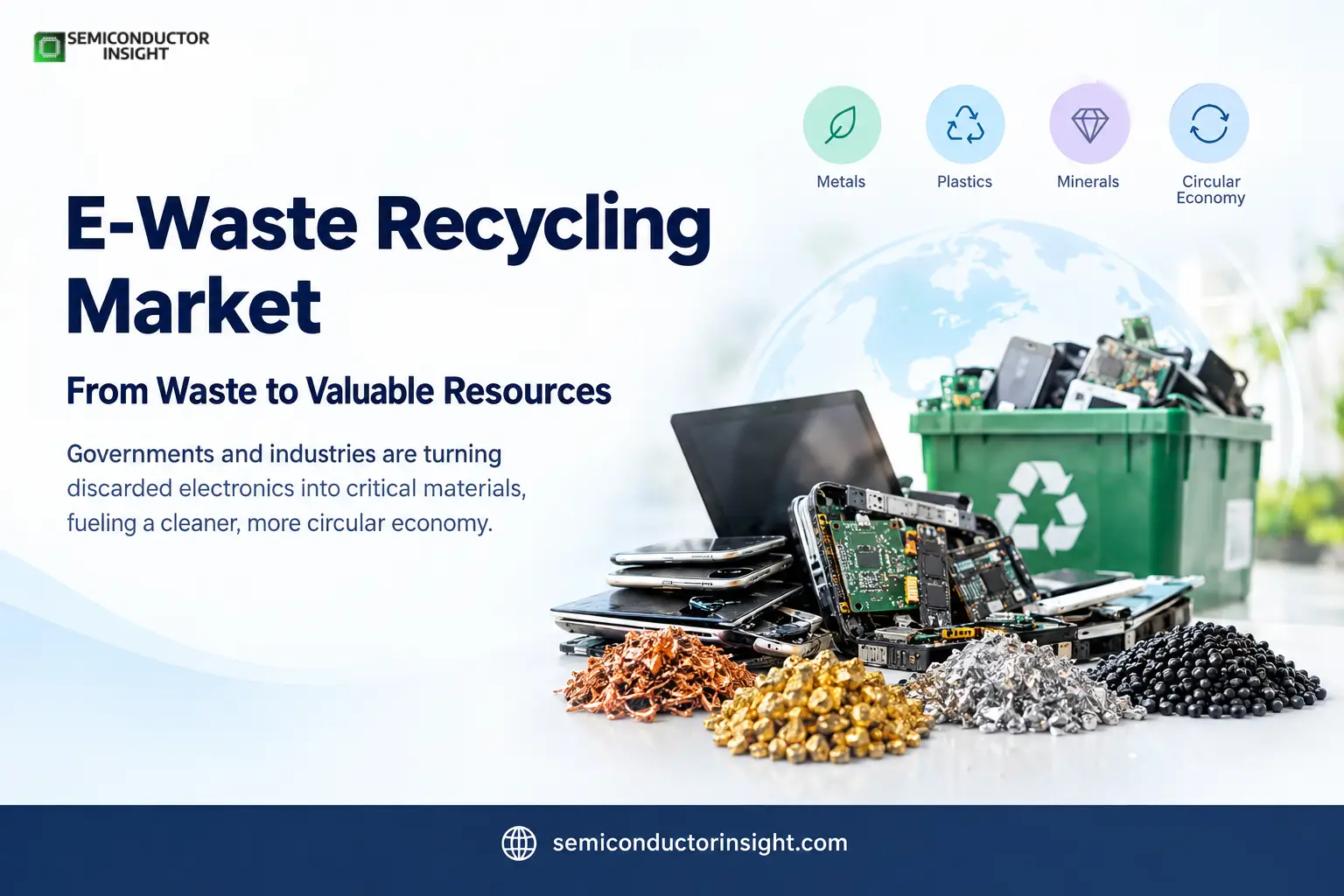
Top 5 Major Leading Regions for the E-waste Recycling Market amid Rising Smartphone and Electronics Waste
The e-waste recycling market is moving beyond conventional waste handling as governments and electronics industries increasingly view discarded devices as sources of metals, plastics and other recoverable materials. The latest Global E-waste Monitor recorded 62 million tonnes of e-waste globally in 2022, equivalent to 7.8 kg per person.
Only 22.3% was documented as formally collected and recycled. The material inside this waste stream included about 31 million tonnes of metals, 17 million tonnes of plastics and 14 million tonnes of other materials such as glass and minerals.
This is particularly relevant for electronics containing copper, gold, aluminium and other materials used across semiconductor equipment, telecommunications, computers, consumer electronics and industrial systems.
Asia Pacific sets the volume benchmark
Asia Pacific stands apart because of the sheer quantity of electronics entering and leaving consumer and industrial markets. Asia generated around 30.1 million tonnes of e-waste in 2022, almost half of the global total. Its formal collection and recycling rate was 11.8%, showing a substantial gap between waste generation and organized recovery.
China, India, Japan, South Korea and Southeast Asian economies are particularly important to the regional landscape. Manufacturing clusters, expanding smartphone ownership, data infrastructure and shorter electronics replacement cycles are creating large volumes of discarded equipment. India is also strengthening the formal recycling ecosystem. In March 2026, the Indian government reported 386 registered e-waste recyclers and 28.75 lakh tonnes of e-waste recycled under its EPR framework as of March 5, 2026.
Europe turns regulation into recycling infrastructure
Europe represents a different kind of leadership, where regulation, collection systems and material recovery are tightly connected. The region generated 17.6 kg of e-waste per person in 2022 and recorded the world’s highest documented collection and recycling rate at 42.8%.
The European Commission’s WEEE framework covers products ranging from smartphones and household appliances to medical equipment. In 2022, around 5 million tonnes of e-waste were collected in the EU, equal to 11.2 kg per person. Eurostat later reported that 5.2 million tonnes of WEEE were collected in 2023, while 4.3 million tonnes were recycled or prepared for reuse.
North America connects recycling with electronics recovery
North America’s importance comes from its large installed base of computers, smartphones, networking equipment, televisions, industrial electronics and data infrastructure. The region generated approximately 14.4 million tonnes of e-waste in 2022, according to data compiled from the Global E-waste Monitor.
The recycling opportunity extends beyond consumer products. Retired servers, circuit boards, telecommunications hardware and computer equipment can contain recoverable metals and components. In the United States, the EPA specifically recognizes electronics recycling and certified recycling systems, while highlighting hazardous materials such as lead, mercury, cadmium and brominated flame retardants that require controlled handling.
Latin America builds a more formal collection network
Latin America’s e-waste story is increasingly linked to formalization. The region’s generation increased from approximately 0.9 million tonnes in 2010 to 1.3 million tonnes in 2019 across the 13 countries assessed by the Regional E-waste Monitor. Yet only 2.7% was collected for environmentally sound management.
Brazil, Mexico, Argentina, Colombia and Chile are important markets as electronics penetration expands. Collection points, producer responsibility systems, refurbishment and specialized dismantling are becoming increasingly important for bringing discarded electronics into controlled recycling channels rather than informal disposal routes.
Middle East and Africa move toward structured recovery
The Middle East and Africa represent an emerging part of the recycling landscape, with substantial room for formal collection and processing capacity. Africa generated approximately 3.5 million tonnes of e-waste in 2022, while only around 25 million kg, or 0.7%, was documented as formally collected and recycled.
Egypt generated about 690,000 tonnes, South Africa 530,000 tonnes and Nigeria 500,000 tonnes in 2022, making these significant national waste streams. Across the Arab States, the need for structured systems is also visible through regional initiatives focused on legislation, collection infrastructure and environmentally sound management.
A Brief Look at Our Detailed Analysis Related Report: https://semiconductorinsight.com/report/e-waste-recycling-market/
Critical minerals give recycling a new industrial role
The economic case for e-waste recycling is increasingly connected to resource security. The UN estimates that metals contained in global e-waste in 2022 represented about USD 91 billion in potential value, including approximately USD 19 billion in copper, USD 15 billion in gold and USD 16 billion in iron.
India provides a current example of this shift. In October 2025, the government launched a ₹1,500 crore incentive scheme aimed at developing recycling capacity for critical minerals from e-waste, spent lithium-ion batteries and other scrap.
2026 shows where the market is heading
The latest developments point toward a recycling model increasingly built around EPR systems, digital tracking, organized collection, automated sorting, component recovery and critical-mineral extraction. India strengthened this direction through its E-Waste Management Rules and EPR framework, while Europe continues to expand WEEE collection and recovery systems.
With global e-waste projected by the UN to reach 82 million tonnes by 2030 under current trajectories, the role of recycling is shifting from end-of-life waste treatment toward a strategic source of secondary materials for the electronics and wider industrial economy.

Comments (0)