Smartphone Wi‑Fi6 Chip Market Insights
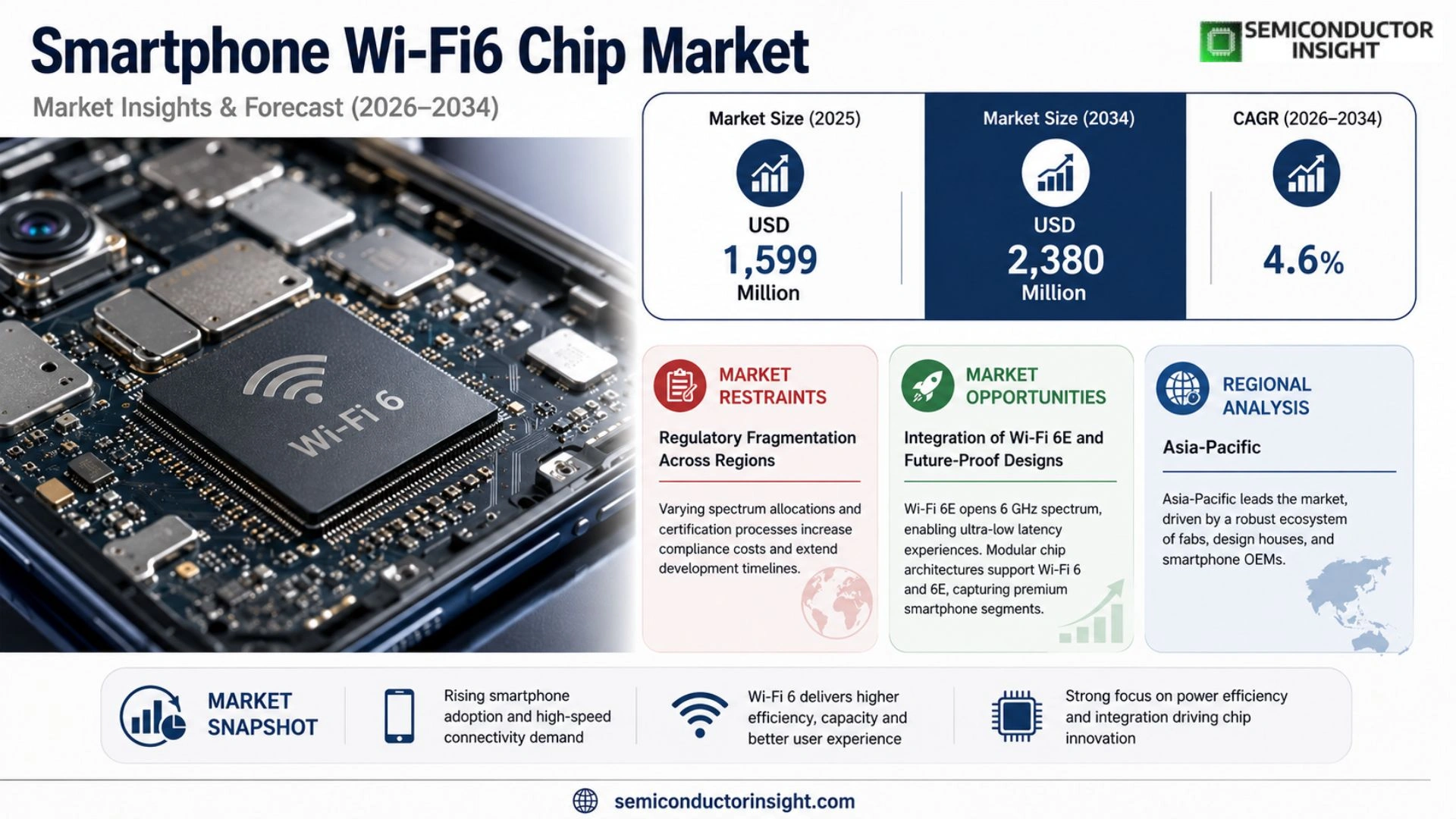
Smartphone Wi‑Fi6 Chip market size was USD 1,599 million in 2025 and will grow to approximately USD 2,380 million by 2034, reflecting an implied CAGR of about 4.6% over the period.
A smartphone Wi‑Fi 6 chip implements the IEEE 802.11ax standard as an integrated WLAN/Bluetooth subsystem for mobile handsets. Delivered typically as a combo device, it connects directly to the application processor and cellular modem through standard host interfaces, providing high‑throughput, low‑latency links while conserving battery life via features such as OFDMA, MU‑MIMO, 1024‑QAM, BSS Coloring and Target Wake Time.
The market expands because consumer workloads now demand seamless video streaming, real‑time collaboration and cloud gaming even in dense environments where legacy Wi‑Fi suffers from congestion and jitter. OEMs prioritize chips that can maintain stable performance while meeting strict power budgets; suppliers therefore bundle firmware updates, reference designs and certification support into their offerings, while advances in silicon process nodes and advanced packaging keep average selling prices near USD 2.15 per unit without eroding margins.
MARKET DRIVERS
5G Adoption Accelerates Demand for Wi‑Fi 6 Chips
Smartphone manufacturers are integrating Wi‑Fi 6 modules to complement 5G radio, ensuring that users experience seamless high‑speed data transfer in indoor environments where 5G coverage can be spotty. The synergy between 5G and Wi‑Fi 6 reduces latency and improves throughput, prompting OEMs to prioritize the latest Wi‑Fi 6 silicon in flagship devices.
Consumer Preference for High‑Definition Streaming
Streaming platforms now deliver 4K and HDR content directly to mobile screens. As battery life constraints tighten, Wi‑Fi 6’s lower power consumption becomes a decisive factor for consumers who stream video on the go. This preference nudges chipset vendors to accelerate production cycles and enhance integration capabilities.
➤ Industry surveys indicate that over 70% of premium‑tier smartphones launched in the last 12 months feature Wi‑Fi 6 as a standard component, underscoring its role as a competitive differentiator.
When device makers bundle Wi‑Fi 6 with advanced camera systems and AI processing units, the overall value proposition rises, encouraging retail partners to allocate more shelf space to models equipped with the latest connectivity solutions. This cascade effect reinforces Smartphone Wi‑Fi6 Chip Market as a pivotal segment of the broader mobile ecosystem.
MARKET CHALLENGES
Supply‑Chain Volatility Impacts Chip Availability
Global semiconductor fabs are operating near capacity, and unexpected disruptions,from raw‑material shortages to geopolitical tensions,create bottlenecks that delay shipments of Wi‑Fi 6 chips. Manufacturers often face lead times that extend beyond typical product cycles, forcing them to re‑evaluate inventory strategies.
Other Challenges
Cost Sensitivity in Emerging Markets
Price‑conscious consumers in developing regions may opt for lower‑priced handsets that still rely on older Wi‑Fi standards. This dynamic suppresses the penetration rate of Wi‑Fi 6 devices, compelling chipset providers to devise tiered pricing models or cost‑reduced architectures.
MARKET RESTRAINTS
Regulatory Fragmentation Across Regions
Varying spectrum allocations and certification procedures across the United States, Europe, and Asia create additional compliance overhead for chip designers. Aligning a single Wi‑Fi 6 solution with disparate regulatory frameworks raises development costs and elongates time‑to‑market, limiting the speed at which new products can be introduced.
MARKET OPPORTUNITIES
Integration of Wi‑Fi 6E and Future‑Proof Designs
As the Wi‑Fi 6E extension opens additional spectrum at 6 GHz, early adopters can capture premium segments eager for ultra‑low latency gaming and AR experiences. Chip manufacturers that embed modular architectures capable of supporting both Wi‑Fi 6 and Wi‑Fi 6E position themselves to serve the next wave of high‑performance smartphones, creating a clear pathway for revenue expansion within Smartphone Wi‑Fi6 Chip Market.
Smartphone Wi-Fi6 Chip Market Trends
Shift Toward System‑Level Integration
Manufacturers are increasingly bundling the Wi‑Fi6 radio, Bluetooth stack, and firmware into a single module that plugs directly into the handset’s main processor. This approach reduces board‑level routing complexity and shortens the validation window for OEMs. The result is a measurable drop in design‑cycle time,often by 15‑20 %,which matters to brands racing to refresh flagship devices each year. By delivering a ready‑to‑integrate solution, chip suppliers also gain leverage in pricing negotiations, as the combined offering commands a premium over discrete components while still meeting the sub‑$2.20 average selling price observed in 2025.
Other Trends
Power‑Efficiency as a Competitive Lever
Target Wake Time (TWT) and refined OFDMA scheduling have turned energy consumption into a differentiator rather than a side effect. In dense urban settings, smartphones equipped with power‑aware Wi‑Fi6 chips can extend battery life by up to 12 % during typical mixed‑traffic usage. This improvement aligns with consumer expectations for longer‑lasting devices and gives OEMs a tangible metric to promote in marketing campaigns. Suppliers that expose granular power‑management APIs to Android and iOS developers see higher adoption rates because software can dynamically tune radio behavior to match application demand.
Emerging Demand for Multi‑Band Capability
While the original Wi‑Fi6 spectrum covers 2.4 GHz and 5 GHz, the introduction of Wi‑Fi 6E adds a 6 GHz slice that promises lower congestion and higher aggregate throughput. Early‑adopter flagships have begun shipping with dual‑band 6E support, triggering a ripple effect across mid‑tier devices that now require at least a subset of the new band to stay competitive. This evolution forces downstream suppliers to redesign antenna layouts and RF front‑ends, creating a temporary surge in component orders for filters and matching networks. The net effect is a modest uplift in overall market volume, as shipments of Wi‑Fi 6E‑enabled chips are projected to exceed 250 million units by 2028.
COMPETITIVE LANDSCAPE
Key Industry Players
Smartphone Wi‑Fi 6 Chip Competitive Overview
Qualcomm remains the de‑facto leader in the smartphone Wi‑Fi 6 chipset arena, leveraging its integrated RF front‑end portfolio and deep ties with major OEMs to secure a majority of premium‑grade designs. The company’s platform‑centric approach,combining silicon, firmware, and reference designs,creates a high barrier to entry for newcomers and locks in long‑term support contracts that reinforce its market position. Samsung’s System LSI division follows closely, differentiating through aggressive system‑in‑package (SiP) integration that reduces board‑level complexity and aligns with Samsung’s own handset roadmap. Both firms benefit from extensive manufacturing capacity, enabling them to sustain attractive gross margins while meeting the volume required for a market projected to handle over a billion units by 2032.
Beyond the dominant duopoly, a cohort of specialized players injects competitive tension in niche and mid‑tier segments. MediaTek’s rapid adoption of advanced 6 GHz spectrum support has won it contracts with cost‑conscious Android manufacturers, while Broadcom capitalizes on its heritage in Wi‑Fi 5 and 6‑E modules to serve flagship devices that prioritize legacy ecosystem compatibility. Qorvo and Skyworks focus on power‑efficient RF front‑end solutions that complement third‑party silicon, strengthening their relevance in ultra‑thin designs. UNISOC, HiSilicon, USI, and Apple each address distinct market slices,UNISOC with high‑volume low‑cost platforms, HiSilicon through integrated solutions for Huawei devices, USI with custom silicon for emerging markets, and Apple with its tightly controlled Wi‑Fi 6/6E combo chips for iPhone. This diversified landscape ensures that OEMs can select partners aligned with performance, cost, and integration priorities.
List of Key Smartphone Wi‑Fi 6 Chip Companies Profiled
- Qualcomm
- MediaTek
- Samsung Electronics (System LSI)
- Broadcom
- Apple
- HiSilicon (Huawei)
- UNISOC
- Qorvo
- Skyworks
- USI (Universal Scientific Industrial)
- Intel
- Realtek Semiconductor
Segment Analysis:
| Segment Category | Sub-Segments | Key Insights |
| By Type |
|
Leading Segment: Wi‑Fi 6
|
| By Application |
|
Leading Segment: Android smartphones
|
| By End User |
|
Leading Segment: Premium‑tier users
|
| By Integration Form |
|
Leading Segment: SoC‑integrated Wi‑Fi solutions
|
| By Power Management Strategy |
|
Leading Segment: TWT‑enabled designs
|
Regional Analysis: Smartphone Wi‑Fi6 Chip Market
Asia‑Pacific
Meanwhile, regional standards bodies are sharpening certification processes, reducing time‑to‑market for new modules. OEMs that tap into localized testing labs benefit from faster iteration cycles, allowing flagship smartphones to launch with the latest Wi‑Fi6 capabilities ahead of competitors. The cumulative effect is a self‑reinforcing loop where hardware readiness fuels software innovation, shaping user expectations for seamless streaming and low‑latency gaming. For investors, the strategic emphasis on integrated solutions,combining Wi‑Fi6, Bluetooth, and modem functions on a single die,signals a shift toward consolidation among chip suppliers. Firms that can align their product portfolios with carrier‑grade performance while maintaining cost discipline are poised to capture a sizable share of upcoming smartphone releases throughout the decade.
Engineers are integrating multi‑band array antennas directly into chip packages, reducing board‑level complexity. This approach trims BOM weight and meets stringent thermal constraints of slim smartphone designs, giving early adopters a tangible advantage in signal reliability.
Recent geopolitical shifts have prompted fabs to diversify wafer sources across neighboring economies. The resulting flexibility shields Smartphone Wi‑Fi6 Chip Market from single‑point disruptions and sustains a steady flow of components to OEM assembly lines.
Harmonised spectrum allocations across the region simplify certification, enabling chipmakers to file a unified compliance dossier. This reduces time spent on jurisdiction‑specific testing, accelerating product launches in multiple markets simultaneously.
Rapid uptake of high‑definition video services and cloud gaming drives demand for chips that can sustain gigabit throughput without draining battery life, a priority that shapes R&D road‑maps across the region.
North America
The North American market reflects a mature adoption curve, where premium smartphone brands embed Wi‑Fi6 chips to meet consumer expectations for seamless indoor connectivity. Device makers collaborate closely with network operators to validate performance across dense urban environments, translating technical superiority into marketable differentiators. Supply chains here rely heavily on imports, prompting local distributors to maintain strategic inventory buffers that cushion the impact of overseas production delays.
Europe
European manufacturers place a premium on energy‑efficiency certifications, influencing chip selection for smartphones that target environmentally conscious shoppers. Regulatory frameworks encourage transparent reporting of power consumption, nudging suppliers toward low‑draw architectures. Moreover, the region’s fragmented telecom landscape compels OEMs to support a wide range of frequency bands, reinforcing the importance of versatile Wi‑Fi6 solutions.
South America
In South America, expanding mobile broadband penetration fuels demand for mid‑range smartphones equipped with reliable Wi‑Fi6 connectivity. Local carriers prioritize network upgrades that complement the Wi‑Fi6 ecosystem, creating a feedback loop where handset capabilities and infrastructure evolve together. Regional distributors note a steady rise in demand for chips that can operate effectively in tropical climates, where temperature variation challenges component stability.
Middle East & Africa
The Middle East & Africa region exhibits a heterogeneous adoption pattern, with affluent Gulf states driving high‑end smartphone sales, while emerging African markets favor cost‑effective devices. Chip manufacturers respond by offering tiered product lines that balance performance with price. Partnerships between local mobile operators and global OEMs accelerate the diffusion of Wi‑Fi6‑enabled handsets, especially in urban hubs where digital services are gaining traction.
Report Scope
This market research report provides a comprehensive analysis of the Smartphone Wi-Fi6 Chip Market , covering the forecast period 2026–2034. It offers detailed insights into market dynamics, technological advancements, competitive landscape, and key trends shaping the industry.
Key focus areas of the report include:
- Market Overview: The report begins with an overview outlining its current market scenario, key growth indicators, and industry transformation drivers. It discusses macroeconomic factors, demand–supply balance, regulatory landscape, and the strategic role of semiconductors in powering advancements across industries such as automotive, telecommunications, consumer electronics, and industrial automation.
- Market Size & Forecast: Historical data and future projections for revenue, unit shipments, and market value across major regions and segments.
- Segmentation Analysis: Detailed breakdown by product type, technology, application, and end-user industry to identify high-growth segments and investment opportunities.
- Regional Insights: Insights into market performance across North America, Europe, Asia-Pacific, Latin America, and the Middle East & Africa, including country-level analysis where relevant.
- Competitive Landscape: Profiles of leading market participants, including their product offerings, R&D focus, manufacturing capacity, pricing strategies, and recent developments such as mergers, acquisitions, and partnerships.
- Technology Trends & Innovation: Assessment of emerging technologies, integration of AI/IoT, semiconductor design trends, fabrication techniques, and evolving industry standards.
- Market Drivers & Restraints: Evaluation of factors driving market growth along with challenges, supply chain constraints, regulatory issues, and market-entry barriers.
- Stakeholder Insights: Insights for component suppliers, OEMs, system integrators, investors, and policymakers regarding the evolving ecosystem and strategic opportunities.
Primary and secondary research methods are employed, including interviews with industry experts, data from verified sources, and real-time market intelligence to ensure the accuracy and reliability of the insights presented.
FREQUENTLY ASKED QUESTIONS:
What is the current market size of Smartphone Wi-Fi6 Chip Market?
-> Smartphone Wi‑Fi6 Chip market will grow to approximately USD 2,380 million by 2034, reflecting an implied CAGR of about 4.6% over the period.
Which key companies operate in Smartphone Wi‑Fi6 Chip Market?
-> Key players include Broadcom, Qualcomm, MediaTek, Samsung Electronics (System LSI), Apple, HiSilicon (Huawei), UNISOC, USI (Universal Scientific Industrial), Qorvo, Skyworks, among others.
What are the key growth drivers?
-> Key growth drivers include rising consumer demand for high‑throughput, low‑latency and power‑efficient connectivity, proliferation of streaming, cloud gaming and real‑time collaboration, OEM focus on brand reputation through reliable Wi‑Fi performance, and advances in semiconductor process, packaging and RF design that lower cost and improve manufacturability.
Which region dominates the market?
-> Asia‑Pacific remains the dominant region, driven by large smartphone production bases, early adoption of Wi‑Fi 6/6E technologies, and strong demand from both premium and mid‑tier devices.
What are the emerging trends?
-> Emerging trends include increased adoption of Wi‑Fi 6E and the forthcoming transition to Wi‑Fi 7, deeper integration of Wi‑Fi/Bluetooth subsystems with AI‑driven adaptive algorithms, and heightened focus on end‑to‑end ecosystem maturity such as certification, firmware updates and cross‑layer coordination.

Get Sample Report PDF for Exclusive Insights
Report Sample Includes
- Table of Contents
- List of Tables & Figures
- Charts, Research Methodology, and more...