

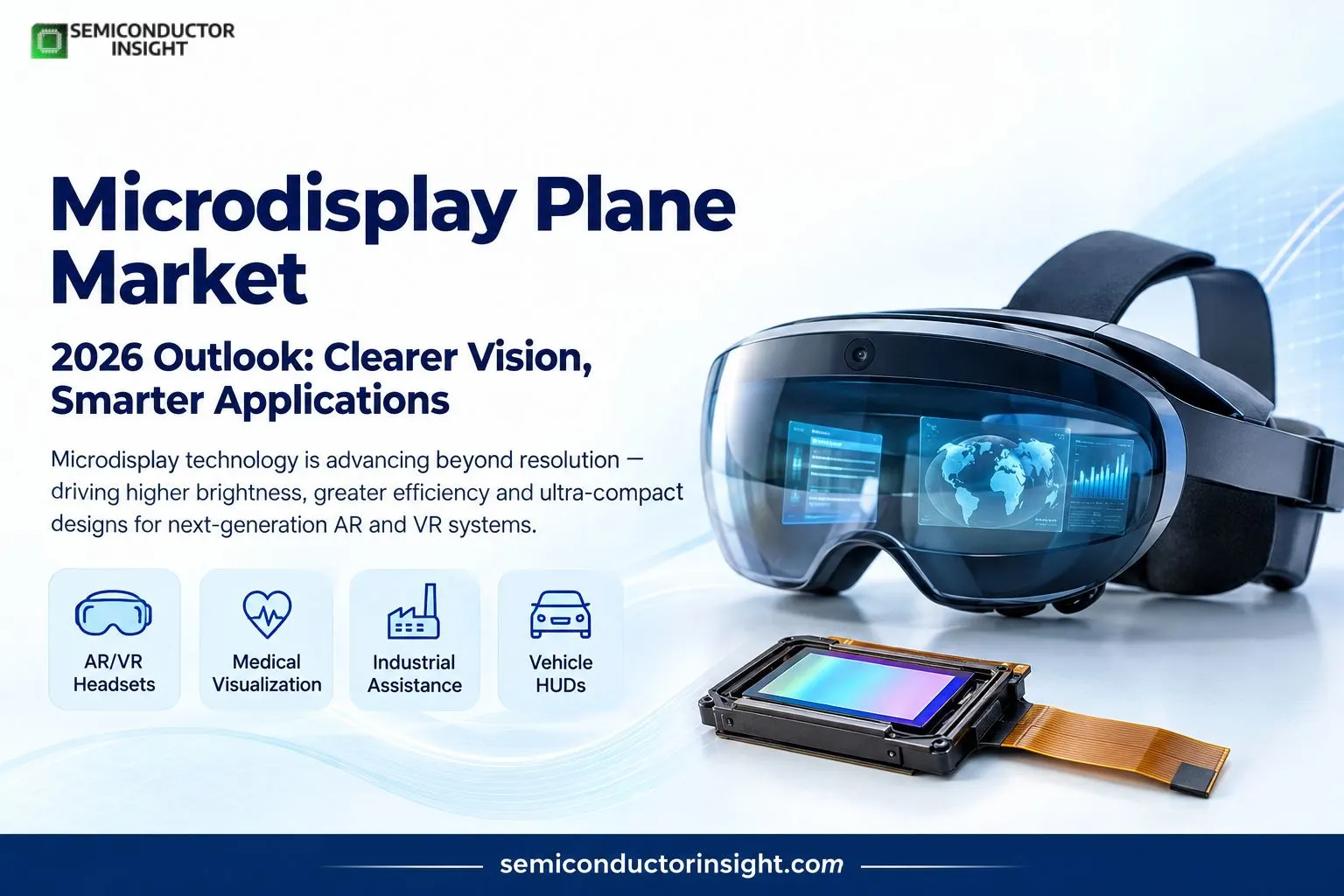
Top 5 Major Leading Regions for Microdisplay Plane Market 2026 as AR Glasses, Spatial Computing and High Precision Vision Systems Accelerate
Microdisplay Plane Market is moving into a more technically demanding phase in 2026. Instead of competing only on resolution, manufacturers are now balancing pixel density, brightness, power consumption, optical efficiency, thermal performance and physical weight. Academic research identifies LCoS, OLED-on-silicon and LED-on-silicon as the three important silicon-backplane approaches for AR and VR microdisplays.
A useful indicator of this shift is Apple’s current Vision Pro platform, which uses a Micro-OLED display system with 23 million pixels, a 7.5-micron pixel pitch and refresh rates reaching 120 Hz. At the smaller end of the spectrum, Sony demonstrated a 0.26-inch LED microdisplay delivering 5,644 pixels per inch, showing how aggressively manufacturers are pushing miniaturization.
The 2026 Microdisplay Technology Chain
Silicon CMOS Backplane → Microdisplay Engine → Illumination → Optical Combiner → AR/VR Device → Real-World Application
This architecture is expanding the opportunity from consumer headsets into medical visualization, industrial assistance, vehicle HUDs, aerospace equipment and defense systems.
A Quick 2026 Technology Snapshot
- In 2026, augmented-reality innovation is defined by premium visual performance and increasingly compact hardware: 23 million pixels and a 5,644 PPI display density signal exceptional spatial-computing clarity, while 2.5 μm pixels reflect next-generation silicon micro-LED advancement.
- Ultra-compact engineering is further demonstrated by a 0.34 cc LCoS module and more than 1,000 nits of brightness delivered to the eye, enabling practical outdoor AR use. At the same time, over 9 billion daily AR Lens uses highlight the massive scale and everyday adoption of digital AR interactions.
- Himax’s 2026 HX7319FL LCoS microdisplay illustrates where engineering is heading. The module combines 720 × 720 resolution, a 0.34 cc volume and 0.79 gram weight, while delivering more than 1,000 nits to the eye when paired with suitable waveguide optics.
North America Builds the Application Pull
North America remains one of the most important demand and innovation centers because AR is moving from experimental hardware toward practical computing interfaces. Snap reported that its community used AR Lenses more than 9 billion times per day in Q1 2026, while more than 350 million users engaged with AR daily on average in earlier reporting.
The region is also pushing professional applications. In 2025, Himax and Vuzix demonstrated an integrated AR optical module combining a miniature LCoS microdisplay with production-ready waveguides for enterprise and consumer applications.
Our most recent updated related study is available for free at this link: https://semiconductorinsight.com/report/microdisplay-plane-market/
Europe Turns Research into Display Engineering
Europe’s strength is increasingly visible in advanced photonics and microdisplay research. Germany’s Fraunhofer IPMS developed OLED microdisplay structures exceeding 70,000 nits, with reference substrates exceeding 200,000 nits, targeting the demanding brightness requirements of daylight AR.
A newer German-Taiwanese project running from July 2025 to June 2028 is developing transparent AR displays combining micro-LEDs and metalenses while training specialists in microelectronics and chip design.
Asia Pacific Owns the Miniaturization Race
- Asia Pacific stands out through its combination of semiconductor manufacturing, display engineering and optical-component expertise. Japan, South Korea, Taiwan and China are building different pieces of the microdisplay ecosystem.
- China’s INNOVISION announced mass production of its 2.5 μm silicon-based microdisplay in March 2026. Its Chimo M06 provides 540 × 280 resolution, up to 10,000 PPI, and has already completed validation in smart-glass applications.
- China’s GZOT also showcased a 0.65-inch 2.5K OLED-on-silicon panel in 2026 with 2,560 × 1,440 resolution, 5.67 μm pixel pitch, at least 6,000 nits brightness and power consumption below 500 mW.
Latin America Finds High-Value Medical Uses
Latin America is developing more application-led opportunities rather than competing primarily on microdisplay fabrication. Brazil provides a strong example. A 2026 clinical simulation study involved 35 healthcare professionals using AR smart glasses for pediatric catheterization training with remote specialist guidance.
Earlier Brazilian research also tested AR smart glasses for simulated thoracostomy training with physicians and medical students, demonstrating how compact displays can support remote expertise and procedural visualization.
Middle East and Africa Move toward Specialized Deployment
The region’s strongest opportunity is likely to remain specialized applications where compact, bright and rugged displays deliver operational value. Defense, aviation, industrial inspection, healthcare and infrastructure visualization are particularly relevant. A 2025 U.S. Navy-funded AR project selected an Israeli optical technology provider to support hands-free maintenance of critical naval equipment, illustrating the role of high-brightness near-eye displays in demanding environments.

Comments (0)