Introduction
LCoS (Liquid Crystal on Silicon) Chips are becoming an increasingly important component in the semiconductor industry, offering advanced display solutions for a wide range of applications. These chips are widely used in projectors, AR/VR devices, and consumer electronics due to their ability to provide high-resolution, compact, and efficient displays. As the demand for superior visual experiences continues to rise, the LCoS Chips Market is expected to witness significant growth.
The LCoS Chips Market size is expanding as industries such as entertainment, automotive, and healthcare adopt this technology for better display performance. With innovations driving the LCoS Chips Market share, companies in the semiconductor market are focusing on improving product efficiency and reducing costs.
According to the semiconductor industry analysis, the LCoS Chips Market is poised for robust market growth, with a positive LCoS Chips Market forecast 2025 predicting further adoption in both consumer and industrial applications. Leading LCoS Chips Market companies are investing in R&D to capitalize on emerging opportunities, positioning themselves for success in the expanding semiconductor LCoS Chips Market.
Report Overview
LCoS (Liquid Crystal on Silicon) chips are a type of display technology that utilizes liquid crystal panels mounted on a silicon backing. These chips function by modulating light through liquid crystal cells arranged on a silicon substrate, which allows for the precise control of light and color. LCoS chips are commonly used in applications such as high-resolution projectors, head-up displays, and various optical devices due to their ability to deliver sharp images and high color accuracy. The technology benefits from the high pixel density of silicon, leading to finer resolution and better image quality compared to other display technologies like LCD or DLP. Additionally, LCoS chips offer advantages such as low power consumption and compact form factors, making them suitable for a wide range of advanced imaging and display applications.
This report provides a deep insight into the global LCoS Chips market covering all its essential aspects. This ranges from a macro overview of the market to micro details of the market size, competitive landscape, development trend, niche market, key market drivers and challenges, SWOT analysis, value chain analysis, etc.
The analysis helps the reader to shape the competition within the industries and strategies for the competitive environment to enhance the potential profit. Furthermore, it provides a simple framework for evaluating and accessing the position of the business organization. The report structure also focuses on the competitive landscape of the Global LCoS Chips Market, this report introduces in detail the market share, market performance, product situation, operation situation, etc. of the main players, which helps the readers in the industry to identify the main competitors and deeply understand the competition pattern of the market.
In a word, this report is a must-read for industry players, investors, researchers, consultants, business strategists, and all those who have any kind of stake or are planning to foray into the LCoS Chips market in any manner.
Global LCoS Chips Market: Market Segmentation Analysis
The research report includes specific segments by region (country), manufacturers, Type, and Application. Market segmentation creates subsets of a market based on product type, end-user or application, Geographic, and other factors. By understanding the market segments, the decision-maker can leverage this targeting in the product, sales, and marketing strategies. Market segments can power your product development cycles by informing how you create product offerings for different segments.
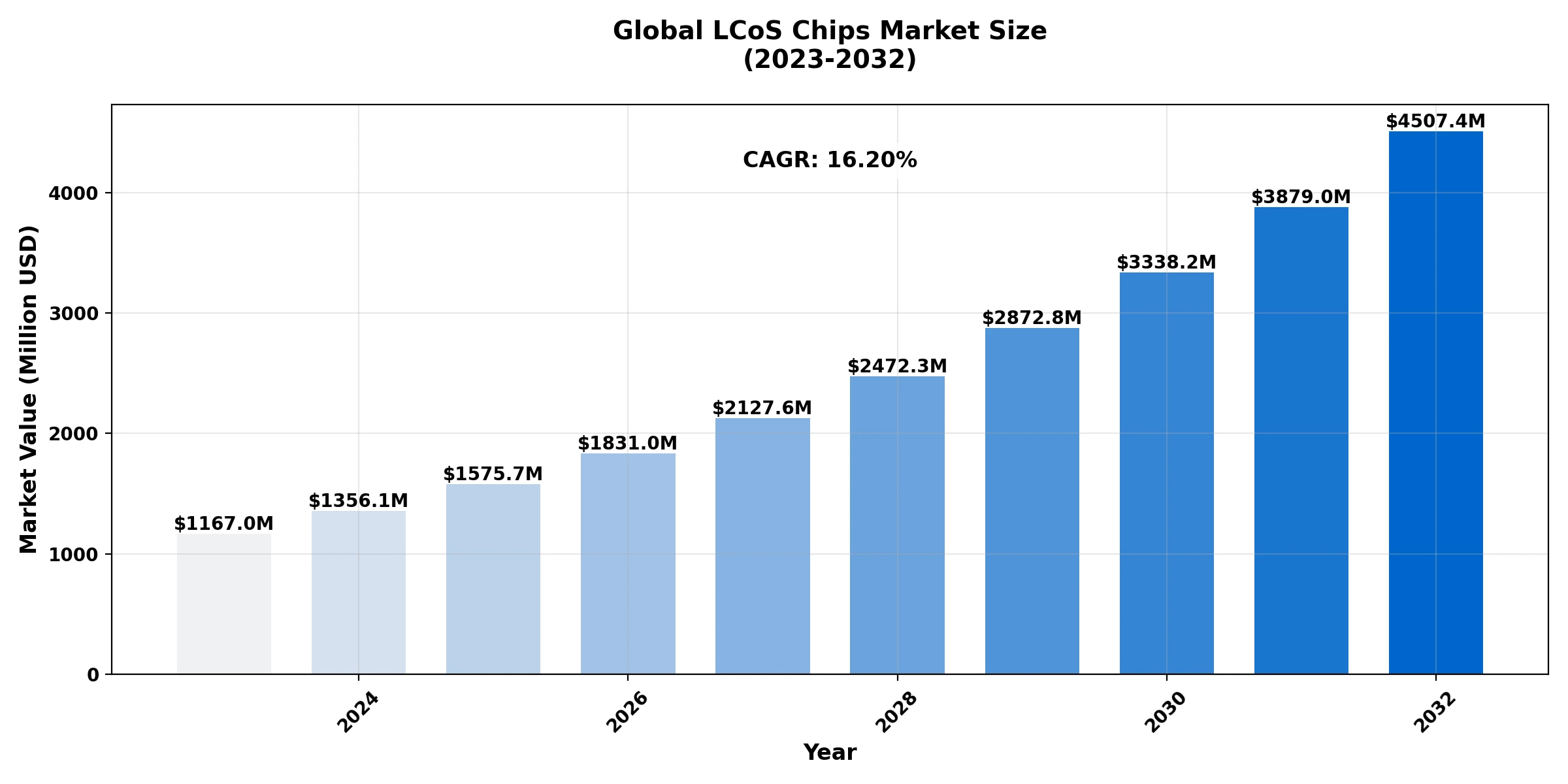
The Global LCoS Chips Market size was estimated at USD 1167 million in 2023 and is projected to reach USD 4507.40 million by 2032, exhibiting a CAGR of 16.20% during the forecast period.
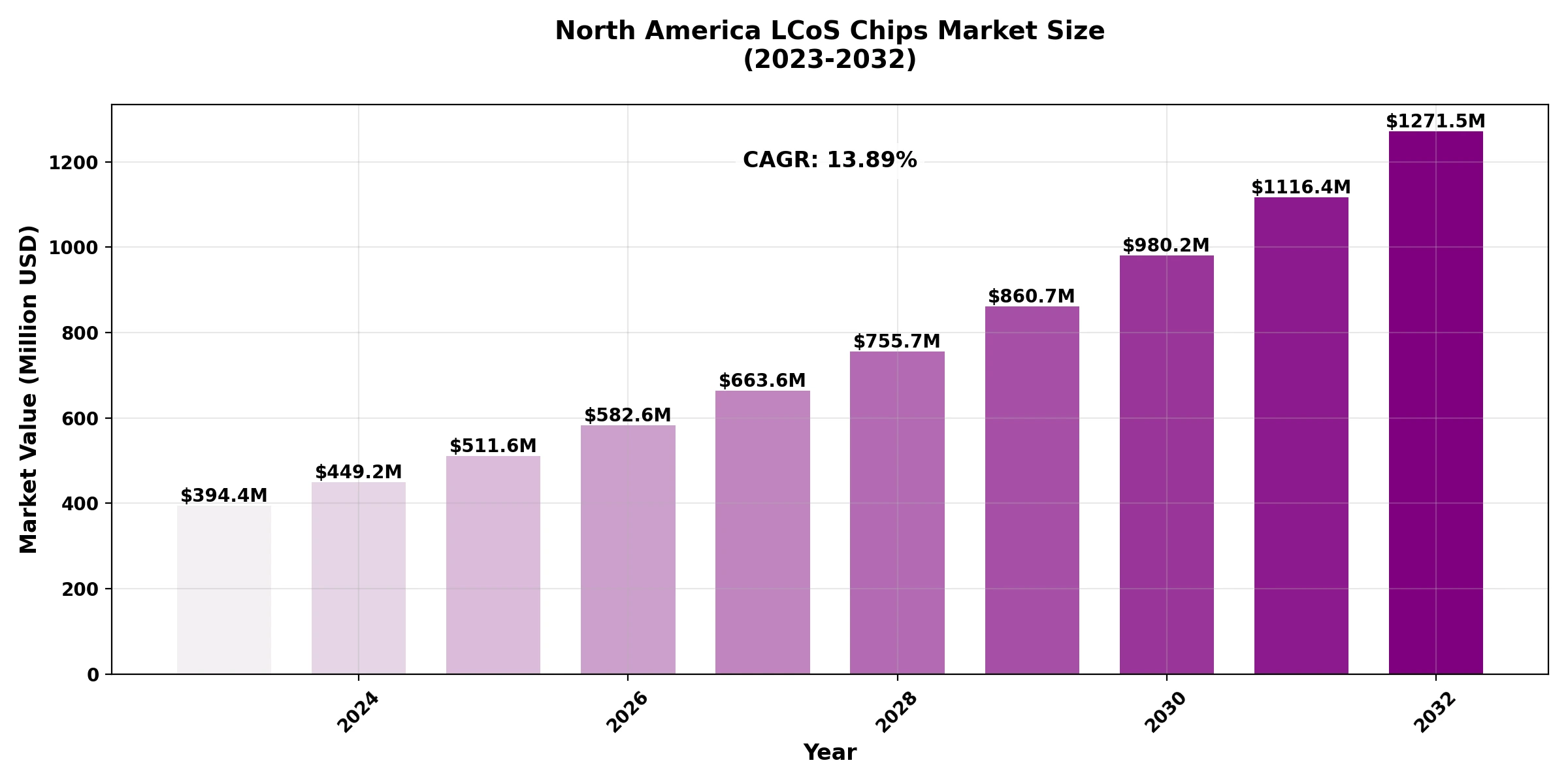
North America LCoS Chips market size was estimated at USD 394.40 million in 2023, at a CAGR of 13.89% during the forecast period of 2025 through 2032.
Click Here to Download Your Free Sample Report
Key Company
- Sony
- JVC Kenwood
- Himax Display
- Kopin
- Syndiant
- Raontech
- HOLOEYE Photonics
- OmniVision
- Jiangsu Huixinchen Technology
- Jucheng Group
- Nanjing SmartVision Electronics
Market Segmentation (by Type)
- HD
- Full HD
- WQHD
- Others
Market Segmentation (by Application)
- Industrial Projection
- AR, VR Applications
- HUDs and HMDs
- Industrial Imaging
- Others
Geographic Segmentation
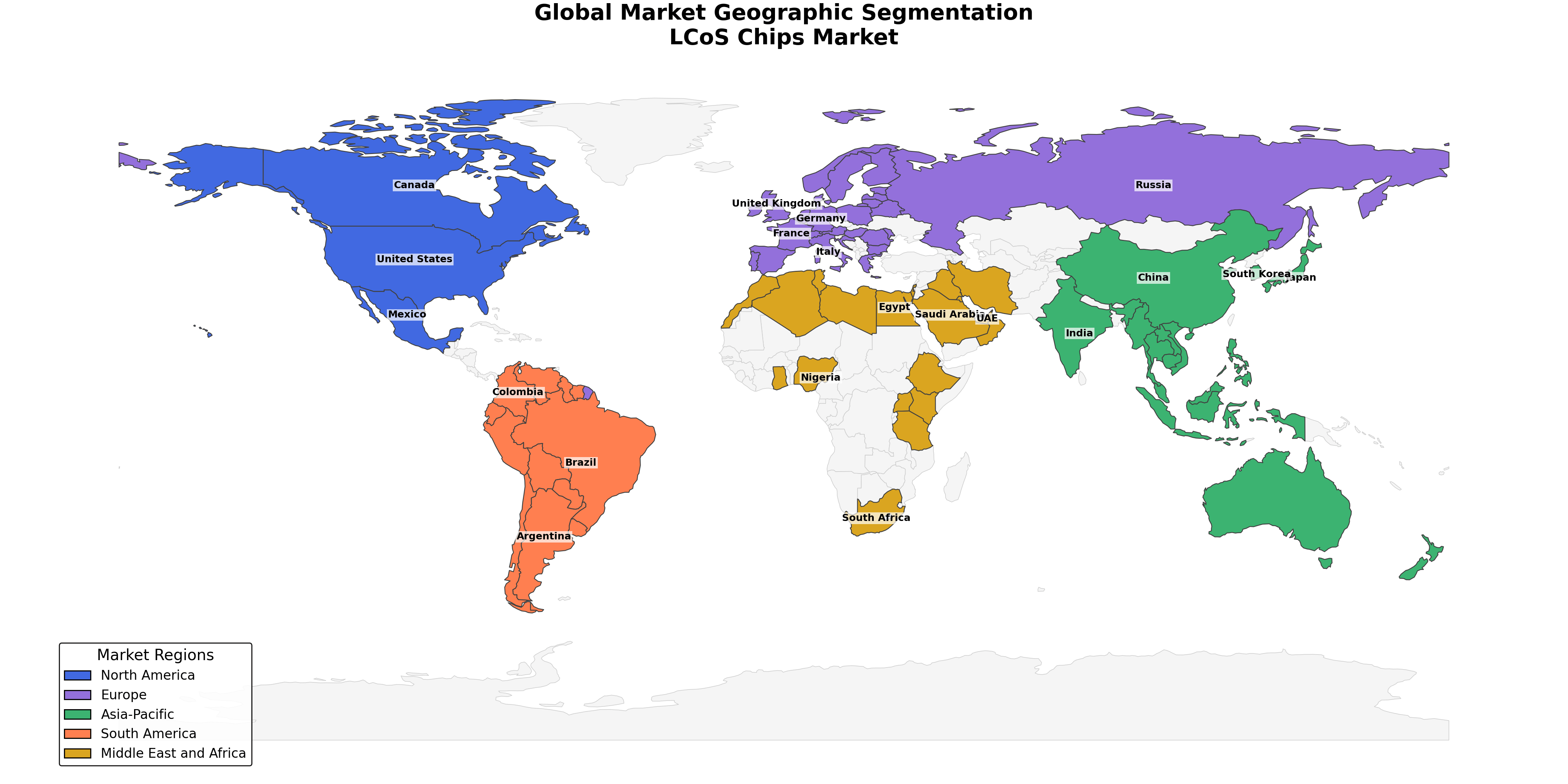
- North America (USA, Canada, Mexico)
- Europe (Germany, UK, France, Russia, Italy, Rest of Europe)
- Asia-Pacific (China, Japan, South Korea, India, Southeast Asia, Rest of Asia-Pacific)
- South America (Brazil, Argentina, Columbia, Rest of South America)
- The Middle East and Africa (Saudi Arabia, UAE, Egypt, Nigeria, South Africa, Rest of MEA)
Key Benefits of This Market Research:
- Industry drivers, restraints, and opportunities covered in the study
- Neutral perspective on the market performance
- Recent industry trends and developments
- Competitive landscape & strategies of key players
- Potential & niche segments and regions exhibiting promising growth covered
- Historical, current, and projected market size, in terms of value
- In-depth analysis of the LCoS Chips Market
- Overview of the regional outlook of the LCoS Chips Market:
Key Reasons to Buy this Report:
- Access to date statistics compiled by our researchers. These provide you with historical and forecast data, which is analyzed to tell you why your market is set to change
- This enables you to anticipate market changes to remain ahead of your competitors
- You will be able to copy data from the Excel spreadsheet straight into your marketing plans, business presentations, or other strategic documents
- The concise analysis, clear graph, and table format will enable you to pinpoint the information you require quickly
- Provision of market value data for each segment and sub-segment
- Indicates the region and segment that is expected to witness the fastest growth as well as to dominate the market
- Analysis by geography highlighting the consumption of the product/service in the region as well as indicating the factors that are affecting the market within each region
- Competitive landscape which incorporates the market ranking of the major players, along with new service/product launches, partnerships, business expansions, and acquisitions in the past five years of companies profiled
- Extensive company profiles comprising of company overview, company insights, product benchmarking, and SWOT analysis for the major market players
- The current as well as the future market outlook of the industry concerning recent developments which involve growth opportunities and drivers as well as challenges and restraints of both emerging as well as developed regions
- Includes in-depth analysis of the market from various perspectives through Porters five forces analysis
- Provides insight into the market through Value Chain
- Market dynamics scenario, along with growth opportunities of the market in the years to come
- 6-month post-sales analyst support
Click Here to Download Your Free Sample Report
Customization of the Report
In case of any queries or customization requirements, please connect with our sales team, who will ensure that your requirements are met.
Drivers
- Growing Demand for High-Resolution Displays
The increasing demand for high-definition, high-resolution displays in applications such as projectors, virtual reality (VR), and augmented reality (AR) drives the growth of the LCoS chips market. LCoS technology enables higher pixel densities, providing sharper and clearer images, making it ideal for use in advanced display systems. - Advancements in Consumer Electronics
The rise in consumer electronics, including smart TVs, digital signage, and mobile devices, is a significant driver. With consumers demanding better picture quality and more compact form factors, LCoS chips are becoming a preferred choice for applications requiring high-definition visuals, such as personal projectors and home theater systems. - Growth of Augmented and Virtual Reality
With the increasing adoption of AR and VR technologies, LCoS chips are playing a critical role in providing high-quality displays. The need for lightweight, compact, and high-performance display solutions is driving the integration of LCoS technology into AR and VR headsets. - Improved Optical Efficiency and Brightness
LCoS chips offer excellent optical efficiency and high brightness, which is critical for applications such as projectors and displays in well-lit environments. As consumers and industries seek brighter and more energy-efficient display solutions, LCoS technology becomes an attractive option.
Restraints
- High Manufacturing Costs
The production of LCoS chips involves complex manufacturing processes, making them relatively expensive compared to other display technologies such as OLED or LCD. High production costs can hinder widespread adoption, particularly in price-sensitive markets. - Competition from Alternative Technologies
The LCoS market faces intense competition from alternative display technologies like OLED, MicroLED, and LCD. These technologies are often less expensive and can offer comparable or even superior performance in certain applications, limiting the potential growth of the LCoS chips market. - Limited Color Saturation
LCoS displays are often criticized for their limited color saturation compared to OLED or LED-based displays. This can affect their suitability in applications where vibrant color reproduction is critical, such as in high-end televisions or professional monitors. - Complexity in Integration
The integration of LCoS chips into consumer electronics or industrial equipment requires specialized knowledge and can be challenging. This complexity, combined with the need for precise alignment and calibration, can deter manufacturers from adopting LCoS technology, especially in industries that demand ease of integration and scalability.
Opportunities
- Expansion in Projection Systems
The growing demand for portable and high-performance projectors in education, business, and entertainment creates significant opportunities for the LCoS chips market. As the demand for compact, high-quality projectors continues to rise, LCoS technology is well-positioned to meet these needs. - Advancements in Automotive Displays
The automotive industry is increasingly adopting advanced display technologies for in-car entertainment systems, head-up displays (HUDs), and other applications. LCoS chips are being explored for use in automotive displays due to their compact size, resolution capabilities, and optical efficiency. - Development of Wearable Devices
LCoS technology is also finding new opportunities in the wearable devices sector. With wearable tech, especially in AR glasses, requiring small, lightweight, and high-resolution displays, LCoS chips can play a pivotal role in developing future AR glasses and heads-up displays. - Growing Demand in Healthcare Imaging
LCoS chips are poised to capitalize on the expanding medical imaging market, where high-resolution displays are crucial for diagnostics and surgeries. The demand for advanced imaging solutions in healthcare presents a growth avenue for LCoS technology.
Challenges
- Power Consumption
LCoS chips, particularly those used in high-resolution displays, tend to consume more power than some competing display technologies, such as OLED. This can be a concern in battery-powered devices, like portable projectors and wearables, where energy efficiency is crucial. - Heat Generation
High-power LCoS chips may generate substantial heat, which can reduce their performance and lifespan if not properly managed. Ensuring adequate thermal management in devices using LCoS technology remains a challenge for manufacturers. - Limited Viewing Angles
While LCoS technology delivers excellent image quality, it often suffers from limited viewing angles compared to OLED and LCD displays. This limitation can restrict its use in applications where a wider viewing angle is necessary, such as large-screen televisions or interactive displays. - Technology Adoption Barriers
Despite its potential, LCoS technology faces barriers to widespread adoption due to the dominance of established display technologies like LCD and OLED. Convincing businesses and consumers to adopt LCoS-based solutions requires overcoming established preferences and habits, which can slow market penetration.
Interested in related market reports? Click here to explore more!
About Semiconductor Insight:
At Semiconductor Insight, we are dedicated to delivering in-depth semiconductor market research and analysis that empowers businesses to make informed decisions in this rapidly evolving industry. With a focus on providing comprehensive semiconductor research, we uncover trends, opportunities, and challenges shaping the global semiconductor market.
Our meticulously crafted semiconductor market reports offer actionable insights, including market forecasts, competitive analysis, and technological advancements, ensuring our clients stay ahead in the highly competitive semiconductor landscape.

Get Sample Report PDF for Exclusive Insights
Report Sample Includes
- Table of Contents
- List of Tables & Figures
- Charts, Research Methodology, and more...
 Download Sample Report PDF