
Top 5 Major Leading Regions for Low Vos Operational Amplifier Market in 2026
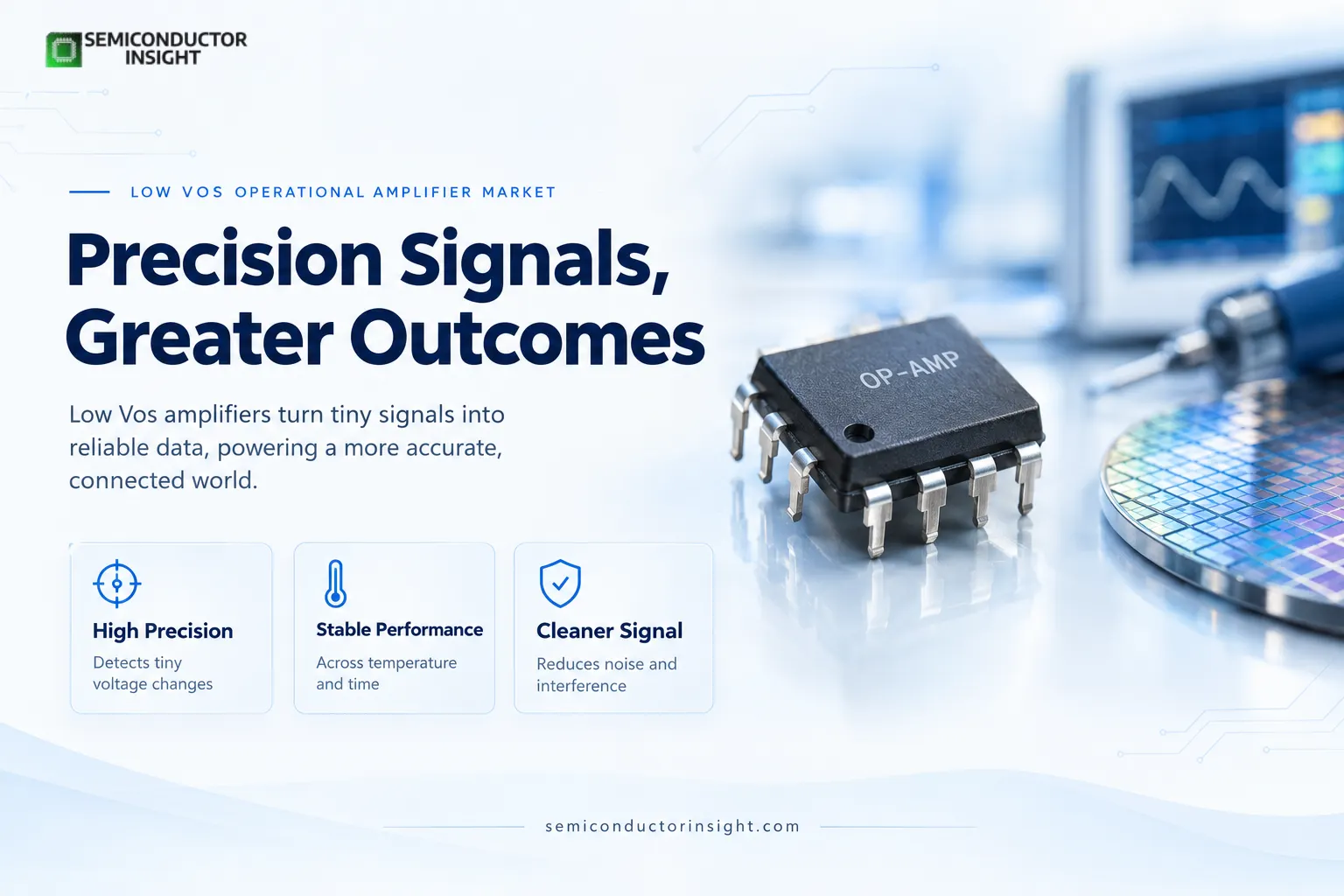
Low Vos Operational Amplifier Market is moving into a more demanding phase in 2026 as electronic systems increasingly need to detect extremely small voltage changes without allowing amplifier error to distort the measurement. Low input offset voltage, commonly written as Vos, is particularly important when an amplifier handles low-level signals from pressure sensors, thermocouples, strain gauges, current-sensing circuits and medical instruments. Modern zero-drift architectures can reach microvolt-level offset performance while continuously correcting DC errors caused by time and temperature.
The wider semiconductor environment is reinforcing this demand. Global semiconductor sales reached $795.6 billion in 2025, while Q4 sales climbed to $238.9 billion. In Q1 2026, semiconductor sales reached $298.5 billion, up 25% from Q4 2025, showing how quickly electronic-system demand is expanding.
A Small Error with a Large System Impact
- The importance of low Vos becomes clearer when the signal itself is tiny.
- For example, Analog Devices’ ADA4528-1 specifies a maximum offset of 2.5 µV, offset drift of 0.015 µV/°C, noise of 5.6 nV/√Hz, and CMRR of at least 135 dB.
- Such specifications are relevant to pressure and position sensors, load cells, thermocouples, medical instrumentation and other precision measurement systems.
- Modern precision devices are engineered to maintain accurate and stable signal measurement in demanding applications.
- With a maximum input offset voltage of 2.5 µV, they help reduce DC measurement errors, while an offset drift of up to 0.015 µV/°C supports consistent performance across temperature changes. Low voltage noise of 5.6 nV/√Hz protects weak sensor signals, and a minimum CMRR of 135 dB effectively suppresses unwanted common-mode interference.
- Their operating temperature range of -40°C to +125°C also makes them suitable for industrial and automotive environments.
North America – Precision Design Moves Closer to the System
North America remains one of the most influential locations for precision analog design because of its concentration of semiconductor designers, medical-device developers, industrial automation companies, aerospace electronics and automotive technology programs. The Americas recorded 31.4% semiconductor-sales growth in 2025, according to WSTS, and March 2026 semiconductor sales in the region were up 83.1% year over year.
For low Vos amplifiers, the opportunity is less about producing a generic op amp and more about solving difficult signal-chain problems. Precision current measurement, battery monitoring, industrial instrumentation, data-acquisition equipment and medical sensing can all require microvolt-level error control. The presence of long-established precision-amplifier portfolios also shows how deeply low-offset technology is embedded in North American analog design practices.
Europe – Automotive Accuracy Becomes a Semiconductor Requirement
Europe’s position is strongly connected with automotive electronics, industrial equipment, energy systems and medical technology. The European Commission notes that a modern vehicle can contain well over 1,000 chips, while its Chips Act targets a 20% share of global semiconductor production by 2030.
That electronics density creates opportunities for low Vos amplifiers in battery monitoring, motor control, pressure sensing, current measurement and safety-related electronic systems. Europe’s semiconductor sales increased 6.7% in 2025, followed by a much stronger 46.5% year-over-year increase in March 2026, indicating a renewed electronics cycle.
Asia-Pacific – The Volume Engine for Precision Analog
Asia-Pacific stands out as the largest-volume regional ecosystem because it combines semiconductor manufacturing, electronics assembly, consumer devices, automotive production and rapidly expanding industrial automation. WSTS reported 45.4% growth in Asia Pacific/All Others semiconductor sales during 2025, while March 2026 sales increased 108.5% year over year.
The region’s relevance extends beyond high-volume consumer electronics. Battery-management systems, factory sensors, robotics, test equipment, power electronics and healthcare devices increasingly require accurate analog front ends. India’s electronics production, for example, increased from approximately $76 billion in FY2020–21 to $115 billion in FY2023–24, with government projections targeting $300 billion by 2026.
For More Detailed Insights, You Can Surf Our Latest Report Here: https://semiconductorinsight.com/report/low-vos-operational-amplifier-market/
Latin America – Sensor Demand Is Building Through Industrial Electronics
Latin America represents a smaller precision-semiconductor ecosystem but an increasingly interesting application market. Brazil’s government reported that more than 85% of chips used in Brazil are imported, highlighting both supply dependence and the potential for domestic electronics-chain development.
Low Vos amplifiers can benefit from electronics growth in automotive components, industrial monitoring, energy equipment, agricultural machinery and medical devices. Brazil also allocated R$267 million to strategic ICT projects in 2025, representing a 116% increase in related funding from 2024.
Middle East & Africa – Industrial Digitization Creates New Analog Use Cases
The Middle East & Africa region is developing an increasingly sophisticated electronics ecosystem around smart infrastructure, energy, industrial automation, healthcare and advanced manufacturing. Saudi Arabia’s 2025 Vision 2030 reporting highlights localization of high-tech industries, including semiconductors, smart devices and AI infrastructure. Its ALAT initiative is structured around nine core business units, while the Future Factories Program is supporting automation and advanced production systems.
These developments create applications where precision measurement becomes important rather than optional. Battery systems, factory sensors, energy monitoring, robotics and process-control equipment can all use low-offset amplifiers to convert weak physical signals into reliable digital information.
Why Low Vos Is Becoming a Design KPI?
The technology is evolving from simply having a “low offset” specification toward managing the entire error budget.
Lower Vos → Lower temperature-induced error → Better sensor accuracy → Cleaner ADC input → More reliable system decisions
Zero-drift technology is particularly significant because auto-zero and chopping architectures continuously correct DC errors. Analog Devices notes that these architectures can achieve nanovolt-level offset characteristics and very low drift, although designers must account for switching artifacts, bandwidth and noise behavior.

Comments (0)