
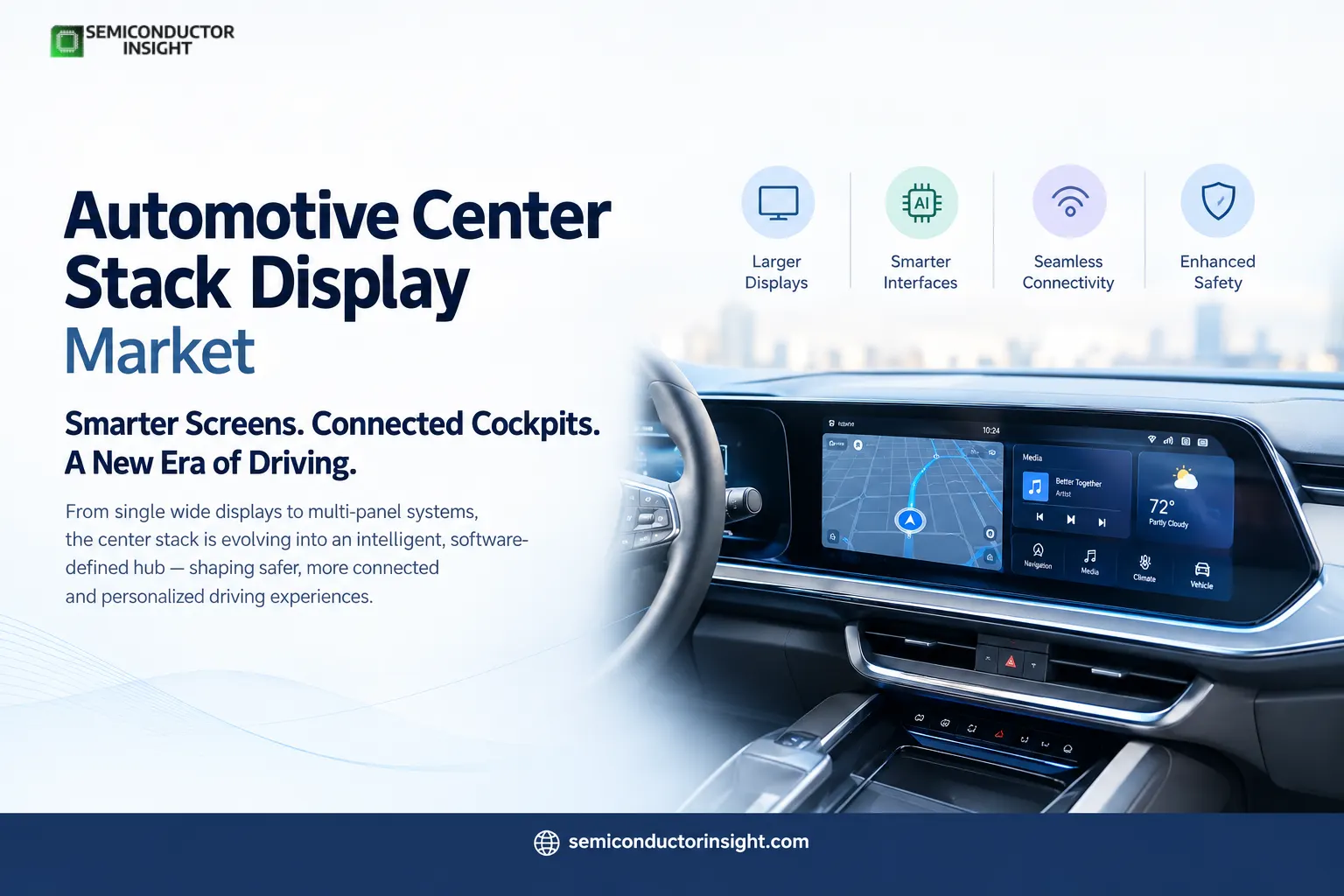
Top 10 Automotive Center Stack Display Companies Shaping the Future of Smart Cockpits
The automotive center stack display has evolved from a simple touchscreen into the digital heartbeat of the modern cockpit. As software-defined vehicles demand larger, brighter, more integrated screens that handle navigation, media, climate, and vehicle controls in one seamless surface, a handful of suppliers are shaping how drivers and passengers interact with the road ahead.
What follows explores how ten key players are advancing center-stack technology through real production moves, production-line expansions, new form factors, and concrete deployments seen across 2025 and 2026.
LG Display’s Pillar-to-Pillar Push Redefines the Dashboard Canvas
LG Display has moved aggressively into ultra-wide center-stack territory, beginning mass production of a roughly 40-inch pillar-to-pillar automotive display and developing a 38.9-inch oxide TFT LCD specifically for the 2026 Mercedes-Benz GLC electric model. The company shifted automotive LCD production onto its 8.5-generation lines alongside existing 6-generation capacity, enabling larger single-sheet panels that support high-reliability oxide semiconductors.
Facilities across Gumi, Paju, and Guangzhou contributed to a cumulative capacity of about 3.4 million eighth-generation-equivalent glass sheets in the first three quarters of 2025. Recent filings also highlight the first automotive advanced thin OLED products in sizes ranging from 7.2 to 24.2 inches, giving OEMs options for both expansive single-surface center stacks and multi-zone layouts that keep the driver focused while still delivering passenger entertainment.
BOE Turns the Center Stack into an AI-Connected Interface
BOE has positioned its automotive displays as intelligent nodes rather than passive screens, showcasing panoramic and multi-zone cockpit concepts that feed directly into center-stack architectures. At its 2025 Innovation Partner Conference the company highlighted 44.8-inch panoramic solutions and AI-driven interaction layers that allow gesture and predictive content routing across the dashboard.
Production progress includes the Chengdu Gen 8.6 AMOLED line that began customer shipments in mid-2026, expanding capacity for larger mid-size panels suitable for center consoles. BOE continues to allocate substantial resources tens of billions of yuan over multi-year periods toward R&D that links display performance with onboard computing, enabling center stacks that adapt brightness, content, and privacy modes in real time under varying cabin conditions.
Tianma Microelectronics Anchors OEM Center-Stack Volume with MicroLED Horizons
Tianma has cemented a strong position supplying instrument clusters and center-stack panels directly to vehicle makers, while simultaneously pushing the brightness and form-factor boundaries needed for next-generation cockpits. Demonstrations in 2026 included a 49.6-inch curved ACRUS display delivering 8K resolution across a 1.25-meter viewing width and a 19-inch transparent tiled microLED surface assembled from three ultra-narrow-border panels. Its microLED HUD imagers have reached measured peak brightness above 120,000 nits, technology that can migrate into high-visibility center-stack elements.
The company also introduced slidable AMOLED modules and pixel-level dimming zones measured in the hundreds of thousands, giving designers tools to create seamless, high-contrast center consoles that remain readable in full sunlight without excessive power draw.
Continental’s Aumovio Unit Advances Modular and Repairable Center-Stack Systems
Following its emergence as an independent entity, Aumovio has secured multiple head-up and display program awards while expanding physical capacity to support complex multi-screen center stacks. A 65,000-square-foot addition in New Braunfels, Texas, more than doubles production floor space and is scheduled for completion in the first half of 2027.
Collaboration with adhesive specialists produced a 2-millimeter-wide detachable bonding solution that enables ultra-narrow bezels yet allows controlled separation for repair or recycling critical as center-stack modules grow larger and more expensive. At CES 2026 the unit demonstrated modular multi-display landscapes combining OLED and electronic-ink surfaces, illustrating how a single center-stack architecture can adapt appearance and function across different vehicle brands and software generations.
To find out more, feel free to browse our latest updated report: https://semiconductorinsight.com/report/automotive-center-stack-display-csd-market/
Visteon Scales Multi-Display and Domain-Controller Integration
Visteon treats the center stack as one element within a broader cockpit domain, delivering large 15- to 17-inch TFT systems, multi-display configurations under a single cover lens, and pillar-to-pillar solutions. The company has accumulated more than two billion dollars in awards for OLED-based displays and high-performance SmartCore platforms since recent program wins.
Operations span more than thirty countries and rely on a network of global engineering teams that vertically integrate many layers of the display stack beyond the raw panel. Recent program launches include panoramic units for premium European brands and multi-screen setups for commercial vehicles, positioning Visteon to convert rising content per vehicle often several hundred dollars of incremental value into sustained volume as software-defined architectures consolidate controls onto fewer, larger surfaces.
Japan Display Maintains Automotive Focus through Integrated Operations
Japan Display elected in 2026 to keep its automotive display activities fully inside the parent organization rather than spinning them out, consolidating AutoTech under company-wide operational leadership. Automotive-related sales remained a substantial portion of recent fiscal results, reflecting ongoing supply of high-reliability panels for center-stack and cluster applications. The company continues to prepare back-end processes at its Philippines facility and is expanding inquiries for dual-view and digital-mirror products that can share real estate with or complement a primary center stack. Stable high-temperature performance and custom LTPS substrates keep JDI relevant for OEMs that prioritize long-term supply security and precise optical characteristics in the cabin.
Innolux Broadens Center-Stack Reach through CarUX and System Integration
Innolux, operating through its CarUX automotive arm and the recently completed Pioneer acquisition, has extended its offering from pure panels into head-unit software and audio elements that sit alongside the center stack. The combined entity now draws on R&D footprints in Taiwan, Japan, and Germany plus manufacturing reach in Vietnam, Thailand, and Mexico.
At CES 2026 Innolux highlighted microLED HUD units delivering 50,000 nits direct brightness and 10,000 nits reflected virtual-image brightness performance levels that support clear information transfer even when ambient light floods the cabin. Transparent and decorative microLED variants further allow center-stack surfaces to disappear into wood-grain or metallic trim when inactive, expanding design freedom for future interiors.
Robert Bosch Embeds Intelligence Directly into Instrumentation Surfaces
Bosch is advancing AI-enabled cockpit instrumentation that can modernize existing vehicle architectures without wholesale hardware replacement. Collaboration with major computing partners underpins an extension platform intended to bring generative and predictive features to center-stack and cluster displays.
The company has publicly targeted multi-billion-dollar revenue potential in the broader infotainment domain over the coming decade. By focusing on software layers that sit atop established display hardware, Bosch enables OEMs to refresh the information density and responsiveness of center stacks across multiple model years while controlling complexity and cost.
Hyundai Mobis Builds Seamless Multi-Panel Center Experiences
Hyundai Mobis has refined its M.VICS platform into configurations that treat multiple physical panels as one continuous visual surface. A representative 2024–2025 generation integrates a 27-inch main display with a 12.3-inch passenger screen and dual 7-inch side units, all coordinated under a single design language that stretches from pillar to pillar. Projection displays with haptic feedback embedded in curved leather surfaces add tactile control without interrupting the visual flow.
Collaboration with optics specialists has also produced holographic windshield concepts that could eventually reduce reliance on conventional center-stack real estate, yet the current multi-panel systems already demonstrate how a single supplier can deliver both the visual hardware and the integration software needed for coherent cabin experiences.
Garmin Unifies Multiple Screens under One Computing Core
Garmin’s Unified Cabin architecture, introduced at CES 2026, uses a single system-on-chip to drive up to six separate displays including center-stack, cluster, and passenger or rear screens while running one instance of the operating system. Seat-aware audio and video routing, digital-key functions, and an AI-based conversational assistant that handles multi-intent requests in multiple languages turn the center stack into the visible face of a fully orchestrated cabin.
Parallel consumer products such as the redesigned Drive navigators feature ultrawide 7.1- and 8.8-inch high-resolution screens that preview the aesthetic and interaction language Garmin is bringing into full vehicle platforms. The approach reduces electronic control units and cabling while giving software teams a unified canvas for continuous feature updates.

Comments (0)