
Top 5 Major Leading Regions for Distributed Strain Sensing Systems Transforming Infrastructure Monitoring in 2026
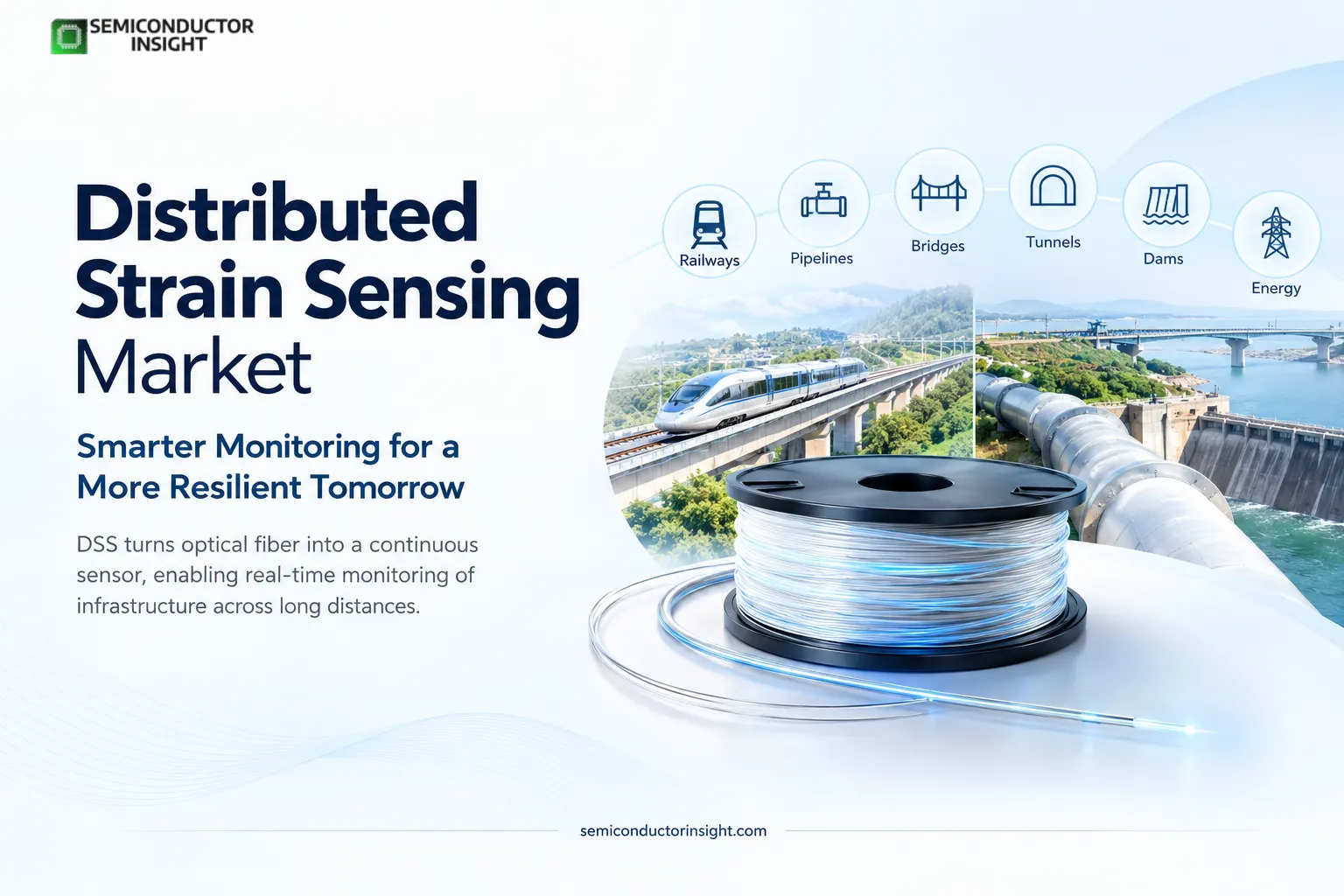
Distributed Strain Sensing is changing how long assets are monitored by replacing isolated measurement points with continuous information along an optical fiber. Modern systems can identify strain, deformation, vibration and temperature changes across extended distances, making them particularly relevant to railways, pipelines, bridges, tunnels, dams and energy infrastructure.
A 2026 review of railway applications highlights the growing integration of distributed fiber sensing with AI and machine learning, with recent studies reporting detection accuracy above 97%.
The Technology Shift Is Happening Inside the Fiber
The important development is not simply adding more sensors. DSS systems increasingly use Rayleigh, Brillouin and Raman scattering techniques to turn optical fiber into a distributed measurement platform. This allows operators to locate changes along the fiber rather than relying on conventional sensors installed at individual points.
In November 2025, the U.S. Department of Energy’s National Energy Technology Laboratory described a distributed optical sensing system capable of simultaneously measuring strain, temperature and vibration over up to 25 km of fiber.
North America Builds around Long-Distance Energy Monitoring
North America remains an important DSS deployment environment because of its extensive oil and gas, power and infrastructure assets. The DOE’s NETL technology demonstrates the scale possible for pipeline and power-grid applications, with one fiber supporting multi-parameter measurements over 25 km. Pipeline monitoring is particularly significant because distributed sensing can identify ground movement, intrusion and integrity changes without installing conventional sensors at every location.
Europe Turns Existing Fiber into Railway Intelligence
- Europe’s strongest DSS story is increasingly connected to transportation infrastructure.
- European rail research is examining distributed fiber sensing for train identification, intrusion detection, rockfall detection and wheel-related events.
- One recent railway research deployment examined sensing along 12 km of track, collecting day-and-night data for events including walking, digging and falling rocks.
- Another 2025 study investigated distributed strain measurement along 50 m of railway track, including a 7.5 m buried section beneath the rail. The research showed how fiber-based sensing can capture mechanical behavior associated with moving trains and variations in track support.
You can freely browse our most recent updated report to learn more about it before scrolling further: https://semiconductorinsight.com/report/distributed-strain-sensing-dss-systems-market/
Asia Pacific Connects DSS with High-Speed Rail and Smart Infrastructure
Asia Pacific is producing some of the most visible application-level demonstrations. A 2025 study in Taiwan used multiple strain-sensing fibers across a 1 km elevated bullet-train bridge to calculate three-dimensional deformation. The monitoring system also supported rapid safety assessment following earthquakes measuring magnitude 6.4 and 6.8.
China is simultaneously pushing DSS toward pipeline intelligence and AI-based interpretation. A 2025 study developed a 1D-CNN/SVM framework for real-time classification of distributed fiber monitoring signals for pipeline safety, illustrating how sensing hardware and machine learning are becoming increasingly interconnected.
Latin America Finds a Practical Route into Distributed Monitoring
Latin America’s opportunity is closely linked with civil engineering, geotechnical monitoring and energy infrastructure. Research from Brazil has evaluated distributed fiber-optic sensors for strain and geotechnical applications, highlighting their ability to cover larger monitoring areas than conventional instruments while measuring multiple physical quantities through a single fiber cable.
This makes DSS particularly relevant to long structures, slopes, buried infrastructure and construction projects where installing large numbers of individual sensors can be difficult.
Middle East and Africa Put the Focus on Remote Assets
- In the Middle East, pipeline and water infrastructure provide a natural application base for distributed sensing.
- A Saudi Arabian case study examined fiber-based monitoring for major water pipelines around Ras Al-Khair and Riyadh, where continuous monitoring was used to identify potentially damaging third-party activity.
- For Africa and other infrastructure-intensive markets, the attraction is similar: one distributed sensing cable can monitor extensive assets without requiring dense networks of powered electronic sensors.
- This is especially relevant where pipelines, rail corridors and remote industrial assets extend across large geographic areas.
Where the Next DSS Applications Are Appearing
The application map is widening beyond conventional strain measurement. Current research is combining DSS with digital twins, machine learning and automated anomaly recognition for bridges, railways, pipelines and civil structures. A 2026 review specifically identifies crack detection, AI-based processing and digital-twin integration as emerging directions for distributed fiber sensing.
The result is a gradual shift in infrastructure monitoring: instead of asking whether a particular sensor has detected damage, operators can increasingly examine how an entire structure or corridor is behaving along its length. That shift is giving distributed strain sensing a broader role across the global semiconductor, photonics and intelligent sensing ecosystem.

Comments (0)