AI-Driven Power Grid Design and IR Drop Analysis Market Insights
Global AI-Driven Power Grid Design and IR Drop Analysis market size was valued at USD 0.85 billion in 2025. It will rise to USD 1.75 billion by 2034, delivering a CAGR of roughly 8.3 % across the forecast horizon.
AI‑driven power‑grid design combines machine‑learning algorithms with electronic‑design‑automation (EDA) tools to optimise routing, voltage regulation and component placement early in the chip layout cycle.IR drop analysis, meanwhile, predicts voltage sag across the power network under dynamic load conditions, helping designers mitigate reliability risks before silicon fabrication.
The upward trajectory stems from escalating chip complexity, tighter power budgets in mobile‑first devices, and increasing regulatory pressure on energy efficiency.
Major EDA vendors such as Synopsys, Cadence and Siemens Mentor have expanded their portfolios with ML‑enhanced integrity suites; for example
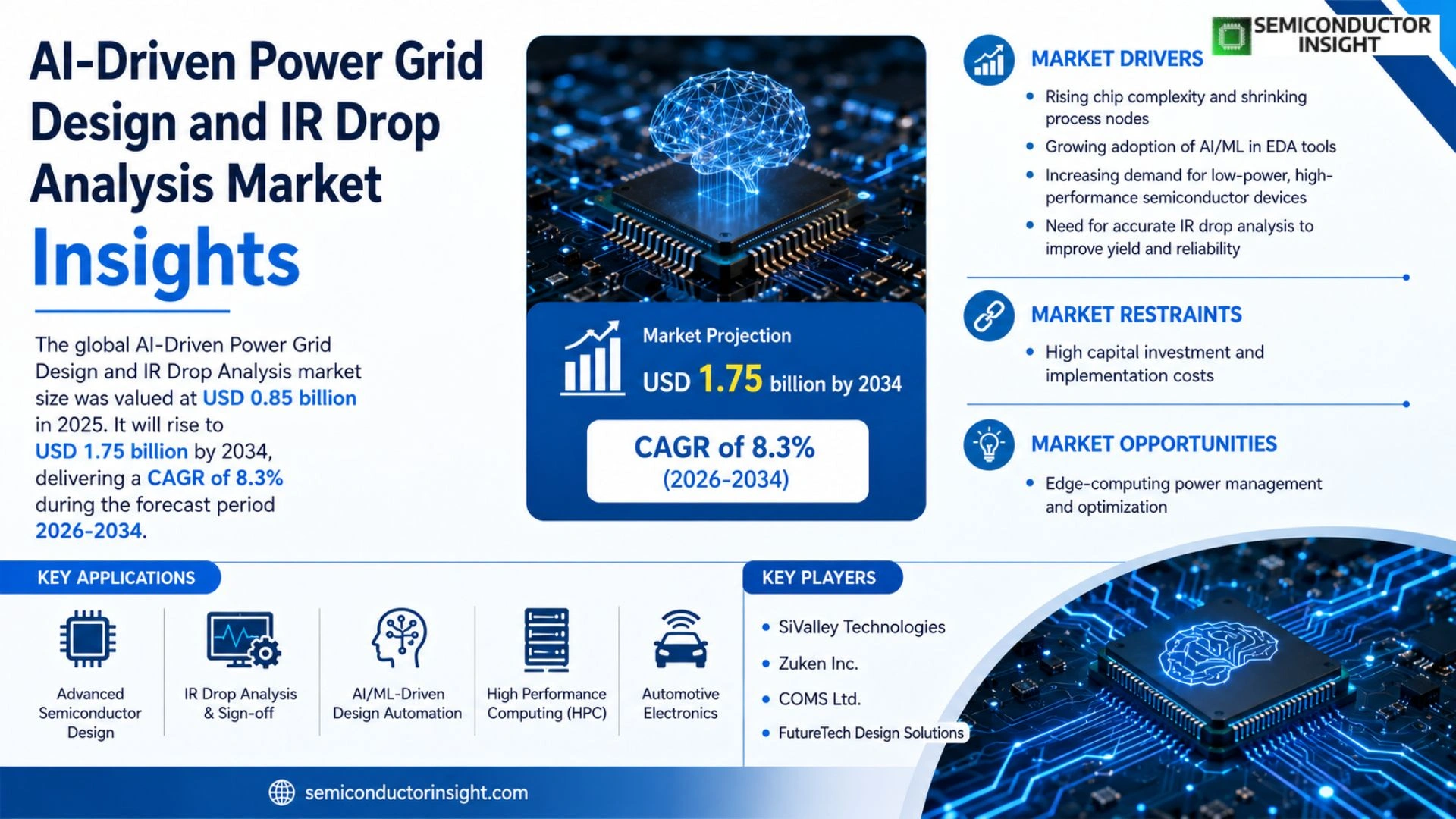
MARKET DRIVERS
Rising Chip Complexity Accelerates Adoption
As semiconductor nodes shrink below 5 nm, designers confront tighter voltage margins and heightened susceptibility to IR drop. AI‑enhanced layout tools can evaluate millions of routing permutations in minutes, delivering a level of precision that manual methods cannot match. This efficiency gain translates into shorter time‑to‑market for high‑performance products, a factor that directly fuels demand for specialized solutions.
Energy‑Efficiency Mandates Shape Design Priorities
Regulatory pressure on data‑center power consumption forces OEMs to optimize every milliwatt. AI‑driven simulations pinpoint hotspots before silicon fabrication, allowing engineers to rebalance power grids proactively. The resulting reduction in operational costs makes the technology attractive across server, automotive, and aerospace segments.
➤ Early adopters report up to a 30 % decline in post‑silicon re‑work after integrating AI‑based IR‑drop analytics.
The convergence of these forces creates a fertile environment for vendors that can bundle predictive analytics with design‑automation platforms, positioning the AI‑Driven Power Grid Design and IR Drop Analysis Market for sustained expansion.
MARKET CHALLENGES
Data Quality and Model Training
AI models rely on large, high‑fidelity datasets captured from previous tape‑outs. In many organizations, legacy records are fragmented, leading to inconsistent training inputs that diminish prediction accuracy. Overcoming this obstacle often requires costly data‑cleaning initiatives before the technology can deliver reliable outcomes.
Other Challenges
Integration with Existing EDA Workflows
Most design teams operate within entrenched electronic‑design‑automation (EDA) ecosystems. Embedding AI modules without disrupting established sign‑off procedures demands careful API design and extensive validation, a hurdle that can slow deployment timelines.
Talent Gap
The specialized skill set required to fine‑tune machine‑learning pipelines for power‑grid analysis is scarce. Companies that cannot attract or develop this expertise may find their projects stalled, reducing the overall momentum of market uptake.
MARKET RESTRAINTS
Capital Investment Requirements
Implementing AI‑driven analysis platforms typically involves upfront licensing fees, high‑performance compute infrastructure, and specialist talent. For midsized design houses, the budgetary commitment can outweigh perceived short‑term benefits, curbing broader adoption.
Regulatory Uncertainty
Emerging standards for AI usage in safety‑critical silicon have not yet solidified, leaving companies cautious about committing to solutions that might later require compliance retrofits. This ambiguity adds a layer of risk that slows investment decisions.
Intellectual‑Property Concerns
AI models trained on proprietary layout data raise questions about data ownership and confidentiality. Firms hesitant to expose internal design artefacts to third‑party platforms may delay or abandon AI‑based initiatives altogether.
MARKET OPPORTUNITIES
Edge‑Computing Power Management
Emerging edge devices demand ultra‑low power envelopes while maintaining performance. AI‑enabled power‑grid optimization can deliver the fine‑grained voltage regulation required for such applications, opening a new revenue stream for solution providers targeting IoT and autonomous‑vehicle silicon.
Subscription‑Based SaaS Models
Offering AI analytics as a cloud service reduces the need for heavy upfront capital, allowing smaller firms to access cutting‑edge capabilities on a pay‑as‑you‑go basis. This shift aligns with the broader software‑defined semiconductor trend and can accelerate market penetration.
Foundry Partnerships
Collaborations between AI platform vendors and leading silicon foundries enable co‑development of design‑for‑manufacturability guidelines that embed IR‑drop awareness from the outset. Such joint initiatives create a competitive edge for early adopters and generate recurring licensing opportunities for technology providers.
AI-Driven Power Grid Design and IR Drop Analysis Market Trends
Integration of Machine Learning into Power Grid Layout Optimization
Machine‑learning algorithms are being woven directly into electronic‑design‑automation suites, allowing layout engineers to evaluate routing and voltage‑regulation options while the chip architecture is still abstract. This early‑stage insight compresses the design loop, because potential hot spots are identified before physical placement, reducing costly redesigns after tape‑out. The shift also aligns with the broader industry move toward data‑driven decision making, where historical silicon performance feeds predictive engines that suggest optimal component placement. For the AI‑Driven Power Grid Design and IR Drop Analysis Market, this integration translates into higher adoption rates among fabless companies seeking to shorten time‑to‑market while preserving yield. Synopsys, Cadence and Siemens Mentor have each released a dedicated AI‑enhanced integrity suite, embedding the same predictive kernels into their flagship tools, which has accelerated cross‑platform adoption among design houses that operate heterogeneous toolchains. The cost implication is measurable, with early‑stage optimization reducing post‑layout iteration expenses by an estimated fifteen percent.
Other Trends
Enhanced IR Drop Predictive Models
Advances in simulation fidelity now enable IR drop analysis to reflect dynamic load swings that occur during real‑world operation, rather than static worst‑case assumptions. By training models on large datasets of measured voltage sag across diverse process corners, vendors can forecast sag events with sub‑nanosecond resolution. Designers can therefore allocate decoupling resources more precisely, avoiding over‑design that inflates power budgets. This capability is especially valuable for mobile‑first devices where every milliwatt counts, and it positions the AI‑Driven Power Grid Design and IR Drop Analysis Market as a strategic enabler of energy‑efficient silicon. Furthermore, the inclusion of temperature‑aware load profiling allows the analysis engine to account for thermal coupling effects, a factor that previously required separate manual correction.
Regulatory and Sustainability Drivers
Stringent energy‑efficiency standards imposed by both government bodies and major OEMs are compelling chip makers to scrutinize power distribution networks more closely. Compliance audits now request quantifiable evidence that voltage stability meets predefined thresholds under real‑world workloads. As a result, design houses are turning to AI‑augmented tools that can produce audit‑ready reports automatically. This regulatory pressure creates a clear business case for investing in the AI‑Driven Power Grid Design and IR Drop Analysis Market, because firms that adopt the technology can reduce compliance costs, accelerate certification cycles, and differentiate their products on the basis of reliability and sustainability. Companies that build proprietary AI models can license them to smaller fabs, creating a new revenue stream and fostering an ecosystem of plug‑in analytics. As the industry pushes toward sub‑5‑nanometer nodes, the margin for voltage fluctuation narrows, making these AI‑driven capabilities virtually indispensable.
COMPETITIVE LANDSCAPE
Key Industry Players
AI‑Driven Power Grid Design and IR Drop Analysis Market – Competitive Overview
Synopsys and Cadence continue to anchor the market, each offering end‑to‑end electronic‑design‑automation platforms that embed machine‑learning models directly into power‑grid synthesis and IR‑drop forecasting. Synopsys’ PrimePower suite leverages a neural‑network estimator to trim routing length while preserving voltage headroom, allowing flagship customers to compress design cycles by weeks. Cadence’s Innovus with AI‑enhanced integrity checks similarly widens the design window, but distinguishes itself through a tighter integration with its verification ecosystem, giving foundries a seamless hand‑off from layout to sign‑off. The duopoly shapes pricing tiers, channel strategies, and the cadence of feature releases, compelling smaller vendors to align their roadmaps with either of the two dominant APIs.
Beyond the two giants, a set of specialized firms is carving out niches that influence the broader ecosystem. Siemens EDA (formerly Mentor Graphics) supplies a modular advisor that focuses on power‑grid topology optimization for automotive ASICs, while Ansys introduces physics‑based AI layers that predict voltage sag under extreme process variations. Altair Engineering’s HyperWorks AI module targets high‑performance computing designs, and MathWorks offers a MATLAB‑driven toolbox that blends statistical learning with classic IR‑drop solvers for academic and early‑stage startups. Emerging players such as DeepCI, SiValley, and Zuken contribute domain‑specific plugins that enhance data‑exchange standards and provide bespoke analytics for niche markets like IoT sensors and aerospace. Collectively, these companies broaden the choice set, pressuring the leaders to innovate faster and to consider partnership models that extend functionality without fragmenting the tool chain.
List of Key AI‑Driven Power Grid Design and IR Drop Analysis Companies Profiled
- Synopsys Inc.
- Cadence Design Systems, Inc.
- Siemens EDA (Mentor Graphics)
- Ansys, Inc.
- Altair Engineering Inc.
- MathWorks, Inc.
- Keysight Technologies
- DeepCI Ltd.
- SiValley Technologies
- Zuken Inc.
- COMS Ltd.
- FutureTech Design Solutions
Segment Analysis:
| Segment Category | Sub-Segments | Key Insights |
| By Type |
|
Neural‑Network‑Based Routing
|
| By Application |
|
Mobile SoCs
|
| By End User |
|
Semiconductor Designers
|
| By Technology |
|
Machine‑Learning‑Enhanced EDA Suites
|
| By Design Phase |
|
Power‑Grid Synthesis
|
Regional Analysis: AI-Driven Power Grid Design and IR Drop Analysis Market
Enterprises in the region have embedded machine‑learning models into core design workflows, allowing real‑time IR drop forecasts during layout iterations. The pace outstrips most other markets, driven by a willingness to experiment with cloud‑based compute resources and a robust ecosystem of AI tooling vendors.
Federal agencies incentivize grid resiliency projects that explicitly mention AI analytics as qualifying technology. This regulatory encouragement reduces risk perception for utilities, encouraging them to allocate budget toward advanced design verification platforms.
A concentration of universities offering specialized curricula in power electronics and data science supplies a steady pipeline of engineers capable of bridging hardware constraints with algorithmic solutions, reinforcing the region’s competitive edge.
Venture capital and corporate R&D funds are disproportionately directed toward start‑ups that combine AI inference with power‑grid simulation, indicating confidence that intellectual‑property gains will translate into measurable efficiency improvements.
Europe
European power operators are leveraging AI-driven design to meet stringent EU decarbonization targets. National grids in Germany and France prioritize low‑loss architectures, prompting manufacturers to adopt IR drop analysis that reconciles renewable integration with legacy infrastructure. Cross‑border standardization initiatives foster data sharing, allowing AI models trained on one market to be repurposed elsewhere, thereby lowering entry barriers for smaller utilities.
Asia‑Pacific
Rapid urbanization and escalating electricity demand in China, India, and Southeast Asia create pressure to modernize distribution networks. AI-powered design tools help balance cost constraints with performance, especially in densely populated megacities where voltage stability is critical. Government‑backed digitalization schemes accelerate the rollout of intelligent grid planning solutions, though talent gaps in advanced analytics remain a notable challenge.
South America
In Brazil and Chile, the push to integrate distributed generation sources is prompting utilities to explore AI-driven grid design. Limited legacy data hampers model training, yet collaborative projects with North American firms are transferring expertise in IR drop mitigation. The region’s emphasis on cost‑effective solutions drives a preference for modular AI platforms that can be scaled as grid complexity grows.
Middle East & Africa
Energy‑rich nations of the Gulf are investing heavily in smart‑grid pilots that incorporate AI for voltage regulation and loss reduction. In contrast, many African markets are still nascent, focusing on foundational grid extensions. International development agencies are introducing AI‑enabled design kits as part of capacity‑building programs, positioning the technology as a catalyst for both reliability and sustainability across divergent market conditions.
Report Scope
This market research report provides a comprehensive analysis of the AI-Driven Power Grid Design and IR Drop Analysis Market , covering the forecast period 2026–2034. It offers detailed insights into market dynamics, technological advancements, competitive landscape, and key trends shaping the industry.
Key focus areas of the report include:
- Market Overview: The report begins with an overview outlining its current market scenario, key growth indicators, and industry transformation drivers. It discusses macroeconomic factors, demand–supply balance, regulatory landscape, and the strategic role of semiconductors in powering advancements across industries such as automotive, telecommunications, consumer electronics, and industrial automation.
- Market Size & Forecast: Historical data and future projections for revenue, unit shipments, and market value across major regions and segments.
- Segmentation Analysis: Detailed breakdown by product type, technology, application, and end-user industry to identify high-growth segments and investment opportunities.
- Regional Insights: Insights into market performance across North America, Europe, Asia-Pacific, Latin America, and the Middle East & Africa, including country-level analysis where relevant.
- Competitive Landscape: Profiles of leading market participants, including their product offerings, R&D focus, manufacturing capacity, pricing strategies, and recent developments such as mergers, acquisitions, and partnerships.
- Technology Trends & Innovation: Assessment of emerging technologies, integration of AI/IoT, semiconductor design trends, fabrication techniques, and evolving industry standards.
- Market Drivers & Restraints: Evaluation of factors driving market growth along with challenges, supply chain constraints, regulatory issues, and market-entry barriers.
- Stakeholder Insights: Insights for component suppliers, OEMs, system integrators, investors, and policymakers regarding the evolving ecosystem and strategic opportunities.
Primary and secondary research methods are employed, including interviews with industry experts, data from verified sources, and real-time market intelligence to ensure the accuracy and reliability of the insights presented.
FREQUENTLY ASKED QUESTIONS:
What is the current market size of AI-Driven Power Grid Design and IR Drop Analysis Market?
-> AI-Driven Power Grid Design and IR Drop Analysis Market was valued at USD 0.85 billion in 2025 and is expected to reach USD 1.75 billion by 2034.
Which key companies operate in AI-Driven Power Grid Design and IR Drop Analysis Market?
-> Key players include Synopsys, Cadence, Siemens Mentor.
What are the key growth drivers?
-> Key growth drivers include escalating chip complexity, tighter power budgets in mobile‑first devices, and increasing regulatory pressure on energy efficiency.
Which region dominates the market?
-> The reference does not specify a dominant region.
What are the emerging trends?
-> Emerging trends include AI/ML‑enhanced integrity suites, advanced IR drop analysis techniques, and deeper integration of machine‑learning algorithms within EDA tools.

Get Sample Report PDF for Exclusive Insights
Report Sample Includes
- Table of Contents
- List of Tables & Figures
- Charts, Research Methodology, and more...
 Download Sample Report PDF