

Top 5 Global Regions Shaping the Next Wave of Cooling Element Market Development
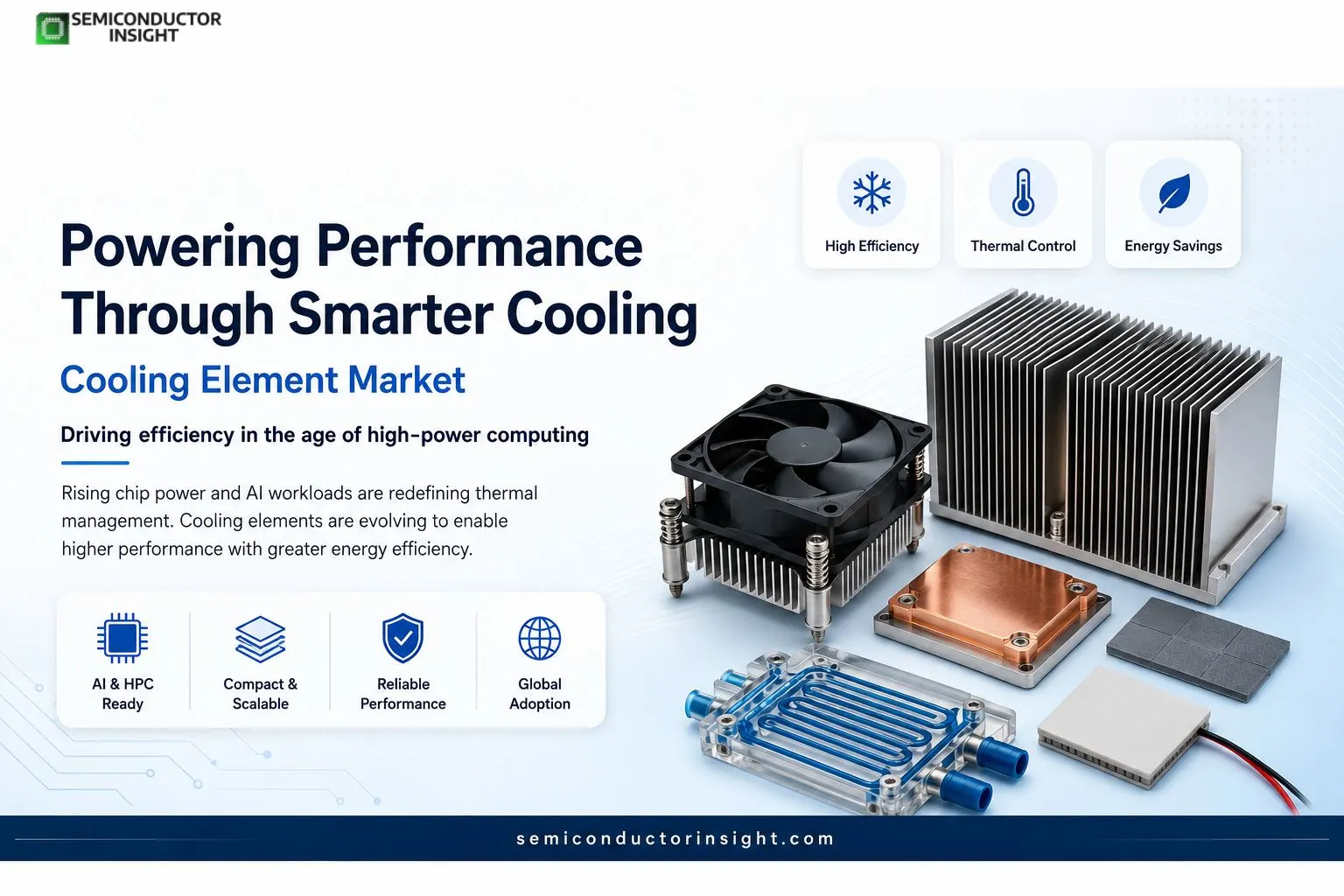
Cooling Element Market is becoming an increasingly important part of the semiconductor ecosystem as chips move toward higher power densities and more demanding workloads. Cooling elements include thermoelectric coolers, heat spreaders, heat sinks, microchannel structures and liquid-based thermal solutions that help remove heat from processors, power devices, sensors and advanced semiconductor packages.
The pressure is particularly visible in AI infrastructure. The International Energy Agency estimates that data centers consumed about 415 TWh of electricity in 2024, equal to around 1.5% of global electricity demand. Its base case projects this figure to reach roughly 945 TWh by 2030. Accelerated servers, largely associated with AI, are expected to be one of the fastest-growing sources of this demand.
United States Builds a High-Power Computing Cooling Ecosystem
The United States remains a major center for cooling-element demand because of its combination of semiconductor manufacturing, hyperscale data centers, AI infrastructure and advanced packaging research. The U.S. Department of Energy has highlighted cooling as a major energy-efficiency opportunity, noting that data-center cooling can account for up to 40% of total data-center energy use. In 2023, the DOE committed $40 million across 15 projects focused on high-performance cooling technologies.
The semiconductor expansion is adding another layer of demand. U.S. CHIPS investments had reached approximately $34 billion in awarded funding across 34 negotiated deals in 22 states, while planned electronics-manufacturing investments approached $450 billion. Advanced packaging and AI hardware expansion are creating more applications for compact thermal management at chip and package level.
Taiwan Pushes Cooling Beyond Conventional Air Systems
- Taiwan occupies a central position because its semiconductor manufacturing base is closely connected with advanced packaging, AI processors and high-density computing.
- As chip power rises, conventional air cooling is increasingly being complemented by liquid and two-phase technologies.
- A notable 2025 example came from Taiwan’s Ministry of Economic Affairs and Industrial Technology Research Institute. Their two-phase immersion cooling development was validated in an AMD-related application and was designed to handle high-heat-density AI chips.
- The technology demonstrated cooling capability above 1,500 W, compared with the approximately 1,000 W limitation highlighted for an earlier single-phase approach.
- This shows how cooling elements are moving from simple supporting components toward technologies designed directly around AI accelerator performance.
China Expands Liquid Cooling Across Large Computing Facilities
China is rapidly developing cooling applications alongside its expanding computing infrastructure. The Ministry of Industry and Information Technology has promoted liquid cooling, phase-change technologies and high-efficiency thermal equipment as part of its energy-saving equipment strategy.
One documented Chinese data-center application deployed approximately 2,200 liquid-cooled servers. The project achieved a power usage effectiveness figure of around 1.10 and reported annual electricity savings of approximately 6.3 million kWh.
The country’s push is also becoming more standardized. A national standards project for cooling liquid used in liquid-cooled data centers entered development in 2025, covering materials specifically associated with electronic technology applications.
Don’t Forget to Surf Our Updated Report for More Detailed Analysis: https://semiconductorinsight.com/report/cooling-element-market/
Europe Connects Chip Cooling With Data Center Sustainability
Europe’s opportunity is closely tied to energy efficiency and sustainable digital infrastructure. The European Commission identifies cooling-water consumption and carbon emissions as important environmental considerations for data centers and is strengthening monitoring of energy performance.
The region is also expanding AI infrastructure. By October 2025, the European Commission reported 19 AI Factories across 16 Member States, with a further six facilities added through more than €500 million in joint EU and national investment. These high-performance computing environments require thermal solutions capable of supporting sustained AI workloads without excessive energy consumption.
Japan Turns Semiconductor Expansion into a Thermal Technology Opportunity
- Japan is rebuilding its advanced semiconductor manufacturing footprint, creating another important application base for cooling elements.
- TSMC’s Kumamoto operations entered mass production in late 2024, while construction of a second factory began in 2025.
- In 2026, Japan’s Ministry of Economy, Trade and Industry confirmed that the second facility’s plan had been upgraded toward 3-nanometer semiconductor production, subject to the ongoing implementation process.
- More advanced nodes mean tighter thermal budgets, particularly for high-performance logic and AI-related applications.
- Japan’s growing semiconductor cluster therefore creates demand not only for fabrication equipment but also for heat-management materials, thermoelectric components, thermal interfaces and compact cooling architectures.
The New Cooling Equation for Semiconductor Design
The direction of Cooling Element Market is increasingly being determined at the chip-design stage rather than after a processor has been manufactured. Higher transistor density, 3D packaging, AI accelerators and high-bandwidth computing are forcing manufacturers to consider heat transfer alongside electrical performance.
The result is a broader application landscape covering AI accelerators, GPUs, CPUs, power semiconductors, advanced packages, optical modules, sensors and data-center servers. As computing moves toward higher wattage per package, the regions investing simultaneously in semiconductor capacity and digital infrastructure are likely to remain the most important centers for next-generation cooling technologies.

Comments (0)