

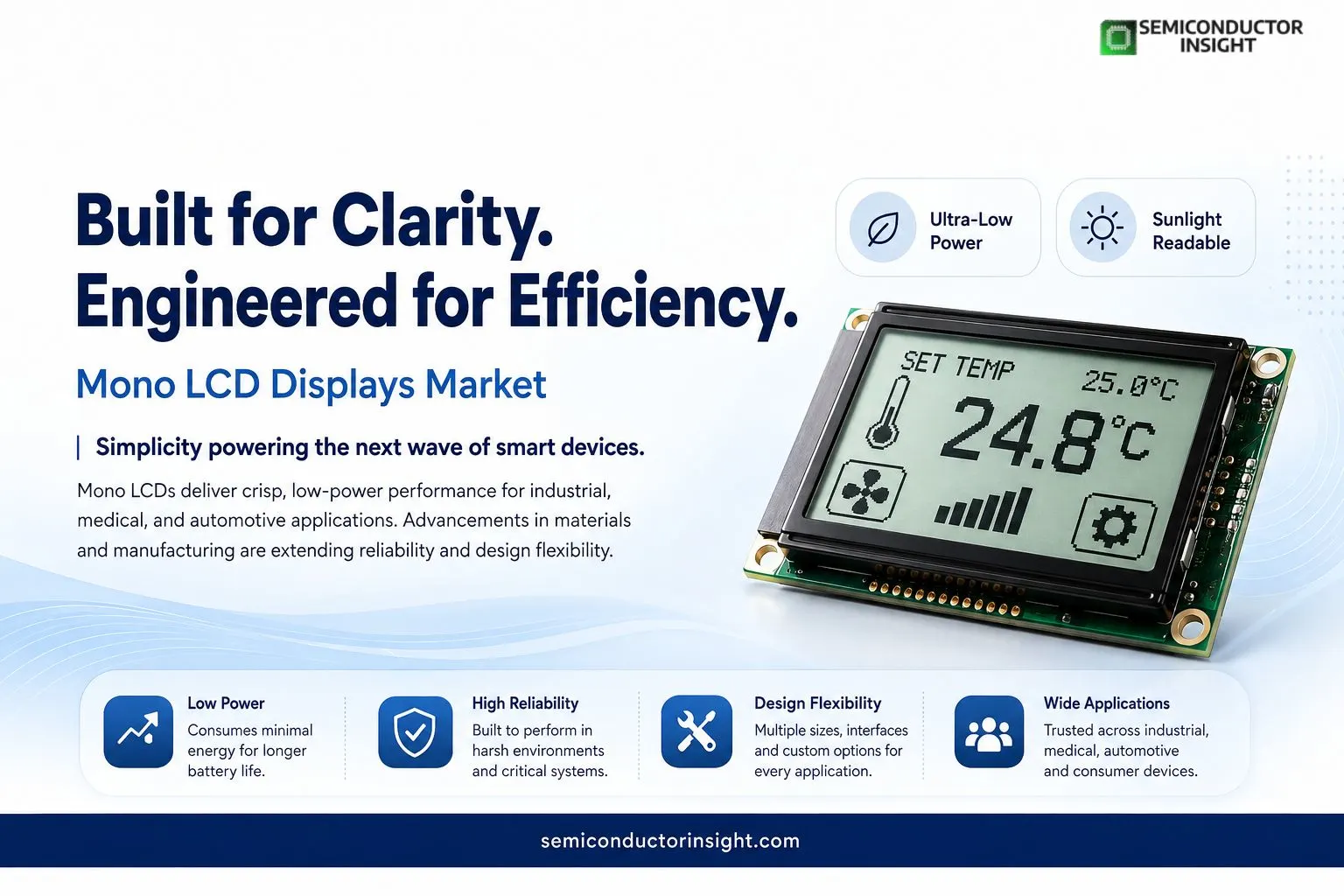
Top 10 Top-Performing Mono LCD Displays Manufacturers Leading Global Market Expansion
Monochrome liquid crystal panels continue to serve roles where color adds no functional value and every microamp of current counts. Their construction omits color filter arrays and multiple sub-pixel electrodes, leaving a simpler stack of five to seven layers instead of the ten or more found in full-color TFT modules. This reduction cuts both material complexity and optical losses, allowing ambient light or a modest LED edge light to produce usable contrast.
Powertip Technology
- In the world of monochrome LCDs that quietly power industrial meters, medical devices, and parking systems, Powertip stands as a long-running specialist.
- Founded in 1991 and headquartered in Taichung, Taiwan, the company runs production sites in Taiwan and Nanjing, China, across more than 90,000 square meters of floor space.
- Roughly 900 to 1,450 people work on character modules, graphic LCMs, COG designs, and VATN panels that serve hundreds of configurations.
- Over 79 series and more than 1,000 standard module variants leave its lines for medical, automotive, white-goods, and test-equipment makers.
- Recent focus stays on HMI-embedded solutions and mono STN modules produced in Jiangsu, keeping supply steady for applications that need clear, low-power readouts in harsh environments.
Raystar Optronics
Walk into many industrial control panels or medical instruments and you may meet a Raystar monochrome graphic LCD. Set up in 2007 inside Taiwan’s Central Taiwan Science Park, the firm builds character and graphic STN/FSTN modules alongside OLED lines. Its catalog lists sizes from 1.15-inch to 5.67-inch with resolutions such as 128×64, 160×128, 240×64, and 320×240, offered in COB, COG, and COG+PCB forms.
Multiple interfaces (6800, 8080, SPI, I2C) and built-in fonts covering English, Chinese, Japanese, Korean, and more support global equipment. Raystar keeps standard products with no minimum order quantity, making it a practical partner for designers who need reliable mono displays for POS systems, automation, and home appliances.
For More Detailed Insights, You Can Surf Our Latest Report Here: https://semiconductorinsight.com/report/mono-lcd-displays-market/
Riverdi
From a workshop in Gdańsk, Poland, Riverdi has spent more than a decade turning display constraints into working solutions for European engineers. The team designs and builds industrial modules that plug into STM32 boards and other embedded platforms, offering more than 350 off-the-shelf TFT and related options while supporting mono-style needs through custom engineering.
Sizes run from 1.54-inch to 15.6-inch with interfaces including LVDS, MIPI, RGB, and USB-C. The company reports 95 percent on-time delivery and 99.95 percent quality levels, with component longevity often planned for 5-10 years. Recent work emphasizes optical bonding done in-house and displays that survive vibration, dust, and wide temperature ranges for medical, energy, and industrial projects.
BOE Varitronix
- Automotive dashboards and industrial instruments around the world rely on BOE Varitronix for both monochrome passive LCDs and advanced modules.
- Established in 1978 and now part of the BOE group, the company keeps dedicated mono manufacturing capacity alongside TFT and touch assembly lines.
- Its passive TN, ISTN, and high-contrast IBN solutions deliver sunlight-readable panels and free-form shapes tailored for vehicles and white goods.
- Recent expansions include the Phase III project at the Heyuan plant and a new Vietnam facility that powered up its first product in 2025, with mass production planned by year-end.
- Shipments of automotive displays continue to grow, supporting center-stack and cluster applications that demand long life and wide temperature performance.
WINSTAR Display
For more than 28 years WINSTAR has specialized in the low-volume, high-mix world of industrial monochrome modules. Founded in 1998 in Taichung, Taiwan, the company operates factories in Taiwan, China, and Myanmar and employs around 1,500 people. Its lineup covers TN/STN/FSTN character and graphic LCMs, COG designs, VATN panels, and system-integration solutions.
Engineers value the flexibility of Made-in-Taiwan quality alongside China-based capacity. Recent annual reports show continued investment in R&D (roughly 5-7 percent of revenue) aimed at ultra-low-power architectures and outdoor-readable mono displays used in medical devices, POS terminals, and industrial controllers.
Kyocera Display
Kyocera’s monochrome LCDs appear in handheld medical tools, industrial handhelds, and sunlight-readable instruments where power budgets are tight. The Japanese maker supplies TN and related reflective modules that pair with ultra-thin front-light films drawing far less power than conventional backlights.
Value-add production in Michigan includes optical bonding in a Class-1000 clean room, allowing custom cover glass, touch, and gasket packages. Applications range from wearable secondary displays and test equipment to EV charging interfaces. Development kits and low minimum-order quantities help engineers move quickly from prototype to production while keeping long-term supply commitments.
Tianma
With roots dating to 1983 and more than 23,500 employees today, Tianma Microelectronics supplies mono and color industrial displays for medical, automotive, and instrumentation markets. Multiple generations of TFT lines (including G4.5, G5, and LTPS) feed both consumer and professional segments.
The company’s dual-brand approach (Tianma and NLT) supports specialized industrial modules that require high reliability and long product life. Recent capacity expansions and a large flexible AMOLED project in Xiamen illustrate the scale of its manufacturing base, while mono and character solutions continue to serve meters, control panels, and avionics where simple, clear information is essential.
Sharp
Sharp’s Memory-in-Pixel (MIP) monochrome modules remain a quiet workhorse for ultra-low-power devices that must stay readable in bright sunlight. Modules in the 1.2-inch to 1.8-inch range with resolutions such as 184×38 or 230×303 appear in wearables, medical handhelds, and outdoor instruments.
Although the company is winding down conventional industrial LCD production at its Kameyama plant by the end of 2026, it continues to support the industrial sector with MIP technology. Partners such as DATA MODUL help maintain long-term availability, ensuring existing designs can stay in production while new low-power applications adopt the reflective panels.
Sinocrystal Technology
Since 2008 Sinocrystal has focused on small- and medium-size mono character, graphic, and segment LCDs alongside TFT and OLED options. The Chinese manufacturer offers COB and COG packaging, custom PCBA, cover lenses, and plastic housings for medical, industrial, automotive, and white-goods projects. Its engineering team brings more than two decades of collective experience, enabling free-form and application-specific designs.
Products reach instrumentation, blood-pressure monitors, smart meters, and industrial HMIs. Recent emphasis on ruggedized modules and value-added services keeps the company relevant for designers who need dependable mono displays with short lead times.
Vatronix
Vatronix Industrial, founded in 2001, runs automated lines for TN-LCD, STN-LCD, COB, COG, and related mono modules with fine features down to 0.001 mm dot pitch. More than 400 standard LCM variants sit alongside extensive custom work for instruments, automotive electronics, thermometers, electronic scales, smart meters, and medical devices.
The company holds multiple international certifications and supplies both standard and fully customized panels. Its strength lies in matching exact mechanical and optical requirements for handheld devices, industrial automation, and consumer appliances that still rely on clear monochrome information.

Comments (0)