

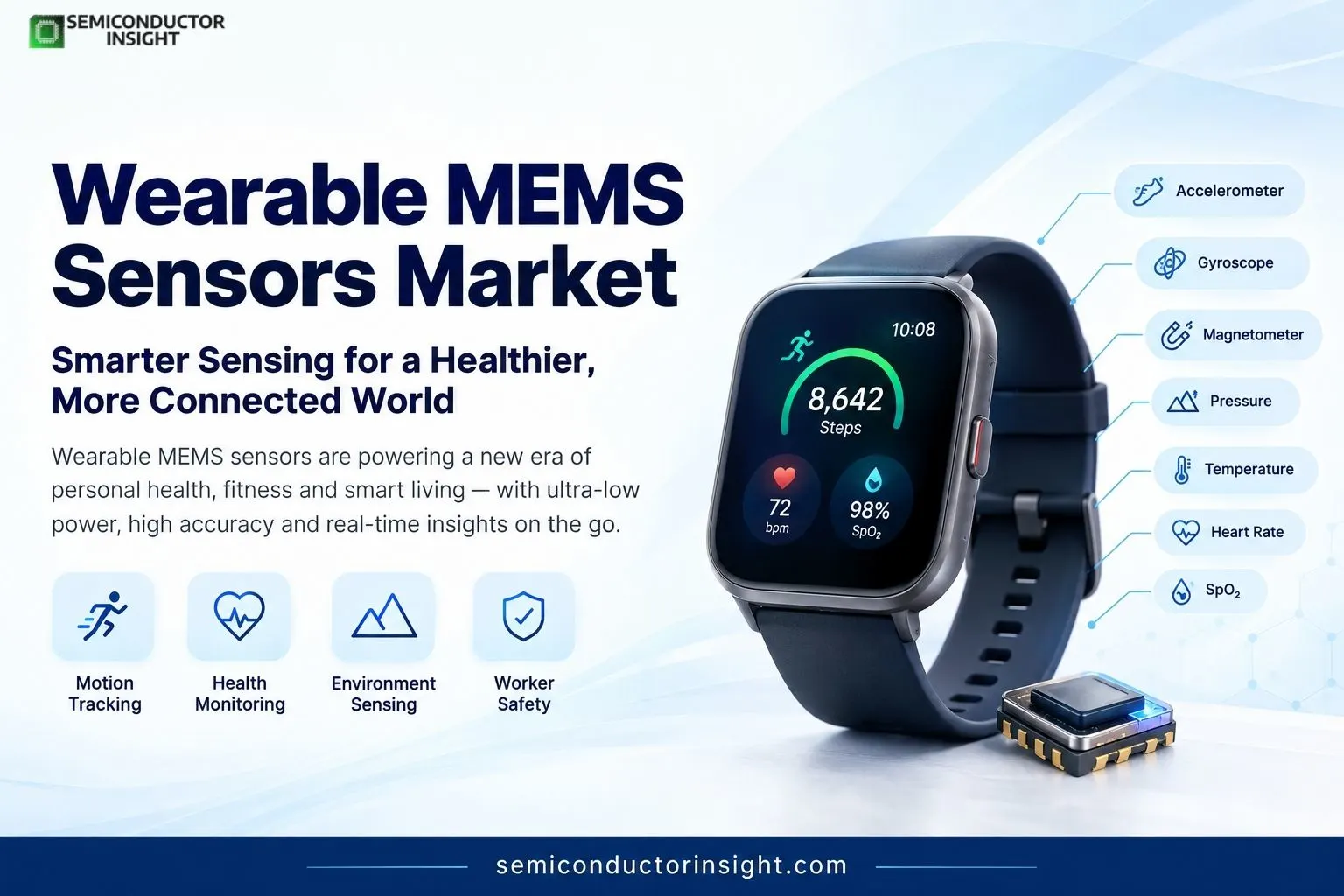
Top 10 Strategic Sensor Categories Driving the Evolution of Wearable MEMS Solutions in Biometric Activity Monitoring and Energy Management
Wearable MEMS sensors form the sensing core of devices that track motion, orientation, environment, and physiological signals on the body. Accelerometers detect linear acceleration and steps with high sensitivity while drawing minimal current. Gyroscopes measure angular rate for orientation and gesture tracking. Magnetometers supply absolute heading references. Pressure sensors enable barometric altitude resolution down to centimetre scales. Ambient temperature sensors correct other readings and monitor skin or surroundings.
Heart-rate monitoring sensors, typically optical but supported by inertial fusion, and blood-oxygen sensors expand continuous health tracking. Smart watches remain the highest-volume application platform because they combine these elements into a single wrist-worn form. Fitness trackers emphasise activity metrics, health-monitoring devices prioritise clinical-grade signals, AR/VR headsets demand precise head tracking, and industrial IoT wearables focus on worker safety and environment.
Consumer users drive volume, while healthcare providers, military and defence, sports performance, and industrial operators impose stricter accuracy, ruggedness, and data-integrity requirements. Indoor, outdoor, automotive, and industrial-site deployments each shape packaging and interference tolerance. Power strategies range from energy harvesting and optimised battery operation to ultra-low-power designs that extend continuous runtime.
Accelerometers continue to serve as the foundational element because their low power and compact footprint allow always-available motion data. Commercial six-axis inertial measurement units combining accelerometer and gyroscope frequently operate in the 0.55-0.7 mA range when both axes are active, with sampling rates selectable from a few hertz to several kilohertz depending on the use case.
Research front-ends have demonstrated continuous-time accelerometer channels consuming as little as 90 µW while maintaining tens of decibels of signal-to-noise ratio over multi-kilohertz bandwidths. Gyroscopes benefit from always-on techniques that reduce wake-up latency to a few milliseconds, enabling event-driven operation without continuous high current. Magnetometers complete the nine-axis orientation stack used for heading-aware navigation indoors and outdoors.
Sensor Fusion and Signal Pathway
- Raw MEMS outputs first undergo filtering and calibration for bias, scale factor, and temperature drift.
- Accelerometer and gyroscope data are then fused through complementary or Kalman-style filters to produce stable orientation estimates. Pressure readings convert to relative altitude, resolving height changes on the order of 13 cm in commercial modules measuring only a few millimetres on each side.
- Optical heart-rate and blood-oxygen channels are cross-checked against inertial activity state so that motion artefacts can be rejected. The resulting streams feed on-device algorithms or are transmitted for cloud analytics, closing the loop from physical sensing to user insight.
- Heart-rate validation studies across diverse cohorts of roughly 60 participants have shown median absolute%age errors often remaining below 5% during cycling and resting conditions when compared with electrocardiogram references, although error rises during walking.
- Blood-oxygen measurements on popular smartwatches have met ISO root-mean-square deviation limits of 4% or better against medical pulse oximeters in controlled desaturation protocols involving multiple participants and hundreds of paired readings.
- These figures illustrate that optical MEMS-supported channels can approach clinical utility under defined conditions while still requiring careful algorithm design for everyday motion.
Our most recent updated related study is available for free at this link: https://semiconductorinsight.com/report/wearable-mems-sensors-market/
Power Envelope and Autonomy Mapping
Ultra-low-power sensor modes and duty cycling allow multi-day operation from small lithium cells. Prototype multi-sensor motion systems have demonstrated total sensing-layer consumption near 0.3 mW. Energy-harvesting approaches that scavenge kinetic or thermal energy further reduce dependence on frequent recharging, particularly valuable for continuous health-monitoring patches. Outdoor and industrial deployments add constraints of temperature extremes and electromagnetic interference, prompting packaging innovations that preserve sensor accuracy without increasing power draw.
Deployment and Form-Factor Considerations
Smart-watch and fitness-tracker designs prioritise thin profiles and skin contact for optical sensors. Healthcare modules emphasise regulatory traceability and secure data paths into electronic health records. Military and industrial units require wider temperature ranges and mechanical robustness. AR/VR headsets place higher demands on gyroscope bandwidth and latency for immersive tracking. Across all cases the MEMS die itself occupies only a fraction of a cubic millimetre, leaving the surrounding system packaging, antenna, and battery as the dominant size and power contributors.
Recent laboratory and field evaluations continue to refine these building blocks. Stretchable multi-sensor arrays for gait analysis have achieved classification accuracies above 99% after individual training while consuming under a third of a milliwatt at the sensing layer. High-precision resonant pressure sensors have demonstrated full-scale accuracies better than 0.01% across wide temperature spans, supporting reliable barometric tracking. Optical validation campaigns keep quantifying the residual error under varying skin tones, activity intensities, and ambient conditions, guiding firmware improvements that tighten agreement with reference instruments.
Wearable MEMS sensors therefore operate as a tightly integrated set of motion, environmental, and biometric transducers whose value emerges from low power, high sampling flexibility, and fusion algorithms rather than from any single channel in isolation. From the microampere-scale accelerometer that counts steps to the pressure sensor that registers a single stair climb and the optical channels that estimate heart rate and oxygen saturation, these devices convert continuous physical phenomena into actionable digital streams for everyday and specialised use.

Comments (0)