
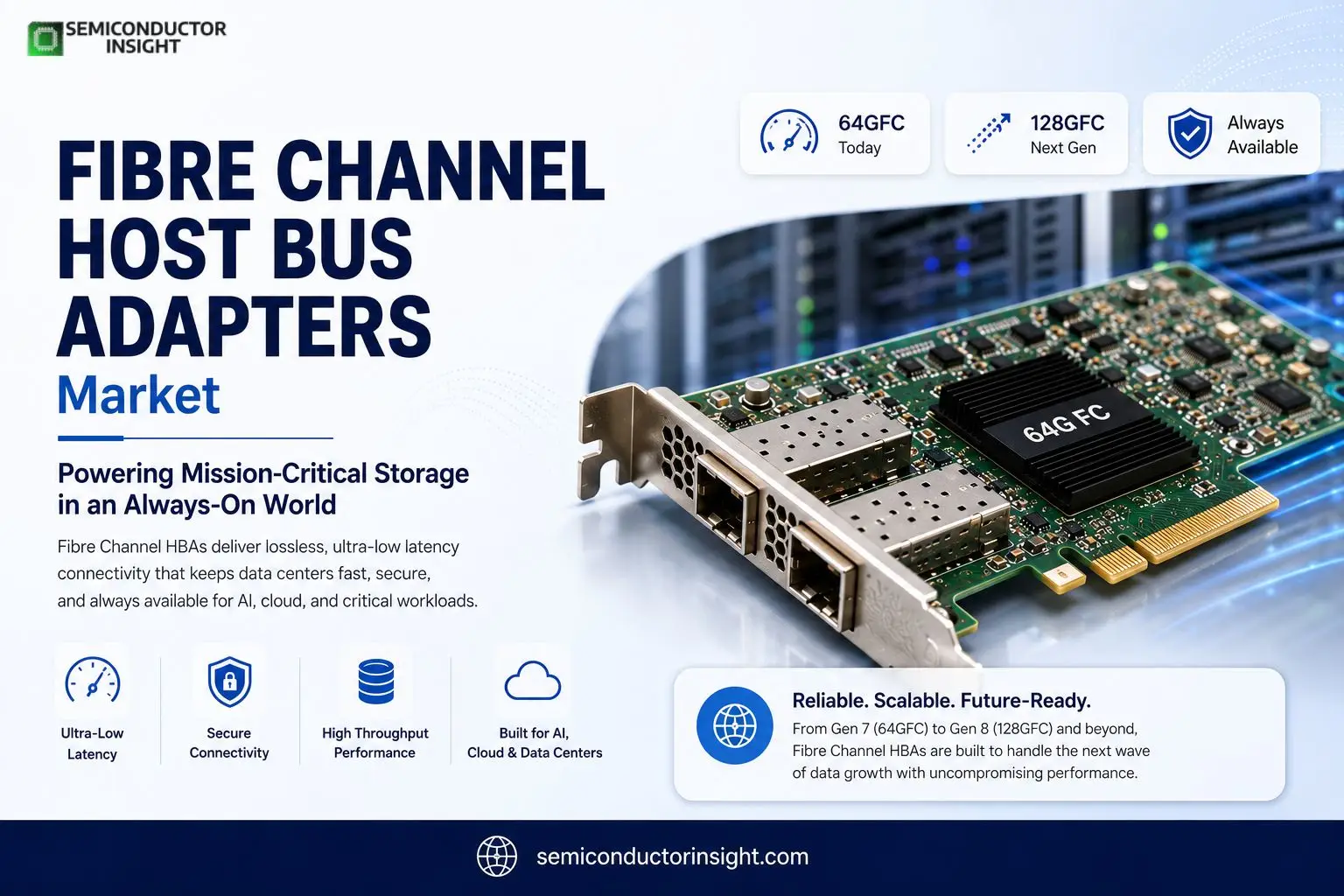
Top 10 Companies Leading Fibre Channel HBA Market in 2026 and Beyond
Fibre Channel Host Bus Adapters continue to anchor high-stakes storage networks across global data centers, powering the relentless flow of mission-critical data in an era where downtime simply isn’t an option.
As enterprises grapple with exploding volumes of information from AI workloads, cloud migrations, and real-time analytics, these specialized adapters deliver the lossless, low-latency connectivity that keeps everything running smoothly.
Broadcom Inc. dominates Fibre Channel HBA market through its;
Emulex brand, offering high-performance 32 Gb/64Gb adapters with advanced security features like end-to-end encryption for data in transit. Its SecureHBA solutions protect storage networks in enterprise environments, recently shipping 7th-generation models that support low-latency flash storage with sub-10 microsecond latencies in earlier lines.
Broadcom’s importance stems from powering mission-critical SANs across thousands of data centers worldwide, with its HBAs installed in numerous servers for reliable connectivity. Operating global production and R&D sites, the company employs tens of thousands and continues innovating quantum-resistant encryption. In 2025 instances, new Emulex Secure HBAs were highlighted for offloading encryption in high-speed 32G/64G fabrics, addressing rising cybersecurity demands in hybrid cloud setups.
Marvell Technology Ltd. leads with its QLogic Fibre Channel HBAs;
Delivering 64GFC adapters backward-compatible with 16G/32G SANs and supporting concurrent FCP and FC-NVMe for flexible storage orchestration. These adapters achieve high IOPS (e.g., 1.5 million read IOPS for 4KB blocks in internal tests) and feature port isolation for reliability.
Marvell’s dominance comes from rapid server deployment in enterprise data centers, with partnerships like HPE for Gen10 servers. The company maintains extensive semiconductor fabs and design centers. Recent developments include Enhanced 32GFC/64GFC lines enhancing transactional performance by up to 50% over prior generations, deployed in modern AI-driven storage infrastructures.
ATTO Technology, Inc. specializes in high-performance Fibre Channel HBAs;
Tailored for media and entertainment, with Celerity series featuring latency-management technology for demanding workflows. It recently showcased the Celerity 64Gb Quad HBA at IBC 2025 alongside Thunderbolt solutions. ATTO’s importance lies in low-latency, efficient data transfers for video editing and large file environments, shipping thousands of units to creative professionals and enterprises. As a focused innovator, it operates dedicated engineering teams producing specialized adapters. Current market position emphasizes breakthrough connectivity for 4K/8K media pipelines, supporting faster transfers in post-production studios handling massive daily data volumes.
Hewlett Packard Enterprise (HPE);
Integrates Fibre Channel HBAs like StoreFabric models (16G/32G) into its ProLiant and Apollo servers, often powered by Broadcom or Marvell chips for seamless SAN connectivity. HPE provides firmware updates, such as versions up to 2.00.01 enhancing features. Its dominance is in enterprise server ecosystems, with HBAs deployed in countless hybrid IT deployments. HPE operates global manufacturing facilities and serves large customer bases. Recent 2025 advisory notes and SN1200E/SN1600E lines support high-density fabrics, aiding data centers transitioning to faster storage networks amid growing edge computing needs.
Dell Technologies offers Emulex-based Fibre Channel HBAs such as LPe35002 dual-port 32G and LPe36002 64G models;
For its PowerEdge servers, ensuring high-reliability storage access. These low-profile adapters are key for scalable data center builds. Dell’s importance is in end-to-end infrastructure solutions, with HBAs integrated into thousands of shipped server units annually. With extensive global operations and supply chains, it supports diverse enterprise clients. Latest instances include promotion of FC32/FC64 adapters for modern SANs, facilitating low-latency connectivity in AI and cloud storage environments.
International Business Machines (IBM);
Provides Fibre Channel support through its storage and server solutions, including endpoint security features for FC ports with authentication and encryption on DS8000 systems. IBM’s role involves robust FCP implementations for mainframe and enterprise environments. Its dominance includes legacy and modern SAN integrations across large organizations. IBM maintains numerous R&D labs and production sites worldwide. Recent documentation highlights FCP channel configurations for Linux/zVM, supporting secure, high-availability paths in mission-critical setups handling enterprise workloads.
- Cisco Systems excels in Fibre Channel SAN infrastructure via its MDS 9000 Series switches and directors, complementing HBAs with high-port-density fabrics and 32G FC capabilities. MDS platforms offer integrated analytics for storage networks. Cisco’s importance is in complete SAN fabric management, deployed in thousands of enterprise data centers. It operates global manufacturing and supports massive networks. Recent advancements include 32G FC switches with telemetry, enabling always-available, secure storage access in cloud-scale environments.
- Huawei Technologies Co., Ltd. delivers Fibre Channel HBAs and storage networking solutions as part of its OceanStor and server portfolios, supporting high-speed SANs in data centers. Huawei’s global reach includes extensive production facilities serving Asia and beyond. Its dominance grows in emerging markets with integrated IT infrastructure. Recent deployments emphasize reliable FC connectivity for large-scale storage arrays in telecom and enterprise projects, aligning with 5G and cloud expansions.
- Lenovo Group Ltd. incorporates Fibre Channel HBAs into its ThinkSystem servers for enterprise storage connectivity, partnering with leaders like Broadcom. Lenovo’s importance lies in affordable, scalable server solutions shipped in high volumes globally. With manufacturing plants across continents, it supports diverse workloads. Current offerings focus on 32G/64G compatibility for hybrid cloud data centers, aiding customers in performance-optimized SAN implementations.
- Fujitsu Ltd. provides Fibre Channel HBAs within its PRIMERGY servers and storage systems, ensuring reliable connectivity for mission-critical applications. Fujitsu operates multiple production sites and R&D centers. Its role supports enterprise and data center customers with integrated solutions. Recent instances include advancements in high-speed FC for Japanese and global markets, enhancing storage performance in digital transformation projects.
At Last, before Ending, Don’t Forget to Browse Our Recent Exclusive Report for Detailed Insights: https://semiconductorinsight.com/report/fibre-channel-hbas-market-2/
Evolution of Speeds and the Push toward Higher Generations
Fibre Channel technology has steadily doubled performance roughly every few years since its early days. Current Gen 7 (64GFC) adapters deliver around 6,400 MB/s nominal throughput per direction, with Gen 8 (128GFC) on the horizon promising even greater leaps for bandwidth-hungry applications.
Enterprises upgrading from older 16G or 32G setups report noticeable gains in application responsiveness, particularly for flash storage arrays where latency measured in microseconds determines user experience. One prominent financial institution in Europe, for instance, migrated its core trading platforms to 64GFC HBAs and saw transaction processing times drop significantly while handling peak daily volumes exceeding multiple petabytes of data movement. Similar stories emerge from healthcare providers managing massive imaging archives and government agencies securing classified datasets.

Comments (0)