
Fibre Channel HBAs Market Insights
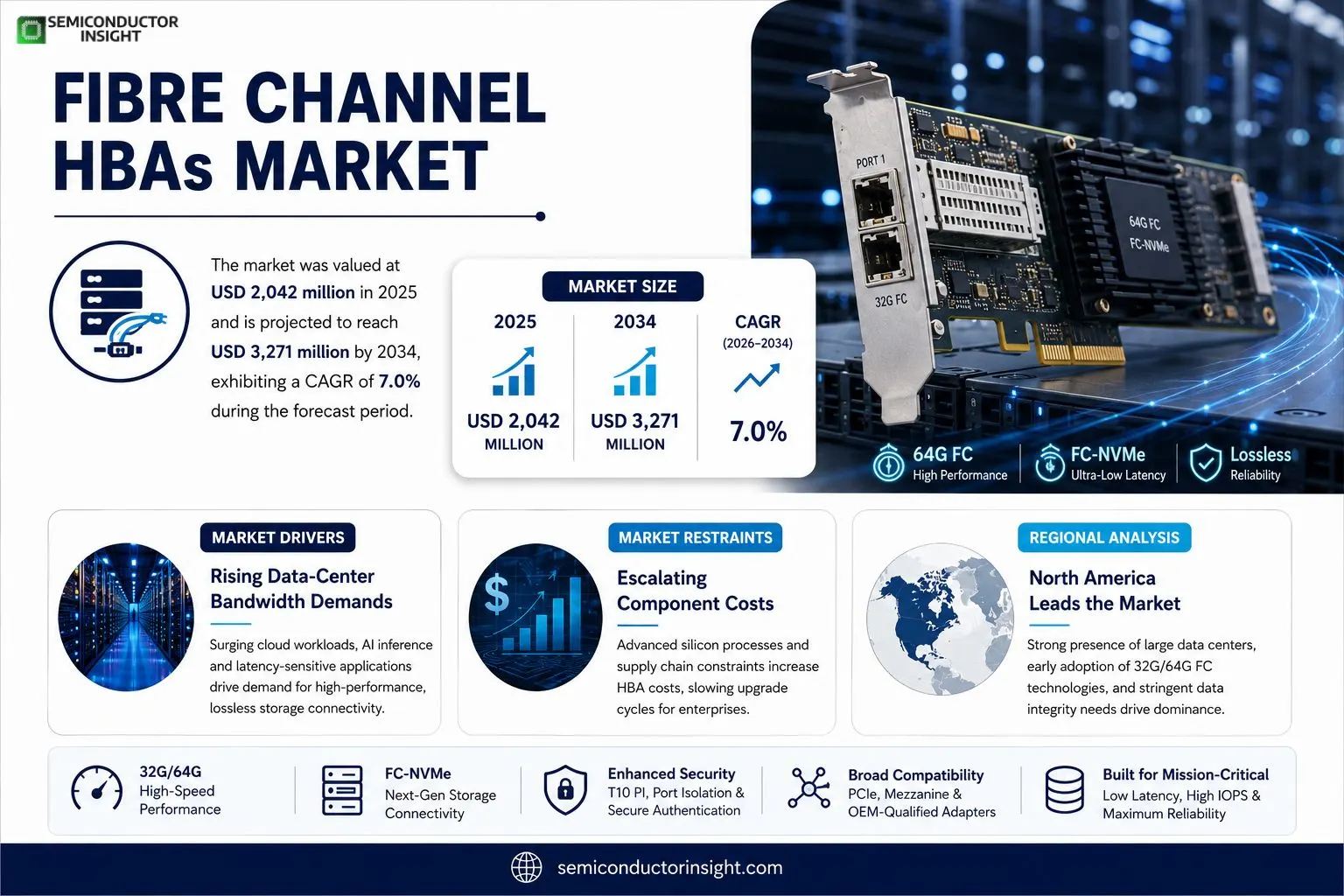
Fibre Channel HBAs Market was valued at USD 2,042 million in 2025 and is projected to reach USD 3,271 million by 2034, exhibiting a CAGR of 7.0% during the forecast period.
A Fibre Channel HBA is a dedicated host‑bus adapter installed on servers to provide stable, low‑latency connectivity to a Fibre Channel SAN. It creates a lossless data path that underpins databases, virtualization platforms, backup/recovery workflows and all‑flash or NVMe storage environments. Modern adapters have progressed from 8 G/16 G speeds to 32 G/64 G and now support FC‑NVMe across PCIe card, mezzanine and platform‑specific form factors.Growth is supported by the expanding deployment of all‑flash arrays, rising server core counts and the need for deterministic performance in high‑IOPS workloads. Vendors such as Broadcom, Marvell and ATTO are extending port densities while OEMs embed qualified HBAs into Dell, HPE and Lenovo systems to meet enterprise requirements for boot from SAN, multipathing and enhanced security.
MARKET DRIVERS
Rising Data‑Center Bandwidth Demands
The explosion of cloud‑native workloads, AI inference and high‑frequency trading has forced operators to upgrade interconnect capacity. Fibre Channel HBAs Market benefits because its low‑latency, lossless transport aligns perfectly with the need for deterministic performance across multi‑petabyte storage arrays.
Consolidation of Storage Architectures
Enterprises are replacing disparate Ethernet‑based SANs with unified Fibre Channel fabrics to cut management overhead and improve data integrity. This shift drives higher unit shipments of HBAs as legacy host adapters are phased out in favor of newer, feature‑rich modules.
➤ Adoption of 64‑Gbit/s Fibre Channel is accelerating, delivering a 30 % jump in per‑port throughput over the previous generation.
Combined, these forces generate a tangible uplift in spend on host‑bus adapters, prompting OEMs to broaden their product portfolios and invest in firmware that supports emerging storage protocols.
MARKET CHALLENGES
Escalating Component Costs
Advanced silicon processes, coupled with a smaller pool of qualified foundries, have pushed the bill of materials for high‑speed HBAs upward. Buyers now face tighter CAPEX budgets, prompting a more cautious upgrade cadence.
Other Challenges
Supply Chain Vulnerabilities
Geopolitical tensions and pandemic‑related disruptions have exposed thin inventory buffers for critical ASICs. Procurement teams are forced to secure longer‑term agreements, which can limit flexibility.In parallel, the talent shortage in firmware engineering slows the rollout of next‑generation features, extending product lifecycles beyond the optimal refresh window.
MARKET RESTRAINTS
Legacy Infrastructure Compatibility
Many data‑center operators still host older storage arrays that rely on 8‑Gbit/s or 16‑Gbit/s Fibre Channel. Upgrading to newer HBAs requires retrofitting switches and firmware updates, a process that can be both costly and risky. This compatibility hurdle dampens the speed at which organizations replace aging adapters.
MARKET OPPORTUNITIES
Emergence of NVMe‑over‑Fibre Channel Integration
Vendors are now embedding NVMe command sets directly into Fibre Channel HBAs, enabling storage devices to tap into the protocol’s ultra‑low latency while preserving existing fabric investments. Early adopters report a measurable reduction in I/O wait times, opening a revenue stream for firms that can certify their adapters for NVMe‑FC.Furthermore, the convergence of hyper‑converged infrastructure with Fibre Channel fabrics creates a niche where customized HBAs can command premium pricing, especially when bundled with managed services that guarantee end‑to‑end performance benchmarks.
Fibre Channel HBAs Market Trends
Shift Toward 32G/64G FC‑NVMe Interfaces
The enterprise storage layer is increasingly defined by the need for deterministic latency and bandwidth that far exceed the capabilities of legacy 8G and 16G adapters. Vendors such as Broadcom, Marvell and ATTO have positioned 32G and 64G adapters as the default choice for new all‑flash arrays and high‑IOPS workloads, while also embedding FC‑NVMe support to bridge the protocol gap between server CPUs and modern storage subsystems. This migration is propelled by the proliferation of multicore processors, which generate parallel I/O streams that saturate older links, and by the rise of virtualization platforms that demand consistent block‑level performance across dozens of virtual machines. For customers, the upgrade translates into tighter control over end‑to‑end response times, reduced jitter in transaction processing, and a clearer path to future‑proofing their SAN fabric without wholesale replacement of the underlying infrastructure. As a result, Fibre Channel HBAs Market is seeing a steady influx of retrofit projects that replace 16G cards with their higher‑speed counterparts, alongside greenfield deployments that embed the newest adapters from the design stage.
Other Trends
Consolidation of Vendor Ecosystem and Certification Emphasis
While the core technology pool remains limited to a handful of chip designers, the broader market dynamics are shaped by OEMs that integrate these adapters into server line‑ups. Dell, HPE, Lenovo, IBM and Cisco act as distribution channels and certification bodies, ensuring that each adapter passes rigorous Boot‑from‑SAN, multipathing and security validation for their respective platforms. This dual‑layer structure creates competitive pressure not on the silicon itself but on the breadth of supported firmware, driver ecosystems and long‑term service contracts. Companies that can guarantee seamless firmware upgrades and consistent diagnostic tooling across multiple server generations capture a disproportionate share of enterprise spend, especially in environments where downtime translates directly to revenue loss.
Enhanced Security and Management Features
Security considerations have moved from optional add‑ons to baseline requirements. Modern adapters now incorporate hardware‑based authentication, port isolation and support for T10 protection information, reflecting the heightened scrutiny of data‑in‑transit in regulated industries. Management interfaces have evolved to expose granular telemetry, enabling administrators to correlate link‑level metrics with application performance dashboards. This visibility helps IT leaders justify investments in newer HBAs, as the devices themselves become instruments for proactive capacity planning and compliance reporting. The confluence of higher‑speed standards, rigorous certification, and embedded security functions positions Fibre Channel HBAs Market as a strategic component rather than a peripheral accessory, reinforcing its role in the next generation of high‑performance enterprise storage architectures.
COMPETITIVE LANDSCAPE
Key Industry Players
Fibre Channel HBA Competitive Overview – 2025‑2034
The market clocked US$ 2.04 billion in 2025 and aims at US$ 3.27 billion by 2034, reflecting a compound annual growth rate of roughly 7 percent. Broadcom, inheriting the Emulex portfolio, dominates the high‑performance segment through a blend of 32 G and 64 G adapters that support the emerging FC‑NVMe protocol. Its breadth of PCIe, mezzanine and OEM‑specific form factors gives it leverage across server OEMs and independent integrators. Marvell’s acquisition of QLogic has fortified its position in the dual‑port and quad‑port space, allowing it to compete on latency‑critical workloads such as financial transaction processing and large‑scale virtualization. Both firms benefit from deep silicon expertise and a robust driver ecosystem that eases certification across the leading SAN vendors.Beyond the two technology leaders, a cohort of platform‑centric and niche manufacturers shape the remainder of the landscape. Dell, HPE, Lenovo and IBM embed Broadcom or Marvell silicon into qualified options that carry the OEM brand, turning the HBA into a revenue‑share component of broader server contracts. ATTO maintains a loyal following in media‑production and high‑bandwidth content pipelines, while Cisco’s UCS portfolio offers integrated FC connectivity for hyper‑converged solutions. Regional players such as Huawei, Fujitsu, Hitachi and Inspur provide localized support and certification for Asian data‑center operators, adding depth to the supply chain without eroding the market share of the core silicon vendors.
List of Key Fibre Channel HBA Companies Profiled
- Broadcom Inc.
- Marvell Technology Ltd.
- ATTO Technology, Inc.
- Dell Technologies
- Hewlett Packard Enterprise (HPE)
- Lenovo Group Ltd.
- International Business Machines (IBM)
- Cisco Systems
- Huawei Technologies Co., Ltd.
- Fujitsu Ltd.
- Hitachi, Ltd.
- Inspur Group
Segment Analysis:
| Segment Category | Sub-Segments | Key Insights |
| By Type |
|
Dual Port FC HBAs are widely regarded as the leading segment because they balance scalability and cost.
|
| By Application |
|
Database and Mission‑Critical Workloads dominate due to strict latency and reliability requirements.
|
| By End User |
|
Large Enterprise Data Centers are the primary consumer of advanced FC HBAs.
|
| By Product Format |
|
Standard PCIe Card leads because of its universal compatibility across server platforms.
|
| By Performance Tier |
|
FC‑NVMe Next‑Gen is emerging as the strategic focus for forward‑looking enterprises.
|
Regional Analysis: Fibre Channel HBAs Market
North America
Large‑scale enterprises continue to expand their storage grids to accommodate AI‑driven analytics and real‑time processing. Their preference for deterministic latency steers procurement toward Fibre Channel HBAs that can sustain consistent throughput under heavy I/O bursts, reinforcing the technology’s relevance in core data‑center strategies.
Leading cloud providers are standardizing on Fibre Channel fabrics for tier‑1 storage clusters, citing the protocol’s ability to isolate traffic and guarantee performance. This creates a ripple effect across the supply chain, prompting OEMs to align product roadmaps with cloud‑centric use cases.
Proximity to semiconductor hubs in the United States enables rapid iteration of controller silicon, shortening time‑to‑market for next‑generation adapters. The resulting agility helps vendors respond to shifting capacity requirements without extensive lead‑time penalties.
Strict data‑protection statutes in the United States and Canada encourage firms to adopt storage solutions that guarantee lossless transmission. Fibre Channel HBAs, with built‑in error‑checking, align closely with compliance checkpoints, influencing procurement policies.
Europe
European enterprises exhibit a cautious but steadily advancing stance toward Fibre Channel HBAs. Financial services firms in the UK and Germany, bound by rigorous data‑integrity standards, view the technology as a safeguard against data corruption. Meanwhile, manufacturers in the Nordics leverage the protocol’s predictable latency to synchronize production lines with centralized analytics platforms. The region’s fragmented regulatory tapestryGDPR coupled with national cyber‑security directivescreates a niche for solutions that combine performance with compliance. Vendor partnerships with local system integrators facilitate customized deployments, allowing mid‑market players to adopt Fibre Channel without the scale advantages that dominate North America. Although cloud migration rates lag slightly behind the United States, the rise of sovereign cloud initiatives is prompting a modest re‑investment in high‑performance SANs, sustaining demand for HBAs across key industrial clusters.
Asia‑Pacific
Asia‑Pacific presents a divergent landscape where rapid data‑center construction meets varying degrees of technology maturity. In Japan and South Korea, legacy mainframe environments remain heavily reliant on Fibre Channel, prompting ongoing replacement cycles for HBAs that support higher bandwidths. China’s massive hyperscale operators, while favoring Ethernet‑based storage, retain Fibre Channel in niche segments such as telecom backbone and government‑critical infrastructure, where loss‑less transport is non‑negotiable. Australia’s financial sector, guided by stringent data‑security requirements, continues to allocate capital toward proven Fibre Channel solutions. Regional OEMs are increasingly localizing firmware to address language and compliance nuances, a move that deepens market penetration despite the overall slower adoption curve compared with Western markets.
South America
In South America, the market is characterized by selective adoption driven by cost‑sensitivity and the need for reliable storage in mining and oil‑&‑gas operations. Brazil’s large commodity exporters invest in Fibre Channel HBAs to ensure that their high‑throughput data pipelines remain error‑free, a critical factor for real‑time geological modeling. Argentina’s growing fintech sector, while experimenting with cloud‑first architectures, still relies on deterministic storage for transaction processing, preserving a modest but consistent demand for adapters. Limited local manufacturing capacity forces most purchases to be imported, which adds a premium but also encourages channel partners to bundle professional services, creating a value‑added ecosystem around the technology.
Middle East & Africa
The Middle East & Africa region displays a nascent yet promising appetite for Fibre Channel HBAs, largely fueled by sovereign data‑center projects in the Gulf states. Energy companies in Saudi Arabia and the United Arab Emirates deploy high‑performance SANs to manage seismic data and real‑time monitoring, where lossless transmission directly impacts operational safety. In South Africa, financial institutions prioritize data‑integrity mandates, leading to incremental upgrades of existing Fibre Channel fabrics. While overall market size remains modest, strategic government investments in digital infrastructure are laying the groundwork for a gradual expansion of HBA deployments, especially as local system integrators acquire expertise in configuring and maintaining Fibre Channel environments.
Report Scope
This market research report provides a comprehensive analysis of the Fibre Channel HBAs Market , covering the forecast period 2026–2034. It offers detailed insights into market dynamics, technological advancements, competitive landscape, and key trends shaping the industry.
Key focus areas of the report include:
- Market Overview: The report begins with an overview outlining its current market scenario, key growth indicators, and industry transformation drivers. It discusses macroeconomic factors, demand–supply balance, regulatory landscape, and the strategic role of semiconductors in powering advancements across industries such as automotive, telecommunications, consumer electronics, and industrial automation.
- Market Size & Forecast: Historical data and future projections for revenue, unit shipments, and market value across major regions and segments.
- Segmentation Analysis: Detailed breakdown by product type, technology, application, and end-user industry to identify high-growth segments and investment opportunities.
- Regional Insights: Insights into market performance across North America, Europe, Asia-Pacific, Latin America, and the Middle East & Africa, including country-level analysis where relevant.
- Competitive Landscape: Profiles of leading market participants, including their product offerings, R&D focus, manufacturing capacity, pricing strategies, and recent developments such as mergers, acquisitions, and partnerships.
- Technology Trends & Innovation: Assessment of emerging technologies, integration of AI/IoT, semiconductor design trends, fabrication techniques, and evolving industry standards.
- Market Drivers & Restraints: Evaluation of factors driving market growth along with challenges, supply chain constraints, regulatory issues, and market-entry barriers.
- Stakeholder Insights: Insights for component suppliers, OEMs, system integrators, investors, and policymakers regarding the evolving ecosystem and strategic opportunities.
Primary and secondary research methods are employed, including interviews with industry experts, data from verified sources, and real-time market intelligence to ensure the accuracy and reliability of the insights presented.
FREQUENTLY ASKED QUESTIONS:
What is the current market size of Fibre Channel HBAs Market?
-> Fibre Channel HBAs Market was valued at USD 2042 million in 2025 and is expected to reach USD 3271 million by 2034, at a CAGR of 7.0% during the forecast period.
Which key companies operate in Fibre Channel HBAs Market?
-> Key players include Broadcom, Marvell Technology, ATTO Technology, Dell, Hewlett Packard Enterprise, Lenovo, IBM, Cisco, Huawei Technologies, Fujitsu, and Hitachi, among others.
What are the key growth drivers?
-> Key growth drivers include adoption of all‑flash arrays, increasing virtualization density, migration to 32G/64G speeds, emergence of FC‑NVMe, and the need for low‑latency, high‑IOPS storage connectivity in mission‑critical workloads.
Which region dominates the market?
-> North America remains the dominant region, driven by the concentration of large enterprise data centers and early adoption of advanced FC technologies, while Asia‑Pacific shows the fastest growth.
What are the emerging trends?
-> Emerging trends include wide‑scale deployment of 64G Fibre Channel, integration of FC‑NVMe, enhanced security features such as T10 PI, and the rise of platform‑specific OEM‑qualified adapters for hyper‑converged infrastructures.
Get Sample Report PDF for Exclusive Insights
Report Sample Includes
- Table of Contents
- List of Tables & Figures
- Charts, Research Methodology, and more...
 Download Sample Report PDF