
Top 10 Companies in 2026 for Chargeable Flexible Battery Market shaping the Next Generation of Thin and Bendable Power Systems
The next generation of electronic devices is demanding more than higher battery capacity. Wearables, smart cards, connected medical devices, smart textiles, compact sensors and emerging robotic systems increasingly require power sources that can fit into curved, thin or space-constrained architectures. This is creating a distinct opportunity for chargeable flexible batteries, where the battery is designed to bend, twist, conform or occupy unconventional device geometries without sacrificing rechargeability.
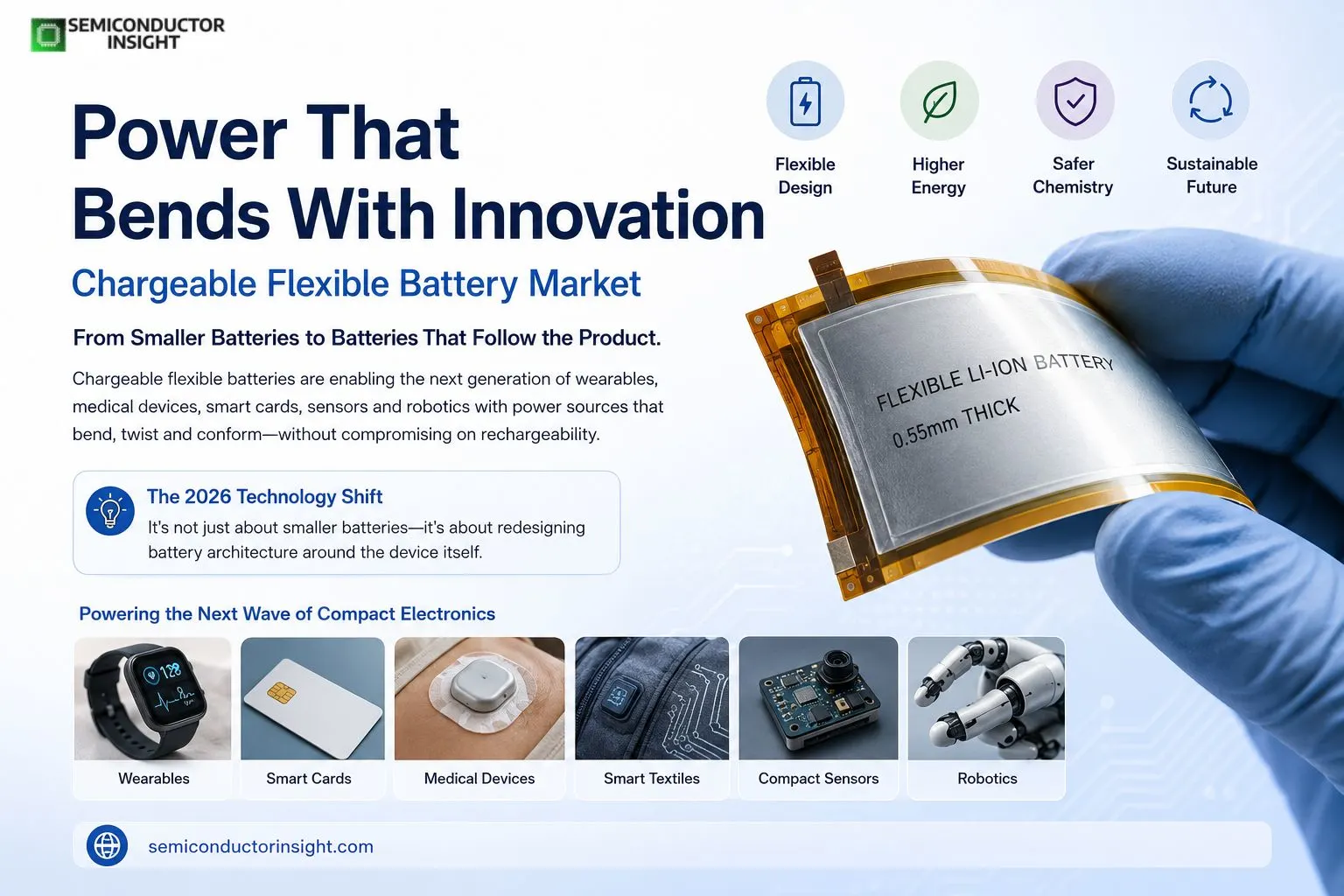
The technology is progressing through several routes, including flexible lithium-ion polymer cells, solid-state architectures, thin-film batteries, silicon-enhanced electrodes and ceramic-based battery systems. Panasonic previously demonstrated a rechargeable flexible lithium-ion battery measuring only 0.55 mm thick, designed to withstand repeated bending and twisting for card devices and wearable applications.
Want to learn more about the report? Check out our latest updated version for free: https://semiconductorinsight.com/report/chargeable-flexible-battery-market/
The 2026 Technology Shift Is From Smaller Batteries to Batteries That Follow the Product
The most important change in this space is not simply reducing cell size. It is the redesign of battery architecture around the device itself. A conventional rigid cell can restrict the shape of a wearable, medical patch or smart textile. Flexible battery systems aim to remove that constraint by allowing the power source to occupy curved or distributed spaces.
This is particularly relevant to semiconductor-linked applications. Advanced sensors, microcontrollers, wireless chips and edge-computing components are becoming smaller, but the battery often remains one of the least flexible components in the system. As a result, battery geometry is increasingly becoming part of the electronics design equation.
- Samsung SDI Is Connecting High-Density Battery Research With Next-Generation Electronics
Samsung SDI brings large-scale battery engineering capabilities into a market that increasingly requires thinner and more advanced cell formats. Its research direction includes high-energy-density chemistries and solid-state battery development, with the company targeting mass production of all-solid-state batteries in the second half of 2027 according to recent industry reporting. The relevance to flexible and compact electronics lies in the potential for safer, higher-density cells that can support applications where available space is severely limited.
- ProLogium Is Turning Ceramic Battery Architecture Into a Scale-Up Strategy
ProLogium stands out for its lithium-ceramic solid-state battery platform. The company says it has more than 1,000 global patents granted and pending and is developing a French manufacturing footprint.
Its current roadmap targets 0.8 GWh in the first phase of its Dunkirk facility, rising to 4 GWh in the second phase, with expansion potential toward 48 GWh over time. The company’s ceramic separator architecture is particularly relevant to next-generation battery designs where safety, density and compact construction are critical.
- Jenax Has Built Its Identity Around Batteries That Move With the Device
Jenax is one of the most directly aligned companies with the flexible battery segment. Its J.Flex rechargeable lithium-ion battery is designed to bend and move with the device and is positioned for smartwatches, smart glasses, headsets, fitness bands, medical devices, smart apparel, footwear and wearable robotics. This application breadth shows how flexible batteries are moving from a niche component concept toward a design platform for multiple connected-device categories.
- Imprint Energy Is Expanding Rechargeable Power Through Zinc-Based Chemistry
Imprint Energy is associated with thin, rechargeable zinc-based battery technology aimed at applications requiring compact and safer power sources. Its technology direction is particularly relevant to connected sensors, wearables and low-power electronics, where the ability to integrate a battery into a thin form factor can be more important than maximizing the energy density of a conventional EV cell.
- LG Chem and LG Energy Solution Represent a Major Route Toward Advanced Cell Manufacturing
The LG battery ecosystem is moving toward broader application coverage, including robotics, ships and urban air mobility. LG Energy Solution has stated that it is supplying cylindrical batteries to six global robotics companies while also developing next-generation products and solid-state technologies. Its 2025 corporate plan also identified pilot-line development for solid-state batteries and commercialization efforts aimed at the end of the decade.
- Panasonic Demonstrated Early Commercial Potential for Flexible Rechargeable Cells
Panasonic remains an important reference point in the development of flexible rechargeable battery formats. Its flexible lithium-ion battery was engineered at 0.55 mm thickness and designed to withstand repeated bending and twisting. The company identified card devices, smart clothing and body-worn electronics as potential application areas. This early development helped demonstrate that rechargeable batteries could be designed around flexible products rather than forcing products to accommodate rigid cells.
Explore the full report details in our recently refreshed edition anytime: https://semiconductorinsight.com/report/chargeable-flexible-battery-market/
- Murata Manufacturing Brings Thin Laminate Packaging Into Compact Electronics
Murata’s laminate-type lithium-ion batteries use gel polymer electrolytes and film-based packaging to reduce the physical restrictions associated with metal-can battery designs. The company highlights the ability to create batteries in customer-specific sizes, while its gel-polymer approach supports thinner construction and improved use of internal device space. This makes the technology relevant to compact electronics and applications where every millimeter of internal volume matters.
- BASF Is Influencing Flexible Battery Development Through Materials Rather Than Finished Cells
BASF’s role is positioned further upstream in the battery ecosystem. Its battery materials division develops cathode active materials, precursor solutions, metals management and recycling technologies.
In 2025, BASF reported mass-produced cathode active materials for semi-solid-state batteries developed with WELION, demonstrating how materials innovation is becoming central to the transition toward advanced battery architectures.
- Enevate Is Pushing Silicon Toward High-Performance Compact Battery Architectures
Enevate’s Gen 5 silicon-cell technology, announced in 2025, is designed for high energy density and rapid charging. The company reports performance exceeding 800 Wh/L, 2,000 cycles to 80% capacity, and 4C fast charging on every cycle. Although its technology is not limited to flexible cells, silicon-based architectures could become important for compact systems where designers need more energy from limited physical space.
- BlueSolutions Is Advancing Solid-State Battery Concepts for Specialized Mobility
BlueSolutions has developed solid-state battery technology for applications where safety and energy storage performance are important. Its work contributes to the wider movement away from conventional liquid-electrolyte architectures and toward solid-state systems that could eventually support new form factors across mobility, robotics and compact electronics.
Why Chargeable Flexible Battery Market Is Becoming a Semiconductor Story?
The growth of edge AI, sensor fusion and connected devices is increasing the number of electronics components that must operate in smaller physical spaces. A sensor package may include a processor, wireless connectivity, memory and power management circuitry, but the battery still determines much of the final product geometry.
This is where chargeable flexible batteries gain strategic importance. Their value is not simply measured in milliamp-hours. It is increasingly measured by how much design freedom they create for the entire electronic system.
The next phase of the market will therefore be shaped by companies that can solve three problems at the same time: flexible form, reliable rechargeability and scalable manufacturing. The companies profiled above are approaching that challenge from different directions, making Chargeable Flexible Battery Market one of the more distinctive technology segments emerging at the intersection of advanced batteries, semiconductor miniaturization and next-generation connected devices.

Comments (0)