Chargeable Flexible Battery Market Insights
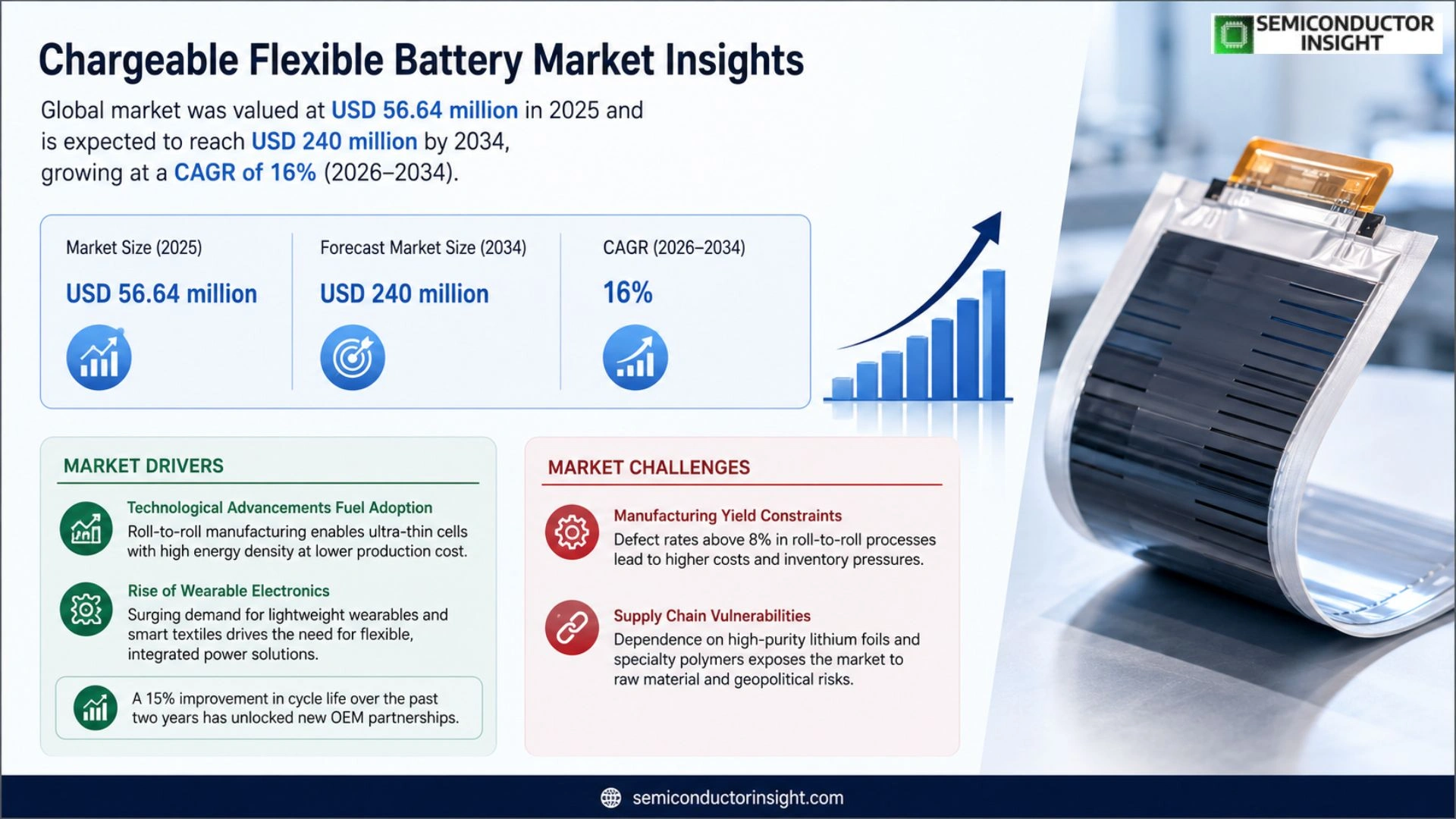
Global Chargeable Flexible Battery market was valued at USD 56.64 million in 2025 and is expected to climb to roughly USD 240 million by 2034, reflecting an annual growth rate of about 16 percent over the period.
Flexible batteries are both primary and secondary cells engineered to be conformal, bendable, and rechargeable, setting them apart from traditional rigid non‑chargeable units. Their emergence aligns with rising interest in portable electronics such as smart cards, wearable devices, novelty packaging, flexible displays and transdermal drug‑delivery patches.
Market expansion stems from three major forces: evolving smart‑card form factors demanding thinner power sources; accelerating adoption of wearables requiring tight mechanical integration; and growing commercialization of high‑reliability medical patches. On the supply side, limited players focus on lithium‑based chemistries prioritizing energy density and zinc‑based solutions emphasizing safety.
MARKET DRIVERS
Technological Advancements Fuel Adoption
Chargeable Flexible Battery Market is gaining momentum as researchers perfect roll‑to‑roll deposition techniques that enable roll‑thin cells with energy densities rivaling rigid counterparts. These processes cut material waste and lower capital expenses, giving manufacturers a clear cost incentive to retool production lines.
Rise of Wearable Electronics
Consumer demand for ultra‑light fitness trackers, smart textiles, and AR headsets is reshaping product roadmaps. Flexible power packs allow designers to embed energy sources directly into fabric or curved casings, eliminating bulk and extending usage time,a value proposition that resonates with premium brands.
➤ Analysts note that a 15% improvement in cycle life over the past two years has unlocked new OEM partnerships, accelerating market entry for niche players.
Beyond consumer gadgets, logistics firms are experimenting with flexible batteries to power sensor‑laden packaging. The ability to conform to irregular surfaces reduces installation labor and opens a revenue stream for battery suppliers willing to certify their products for harsh shipping environments.
MARKET CHALLENGES
Manufacturing Yield Constraints
Current roll‑to‑roll processes still suffer from defect rates that exceed 8%, eroding profit margins for early‑stage producers. Yield variability forces firms to maintain larger safety inventories, which contradicts the lean‑inventory strategies prized by electronics OEMs.
Other Challenges
Supply Chain Vulnerabilities
The reliance on high‑purity lithium‑metal foils and specialty polymers makes the supply chain susceptible to geopolitical shifts. Any disruption in raw‑material flow translates directly into production bottlenecks, pressuring pricing and delivery commitments.
MARKET RESTRAINTS
Regulatory Certification Barriers
Security agencies worldwide impose stringent testing for rechargeable modules that can be integrated into clothing or medical devices. Certification timelines often exceed 12 months, deterring startups that lack deep compliance resources.
In addition, differing safety standards across regions (e.g., UL 2054 in North America versus IEC 62133 in Europe) compel manufacturers to maintain multiple product variants, inflating bill‑of‑materials costs and slowing time‑to‑market.
The cumulative effect is a higher entry threshold, limiting the pool of players able to scale beyond pilot projects and reinforcing the dominance of a few well‑capitalized incumbents.
MARKET OPPORTUNITIES
Emerging Applications in Medical Devices
Flexible, rechargeable cells are uniquely suited for implantable monitors and stretchable diagnostic patches. Their ability to conform to soft tissue reduces patient discomfort and enables continuous data collection, a capability that traditional rigid batteries cannot provide.
Healthcare providers are allocating discretionary budgets toward next‑generation wearables that monitor vitals in real‑time. Companies that can certify biocompatibility while meeting rigorous cycle‑life expectations stand to capture a sizable share of this niche yet fast‑growing segment.
Strategic partnerships with medical‑device OEMs, combined with targeted regulatory expertise, could accelerate commercialization pathways and generate recurring revenue streams for firms positioned early in Chargeable Flexible Battery Market.
Chargeable Flexible Battery Market Trends
Wearable Integration Elevates Power‑Form Factor Requirements
The surge in wearable electronics has forced designers to reconsider power architecture. Because a flexible battery can conform to a curved surface, it removes the thickness and rigidity constraints that traditionally dictated device silhouettes. This shift enables manufacturers to embed power sources directly into fabrics or skin‑compatible patches, which in turn shortens product development cycles and opens new revenue streams for brands that once relied on rigid cell form factors. The underlying driver is not merely novelty; it is the need for continuous operation in devices that must stay attached to the body for extended periods while preserving user comfort. Consequently, suppliers that can guarantee stable output under repeated bending are seeing amplified interest from consumer‑grade manufacturers and niche medical device firms alike.
Other Trends
Supply‑Side Constraints and Material Innovation
On the production front, the industry remains concentrated among a limited set of vendors, each grappling with the dual challenge of maintaining yield while pushing the envelope on ultra‑thin packaging. Lithium‑based chemistries dominate applications that demand higher energy density, yet they impose tighter tolerances on electrode integrity and electrolyte sealing. Zinc‑based alternatives, prized for safety and easier roll‑to‑roll processing, are gaining traction in low‑power smart‑card and IoT label segments. Companies that have invested in stress‑engineered substrates and scalable coating techniques are beginning to differentiate themselves, securing long‑term contracts that hinge on documented bending‑cycle data rather than raw capacity alone.
Cost Evolution and Margin Outlook
Cost structures are still heavily weighted toward specialized films, current collectors, and protective layers; these inputs drive the baseline price of each unit. However, as design standardization improves and volume ramps in high‑adoption use cases,particularly wearable health monitors,average unit costs are trending downward. Margin resilience is further supported by the premium that end‑users are willing to pay for batteries with proven reliability in safety‑critical environments such as transdermal drug‑delivery patches. The strategic implication for market participants is clear: mastering consistent mass‑production while reducing defect rates can translate into a sustainable competitive edge and higher profitability.
COMPETITIVE LANDSCAPE
Key Industry Players
Chargeable Flexible Battery Market: Competitive Overview
The market is dominated by a handful of firms that have translated flexible‑battery chemistry into volume‑ready production lines. Samsung SDI leverages its massive lithium‑cell platform to deliver thin‑form factor packs for wearables, while ProLogium has built a reputation for high‑energy‑density lithium‑polymer ribbons used in smart‑card applications. Jenax, a pioneer in ultra‑thin zinc‑based cells, commands a niche in low‑power IoT tags where safety and cost are paramount. Imprint Energy’s co‑development model with device OEMs gives it a foothold in medical‑patch solutions that demand rigorous cycle‑life testing. Across the supply chain, these leaders differentiate themselves through robust yield management, extensive reliability data libraries, and the ability to certify products against stringent aerospace and medical standards. Their scale and proven track records make them the default suppliers for flagship projects, creating a barrier for new entrants that lack validated manufacturing footprints.
Beyond the primary quartet, a second tier of specialized manufacturers adds depth to the competitive set. LG Chem and Panasonic have introduced flexible lithium‑polymer variants aimed at premium wearable displays, yet their volumes remain modest compared with the leaders. Murata Manufacturing focuses on integrating flexible cells with its sensor modules, positioning itself as a one‑stop solution for edge‑computing devices. Companies such as BASF and Enevate are experimenting with novel electrolyte chemistries that promise higher safety margins, while startups like FlexiGen, Vivosys, and BlueSolutions target emerging markets for disposable medical patches and flexible packaging. These niche players often excel in rapid prototyping and custom form‑factor engineering, which can translate into strategic partnerships when large OEMs seek differentiated performance or accelerated time‑to‑market.
List of Key Chargeable Flexible Battery Companies Profiled
- Samsung SDI
- ProLogium
- Jenax
- Imprint Energy
- LG Chem
- Panasonic
- Murata Manufacturing
- BASF
- Enevate
- FlexiGen
- Vivosys
- BlueSolutions
- PowerSparks
- C&K Advanced Battery
Segment Analysis:
| Segment Category | Sub-Segments | Key Insights |
| By Type |
|
Flexible Lithium‑based Battery drives market momentum because it offers higher energy density and longer cycle life, meeting the stringent demands of wearables and premium smart‑card applications. Key qualitative drivers include:
|
| By Application |
|
Wearable Devices emerge as the leading application segment due to relentless demand for integrated power solutions that conform to the human body. Qualitative insights include:
|
| By End User |
|
Consumer Electronics lead due to the rapid adoption of flexible form factors that enable new user experiences. Core qualitative drivers are:
|
| By Chemistry |
|
Lithium‑ion flexible cells dominate because they balance energy density with mechanical resilience, satisfying both high‑performance wearables and premium smart‑card use cases. Qualitative advantages:
|
| By Market Driver |
|
Form‑factor Innovation is the primary catalyst, pushing manufacturers to pursue ever‑thinner, bendable solutions that integrate seamlessly into devices. Qualitative observations:
|
Regional Analysis: Chargeable Flexible Battery Market
Asia‑Pacific
Concentrated plant upgrades in South Korea and Taiwan focus on roll‑to‑roll electrode processes, enabling higher throughput while preserving the mechanical pliability essential for flexible formats.
Wearable fitness devices with foldable screens have sparked a surge in trial purchases, prompting brands to embed flexible cells as a differentiator rather than a novelty.
Harmonized safety standards across ASEAN are easing certification timelines, allowing firms to commercialise prototypes across multiple markets without redundant testing.
Vertical integration of polymer electrolyte production mitigates raw‑material volatility, ensuring a steadier flow of components to assembly lines during peak launch windows.
North America
In North America, Chargeable Flexible Battery Market is shaped by a strong emphasis on premium consumer electronics and a thriving venture‑capital ecosystem that funds flexible‑battery start‑ups. Companies are leveraging the region’s robust IP framework to secure patents on novel polymer blends, which serves as a competitive moat. However, the market’s expansion pace is moderated by stricter environmental compliance requirements that compel manufacturers to adopt greener production methods, thereby adding cost pressure. OEMs are therefore forging joint‑development agreements with academic labs to share the burden of material research while simultaneously accessing cutting‑edge findings.
Europe
European actors prioritize sustainability and circular‑economy principles, prompting a shift toward recyclable flexible battery architectures. Policymakers in the EU are crafting directives that tie public funding to demonstrable reductions in hazardous waste, nudging firms to design cells that can be disassembled and reclaimed. This regulatory tilt is fostering collaborations between battery producers and textile manufacturers, especially for smart‑fabric applications in sportswear and health monitoring. While the market remains niche compared with Asia‑Pacific, Europe’s focus on high‑value, low‑volume segments creates opportunities for specialty players willing to align with strict eco‑standards.
South America
South America’s market narrative centers on burgeoning mobile‑payment ecosystems that require durable, thin power sources for point‑of‑sale terminals. Local manufacturers are experimenting with low‑temperature curing processes to adapt flexible batteries to the region’s climatic variability. Yet limited access to advanced material suppliers hampers large‑scale adoption, steering firms toward partnerships with Asian producers that can supply ready‑made cells. The resulting import‑driven model is gradually maturing as regional distributors develop expertise in handling delicate flexible formats.
Middle East & Africa
In the Middle East & Africa, the demand for flexible energy storage is driven primarily by emerging smart‑city initiatives and solar‑powered wearables designed for harsh outdoor conditions. Companies are testing encapsulation techniques that protect pliable cells from sand abrasion and high temperatures. Although the market size is modest, strategic pilots funded by sovereign wealth funds spotlight the region’s willingness to be an early testbed for resilient flexible battery solutions, potentially establishing it as a showcase hub for climate‑tolerant energy technologies.
Report Scope
This market research report provides a comprehensive analysis of the Chargeable Flexible Battery Market , covering the forecast period 2026–2034. It offers detailed insights into market dynamics, technological advancements, competitive landscape, and key trends shaping the industry.
Key focus areas of the report include:
- Market Overview: The report begins with an overview outlining its current market scenario, key growth indicators, and industry transformation drivers. It discusses macroeconomic factors, demand–supply balance, regulatory landscape, and the strategic role of semiconductors in powering advancements across industries such as automotive, telecommunications, consumer electronics, and industrial automation.
- Market Size & Forecast: Historical data and future projections for revenue, unit shipments, and market value across major regions and segments.
- Segmentation Analysis: Detailed breakdown by product type, technology, application, and end-user industry to identify high-growth segments and investment opportunities.
- Regional Insights: Insights into market performance across North America, Europe, Asia-Pacific, Latin America, and the Middle East & Africa, including country-level analysis where relevant.
- Competitive Landscape: Profiles of leading market participants, including their product offerings, R&D focus, manufacturing capacity, pricing strategies, and recent developments such as mergers, acquisitions, and partnerships.
- Technology Trends & Innovation: Assessment of emerging technologies, integration of AI/IoT, semiconductor design trends, fabrication techniques, and evolving industry standards.
- Market Drivers & Restraints: Evaluation of factors driving market growth along with challenges, supply chain constraints, regulatory issues, and market-entry barriers.
- Stakeholder Insights: Insights for component suppliers, OEMs, system integrators, investors, and policymakers regarding the evolving ecosystem and strategic opportunities.
Primary and secondary research methods are employed, including interviews with industry experts, data from verified sources, and real-time market intelligence to ensure the accuracy and reliability of the insights presented.
FREQUENTLY ASKED QUESTIONS:
What is the current market size of Chargeable Flexible Battery Market?
-> Chargeable Flexible Battery Market was valued at USD 56.64 million in 2025 and is expected to reach USD 177 million by 2034, growing at a CAGR of 16.4%
Which key companies operate in Chargeable Flexible Battery Market?
-> Key players include Jenax, Samsung SDI, ProLogium, Imprint Energy (CCL Design), among others.
What are the key growth drivers?
-> Key growth drivers include increasing demand for thin, conformal power sources in smart cards, rapid adoption of wearable devices, and expansion of high‑reliability medical patch applications.
Which region dominates the market?
-> Asia‑Pacific leads the market, driven by strong adoption in consumer electronics, wearables, and emerging medical‑grade flexible battery deployments.
What are the emerging trends?
-> Emerging trends include advancements in flexible lithium‑based and zinc‑based chemistries, ultra‑thin packaging films, and greater emphasis on safety and bending‑durability for next‑generation wearable and medical applications.

Get Sample Report PDF for Exclusive Insights
Report Sample Includes
- Table of Contents
- List of Tables & Figures
- Charts, Research Methodology, and more...
 Download Sample Report PDF