
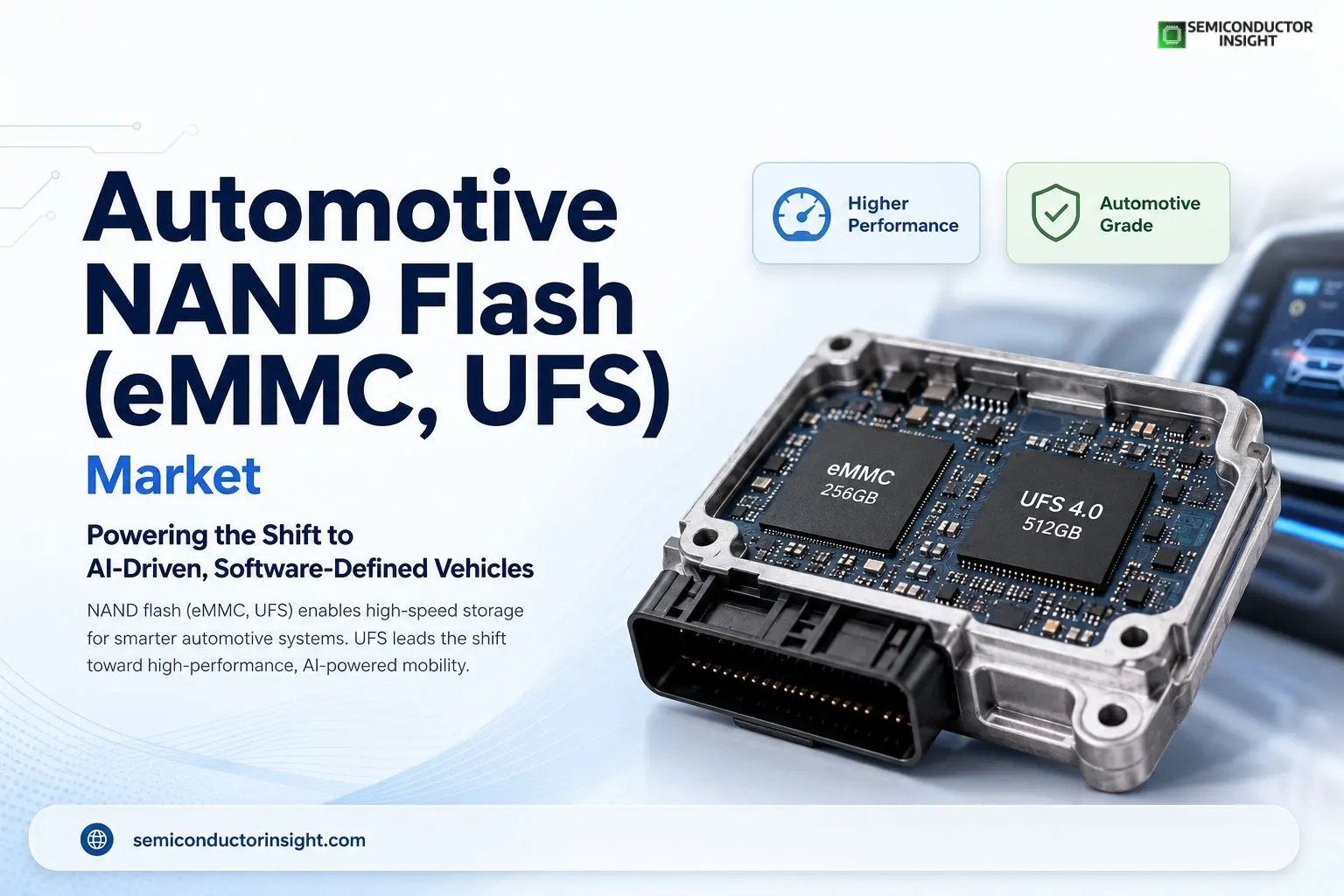
The Rapid Evolution of the Automotive NAND Flash (eMMC, UFS) Market in Connected Mobility
Automotive NAND Flash (eMMC, UFS) Market refers to the global industry focused on the development, production, and integration of NAND flash-based embedded storage solutions used in vehicles for data storage, processing, and system performance enhancement.
The automotive semiconductor ecosystem is undergoing a major architectural transition as vehicles become increasingly software-defined, data-intensive, and AI-enabled. One of the most important yet less visible technologies enabling this transformation is automotive NAND flash memory, particularly embedded MultiMediaCard (eMMC) and Universal Flash Storage (UFS) solutions.
Traditional automotive electronic control units were never designed to manage the enormous data bandwidth required by modern mobility systems. As autonomous functions and AI-powered infotainment evolve, automotive OEMs are rapidly shifting toward faster and more reliable NAND flash architectures. UFS is emerging as the preferred next-generation storage interface because it enables higher throughput, lower latency, improved multitasking, and faster boot performance compared to legacy eMMC solutions.
Premium Vehicle Electronics Shift toward Faster Embedded Storage
- Automotive platforms increasingly require instant data access for navigation rendering, real-time sensor fusion, AI-assisted driving decisions, and cloud-connected vehicle services.
- While eMMC remains widely used in entry-level and mid-range automotive electronics due to cost efficiency and mature integration, UFS technology is gaining momentum because of its full-duplex architecture and significantly faster sequential read/write speeds.
- Recent automotive UFS 4.0 and 4.1 developments demonstrate how semiconductor suppliers are targeting intelligent vehicle workloads.
- KIOXIA introduced automotive-grade UFS products capable of supporting advanced infotainment systems, domain controllers, and ADAS applications while operating within automotive-grade thermal requirements from -40°C to +105°C.
- The company also highlighted faster interface speeds reaching up to 46.4Gbps for modern automotive storage environments.
- The migration from eMMC to UFS is not simply a performance upgrade. It reflects the broader semiconductor industry trend toward centralized vehicle computing architectures.
- It is anticipated that future cars will incorporate fewer but much more potent domain controllers, which will raise the need for high-bandwidth embedded storage.
AI Vehicles Are Creating Massive NAND Storage Demand
The rise of AI-powered mobility platforms is dramatically increasing NAND flash consumption across automotive electronics. Vehicles equipped with Level 2+ and Level 3 autonomous capabilities continuously generate terabytes of sensor data from radar, LiDAR, cameras, and onboard AI processors. These workloads require reliable local storage capable of supporting fast write cycles and real-time processing.
At the same time, software-defined vehicles are increasing the importance of persistent memory. Automakers now deploy continuous firmware upgrades, cybersecurity patches, and feature-on-demand software packages through over-the-air updates. NAND flash memory acts as the foundational layer enabling these software ecosystems.
Industry developments in 2026 also indicate tightening NAND supply conditions as AI infrastructure competes for flash memory production capacity. Semiconductor manufacturers are prioritizing advanced 3D NAND technologies while phasing out older planar NAND processes. This transition is influencing automotive storage procurement strategies, particularly for long-life automotive qualification cycles.
Want to learn more about the report? Check out our latest updated version for free: https://semiconductorinsight.com/report/automotive-nand-flash-emmc-ufs-market/
Key differentiators: eMMC vs. UFS
- eMMC and UFS differ significantly in performance, architecture, and suitability for modern automotive applications. eMMC 5.1 uses a parallel, half-duplex interface with a maximum capacity of up to 256 GB, while UFS 3.1/4.0 adopts a serial, full-duplex design that supports capacities of up to 1 TB. UFS also offers a command queue for handling multiple instructions at once, whereas eMMC does not.
- In terms of signal design, eMMC relies on single-ended communication, making it harder to pass CISPR 25 EMC requirements, while UFS uses differential signalling, which improves noise handling and makes compliance easier.
- UFS further supports advanced power modes such as deep sleep and throttle alerts, making it better suited for new OEM designs, especially in ADAS and other next-generation automotive systems.
3D NAND and QLC Technologies Enter Automotive Discussions
Another significant development shaping the semiconductor landscape is the adoption of advanced 3D NAND architectures and QLC (quad-level cell) technologies. Higher layer-count NAND improves storage density while reducing cost-per-bit, making it attractive for data-heavy automotive applications such as high-definition mapping and AI data logging.
Recent announcements from semiconductor manufacturers show growing confidence in QLC-enabled UFS solutions for high-capacity embedded applications. Enhanced controller technologies and stronger error correction systems are helping improve endurance and reliability performance for next-generation NAND architectures.
However, automotive qualification cycles remain conservative. Many OEMs still rely on TLC and MLC-based solutions for mission-critical applications where endurance and long-term reliability are prioritized over storage density.

Comments (0)