
Tesla Expands Silicon Carbide Strategy as the Silicon Carbide (SiC) Power Device Market Evolves
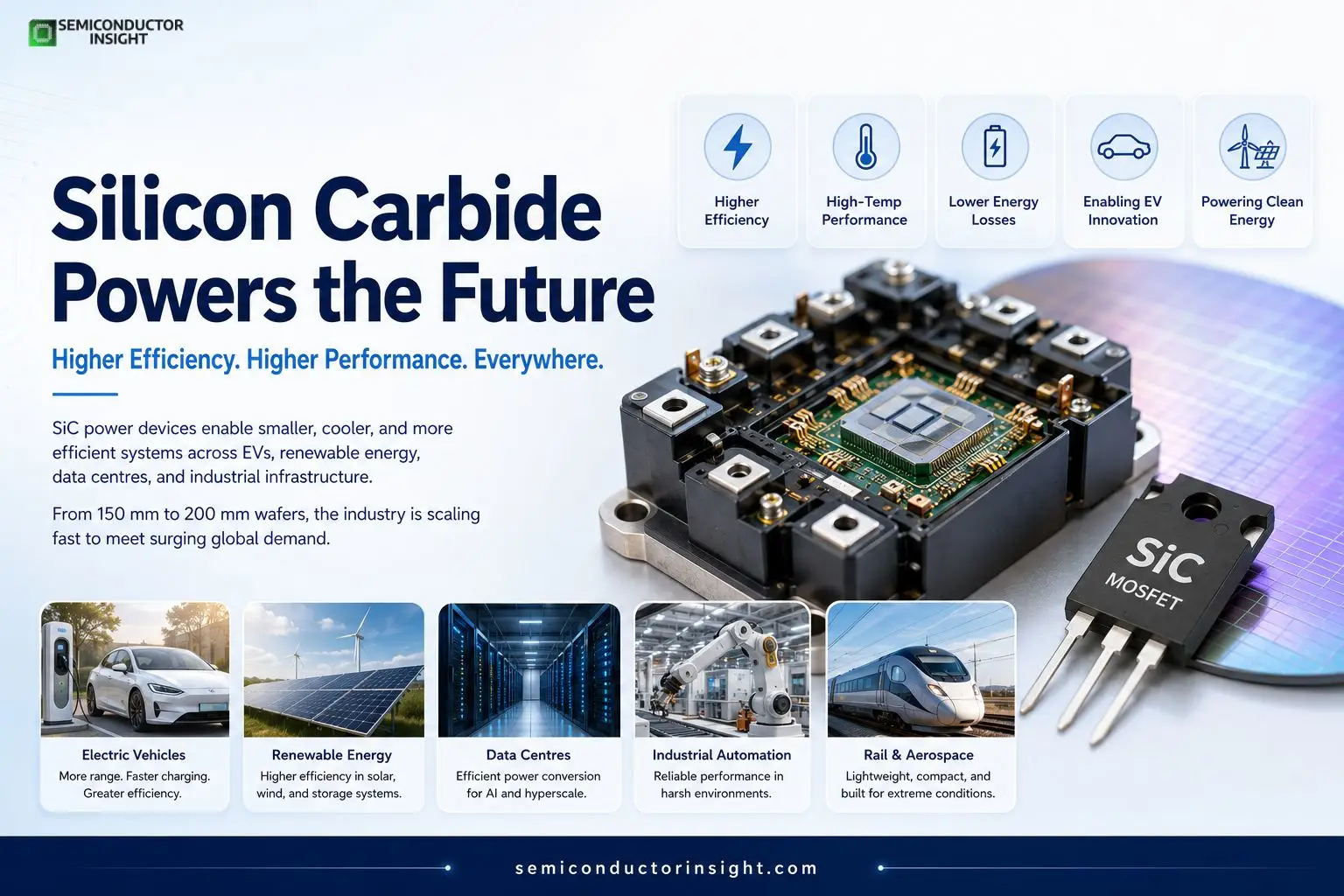
Silicon carbide has moved from being a specialised semiconductor material into one of the most important building blocks of modern power electronics. As industries pursue greater energy efficiency, higher operating temperatures, and compact system designs, SiC power devices are replacing conventional silicon in applications that demand superior electrical performance.
Electric vehicles, renewable energy systems, industrial automation, rail transportation, aerospace, and fast-charging infrastructure increasingly rely on SiC MOSFETs, Schottky diodes, and power modules to minimise energy losses while handling significantly higher voltages. This transition is reshaping semiconductor manufacturing priorities worldwide as investments continue in wafer production, epitaxy, and advanced packaging.
Why Silicon Carbide Changes the Rules of Power Electronics?
Silicon carbide has a broad bandgap of about 3.26 eV, which is over three times wider than silicon, in contrast to normal silicon. This allows devices to switch much more quickly while lowering conduction losses, function at temperatures above 200°C, and tolerate electric fields nearly ten times higher.
These properties allow engineers to design smaller cooling systems, lighter power converters, and more compact inverters without sacrificing reliability. In electric vehicles, this translates into improved driving efficiency, lighter powertrains, and faster DC charging capabilities.
The transition is especially noticeable in systems operating between 650 V and 3,300 V, where efficiency improvements directly affect operating costs and energy consumption.
Does Tesla Use Silicon Carbide?
Yes. Tesla became one of the earliest large-scale adopters of silicon carbide MOSFETs for electric vehicle traction inverters, particularly beginning with the Model 3 platform. By replacing traditional silicon IGBTs with SiC devices, Tesla improved inverter efficiency while reducing energy losses during power conversion.
- Industry technical analyses estimate that a typical Tesla traction inverter contains hundreds of SiC MOSFET dies integrated into power modules that manage propulsion.
- The company has publicly discussed efforts to optimise SiC usage by reducing the amount required per vehicle through improved semiconductor design rather than eliminating the technology altogether.
- Tesla’s engineering strategy reflects a broader industry trend.
- Leading automotive manufacturers including Hyundai, Mercedes-Benz, General Motors, BMW, and several Chinese EV producers continue integrating SiC-based power electronics into premium and long-range vehicle platforms because higher efficiency can contribute additional driving range while supporting ultra-fast charging architectures operating at 800 V and beyond.
Manufacturing Is Moving from 150 mm to 200 mm Wafers
One of the most significant developments across the semiconductor industry is the transition from 150 mm (6-inch) to 200 mm (8-inch) silicon carbide wafers.
Larger wafers enable manufacturers to produce substantially more chips from a single substrate while improving manufacturing efficiency and lowering production costs over time. Multiple semiconductor companies have announced new 200 mm fabrication facilities during the past two years, recognising that future electric vehicle demand requires much larger production volumes.
This shift also encourages equipment manufacturers to redesign crystal growth, wafer polishing, inspection, and epitaxy technologies specifically for larger substrates.
Renewable Energy Is Becoming an Unexpected Growth Engine
Although electric vehicles receive most of the attention, renewable energy is rapidly becoming another major application for SiC power devices.
Modern solar inverters, wind power converters, battery energy storage systems, and utility-scale power converters benefit from higher switching frequencies and lower thermal losses.
For example, utility-scale photovoltaic installations commonly operate with 1,500 V DC architectures, making silicon carbide particularly attractive for improving inverter efficiency while reducing transformer size and cooling requirements.
As countries continue expanding renewable electricity generation and grid modernisation programmes, power semiconductor demand increasingly extends beyond automotive manufacturing.
Data Centres are creating a new wave of SiC Adoption
- Artificial intelligence infrastructure has significantly increased electricity consumption inside modern data centres.
- Operators are investing in high-efficiency power supplies, UPS systems, and power distribution units capable of reducing electrical losses while supporting increasingly power-hungry AI accelerators.
- Silicon carbide devices allow power conversion systems to achieve higher efficiency levels while generating less heat, helping operators reduce cooling requirements across hyperscale facilities housing tens of thousands of servers.
- With global AI infrastructure continuing to expand, semiconductor manufacturers are viewing data centres as one of the fastest-growing opportunities beyond transportation.
At Last, before Ending, Don’t Forget to Browse Our Recent Exclusive Report for Detailed Insights: https://semiconductorinsight.com/report/silicon-carbide-sic-power-device-market-2/
Research Laboratories Continue Expanding Device Performance
Universities, national laboratories, and semiconductor research institutes continue pushing silicon carbide technology beyond today’s commercial limits.
- Current research includes defect reduction in bulk crystal growth, improved gate oxide reliability, trench MOSFET optimisation, advanced edge termination structures, and hybrid module integration combining SiC with gallium nitride technologies.
- Several government-supported semiconductor programmes in the United States, Europe, Japan, and South Korea are also funding next-generation wide-bandgap research aimed at strengthening domestic semiconductor supply chains while improving manufacturing yields.
Rather than simply replacing silicon, silicon carbide is enabling entirely new system architectures where efficiency, thermal performance, and compact design become equally important engineering objectives.

Comments (0)