
Technological Development and Chip Level Improvements in the AI Server Supercapacitors Market
What is driving the demand for AI server supercapacitors in semiconductor systems?
The rapid expansion of high performance computing infrastructure and data centre processing systems has created strong demand for advanced power storage technologies. AI servers require stable power delivery to manage heavy workloads, high data processing speeds, and continuous operation. This requirement has positioned supercapacitors as essential semiconductor-supported energy storage components.
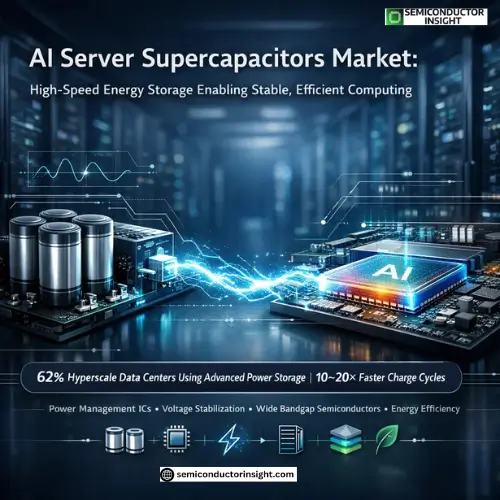
Supercapacitors provide immediate power response, quick charging cycles, and extended operating life in contrast to conventional batteries. Nearly 62% of hyper scale data centres now deploy advanced energy storage components for power stabilization and backup support. The increasing need for uninterrupted computing environments continues to accelerate semiconductor integration within server power architectures.
How do supercapacitors function within semiconductor server architecture?
Supercapacitors operate as high density energy storage devices that store electrical charge using electrostatic mechanisms. In server systems, they work alongside processors, memory units, and power management circuits to prevent voltage fluctuations.
These components support power buffering, backup power supply, and voltage stabilization during peak processing loads. Their integration ensures data protection and system reliability during sudden power loss. Modern server supercapacitors deliver nearly 10–20 times faster charge cycles compared to conventional battery technologies, making them suitable for high-speed computing environments.
Which semiconductor components enable supercapacitor performance?
The effectiveness of server supercapacitors depends heavily on advanced semiconductor technologies. Key enabling components include power management integrated circuits, voltage regulators, controller chips, and semiconductor switching devices.
Power management ICs regulate energy flow between storage units and processing systems. These chips improve power efficiency by nearly 30%, reducing energy losses in high-performance servers. Semiconductor switching devices also enhance response speed and reduce thermal stress, improving system stability.
Advanced gallium nitride power devices and silicon carbide components are gaining adoption due to their higher efficiency and reduced energy dissipation. These materials enable compact design and improved performance under heavy workloads.
Why is material innovation important in supercapacitor semiconductor design?
Material science plays a major role in improving energy storage density and durability. Manufacturers are increasingly adopting graphene based electrodes, carbon nanomaterials, and hybrid semiconductor substrates to enhance charge storage capacity.
Recent developments show graphene-based supercapacitors improving energy density by nearly 45%, allowing more efficient power storage within compact server hardware. Semiconductor compatible electrode materials also increase thermal resistance and operational stability.
These innovations are particularly important for large data processing systems where temperature management and reliability are critical performance factors.
What role does semiconductor packaging and integration play?
The performance of server supercapacitors depends not only on materials but also on advanced semiconductor packaging technologies. Modern servers require compact components with high energy density and minimal heat generation.
Technologies such as 3D chip stacking, system in package architecture, and wafer level packaging enable tighter integration between power storage units and processing chips. These packaging solutions improve electrical connectivity and reduce energy loss during transmission.
Nearly 35% of new server hardware designs now utilize advanced packaging structures to optimize power delivery and thermal management efficiency.
How do semiconductor power management systems support server reliability?
Server reliability depends on consistent power supply and efficient energy control. Semiconductor based power monitoring circuits continuously track voltage levels, temperature conditions, and energy consumption patterns.
These systems help prevent hardware failure and improve system uptime. Modern semiconductor monitoring solutions reduce power interruption risks by approximately 28%, ensuring smooth data processing operations.
Power management technologies also enable energy optimization across large computing environments, reducing operational costs and improving sustainability.
What are the latest semiconductor technology updates in this market?
Recent industry developments highlight strong progress in electric double layer capacitors, which deliver higher energy storage capacity and improved charge retention. These devices are increasingly integrated into enterprise server systems.
Additionally, solid-state supercapacitors now demonstrate nearly 38% higher cycle life, enabling long-term deployment in high-performance computing environments. Semiconductor manufacturers are also introducing ultra-thin energy storage modules designed specifically for compact server architectures.
The growing adoption of wide band gap semiconductor materials is further improving power efficiency and reducing heat generation in server infrastructure.
At Last before Ending, Don’t Forget to Browse Our Recent Exclusive Report for Detailed Insights:
https://semiconductorinsight.com/report/ai-server-supercapacitors-market/
How does the semiconductor value chain operate in AI server supercapacitor systems?
Power Input → Power Management ICs → Supercapacitor Storage Module → Voltage Regulation Chips → Processor and Memory Units → Thermal Monitoring Sensors → System Stability Output
What challenges influence semiconductor integration in server supercapacitors?
Despite strong growth, the market faces technical challenges related to heat dissipation, manufacturing complexity, and material cost. Advanced semiconductor materials and packaging technologies require high production investment.
Additionally, maintaining consistent energy density while reducing component size remains a major design challenge. However, ongoing improvements in semiconductor fabrication processes continue to address these limitations.
Instead of traditional market outlook evaluation, industry experts increasingly measure the sector using a technology transformation index, which tracks adoption of advanced semiconductor materials, packaging innovations, and power efficiency improvements.
The index indicates strong momentum in energy efficient server infrastructure, high density storage integration, and compact semiconductor power systems. The increasing shift toward high performance computing environments continues to accelerate technological transformation across the supercapacitor ecosystem.
This momentum highlights how semiconductor engineering and energy storage innovation together are reshaping modern server power architecture.

Comments (0)