
The Strategic Rise of Thermoelectric Cooling Chip Market in Advanced Electronics
In an era where electronic devices are becoming smaller, faster, and more powerful, managing heat has quietly become one of the biggest engineering challenges. Thermoelectric cooling chips, often based on the Peltier effect, are emerging as a precise and compact solution to this problem. These solid-state devices use electric current to transfer heat, providing vibration-free and highly regulated temperature regulation, in contrast to conventional cooling systems that depend on fans or refrigerants.
From medical imaging systems to laser equipment and high-performance processors, thermoelectric cooling chips are increasingly being integrated where thermal stability is critical. Their ability to provide localized cooling without moving parts makes them particularly valuable in sensitive and miniaturized electronic environments.
Heat Density Is Rising Faster Than Cooling Capabilities
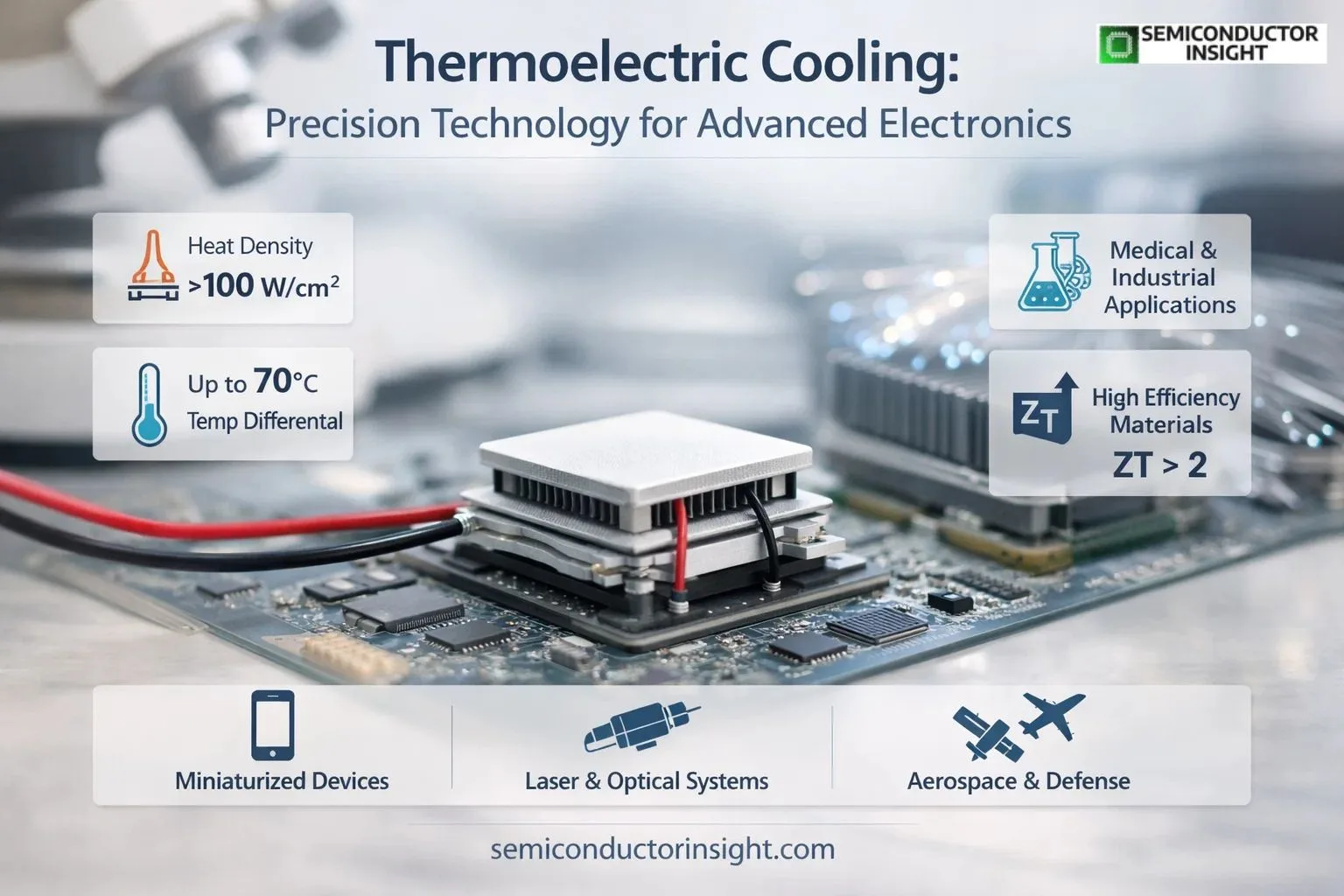
Modern semiconductor devices are pushing the limits of performance, and with that comes a sharp rise in heat generation. Advanced processors used in AI workloads and data centres can operate at power densities exceeding 100 W/cm², creating hotspots that traditional air cooling struggles to manage efficiently.
Thermoelectric cooling chips are stepping in to bridge this gap. These chips can achieve temperature differentials of up to 70°C between their hot and cold sides, making them suitable for precision cooling in compact spaces. In laser diodes and optical communication systems, even a slight temperature fluctuation can impact performance a challenge these chips are specifically designed to address.
Material Innovation Driving Performance Gains
At the core of thermoelectric cooling technology lies material science. Most commercial thermoelectric chips are built using bismuth telluride-based compounds, known for their high thermoelectric efficiency at room temperature. However, ongoing research is exploring advanced materials such as skutterudites and nanostructured semiconductors to improve energy efficiency and cooling capacity.
The efficiency of these chips is measured by a dimensionless figure known as ZT (figure of merit). While traditional materials operate with ZT values around 1, experimental materials have demonstrated values above 2, signalling significant potential for future performance improvements. This evolution is crucial as industries demand more energy-efficient cooling solutions.
Advancing Adoption in High Accuracy Industrial Markets
Thermoelectric cooling chips are no longer limited to niche applications. Their adoption is expanding across multiple industries:
- In healthcare, they are used in portable diagnostic devices and DNA amplification systems where temperature accuracy is critical
- In consumer electronics, they are being explored for cooling high-end smartphones and wearable devices
- In automotive electronics, they support battery thermal management and sensor stability
- In aerospace and defence, they ensure reliability in extreme environmental conditions
One notable instance is their use in infrared sensors and night-vision systems, where maintaining a stable temperature directly impacts image clarity and system performance.
Trade Movements and Supply Chain Shifts
The global trade of thermoelectric components reflects growing demand from electronics manufacturing hubs. Countries such as China, Japan, South Korea, and Germany dominate production and exports due to their strong semiconductor ecosystems.
Export data indicates that Asia-Pacific accounts for over 60% of global thermoelectric module shipments, with China leading in volume manufacturing. On the import side, the United States and European nations remain key consumers, driven by demand in medical, defense, and industrial applications.
India is also gradually increasing its footprint, with imports of thermoelectric modules rising alongside the growth of domestic electronics manufacturing and semiconductor initiatives. This shift highlights a broader trend toward regional supply chain diversification.
Precision Cooling Meets Energy Efficiency Demands
- While thermoelectric cooling chips offer unmatched precision, energy efficiency remains a critical consideration. These systems typically consume more power compared to conventional cooling when used for large-scale applications. However, their efficiency in targeted cooling scenarios often outweighs this limitation.
- For instance, in optical communication systems, thermoelectric coolers can stabilize laser wavelengths with minimal energy input compared to system-wide cooling alternatives. This selective efficiency is what makes them indispensable in high-value applications.
- Additionally, advancements in power management and hybrid cooling systems are helping optimize energy usage, making thermoelectric solutions more viable for broader adoption.
Feel Free to Reach Our Most Recent Updates of the Report: https://semiconductorinsight.com/report/thermoelectric-cooling-chip-market/
Integration with Next-Generation Electronics
As electronics continue to evolve, thermoelectric cooling chips are becoming an integral part of system design rather than an afterthought. Chipmakers and system designers are increasingly incorporating these cooling solutions directly into device architectures.
In high-performance computing systems, thermoelectric modules are being paired with liquid cooling to manage extreme thermal loads. Similarly, in compact devices, they are enabling new form factors by eliminating the need for bulky cooling hardware.
This integration trend is particularly important for emerging technologies such as quantum computing and advanced photonics, where even minor thermal variations can disrupt system functionality.
A Technology Moving from Support Role to Strategic Importance
Thermoelectric cooling chips are no longer just supporting components they are becoming strategic enablers of performance, reliability, and innovation. As industries continue to push the boundaries of miniaturization and computational power, the need for precise, compact, and reliable cooling solutions will only intensify.
What was once considered a specialized technology is now steadily moving into the mainstream, shaping how modern electronics are designed, built, and operated.

Comments (0)