
Smart Track Lighting Market Systems Transforming Modern Infrastructure and Retail Spaces
Track lighting has quietly transitioned from a purely aesthetic installation to a sophisticated system powered by semiconductor innovation. What once relied on basic halogen bulbs now integrates advanced LED chips, sensors, and control circuits that deliver precision lighting across residential, commercial, and industrial environments. This shift is largely driven by the rapid evolution of semiconductor components, enabling lighting systems to become more adaptive, efficient, and intelligent.
Globally, lighting accounts for nearly 15% of total electricity consumption, according to the International Energy Agency, pushing industries toward smarter solutions like track lighting systems powered by semiconductor-based LEDs.
Track Lighting Installation Made Easy and Efficient
There are two main ways to install track lighting:
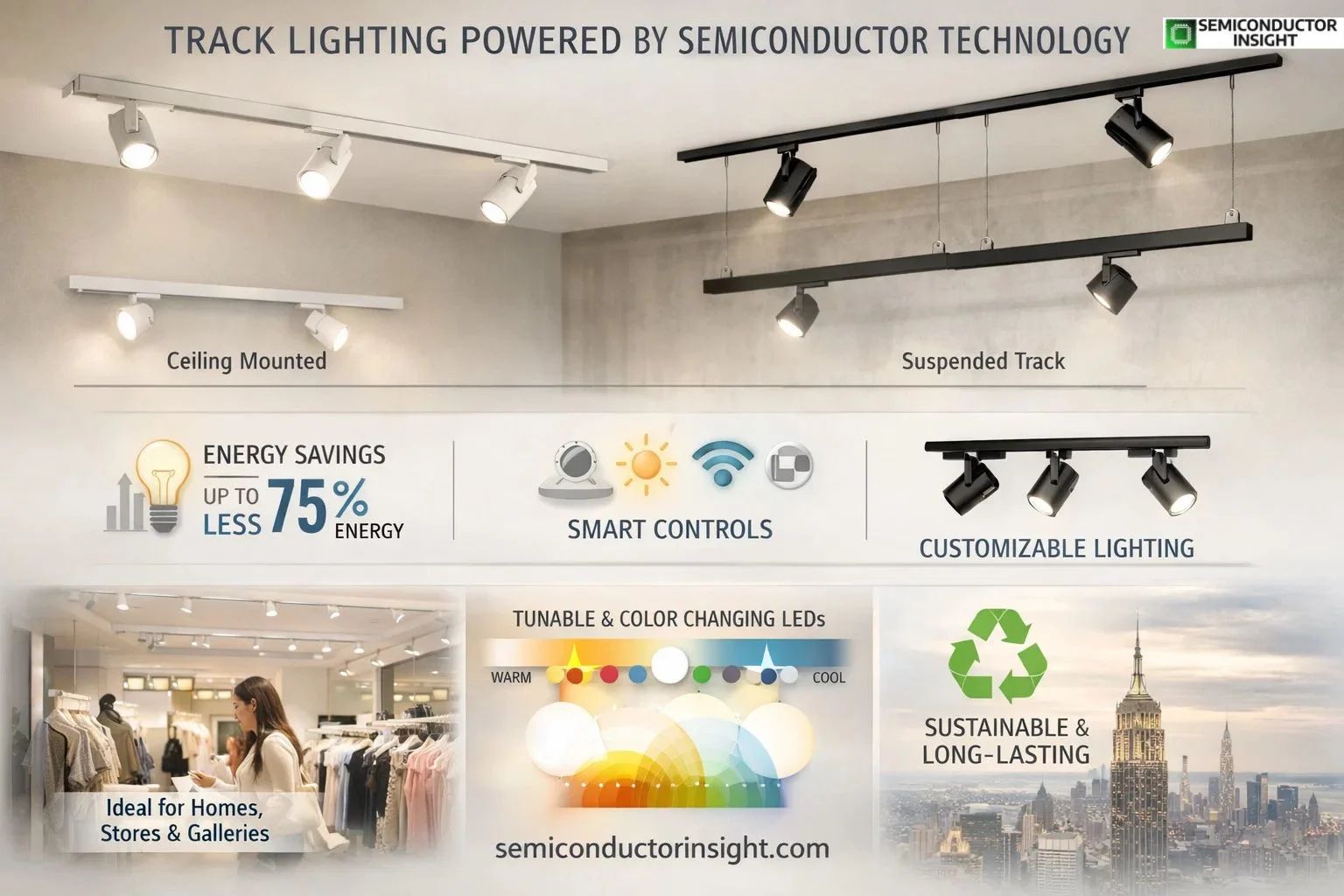
- Ceiling-mounted track lighting: The track is attached to the ceiling itself. It looks nice and performs well in places that don’t have fake ceilings.
- Ceiling track lighting (suspended): The track hangs down a little from rods or wires. This works nicely in places with high ceilings or that have an industrial look.
You can also pick:
- Surface-mounted systems: The track goes right onto the wall or ceiling.
- Systems that dangle down from the ceiling deliver light closer to where it’s needed.
Miniaturized LED Chips Transforming Lighting Design
At the core of modern track lighting lies semiconductor-based LED technology. These LEDs are built using materials such as gallium nitride, which allow for higher brightness with lower power consumption. Compared to traditional incandescent bulbs, LED lighting uses up to 75% less energy and lasts up to 25 times longer, as highlighted by the U.S. Department of Energy.
This efficiency has opened new design possibilities. Track lighting systems today are slimmer, more flexible, and capable of delivering focused illumination in retail displays, art galleries, and smart homes. The miniaturization of semiconductor chips has also enabled multi-directional lighting tracks that can be customized in real time.
Smart Control Systems Enhancing User Experience
The integration of semiconductor sensors and microcontrollers has transformed track lighting into a smart ecosystem. Modern systems now feature motion detection, daylight sensing, and wireless connectivity. These capabilities are powered by embedded chips that process environmental data and adjust lighting accordingly.
For example, in smart buildings, lighting systems can reduce energy usage by up to 30% through automated dimming and occupancy-based controls. Organizations like the Bureau of Energy Efficiency have emphasized the role of smart lighting in reducing national energy demand, especially in commercial infrastructure.
This level of intelligence is particularly valuable in retail environments, where lighting directly influences customer behavior. Studies have shown that well-optimized lighting can increase product visibility and improve sales conversion rates by measurable margins.
Feel Free to Reach Our Most Recent Updates of the Related Report: https://semiconductorinsight.com/report/wireless-smart-lighting-controls-market/
Where to Use Track Lighting?
Track lighting can be used in a lot of places:
- For the full room, use LED Floodlights. For the cooking area, use LED Spotlights.
- Hallways: Light up the way and show off pictures or wall art.
- Living rooms and home offices: The light can help you focus or relax, depending on where it is pointed.
- Shops and galleries: Use wall wash lighting to draw attention to art or items.
- Bedrooms: Use a mix of spotlights and floodlights to provide a warm and useful light.
Advice for Walls and Ceilings:
- Low ceilings: Use ceiling track lighting that is mounted on the surface so the room doesn’t feel too small.
- High ceilings: Use linear pendant lights or smart lights to hang tracks lower and bring light where it needs to go.
- Use wall wash lighting to show off cool colours or designs on fancy walls or textures.
Semiconductor Advancements Driving Precision and Performance
Semiconductors are not just improving efficiency but also enabling precision lighting. Advanced driver circuits ensure stable current flow, reducing flicker and enhancing visual comfort. This is critical in environments such as healthcare facilities and offices, where lighting quality impacts productivity and well-being.
Recent innovations include tunable white lighting and color-changing LEDs, which allow users to adjust color temperature based on time of day or activity. These features rely on integrated circuits that control multiple LED channels simultaneously, offering a seamless lighting experience.
According to Energy Efficiency Services Limited, large-scale LED adoption initiatives have already distributed over 360 million LED bulbs in India, demonstrating the growing reliance on semiconductor-based lighting technologies.
Sustainability through Semiconductor Efficiency
- Sustainability remains a central theme in the evolution of track lighting. Semiconductor-based LEDs significantly reduce carbon emissions by lowering energy consumption.
- The United Nations Environment Programme notes that widespread adoption of energy-efficient lighting could cut global lighting-related emissions by nearly 40%.
- Additionally, modern track lighting systems are designed with recyclable materials and longer lifespans, reducing electronic waste. Semiconductor efficiency ensures that fewer replacements are needed, contributing to a more sustainable lifecycle.
As semiconductor technology continues to evolve, track lighting systems are expected to become even more integrated with digital ecosystems. Future developments may include AI-driven lighting adjustments, enhanced IoT connectivity, and even integration with building management systems.
The convergence of semiconductors and lighting is not just a technological trend but a transformation in how spaces are illuminated and experienced. Track lighting, once a simple fixture, is now a dynamic system that reflects the broader advancements in microelectronics and smart infrastructure.
In this rapidly advancing landscape, the role of semiconductors will remain central, ensuring that lighting systems are not only brighter but also smarter, more efficient, and deeply aligned with the needs of modern environments.

Comments (0)