MARKET INSIGHTS
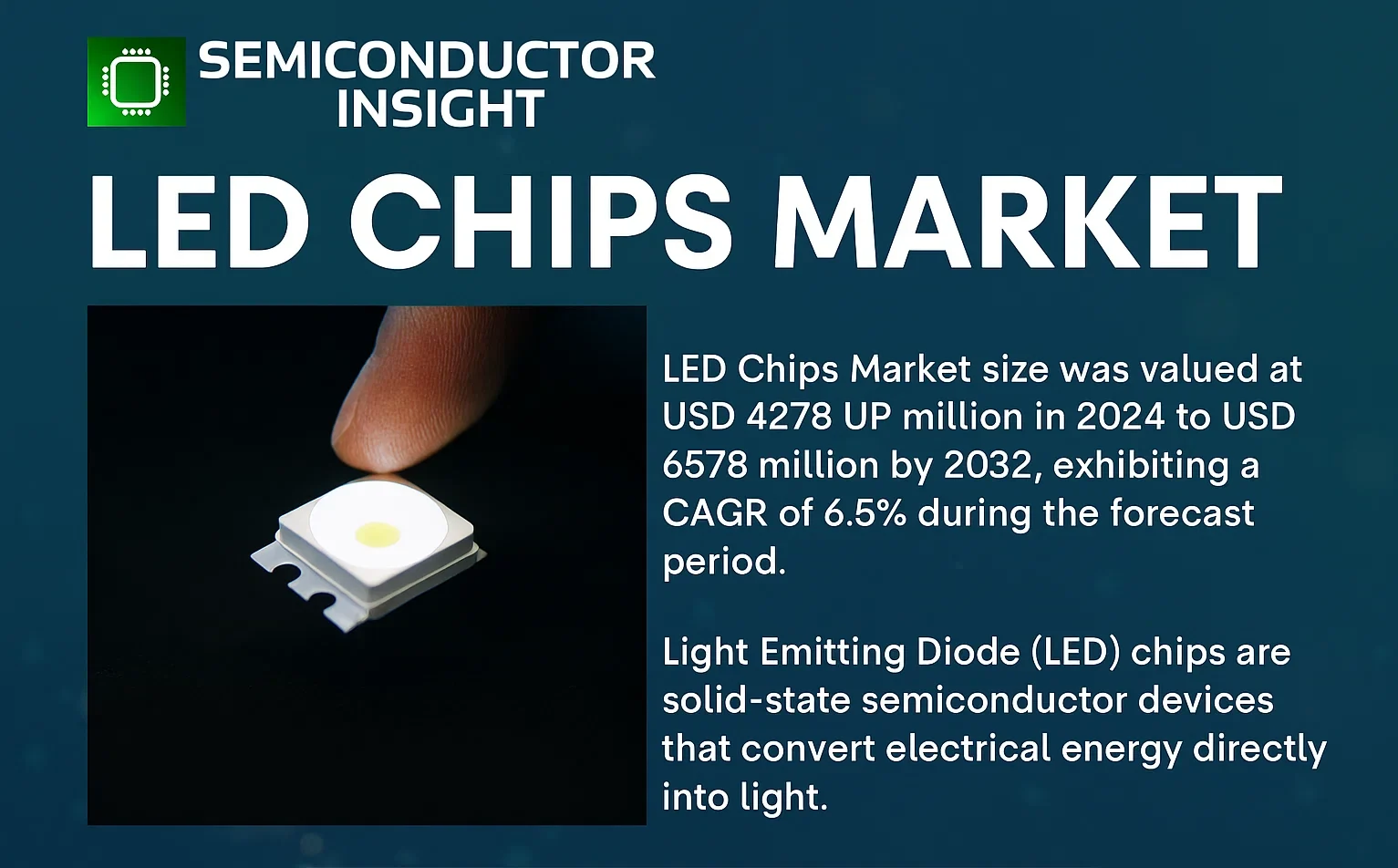
Global LED Chips Market size was valued at USD 4278 million in 2024 to USD 6578 million by 2032, exhibiting a CAGR of 6.5% during the forecast period.
Light Emitting Diode (LED) chips are solid-state semiconductor devices that convert electrical energy directly into light. As the core component of an LED, the chip refers specifically to the fabricated PN junction where electroluminescence occurs. These chips are categorized into types such as Lateral Chip, Vertical Chip, and Flip Chip LEDs.
The market is experiencing steady growth driven by several factors, including the global transition to energy-efficient lighting and rising demand across applications like general lighting, automotive, and displays. China dominates the global landscape as the largest market, holding approximately 24% share. Furthermore, strategic initiatives by key industry players are accelerating adoption. For instance, leading manufacturers like Nichia, Samsung, and Cree continually innovate to enhance luminous efficacy and reduce costs. The top three companies collectively occupy about 28% of the total market share.
MARKET DRIVERS
Rising Demand for Energy-Efficient Lighting Solutions
Global l push for energy conservation and the phasing out of incandescent and fluorescent lighting are primary drivers for the LED chips market. Governments worldwide are implementing stringent regulations and offering subsidies to promote the adoption of LED technology, which consumes up to 80% less energy than traditional lighting. This regulatory environment, combined with growing consumer awareness of energy savings, creates sustained demand for the core semiconductor components LED chips.
Expansion in Display and Backlighting Applications
The proliferation of high-resolution displays in consumer electronics, including smartphones, televisions, and monitors, is a significant driver. The advent of Mini-LED and Micro-LED technologies, which require thousands of tiny, high-performance LED chips for superior contrast and brightness, is pushing innovation and volume production. The market for automotive displays and advanced signage also contributes to this growth.
Furthermore, the integration of LED chips into smart lighting systems and the Internet of Things (IoT) ecosystem is creating new revenue streams. The ability to control color temperature and intensity via smart devices adds value and drives replacement cycles in both consumer and professional markets.
MARKET CHALLENGES
Intense Price Competition and Margin Pressure
The LED chip market is highly competitive, with numerous manufacturers, particularly in the Asia-Pacific region, leading to significant price erosion. While high-volume production has driven down costs, it has also compressed profit margins, making it challenging for companies to reinvest in research and development for next-generation technologies.
Other Challenges
Technical Complexity of Advanced Chips
Manufacturing high-end LED chips, such as those for Micro-LED displays, involves complex processes like mass transfer and defect management. Achieving high yields at a commercially viable cost remains a significant technical hurdle for widespread market penetration.
Supply Chain Vulnerabilities
The market is susceptible to disruptions in the supply of raw materials like gallium nitride (GaN) and sapphire substrates. Geopolitical tensions and trade policies can lead to price volatility and supply shortages, impacting production schedules and market stability.
MARKET RESTRAINTS
Market Saturation in General Lighting Segments
In mature markets, the initial rapid replacement wave for general lighting applications has plateaued. As the penetration rate of LED lighting in regions like North America and Europe approaches saturation, the growth rate for standard LED chips is slowing. This saturation forces manufacturers to compete more aggressively on price and shift focus to niche, high-value segments.
High Initial Investment for Fabrication Facilities
The capital expenditure required for establishing and maintaining state-of-the-art Metalorganic Chemical Vapor Deposition (MOCVD) reactors and cleanroom facilities is substantial. This high barrier to entry limits the ability of new players to enter the market and constrains the expansion capacity of existing manufacturers, thereby restraining overall market growth.
MARKET OPPORTUNITIES
Growth in Automotive Lighting and UV-C LED Applications
The automotive industry’s transition to full LED lighting systems, including adaptive headlights and interior ambient lighting, presents a major growth avenue. Additionally, the demand for UV-C LEDs for disinfection purposes in air, water, and surface purification has surged post-pandemic, creating a new and rapidly expanding market segment for specialized LED chips.
Advancements in Horticulture Lighting and Health & Wellbeing
There is increasing adoption of LED chips in controlled environment agriculture (CEA) for spectrum-specific plant growth. Furthermore, the emerging field of human-centric lighting, which uses tunable LEDs to support circadian rhythms and improve wellbeing in indoor spaces, represents a significant opportunity for innovative chip manufacturers to differentiate their products.
LED Chips Market Trends
Sustained Market Growth Fueled by Energy Efficiency Demands
Global l LED Chips Market continues on a strong growth trajectory, driven by the persistent global demand for energy-efficient lighting solutions. The market was valued at an estimated USD 4278 million in 2024 and is projected to reach USD 6578 million by 2032, representing a compound annual growth rate (CAGR) of 6.5%. As the core component of LED devices the PN junction that converts electrical energy into light LED chips are fundamental to this expansion across numerous applications.
Other Trends
Dominance of the Asia-Pacific Region
Asia-Pacific, and particularly China, is the dominant force in the LED Chips Market, accounting for approximately 24% of the global market share. This regional leadership is supported by a robust manufacturing ecosystem, significant government backing for semiconductor industries, and high domestic demand. Key players such as San’an Opto and HC SemiTek are based in this region, contributing to its strong market position.
Application-Specific Innovations
The market is segmented by application into areas including Automotive, Backlight Sources, Display Screens, Signage, and General Lighting. General lighting remains a major segment due to the ongoing global transition from traditional lighting to LED-based systems. Significant growth is also observed in the automotive sector, where LED chips are increasingly used for advanced headlight systems, interior lighting, and indicators, driven by automotive safety standards and consumer preferences for premium features.
Competitive Landscape and Technological Segmentation
The competitive landscape is characterized by the presence of major global players like Nichia, Samsung, and OSRAM, with the top three companies collectively holding about 28% of the market share. The market is further segmented by chip technology into Lateral Chip, Vertical Chip, and Flip Chip LEDs. Technological advancements are focused on improving luminosity, thermal management, and production efficiency, with Flip Chip technology gaining traction for its superior performance in high-power applications.
COMPETITIVE LANDSCAPE
Key Industry Players
A dynamic and fragmented market with strong regional concentrations
Global LED Chips Market is characterized by a high level of competition among numerous international and regional players, with the top three companies Nichia, Philips Lumileds, and Cree collectively holding approximately 28% of the market share. This indicates a moderately concentrated market landscape where technological innovation, manufacturing scale, and intellectual property are critical competitive factors. The market dynamics are heavily influenced by demand from key application segments such as general lighting, automotive, and display screens. The Asia-Pacific region, particularly China, dominates the market both in terms of consumption and production, accounting for the largest market share. Established global players maintain their leadership through continuous R&D investment in high-efficiency and specialized chips, while facing intense price competition from a large number of manufacturers, especially from China and Taiwan.
Beyond the dominant players, the market includes significant niche and regional competitors that contribute to its fragmentation. Companies like Seoul Semiconductor, Samsung, and LG Innotek are major forces, particularly in the high-brightness and backlighting segments for consumer electronics. A strong cohort of Taiwanese manufacturers, including Epistar, Lextar, and Genesis Photonics, are key suppliers with substantial production capacities. The Chinese market is populated by powerful domestic players such as San’an Opto, Changelight, and HC SemiTek, which have rapidly expanded their market presence through aggressive scaling and cost-competitive offerings. This diverse ecosystem of manufacturers ensures a robust supply chain but also leads to persistent pricing pressures across most product categories.
List of Key LED Chips Companies Profiled
- Nichia
- Philips Lumileds
- Cree
- Toyoda Gosei
- OSRAM
- Epistar
- Tyntek
- Genesis Photonics
- Lextar
- Formosa Epitaxy
- OPTO-TECH
- Seoul Semiconductor
- Samsung
- LG Innotek
- San’an Opto
- Changelight
- Aucksun
- ETI
- Lattice Power
- Tong Fang
- HC SemiTek
Segment Analysis:
| Segment Category | Sub-Segments | Key Insights |
| By Type |
|
Lateral Chip LED represents a foundational technology widely adopted for its established manufacturing processes and cost-effectiveness. The demand for Flip Chip LED is experiencing robust growth driven by superior thermal management and higher lumen density, making it particularly advantageous for high-power lighting applications and advanced displays where performance and reliability are paramount. The market evolution is characterized by a steady transition towards more efficient chip architectures. |
| By Application |
|
General Lighting remains the dominant application segment, underpinned by the global shift towards energy-efficient solutions in residential, commercial, and industrial settings. The Automotive application is a critical growth frontier, with increasing adoption for exterior lighting, interior ambiance, and advanced driver-assistance systems. This diversification into high-value applications highlights the technology’s versatility and expanding role beyond traditional illumination. |
| By End User |
|
Lighting Solution Providers form the largest end-user group, driven by continuous infrastructure development and retrofitting projects worldwide. However, Automotive OEMs are demonstrating the fastest-evolving demand profile, integrating sophisticated LED technology for both functional and aesthetic enhancements. The supply chain is characterized by strong partnerships between chip manufacturers and these end users to co-develop customized solutions for specific performance requirements. |
| By Luminous Efficacy |
|
High Efficacy chips are the leading segment, as they offer the optimal balance between performance and cost for most commercial and industrial applications. There is a clear market trend towards Ultra-High Efficacy products, fueled by stringent energy regulations and the pursuit of sustainability goals. This progression necessitates continuous material science innovations to push the boundaries of lumens per watt, making efficacy a key competitive differentiator. |
| By Material |
|
Gallium Nitride (GaN) on sapphire substrates is the most prevalent material system, renowned for its maturity and cost-efficiency in mass production. The industry is actively exploring alternative substrates like Silicon Carbide (SiC) for specialized high-performance and high-temperature applications. Material innovation is a core focus area, with research aimed at improving thermal conductivity and reducing production costs to enable next-generation LED products with enhanced reliability and performance characteristics. |
Regional Analysis: LED Chips Market
The region’s dominance is rooted in its unparalleled manufacturing infrastructure. Extensive fabrication facilities and a dense network of raw material and component suppliers create exceptional economies of scale and efficiency. This integrated supply chain allows for rapid production scaling and cost-effective manufacturing, making it the preferred sourcing destination for global brands. Specialized clusters for epitaxy, packaging, and testing further enhance its competitive edge.
While mass production is centered in mainland China, Japan and South Korea are global leaders in R&D for next-generation LED chips. They pioneer developments in materials science, such as gallium nitride on silicon, and advanced chip architectures for micro-LED displays. These countries focus on high-value, high-performance chips, setting industry benchmarks for efficiency, luminosity, and reliability that influence global standards.
Massive domestic markets in China, India, and Southeast Asia provide a stable demand base. Growth is propelled by urbanization, rising disposable incomes, and government initiatives promoting LED lighting for general illumination and smart city projects. The region’s vast consumer electronics industry also consumes enormous quantities of LED chips for smartphones, televisions, and laptops, ensuring consistent internal consumption.
Supportive government policies are a significant catalyst. National and local governments actively promote LED adoption through subsidies, stringent energy efficiency standards, and green building codes. Initiatives aimed at reducing carbon footprints and modernizing public infrastructure, such as street lighting and commercial buildings, create sustained, policy-driven demand for energy-efficient LED chips across the region.
North America
The North American market is characterized by a strong emphasis on high-value, specialized LED chip applications and robust R&D activities. The United States is a key center for innovation, particularly in areas like automotive lighting, horticultural lighting, and high-end display technologies, with significant investments from both established players and startups. The market demand is driven by stringent energy regulations, a mature and quality-conscious consumer base, and the adoption of smart lighting systems in commercial and residential sectors. While manufacturing capacity is smaller than in Asia, the region focuses on niche, high-margin segments and benefits from close collaboration between chip developers, lighting designers, and end-users to create tailored solutions.
Europe
Europe’s LED chips market is heavily influenced by some of the world’s most rigorous energy efficiency and environmental directives, which drive consistent demand for high-quality, long-lasting chips. The region has a strong automotive industry that demands advanced LED chips for interior and exterior vehicle lighting, alongside a well-established architectural and horticultural lighting sector. Germany, the UK, and the Netherlands are notable for their research institutions and companies focusing on smart lighting, human-centric lighting, and Li-Fi technology. The market is mature, with growth coming from renovation projects, smart city initiatives, and the replacement of older lighting technologies with sophisticated, connected LED solutions.
South America
The South American market for LED chips is in a growth phase, primarily driven by infrastructure development and increasing urbanization. Brazil and Argentina are the largest markets, where government-led initiatives to upgrade public lighting and a growing construction sector are key demand drivers. The region faces challenges related to economic volatility and import dependency for advanced chips, but the long-term trend favors adoption due to the compelling energy savings of LED technology. The market is largely focused on general lighting applications, with growing interest in agricultural and horticultural lighting in specific countries.
Middle East & Africa
This region presents a mixed but promising landscape for LED chips. The Gulf Cooperation Council (GCC) countries are significant markets, driven by massive infrastructure projects, smart city developments like NEOM and Dubai, and the need for energy-efficient solutions in harsh climatic conditions. In contrast, parts of Africa are experiencing growth through off-grid solar LED lighting solutions, addressing energy access issues. The overall market is nascent but expanding, with potential hinging on economic diversification projects in the Middle East and rural electrification programs in Africa, focusing on basic illumination and signage applications.
Report Scope
This market research report provides a comprehensive analysis of the LED Chips Market, covering the forecast period 2025–2032. It offers detailed insights into market dynamics, technological advancements, competitive landscape, and key trends shaping the industry.
Key focus areas of the report include:
- Market Overview: The report begins with an overview outlining the current market scenario, key growth indicators, and industry transformation drivers. It discusses macroeconomic factors, demand–supply balance, regulatory landscape, and the strategic role of LED semiconductors in powering advancements across industries such as automotive, backlight sources, display screens, signage, and general lighting.
- Market Size & Forecast: Historical data and future projections for revenue, unit shipments (in K Sq.In.), and market value across major regions and segments.
- Segmentation Analysis: Detailed breakdown by product type (Lateral Chip LED, Vertical Chip LED, Flip Chip LED), application, and end-user industry to identify high-growth segments and investment opportunities.
- Regional Insights: Insights into market performance across North America, Europe, Asia, South America, and the Middle East & Africa, including country-level analysis for major economies.
- Competitive Landscape: Profiles of leading market participants, including their product offerings, market share, manufacturing capacity, pricing strategies, and recent developments such as mergers, acquisitions, and partnerships.
- Technology Trends & Innovation: Assessment of emerging LED technologies, design trends, fabrication techniques, and evolving industry standards.
- Market Drivers & Restraints: Evaluation of factors driving market growth along with challenges, supply chain constraints, regulatory issues, and market-entry barriers.
- Stakeholder Insights: Insights for component suppliers, manufacturers, distributors, investors, and policymakers regarding the evolving ecosystem and strategic opportunities.
Primary and secondary research methods are employed, including interviews with industry experts, data from verified sources, and real-time market intelligence to ensure the accuracy and reliability of the insights presented.
FREQUENTLY ASKED QUESTIONS:
What is the current market size of LED Chips Market?
-> LED Chips Market size was valued at USD 4278 million in 2024 to USD 6578 million by 2032, exhibiting a CAGR of 6.5% during the forecast period.
Which key companies operate in LED Chips Market?
-> Key players include Nichia, Philips Lumileds, Cree, Toyoda Gosei, OSRAM, Epistar, Tyntek, Genesis Photonics, Lextar, Formosa Epitaxy, OPTO-TECH, Seoul Semiconductor, Samsung, LG Innotek, San’an Opto, Changelight, Aucksun, ETI, Lattice Power, Tong Fang, and HC SemiTek, among others. The top 3 companies occupied about 28% market share.
What are the key growth drivers?
-> Key growth drivers include increasing demand from automotive lighting, backlight sources for displays, expansion of general lighting applications, and technological advancements in LED efficiency and performance.
Which region dominates the market?
-> China is the largest LED Chips Market, holding about 24% of the global market share.
What are the emerging trends?
-> Emerging trends include development of high-efficiency flip chip LEDs, expansion into new application areas like advanced displays and smart lighting, and increased focus on sustainable manufacturing processes.

Get Sample Report PDF for Exclusive Insights
Report Sample Includes
- Table of Contents
- List of Tables & Figures
- Charts, Research Methodology, and more...
 Download Sample Report PDF