

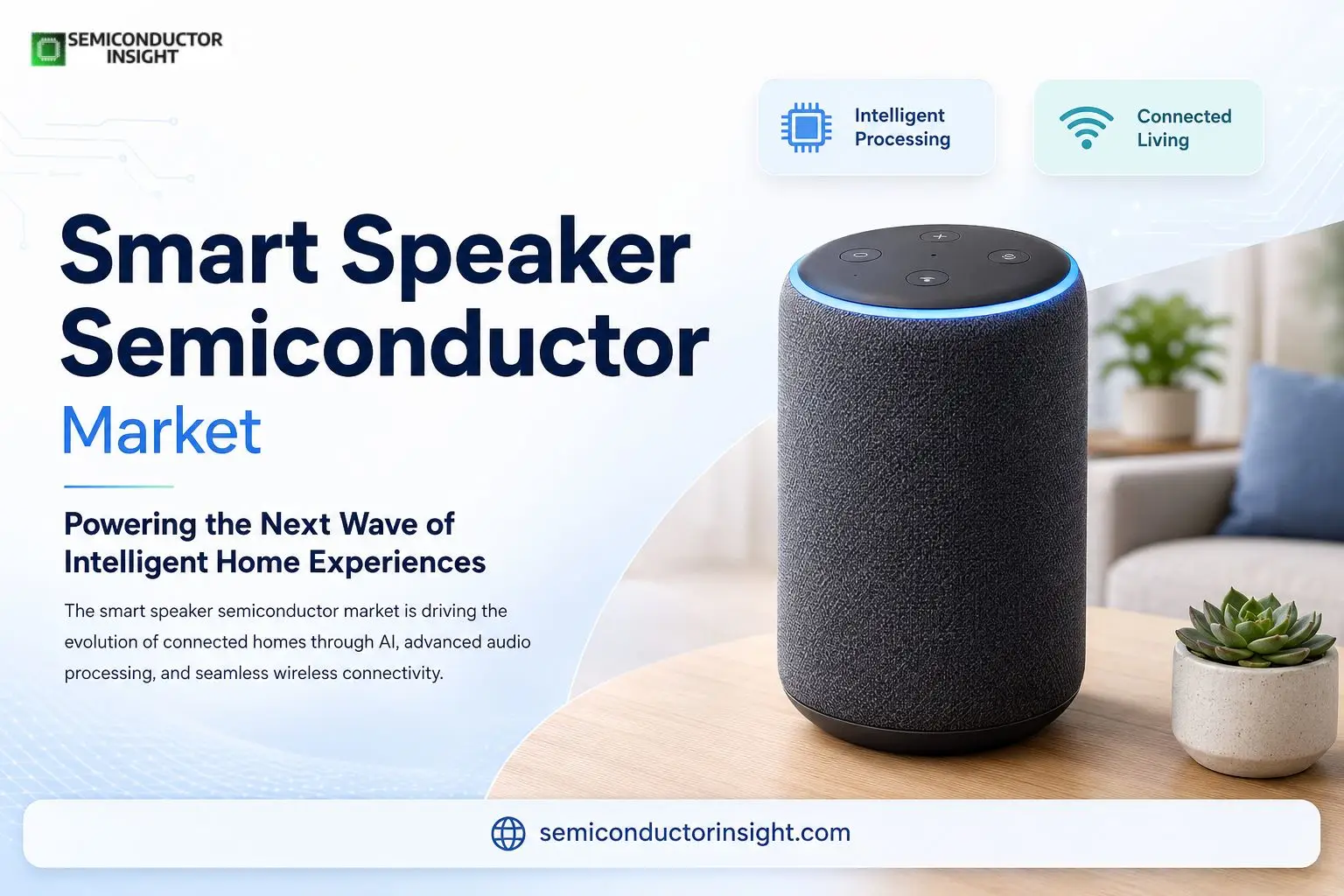
Smart Speaker Semiconductor Market Size 2026: USD 3.4 Billion, Growing at 8%, Driven by Intelligent Home Automation Platforms
The modern smart speaker has evolved far beyond a music playback device. Today’s products combine artificial intelligence, advanced audio engineering, wireless connectivity, and edge computing into a compact consumer device. Behind every voice command lies a advanced semiconductor architecture that processes speech, suppresses background noise, manages connectivity, and enables real-time interactions.
As consumers increasingly expect natural conversations with digital assistants, semiconductor innovation has become one of the defining factors shaping the smart speaker ecosystem. From AI accelerators and digital signal processors to wireless communication chips and power management ICs, the Smart Speaker Semiconductor Market is becoming a critical segment within the broader semiconductor industry.
The Silicon Stack behind Every Voice Command
A single smart speaker may contain multiple specialised semiconductor components working simultaneously.
Key semiconductor categories include:
- System-on-Chip (SoC) processors
- Digital Signal Processors (DSPs)
- AI inference accelerators
- MEMS microphone chips
- Bluetooth and Wi-Fi chipsets
- Power management integrated circuits
- Audio amplifier semiconductors
- Security and encryption chips
When a user activates a voice assistant, several semiconductor subsystems begin processing within milliseconds. Voice capture, wake-word detection, acoustic echo cancellation, and cloud communication all depend on highly optimised chip architectures.
Why Edge AI Is Changing Smart Speaker Design?
A major shift occurring in smart speakers is the migration of AI workloads from cloud servers to local devices.
Instead of sending every voice request to distant data centres, manufacturers increasingly perform speech processing directly on-device. This reduces latency, improves privacy, and enhances responsiveness.
Recent product generations have introduced dedicated neural processing capabilities that support:
- Local speech recognition
- Personalised voice profiles
- Noise classification
- Context-aware responses
- Offline command execution
This transition is creating demand for semiconductor solutions capable of delivering AI performance within strict power and thermal limits.
Unlocking Insights from the Audio Economy
According to publicly available figures from industry reports and company disclosures, hundreds of millions of smart speakers have been shipped globally since the category emerged.
Voice assistants continue to support billions of interactions annually across smart speakers, smartphones, vehicles, and connected devices.
The semiconductor content inside premium smart speakers has also increased significantly. Devices that once relied on basic audio processors now incorporate multiple AI-capable chips, additional memory, advanced connectivity modules, and security processors.
As functionality expands, semiconductor value per device continues to rise.
The MEMS Microphone Revolution Few Consumers Notice
One of the most important semiconductor innovations inside smart speakers is the MEMS microphone.
In contrast to conventional microphone technologies, MEMS designs provide:
- Compact size
- Improved sensitivity
- Better reliability
- Lower power consumption
- Multi-microphone array support
Many premium smart speakers now employ six to eight microphones arranged strategically to detect commands across rooms while filtering ambient noise.
This capability depends heavily on semiconductor miniaturisation and signal-processing advancements.
Smart Speakers Become Command Centres for Connected Homes
The role of smart speakers is shifting from entertainment devices to home orchestration hubs.
Modern devices increasingly control:
- Smart lighting
- Security cameras
- Smart locks
- Thermostats
- Home appliances
- Energy management systems
Each additional connected function increases processing requirements and places greater importance on semiconductor performance.
Manufacturers are therefore investing in more powerful SoCs capable of managing multiple device ecosystems simultaneously.
Stay connected for additional in-depth information right here: https://semiconductorinsight.com/report/smart-speaker-semiconductor-market/
Semiconductor Security Moves to the Forefront
As smart speakers gain access to personal schedules, home controls, payment systems, and connected devices, security is becoming a key design consideration.
New semiconductor architectures increasingly incorporate:
- Hardware-level encryption
- Secure boot mechanisms
- Trusted execution environments
- Biometric authentication support
- Device identity protection
These capabilities help strengthen user trust while supporting increasingly complex smart home ecosystems.
The New Race toward Conversational Intelligence
The next chapter for smart speakers extends beyond voice recognition.
Manufacturers are pursuing systems capable of understanding context, emotion, preferences, and multi-step conversations. Achieving this vision will require more powerful AI semiconductors, advanced memory architectures, and highly efficient edge-computing solutions.
As digital assistants become more conversational and autonomous, semiconductor innovation will remain at the centre of product differentiation, shaping how consumers interact with technology in homes, workplaces, and connected environments worldwide.

Comments (0)