
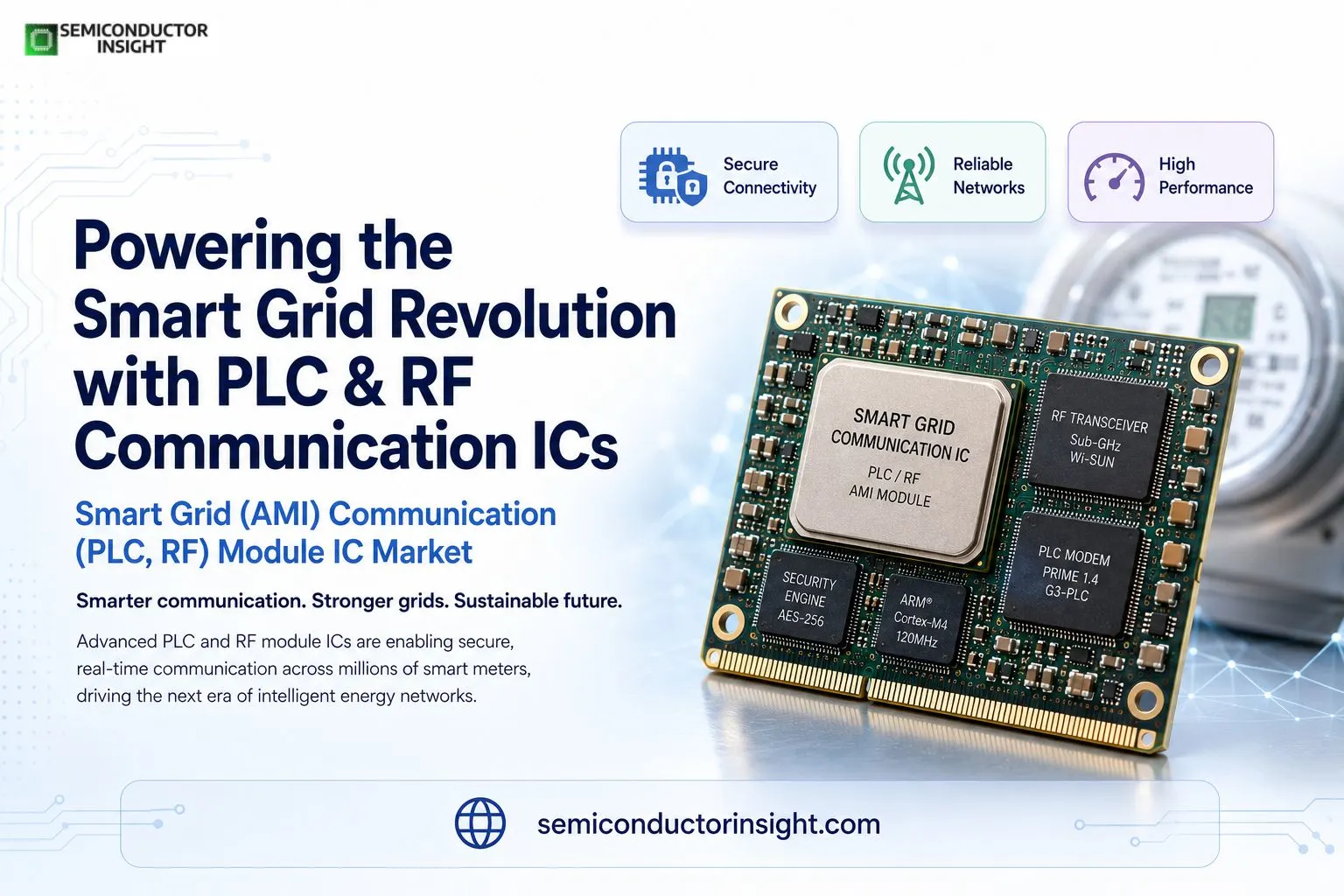
Smart Grid (AMI) Communication (PLC, RF) Module IC Market is becoming the Silent Backbone of Modern Energy Networks
Electricity networks are no longer operating as one-way systems where power simply moves from substations to homes. Modern grids are now data-driven ecosystems where millions of smart meters communicate continuously with utilities in real time. At the centre of this transformation lies a rapidly evolving semiconductor segment Smart Grid AMI communication module ICs based on PLC and RF technologies.
Advanced Metering Infrastructure, commonly known as AMI, depends heavily on communication chipsets that can transmit consumption data securely and reliably across massive utility networks. Semiconductor companies developing PLC (Power Line Communication) and RF (Radio Frequency) module ICs are now shaping how energy utilities modernize aging infrastructure while supporting smart city ambitions worldwide.
Why Utilities Are Prioritizing Communication Layer Semiconductors?
For years, smart meter discussions focused mainly on hardware installations. Today, the focus has shifted toward communication efficiency because utilities require uninterrupted two-way connectivity between meters and control centres. This is where AMI communication ICs are becoming strategically important.
- Modern AMI systems rely on semiconductor modules capable of handling real-time data transfer, remote firmware upgrades, outage notifications, and load balancing instructions.
- RF mesh chipsets are increasingly preferred in densely populated urban zones, while PLC ICs remain valuable in locations where existing electrical wiring infrastructure can be utilized for communication.
According to utility deployment updates published across energy infrastructure platforms, global smart meter installations have already crossed more than 1.3 billion units, creating enormous demand for communication-grade semiconductor components inside every device.
PLC vs. RF Share in AMI Communication Tech Deployments 2025–2026
RF Mesh holds the largest share in AMI communication tech deployments at 57%, making it the dominant technology in this space. Cellular follows with 22%, supported by its wide network coverage and growing utility adoption. NB-PLC accounts for 14%, while LPWAN contributes 5% and other technologies make up the remaining 2%.
To Know More about the Report, You Can Freely Browse Our Latest Updated Report: https://semiconductorinsight.com/report/smart-grid-ami-communication-plc-rf-module-ic-market/
Semiconductor Innovation Is Moving Beyond Basic Meter Connectivity
- The latest generation of AMI communication ICs is no longer designed only for meter reading. Semiconductor firms are now integrating AI-assisted diagnostics, cybersecurity engines, and edge-processing capabilities directly into communication modules.
- In early 2025, STMicroelectronics introduced its programmable ST85MM PLC modem platform designed for multi-protocol smart grid applications. The chipset supports PRIME 1.4 and Meters and More standards while integrating cryptographic security and hybrid PLC-RF compatibility.
- This hybrid communication approach is becoming increasingly important because utility environments differ dramatically between cities, industrial corridors, and rural areas.
- Semiconductor designers are now focusing on flexible chip architectures that can dynamically switch communication pathways depending on signal conditions and grid congestion.
India Has Become One of the Fastest Moving AMI Semiconductor Ecosystems
India’s nationwide smart meter deployment programs are creating major opportunities for communication module IC manufacturers. Under power sector modernization programs, utilities are accelerating deployments across both metropolitan and semi-urban regions where network reliability is critical.
- In 2025, HPL Electric and Wirepas demonstrated one of the industry’s first integrated in-meter RF mesh gateways for AMI deployments during Elecrama in India.
- The solution showcased RF mesh communication directly embedded inside smart meters, reducing the need for separate gateway hardware.
- The companies reported support for large-scale deployments with service reliability reaching 99.9%.
This shift matters significantly for semiconductor suppliers because embedded communication ICs reduce hardware complexity while increasing demand for high-performance RF transceivers and low-power processing chips.
RF Mesh Networks Are Expanding Faster in Dense Urban Deployments
RF communication modules are gaining traction because utilities increasingly need scalable wireless connectivity without relying entirely on telecom operators. Sub-GHz RF mesh technologies such as Wi-SUN and proprietary RF systems are helping utilities create self-healing communication networks across residential neighborhoods.
Japan recently completed major AMI upgrades through collaborations involving TEPCO Power Grid and Landis+Gyr. These upgrades now allow smart meters to act as communication hubs for EV chargers, solar inverters, gas meters, and distributed energy systems. Utilities are essentially transforming smart meters into edge communication nodes powered by advanced semiconductor modules.
Meanwhile, semiconductor developers are improving RF module efficiency for harsh utility environments where communication stability must remain consistent for nearly two decades of continuous operation.
Grid Cybersecurity Is Increasingly Influencing IC Design
- One of the biggest changes in AMI semiconductor development involves cybersecurity
- Communication ICs are now expected to support encryption engines, secure boot functions, tamper detection, and remote authentication capabilities directly at the silicon level.
- Recent interoperability guidelines released in India highlighted growing concerns regarding proprietary RF protocols and fragmented communication architectures across AMI ecosystems.
- Government-backed standardization efforts are now pushing semiconductor vendors toward interoperable and secure communication designs.
- This trend is particularly important because modern smart grids are becoming connected critical infrastructure systems rather than isolated utility assets.
AMI Communication ICs Are Becoming Strategic Semiconductor Assets
The global semiconductor industry is increasingly recognizing smart grid communication ICs as long-cycle infrastructure products rather than short-term consumer electronics components. AMI semiconductor modules are anticipated to operate dependably for 15 to 20 years in harsh environmental circumstances, in contrast to smartphones or wearable technology.
- As governments modernize power infrastructure and renewable energy integration expands globally, communication semiconductor demand is moving beyond traditional metering functions. PLC and RF module ICs are now enabling decentralized energy management, electric vehicle coordination, distributed solar monitoring, and real-time grid balancing.
- The next phase of smart grids will depend not only on electricity generation capacity but also on how intelligently billions of connected devices communicate. Deep inside that transformation, semiconductor communication ICs are quietly becoming the foundation of the digital energy economy.

Comments (0)