Smart Meter (Electricity, Water, Gas) SoC Market Insights
Global Smart Meter (Electricity, Water, Gas) SoC market size was valued at USD 2.12 billion in 2024. The market is projected to grow from USD 2.35 billion in 2025 to USD 4.91 billion by 2034, exhibiting a CAGR of 8.6% during the forecast period.
Smart Meter (Electricity, Water, Gas) SoCs are advanced system-on-chip solutions designed for precise measurement and management of utility consumption. These integrated circuits combine high-accuracy analog-to-digital converters, microcontrollers, communication interfaces such as PLC, RF, NB-IoT, and security modules, enabling real-time data transmission in advanced metering infrastructure. They support diverse applications including single-phase and three-phase electricity meters, ultrasonic water meters, and thermal mass gas meters.
The market is witnessing strong growth owing to expanding smart grid deployments, regulatory mandates for AMI adoption across regions like Europe and Asia-Pacific, and increasing focus on energy efficiency. Moreover, innovations in low-power designs and edge computing further bolster demand. Key industry players are driving progress through strategic developments; for instance, in June 2023, Renesas Electronics Corporation launched the R9A02G021 single-chip microcontroller for residential smart meters, enhancing multi-communication capabilities. Texas Instruments Inc., STMicroelectronics N.V., NXP Semiconductors N.V., and Microchip Technology Incorporated stand out as leading companies with comprehensive portfolios.
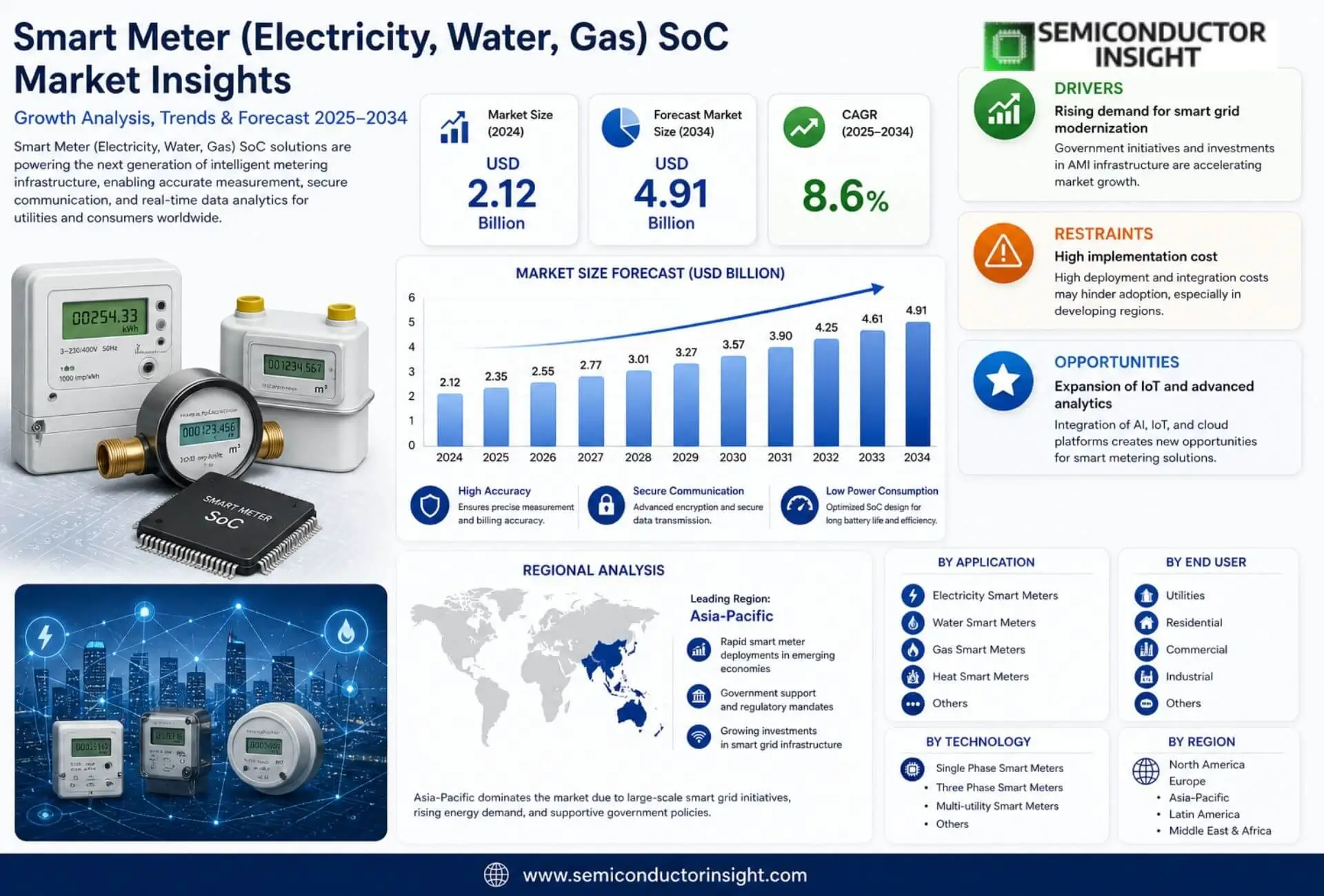
MARKET DRIVERS
Government Mandates and Smart Grid Initiatives
The Smart Meter (Electricity, Water, Gas) SoC Market is propelled by widespread government policies promoting advanced metering infrastructure (AMI) and grid modernization. Utilities are replacing traditional meters with smart solutions to enable real-time data collection, reduce non-technical losses, and support dynamic pricing models across electricity, water, and gas applications.
Rising Demand for Energy Efficiency and Renewable Integration
Integration of renewable energy sources requires precise monitoring and bidirectional communication, driving demand for highly integrated SoC solutions that combine metrology, processing, and communication functions in compact, low-power designs suitable for multi-utility smart meters.
➤ Advancements in IoT and connectivity technologies, including support for RF mesh, cellular, and powerline communication protocols, are enabling more capable and interoperable SoC platforms for smart metering applications.
Technological progress in semiconductor design has resulted in metering SoCs offering high accuracy over wide dynamic ranges, enhanced security features, and edge processing capabilities that optimize performance while lowering overall system costs for electricity, water, and gas meters.
MARKET CHALLENGES
High Initial Deployment and Infrastructure Costs
Deploying smart meters equipped with advanced SoC technology involves substantial upfront investment in hardware, communication networks, data management systems, and workforce training, which can strain budgets especially for smaller utilities and in developing regions.
Other Challenges
Cybersecurity and Data Privacy Concerns
Smart meters with integrated SoCs handle sensitive consumption data and enable two-way communication, raising risks of cyber attacks and privacy issues that require robust embedded security measures and ongoing compliance with evolving regulations.
Interoperability and Legacy System Integration
Ensuring new SoC-based meters seamlessly work with diverse existing utility infrastructures and multiple communication standards remains a technical hurdle, potentially slowing large-scale rollouts across electricity, water, and gas sectors.
MARKET RESTRAINTS
Regulatory and Standardization Barriers
Variations in regional standards, certification requirements, and slow harmonization of protocols for smart metering SoCs can delay product development cycles and increase compliance costs for semiconductor suppliers targeting global electricity, water, and gas markets.
Consumer Acceptance and Installation Hurdles
Public concerns regarding data security, potential health effects from RF communication, and perceived impacts on billing accuracy can hinder adoption rates, while logistical challenges in large-scale meter replacement programs add complexity to SoC integration efforts.
MARKET OPPORTUNITIES
Expansion of Smart City and Multi-Utility Projects
Growing smart city initiatives worldwide create significant potential for integrated SoC platforms that support combined electricity, water, and gas metering solutions, enabling utilities to offer comprehensive energy and resource management services with advanced analytics.
Technological Advancements in Low-Power and AI-Enabled SoCs
Continued innovation in ultra-low-power design, multi-protocol communication, and edge AI capabilities opens opportunities for next-generation smart meter SoCs that deliver higher accuracy, predictive maintenance features, and improved battery life for gas and water applications while enhancing overall grid reliability.
Smart Meter (Electricity, Water, Gas) SoC Market Trends
Expansion of Advanced Metering Infrastructure (AMI) Integration
Smart Meter (Electricity, Water, Gas) SoC solutions continue to evolve as core components enabling precise measurement and real-time data management in utility networks. These integrated circuits combine high-accuracy analog-to-digital converters, microcontrollers, and various communication interfaces including PLC, RF, and NB-IoT, supporting seamless operation across single-phase and three-phase electricity meters as well as ultrasonic water and thermal mass gas meters. Regulatory mandates for advanced metering infrastructure adoption in Europe and Asia-Pacific regions drive consistent demand, as utilities seek enhanced grid reliability and operational efficiency through two-way communication capabilities.
Other Trends
Advancements in Low-Power Design and Multi-Communication Capabilities
Manufacturers focus on ultra-low-power architectures to extend battery life in gas and water metering applications while maintaining high performance. Innovations allow SoCs to operate efficiently in diverse environments, reducing overall system power consumption without compromising measurement accuracy or data transmission reliability. Strategic product launches, such as Renesas Electronics’ R9A02G021 single-chip microcontroller targeting residential smart meters, demonstrate industry efforts to enhance multi-communication support and integration flexibility for cost-sensitive deployments.
Emergence of Edge Computing Features in Smart Meter SoCs
Integration of edge computing capabilities represents a notable development in Smart Meter (Electricity, Water, Gas) SoC Market trends. These features enable localized data processing for anomaly detection and basic analytics directly at the meter level, minimizing latency and reducing dependency on constant cloud connectivity. Leading semiconductor companies including Texas Instruments, STMicroelectronics, NXP Semiconductors, and Microchip Technology continue to expand portfolios with solutions that balance security modules, processing power, and communication versatility. Such designs support utilities in achieving better demand management and outage response while addressing growing requirements for energy efficiency across global deployments. Ongoing progress in system integration helps utilities modernize infrastructure while controlling deployment costs in both mature and emerging markets.
COMPETITIVE LANDSCAPEKey Industry Players
Smart Meter (Electricity, Water, Gas) SoC Market Competitive Analysis
The Smart Meter (Electricity, Water, Gas) SoC market features a concentrated competitive landscape dominated by leading semiconductor manufacturers with extensive expertise in high-accuracy metrology, low-power processing, and integrated communication interfaces. Texas Instruments Inc. and STMicroelectronics N.V. maintain strong positions through comprehensive portfolios that support single-phase and polyphase electricity meters, ultrasonic water meters, and gas metering applications, offering advanced analog-to-digital converters, microcontrollers, and security features essential for advanced metering infrastructure (AMI). Renesas Electronics Corporation stands out with innovations such as the R9A02G021 single-chip solution for residential smart meters, enhancing multi-protocol communication capabilities including PLC, RF, and NB-IoT.
Other significant players include NXP Semiconductors N.V., Microchip Technology Incorporated, Infineon Technologies AG, and Silicon Labs, which provide specialized SoC solutions emphasizing energy efficiency, edge computing, and robust security modules. These companies compete through ongoing R&D in low-power designs and integration of diverse communication standards to meet evolving regulatory mandates for smart grid deployments across Europe, Asia-Pacific, and North America. The market structure reflects a balance between established global leaders and niche innovators focused on specific utility segments or regional requirements.
List of Key Smart Meter SoC Companies Profiled
- Texas Instruments Inc.
- Texas Instruments Inc.
- STMicroelectronics N.V.
- Renesas Electronics Corporation
- NXP Semiconductors N.V.
- Microchip Technology Incorporated
- Infineon Technologies AG
- Silicon Labs
- Analog Devices, Inc.
- Maxim Integrated (Analog Devices)
- ON Semiconductor
- Hi-trend Technology
- Shanghai Belling
Segment Analysis:
| Segment Category | Sub-Segments | Key Insights |
| By Type |
|
Electricity Meter SoC leads the market due to:
|
| By Application |
|
Single-Phase Metering dominates owing to:
|
| By End User |
|
Residential remains the leading end user due to:
|
| By Communication Technology |
|
RF-Based SoCs lead owing to:
|
| By Integration Level |
|
Highly Integrated Multi-Communication SoCs emerge as the leading segment due to:
|
Regional Analysis: Smart Meter (Electricity, Water, Gas) SoC Market
Asia-Pacific
Urbanization trends across Asia-Pacific are prompting significant upgrades to electricity, water, and gas distribution systems. Many cities are prioritizing smart infrastructure integration, creating demand for SoCs that support advanced communication protocols and remote management capabilities. This shift enables utilities to manage consumption patterns more accurately while improving response times within densely populated environments.
Asia-Pacific benefits from a robust semiconductor ecosystem, enabling rapid innovation and cost-effective production of smart meter SoCs. Manufacturers in China, Taiwan, Japan, and South Korea support fast prototyping and scalable production cycles, accelerating adoption among utility companies. This strong industrial base enhances competitiveness and drives continuous improvements in SoC design efficiency.
National initiatives promoting digital utility management, automated metering, and sustainable consumption are strengthening regional demand for integrated SoCs. Many countries are prioritizing smart grid deployments as part of broader environmental and infrastructure mandates, enabling streamlined procurement and adoption of advanced utility metering technologies across multiple sectors.
With increasing emphasis on unified utility management platforms, Asia-Pacific utilities are adopting SoCs capable of supporting electricity, water, and gas metering simultaneously. This approach enhances operational efficiency and simplifies long-term maintenance. The flexibility of modern SoCs positions them as ideal solutions for regions deploying interconnected utility networks.
North America
North America remains a significant market for Smart Meter (Electricity, Water, Gas) SoC adoption due to its established smart grid landscape and consistent investment in digital utility management. Utility companies continue upgrading legacy metering infrastructure, with emphasis on cybersecurity, data accuracy, and grid resilience. The region’s utilities increasingly adopt SoCs that integrate secure communication, edge processing, and compatibility with advanced metering infrastructure platforms. Growing emphasis on energy optimization, sustainability programs, and demand-response systems is further boosting market expansion. Additionally, collaboration between semiconductor vendors and utility technology providers supports development of next-generation SoC architectures tailored to North American regulatory and operational requirements.
Europe
Europe demonstrates strong regulatory alignment and well-defined frameworks for digital utility transformation, driving stable demand for smart meter SoC solutions. The region’s sustainability initiatives encourage widespread smart metering deployment across electricity, water, and gas networks. Advanced infrastructure maturity in Western Europe contrasts with accelerated modernization efforts in Central and Eastern regions, creating a diverse landscape for SoC adoption. The emphasis on security, interoperability, and long-term device reliability continues to influence product selection. European utilities prefer SoCs that ensure efficient data exchange with advanced management platforms and support seamless integration into evolving grid modernization programs.
South America
South America is experiencing growing interest in smart metering technologies as utilities work to address energy losses, water management constraints, and distribution inefficiencies. Countries such as Brazil, Chile, and Colombia are gradually adopting SoC-based smart meter solutions to support digital transformation objectives. Utility providers prioritize technologies that enhance billing accuracy, reduce operational disruptions, and improve resource monitoring. Despite budgetary constraints in some markets, the region is moving toward scalable metering solutions that incorporate improved communication capabilities and remote diagnostics. Increasing participation of international vendors and infrastructure partners is further helping accelerate the adoption of advanced smart metering SoCs in the region.
Middle East & Africa
The Middle East & Africa region is witnessing rising momentum in smart meter deployment as governments adopt initiatives aimed at improving utility efficiency, resource conservation, and grid modernization. Utility companies across the region seek SoCs capable of operating in diverse climatic conditions while maintaining strong performance, data security, and communication reliability. Growing investments in smart cities, digital water management, and intelligent electricity distribution are creating opportunities for adaptable SoC platforms. While adoption varies across markets, expanding infrastructure projects and the push for sustainable utility operations continue to elevate demand for advanced smart meter SoC technologies.
Report Scope
This market research report provides a comprehensive analysis of the Smart Meter (Electricity, Water, Gas) SoC Market , covering the forecast period 2026–2034. It offers detailed insights into market dynamics, technological advancements, competitive landscape, and key trends shaping the industry.
Key focus areas of the report include:
- Market Overview: The report begins with an overview outlining its current market scenario, key growth indicators, and industry transformation drivers. It discusses macroeconomic factors, demand–supply balance, regulatory landscape, and the strategic role of semiconductors in powering advancements across industries such as automotive, telecommunications, consumer electronics, and industrial automation.
- Market Size & Forecast: Historical data and future projections for revenue, unit shipments, and market value across major regions and segments.
- Segmentation Analysis: Detailed breakdown by product type, technology, application, and end-user industry to identify high-growth segments and investment opportunities.
- Regional Insights: Insights into market performance across North America, Europe, Asia-Pacific, Latin America, and the Middle East & Africa, including country-level analysis where relevant.
- Competitive Landscape: Profiles of leading market participants, including their product offerings, R&D focus, manufacturing capacity, pricing strategies, and recent developments such as mergers, acquisitions, and partnerships.
- Technology Trends & Innovation: Assessment of emerging technologies, integration of AI/IoT, semiconductor design trends, fabrication techniques, and evolving industry standards.
- Market Drivers & Restraints: Evaluation of factors driving market growth along with challenges, supply chain constraints, regulatory issues, and market-entry barriers.
- Stakeholder Insights: Insights for component suppliers, OEMs, system integrators, investors, and policymakers regarding the evolving ecosystem and strategic opportunities.
Primary and secondary research methods are employed, including interviews with industry experts, data from verified sources, and real-time market intelligence to ensure the accuracy and reliability of the insights presented.
FREQUENTLY ASKED QUESTIONS:
What is the current market size of Smart Meter (Electricity, Water, Gas) SoC Market?
-> The Smart Meter (Electricity, Water, Gas) SoC Market was valued at USD 2.35 billion in 2025 and is expected to reach USD 4.91 billion by 2034, supported by a CAGR of 8.6%.
Which key companies operate in Smart Meter (Electricity, Water, Gas) SoC Market?
-> Key players include Renesas Electronics Corporation, Texas Instruments Inc., STMicroelectronics N.V., NXP Semiconductors N.V., and Microchip Technology Incorporated, among others.
What are the key growth drivers?
-> Key growth drivers include expanding smart grid deployments, regulatory mandates for AMI adoption, and increasing focus on energy efficiency.
Which region dominates the market?
-> Europe and Asia-Pacific are major regions driving market expansion due to strong regulatory support and accelerated AMI rollout initiatives.
What are the emerging trends?
-> Emerging trends include innovations in low-power SoC designs, advanced edge-computing capabilities, and wider integration of multi-communication interfaces such as PLC, RF, and NB-IoT.

Get Sample Report PDF for Exclusive Insights
Report Sample Includes
- Table of Contents
- List of Tables & Figures
- Charts, Research Methodology, and more...
 Download Sample Report PDF