
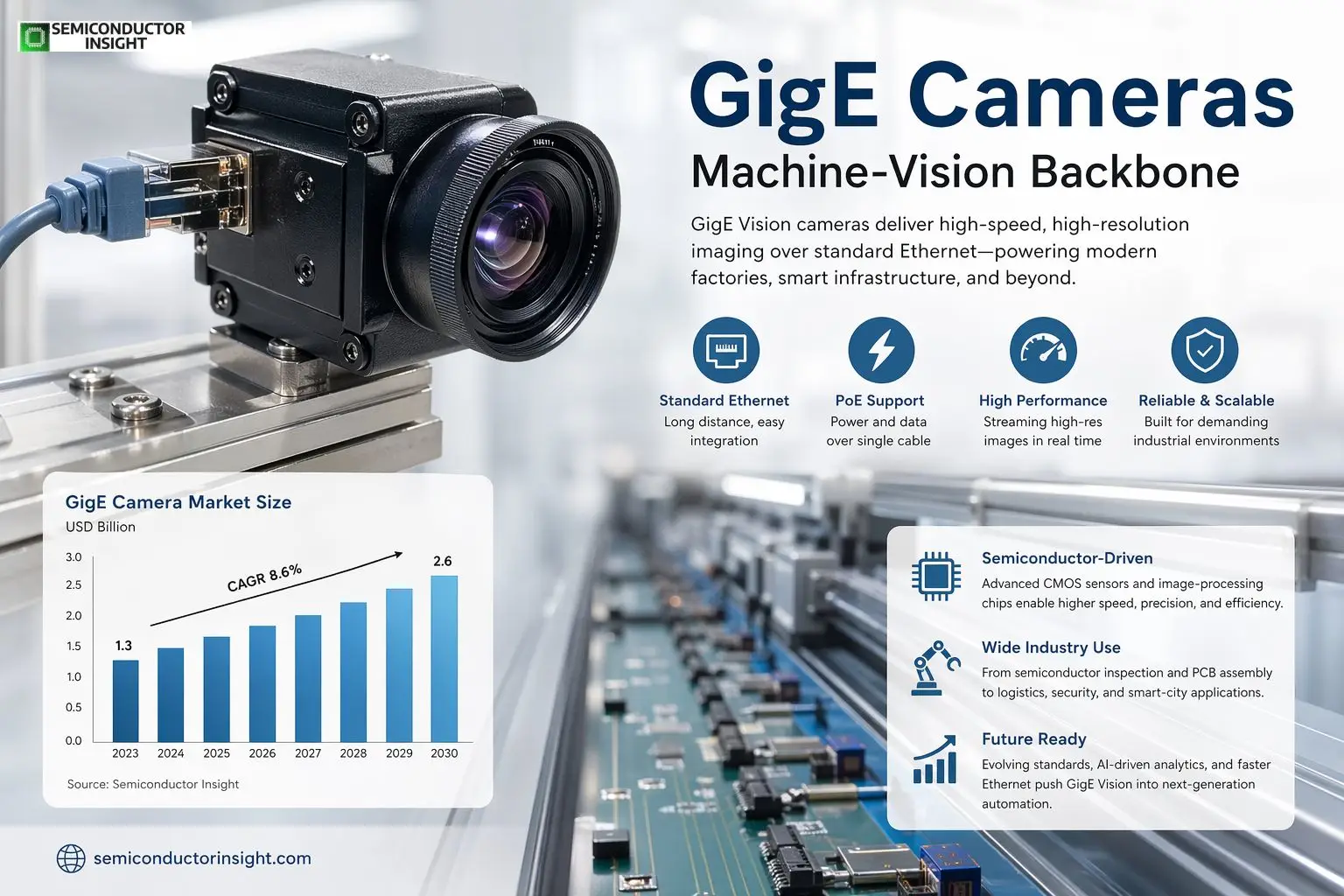
From Silicon Sensor to Smart Factory Floor: GigE Camera Market in Today’s Machine‑Vision World
Why GigE Cameras Have Become Machine‑Vision Backbone?
GigE cameras built around the GigE Vision standard and Ethernet‑based communication have quietly become the workhorses of industrial imaging and automation. GigE uses standard Cat 5e or Cat 6 cabling, which offers long-distance communication, reduced wiring complexity, and simpler interaction with current IT and control networks, in contrast to custom camera interfaces.
This is especially important in sprawling production lines, where cameras may sit tens of meters away from control cabinets or edge‑processing units. In many modern factories, GigE camera systems now run hundreds of cameras in parallel, streaming high‑resolution images at dozens of frames per second without needing custom, expensive interconnect hardware.
You can freely browse our most recent updated report to learn more about it before scrolling further: https://semiconductorinsight.com/report/gige-camera-market/
How GigE Vision Works Inside a Semiconductor‑Driven System?
- At the heart of a GigE camera is a semiconductor image sensor typically CMOS, with pixel counts ranging from a few megapixels to well over 20 MP in higher‑end models.
- These sensors are paired with on‑board image‑processing logic, FPGA‑based frame grabbers, and Gigabit Ethernet controllers that comply with the GigE Vision protocol stack.
- The standard defines how cameras advertise their capabilities, negotiate packet sizes, and transmit image data over TCP/IP, enabling plug‑and‑play interoperability between different vendor’s cameras and software.
- Over the years, the standard has evolved to include features like multi‑part image transfer and support for 3D and multi‑sensor data, which helps when fusing 2D intensity and depth information from multiple sensors over a single Ethernet link.
Expanding Presence in Electronics and Semiconductor Production
Semiconductor and advanced‑electronics fabs are among the most demanding environments for imaging, and GigE cameras have carved a strong niche there. In wafer‑handling and inspection cells, multi‑camera GigE setups monitor alignment, defect presence, and bond‑wire quality at production speeds. Some inspection systems deploy GigE cameras with resolutions of 12-29 megapixels and frame rates above 100 fps, generating gigabytes of image data per hour that must be streamed reliably to in‑line servers.
In printed‑circuit‑board (PCB) assembly, GigE‑based 2D/3D vision systems scan components for missing parts, solder joint quality, and height inconsistencies, often over conveyor lines moving at several meters per minute. These systems typically run hundreds of inspections per board, with each camera polling thousands of images per shift, making stability and jitter‑free Ethernet transmission a hard requirement.
Flexibility, PoE, and System‑Level Design Advantages
Another reason GigE cameras have spread so widely is Power over Ethernet (PoE). With PoE‑capable GigE cameras, system designers can feed both data and power over a single cable, drastically simplifying cabinet layouts, reducing the number of external power supplies, and speeding up installation in retrofit projects.
This is especially valuable in logistics centers, warehouses, and packaging lines, where cameras are often mounted on overhead gantries, moving robots, or high‑bay racks. In some facilities, GigE cameras with PoE support are deployed at distances of 80-100 meters from the switch, well within the standard’s Ethernet limitations, while still delivering low‑latency streaming suitable for real‑time decision‑making.
Beyond the Factory: GigE in Smart Infrastructure and Security
Outside pure manufacturing, GigE cameras are finding new roles in smart‑city and infrastructure‑monitoring systems. Traffic‑management centres, toll plazas, and rail‑monitoring hubs increasingly use GigE‑based cameras for license‑plate recognition, occupancy detection, and anomaly signalling.
In these applications, the ability to reuse existing fibre‑optic or copper‑Ethernet backbones makes GigE a cost‑effective upgrade path compared with older analog or proprietary digital systems. Security and surveillance deployments also benefit from standardized GigE Vision-compatible cameras that can plug into open‑source or OEM‑agnostic VMS platforms, allowing operators to mix hardware from different vendors without lock‑in.
Where Innovation Is Pushing GigE Cameras Next?
- On the semiconductor side, new sensor generations are enabling higher dynamic range, lower noise, and global‑shutter modes that are critical for high‑speed inspection and motion‑capture tasks.
- These sensors are being paired with faster Ethernet controllers and more sophisticated on-board image‑pre-processing to reduce the load on host CPUs.
- At the same time, standards bodies continue to refine GigE Vision, adding features like GenDC streaming and enhanced time stamping to support emerging 3D and multi‑sensor applications in robotics and autonomous‑guided‑vehicle (AGV) fleets.
- As factories and logistics hubs push toward real‑time, AI‑driven decision‑making, GigE cameras are shifting from dumb image sources to intelligent nodes that pre-process, compress, and prioritize data before sending it upstream.
What stands out about the GigE camera ecosystem is not just its growth, but how it has become a quiet infrastructure layer underpinning everything from wafer‑level metrology to supermarket‑supply‑chain tracking.
In a world where cameras are everywhere, GigE Vision offers a standardized, semiconductor‑centric way to get high‑resolution, high‑speed image data from the edge of the network into the analytics core without reinventing the wiring every time a new camera model ships.

Comments (0)