MARKET INSIGHTS
The global GigE Camera market size was valued at USD 703 million in 2024. The market is projected to grow from USD 772 million in 2025 to USD 1337 million by 2032, exhibiting a CAGR of 9.9% during the forecast period.
GigE Cameras are imaging devices based on the GigE Vision interface standard, designed to transmit high-quality images over gigabit Ethernet networks. These cameras are engineered to interface seamlessly with computer systems using GigE ports, offering fast data transfer rates up to 1000Mb/s, which makes them ideal for demanding imaging applications. A key advantage is their ability to operate over long cable lengths, enabling deployment in locations far from a dedicated computer, which is crucial for complex multi-camera setups in industrial and scientific environments.
The market is experiencing robust growth driven by the increasing automation in manufacturing and the rising demand for high-speed, high-resolution machine vision systems. The industrial sector dominates application, holding approximately 80% market share, because these cameras are integral to quality control, robotic guidance, and automated inspection processes. Furthermore, technological advancements in sensor technology and the integration of artificial intelligence for image analysis are creating new opportunities. Key players like Basler AG and Teledyne DALSA are continuously innovating, with recent developments focusing on enhancing camera resolution and frame rates to meet the evolving needs of sectors such as intelligent transportation systems and medical imaging.
 MARKET DRIVERS
Rising Automation and High-Speed Vision Requirements
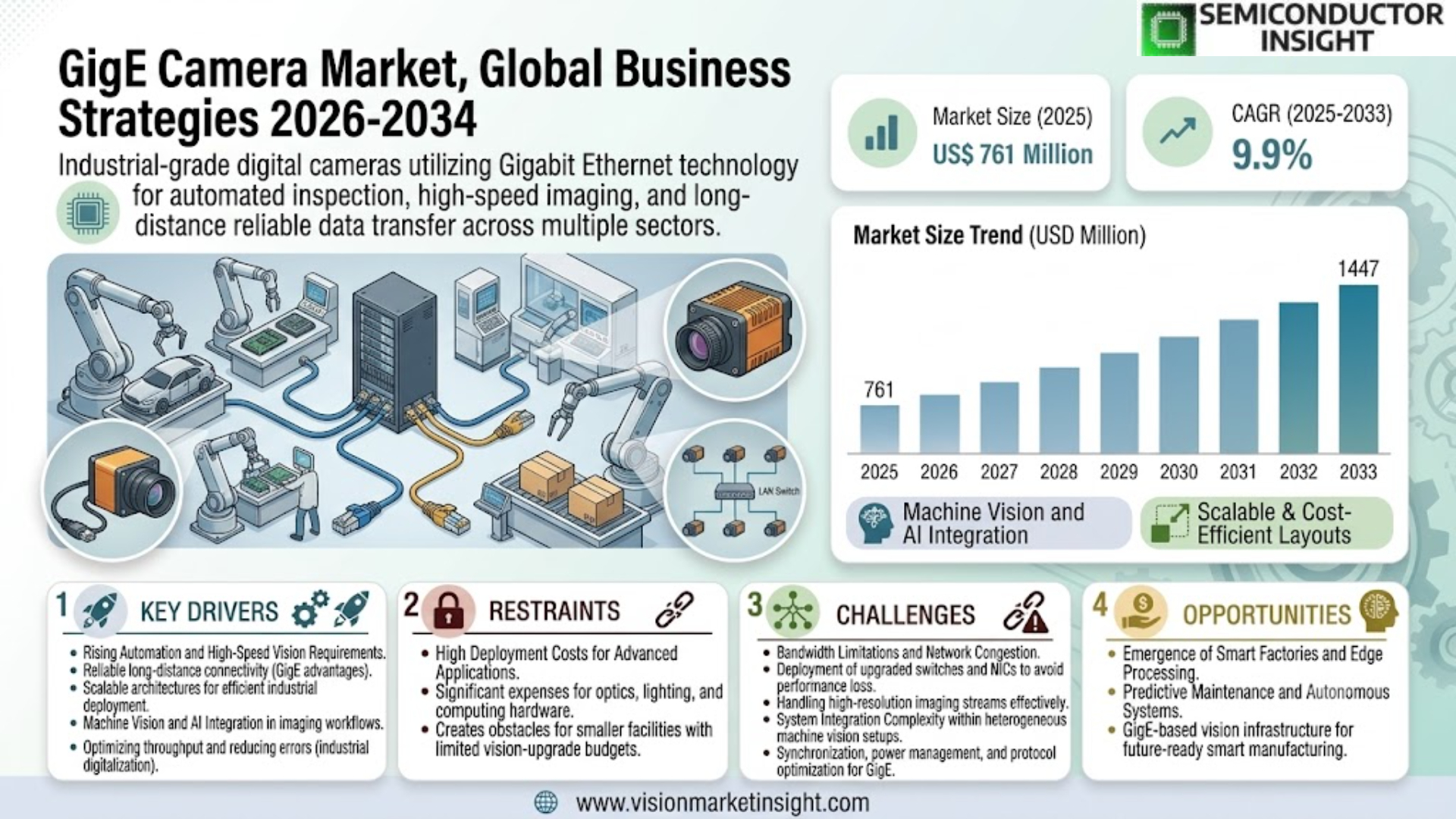
The GigE Camera Market is experiencing steady momentum as industries expand their use of automated inspection, quality monitoring, and high-speed imaging. Demand is increasing in manufacturing and logistics where **reliable data transfer** and long-distance connectivity capabilities are essential. These cameras support scalable architectures, enabling more efficient deployment in industrial environments.
Growth in Machine Vision and AI Integration
Machine vision systems continue to adopt Gigabit Ethernet technologies due to their **low-latency performance** and compatibility with advanced analytics platforms. Integration with AI-driven inspection workflows enhances precision across automotive, semiconductor, and packaging operations, strengthening the role of GigE imaging equipment.
➤ Industrial digitalization trends are accelerating GigE adoption as organizations optimize throughput and reduce operational errors.
Growing interest in scalable and cost-efficient system layouts further supports market expansion, particularly where flexible camera networking is prioritized.
MARKET CHALLENGES
Bandwidth Limitations and Network Congestion
Despite strong demand, the GigE Camera Market faces challenges related to potential **network bottlenecks** when handling high-resolution imaging streams. As frame rates increase, users must deploy upgraded switches, NICs, and optimized network configurations to maintain consistent performance.
Other Challenges
System Integration Complexity
Integrating GigE-based devices within legacy or heterogeneous machine vision setups can require advanced configuration skills, including synchronization, power management, and protocol optimization.
MARKET RESTRAINTS
High Deployment Costs for Advanced Applications
While GigE cameras offer scalability, total system expenses can increase when paired with specialized optics, lighting, and high-performance computing infrastructure. This creates restraints for smaller facilities that require vision upgrades but operate with limited technical budgets.
MARKET OPPORTUNITIES
Emergence of Smart Factories and Edge Processing
The ongoing expansion of smart manufacturing presents significant opportunities for the GigE Camera Market. Advancements in edge computing allow imaging systems to process data locally, reducing network strain and supporting real-time decision-making. Industries transitioning toward predictive maintenance and autonomous systems are poised to accelerate adoption of GigE-based vision infrastructure.
GigE Camera Market () Trends
Growth of High‑Performance Machine Vision Systems
The GigE Camera Market continues to evolve as industries intensify their reliance on advanced machine vision technologies. The adoption of GigE Vision–compliant devices is increasing due to their ability to deliver high‑quality imaging over gigabit Ethernet networks, enabling transmission speeds up to 1000Mb/s. This capability supports demanding inspection tasks in manufacturing, where consistent image quality and reliable data throughput are critical. Industrial users, representing a significant majority of overall adoption, benefit from the long cable flexibility of GigE Cameras, which allows system designers to position cameras away from processing units without compromising performance. This trend is becoming more pronounced as automation expands across global production facilities and as manufacturers prioritize precision, throughput, and reduced downtime.
Another important market shift is the growing integration of AI-driven image analysis into machine vision workflows. As algorithms improve in accuracy and processing efficiency, the combination of GigE Camera hardware with AI-enabled software solutions enhances defect detection, robotics navigation, and real-time monitoring. Legacy systems are steadily being replaced with newer configurations that support higher pixel resolutions and faster frame rates. These innovations respond directly to market demands in sectors such as intelligent transportation and medical diagnostics, where imaging performance plays a central role in system reliability and operational safety.
Other Trends
Rising Use in Intelligent Transportation Systems
The deployment of GigE Cameras within intelligent transportation systems is expanding as cities modernize mobility infrastructure. These cameras support long-distance data transmission and high-speed capture, which are essential for traffic monitoring, automated number-plate recognition, and incident detection. Their ability to integrate seamlessly with networked systems makes them a preferred choice in large-scale, multi-camera installations. The need for enhanced roadway analytics and the shift toward smart mobility continue to reinforce this application trend.
Advancements in Sensor Technology
Improvements in image sensor architectures are contributing to higher resolutions and better low-light performance in GigE Camera platforms. Manufacturers are prioritizing sensors that deliver greater sensitivity and reduced noise, enabling more accurate imaging in industrial inspection and scientific environments. These advancements help support increasingly complex tasks, including micro-defect detection and high-speed process verification, which have become essential in electronics manufacturing and precision engineering.
Expanding Adoption in Medical and Scientific Imaging
The medical and scientific research sectors are incorporating GigE Cameras at a growing pace due to the need for stable, high-resolution imaging across laboratory and diagnostic settings. The standardized GigE Vision interface ensures compatibility with a wide range of analytical tools, making these cameras suitable for microscopy, sample analysis, and dynamic observation tasks. As healthcare providers and research institutions modernize imaging workflows, demand for network-based imaging solutions with reliable long-distance transmission continues to rise, strengthening this emerging trend within the broader GigE Camera Market.
COMPETITIVE LANDSCAPE
Key Industry Players
GigE Camera Market Competitive Dynamics
The GigE Camera market is defined by a mix of global industrial imaging leaders and specialized machine vision manufacturers that collectively shape technological advancements and competitive strategies. Large companies such as Basler AG and Teledyne DALSA maintain strong leadership positions due to their extensive product portfolios, continuous investment in sensor innovation, and robust distribution networks. These players have been instrumental in elevating GigE Vision standards, improving image throughput, and enhancing camera interoperability for industrial automation, intelligent transportation, and scientific imaging applications. Their long-term focus on high-resolution sensors, advanced frame rate capabilities, and AI-enabled image processing has strengthened their influence across the global machine vision landscape.
Alongside the major leaders, several specialized and niche manufacturers contribute significantly to market competitiveness by offering application‑specific GigE cameras designed for robotics, logistics, medical imaging, and quality inspection tasks. Companies such as Allied Vision, FLIR Systems, IDS Imaging Development Systems, and JAI A/S provide differentiated value by focusing on reliability, modularity, thermal stability, and precise optical performance. Regional players in Asia and Europe—including Hikrobot, Daheng Imaging, and The Imaging Source—have also expanded rapidly, driven by strong demand for automation in manufacturing hubs. This diverse competitive ecosystem enables continuous innovation and intensifies product differentiation across performance, connectivity, pricing, and software integration capabilities.
List of Key GigE Camera Companies Profiled
- Basler AG
- Teledyne DALSA
- FLIR Systems (Teledyne FLIR)
- Allied Vision Technologies
- IDS Imaging Development Systems
- JAI A/S
- Hikrobot
- Daheng Imaging (DAHENG IMAGING Co., Ltd.)
- The Imaging Source
- Matrix Vision (Balluff)
- Omron Microscan Systems
- Imperx Imaging
- Baumer Group
- Sony Industrial Cameras
- Photonfocus AG
Segment Analysis:
| Segment Category | Sub-Segments | Key Insights |
| By Type |
|
Leading Segment Area Scan Cameras
|
| By Application |
|
Leading Segment Industrial Inspection
|
| By End User |
|
Leading Segment Manufacturing
|
| By [Sensor Technology]] |
|
Leading Segment CMOS Sensors
|
| By [Integration Level]] |
|
Leading Segment Smart GigE Cameras
|
Regional Analysis: GigE Camera Market
North America
North America’s advanced manufacturing base represents one of the strongest demand pillars for the GigE Camera Market. Smart factory initiatives and Industry 4.0 adoption have accelerated deployment of GigE-based machine vision systems across automotive assembly lines, electronics production, and precision engineering environments, reinforcing the region’s lead as a technology-forward market for industrial imaging solutions.
The life sciences sector in North America is a significant end-user of GigE camera technology, leveraging high-resolution imaging for laboratory automation, diagnostic equipment, and pharmaceutical quality control. The region’s well-funded healthcare research institutions and biotechnology firms are consistently integrating next-generation vision systems, creating a stable and growing demand segment within the broader GigE Camera Market.
The convergence of artificial intelligence and machine vision is reshaping demand dynamics for GigE cameras across North America. Technology firms and system integrators are increasingly pairing GigE camera hardware with deep learning algorithms for defect detection, object classification, and robotic guidance, making intelligent imaging central to next-generation automation strategies across multiple verticals in this region.
North America’s well-developed technology infrastructure, combined with sustained public and private investment in research and development, provides a fertile environment for GigE camera innovation. Specialized imaging research centers, university collaborations, and venture-backed startups continue to push the boundaries of GigE camera performance, ensuring the region remains at the cutting edge of machine vision advancement globally.
Europe
Europe represents one of the most mature and strategically significant regions in the GigE Camera Market, anchored by a long-standing tradition of precision engineering, industrial manufacturing excellence, and rigorous quality standards. Germany, in particular, stands out as the continent’s powerhouse, with its robust automotive sector and world-class mechanical engineering industries maintaining high demand for sophisticated machine vision solutions. Countries such as Switzerland, the Netherlands, and the United Kingdom contribute meaningfully through their strength in semiconductor equipment manufacturing, medical imaging, and advanced robotics. European manufacturers demonstrate a strong preference for high-performance GigE cameras that comply with standardized protocols, making interoperability and network flexibility key purchasing criteria. The region’s proactive approach to industrial digitalization, supported by European Union-backed innovation programs, is further accelerating adoption of GigE camera systems across production environments. Environmental and regulatory compliance requirements also continue to influence procurement decisions, favoring energy-efficient and reliable imaging technology throughout the European GigE Camera Market.
Asia-Pacific
Asia-Pacific is emerging as the fastest-growing regional market for GigE cameras, propelled by rapid industrialization, expanding electronics manufacturing ecosystems, and aggressive investments in factory automation across China, Japan, South Korea, and Southeast Asia. China’s dominance in consumer electronics production, combined with its national ambitions in intelligent manufacturing, has generated enormous demand for high-bandwidth machine vision systems capable of supporting high-speed inspection and process monitoring. Japan remains a critical hub for GigE camera innovation, with leading machine vision companies developing specialized imaging solutions for automotive, semiconductor, and display panel manufacturing. South Korea’s thriving semiconductor and flat-panel display industries also represent compelling growth segments. Additionally, rising labor costs and the pursuit of operational efficiency are pushing manufacturers across India and Southeast Asian economies toward automation solutions that prominently feature GigE camera technology, reinforcing the region’s strong growth trajectory through 2032.
South America
South America occupies a developing but steadily evolving position in the global GigE Camera Market, with Brazil serving as the primary growth engine across the region. The gradual modernization of the Brazilian automotive, food and beverage, and mining industries is creating incremental demand for machine vision systems, including GigE cameras, as companies seek to enhance productivity and maintain competitive quality standards. Argentina and Chile are also witnessing measured adoption of industrial imaging technologies, particularly in agribusiness and resources sectors where quality inspection processes are becoming more data-driven. While infrastructure limitations and economic volatility have historically tempered adoption rates, growing foreign direct investment in manufacturing and increasing awareness of automation benefits are creating new opportunities. South America’s GigE Camera Market is expected to gain sustained momentum as industrial modernization programs mature and regional manufacturers increasingly align with global production standards over the forecast period.
Middle East & Africa
The Middle East and Africa region represents a nascent yet increasingly promising frontier for the GigE Camera Market, as governments and industries across both sub-regions intensify efforts to diversify their economic bases and modernize industrial infrastructure. In the Middle East, initiatives such as Saudi Arabia’s Vision 2030 and the UAE’s industrial diversification programs are stimulating demand for advanced manufacturing technologies, including machine vision systems powered by GigE cameras. Oil and gas, logistics, and smart city projects are among the primary sectors generating early adoption across Gulf Cooperation Council countries. In Africa, the growth of food processing, mining, and pharmaceutical manufacturing is creating gradual but meaningful demand for machine vision solutions. While market penetration remains relatively limited compared to other global regions, the long-term trajectory for the GigE Camera Market across the Middle East and Africa is positive, supported by rising infrastructure investment and growing technological awareness.
Report Scope
This market research report provides a comprehensive analysis of the GigE Camera Market , covering the forecast period 2026–2034. It offers detailed insights into market dynamics, technological advancements, competitive landscape, and key trends shaping the industry.
Key focus areas of the report include:
-
Market Overview: The report begins with an overview outlining its current market scenario, key growth indicators, and industry transformation drivers. It discusses macroeconomic factors, demand–supply balance, regulatory landscape, and the strategic role of semiconductors in powering advancements across industries such as automotive, telecommunications, consumer electronics, and industrial automation.
- Market Size & Forecast: Historical data and future projections for revenue, unit shipments, and market value across major regions and segments.
- Segmentation Analysis: Detailed breakdown by product type, technology, application, and end-user industry to identify high-growth segments and investment opportunities.
- Regional Insights: Insights into market performance across North America, Europe, Asia-Pacific, Latin America, and the Middle East & Africa, including country-level analysis where relevant.
- Competitive Landscape: Profiles of leading market participants, including their product offerings, R&D focus, manufacturing capacity, pricing strategies, and recent developments such as mergers, acquisitions, and partnerships.
- Technology Trends & Innovation: Assessment of emerging technologies, integration of AI/IoT, semiconductor design trends, fabrication techniques, and evolving industry standards.
- Market Drivers & Restraints: Evaluation of factors driving market growth along with challenges, supply chain constraints, regulatory issues, and market-entry barriers.
- Stakeholder Insights: Insights for component suppliers, OEMs, system integrators, investors, and policymakers regarding the evolving ecosystem and strategic opportunities.
Primary and secondary research methods are employed, including interviews with industry experts, data from verified sources, and real-time market intelligence to ensure the accuracy and reliability of the insights presented.
FREQUENTLY ASKED QUESTIONS:
What is the current market size of GigE Camera Market?
-> The GigE Camera Market was valued at USD 703 million in 2024 and is projected to grow from USD 772 million in 2025 to USD 1,337 million by 2032, exhibiting a CAGR of 9.9% during the forecast period.
Which key companies operate in GigE Camera Market?
-> Key players include Basler AG and Teledyne DALSA, among others, who are continuously innovating with recent developments focusing on enhancing camera resolution and frame rates.
What are the key growth drivers?
-> Key growth drivers include increasing automation in manufacturing, rising demand for high-speed and high-resolution machine vision systems, advancements in sensor technology, and the integration of artificial intelligence for image analysis.
Which region dominates the market?
-> The industrial sector dominates application with approximately 80% market share, as GigE Cameras are integral to quality control, robotic guidance, and automated inspection processes.
What are the emerging trends?
-> Emerging trends include AI-powered image analysis, advancements in sensor technology, enhanced camera resolution and frame rates, and expanding applications in intelligent transportation systems and medical imaging.
Get Sample Report PDF for Exclusive Insights
Report Sample Includes
- Table of Contents
- List of Tables & Figures
- Charts, Research Methodology, and more...
 Download Sample Report PDF