
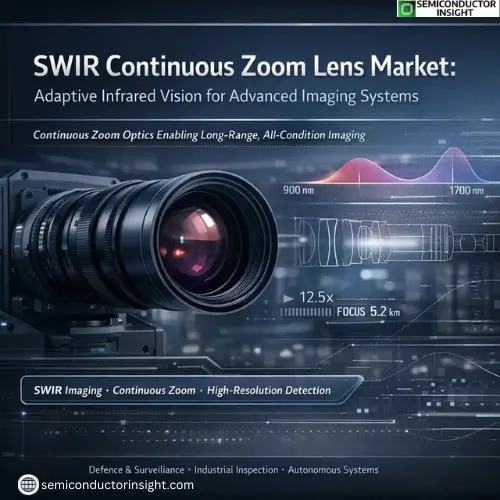
Shortwave Infrared Continuous Zoom Lens Market Exploring Insights Where Advanced Imaging Meets Precision Zooming
Shortwave infrared (SWIR) imaging has long been a cornerstone technology in applications demanding enhanced vision beyond visible wavelengths. When combined with continuous zoom capability, SWIR lenses unlock a powerful blend of high-resolution imaging, variable focal reach, and performance under challenging optical conditions. These lenses are increasingly important across defence, industrial inspection, scientific research, and autonomous systems.
Shortwave infrared continuous zoom lens market is emerging as one of the most dynamic segments in advanced optics, growing in parallel with demand for real-time imaging, long-range detection, and adaptive observation solutions.
Take a Quick Glance at Our In-Depth Analysis Report:
https://semiconductorinsight.com/report/shortwave-infrared-continuous-zoom-lens-market/
Defining SWIR and the Advantage of Continuous Zoom
Shortwave infrared refers to the portion of the electromagnetic spectrum roughly between 900 nm and 1700 nm. SWIR imaging delivers distinct advantages over visible light systems: improved penetration through haze and fog, enhanced material contrast, and the ability to visualize thermal and reflective differences invisible to conventional cameras.
Continuous zoom lenses allow optical systems to vary magnification smoothly without changing lenses, offering operators flexibility across varying target distances. This capability is particularly crucial where fixed focal lenses limit field adaptability. When SWIR sensing is married to continuous zoom optics, the result is versatile imaging equipment capable of long-distance observation without sacrificing clarity.
Current Market Growth and Use Case Expansion
Global demand for shortwave infrared continuous zoom lenses has been shaped by several industrial and security trends. In surveillance and defence, a growing percentage of imaging systems often cited in industry reports feature SWIR capability as part of multi-spectral sensor suites. This trend is driven by the need to detect and track objects across diverse lighting and weather conditions.
In industrial applications, SWIR continuous zoom lenses are increasingly used for materials inspection, quality control, and process monitoring. These lenses assist in identifying defects or inconsistencies that are not visible in traditional optical inspection, particularly in semiconductors, coatings, and complex assemblies.
Strategic Semiconductor Linkages and Optical Electronics Integration
At the heart of every SWIR continuous zoom lens system are semiconductors that perform photo detection, signal processing, focal control, and data transmission. The market is therefore not just about glass and mechanics it is deeply entwined with semiconductor evolution:
- SWIR sensorsbuilt on InGaAs (Indium Gallium Arsenide) and similar materials convert infrared light into electrical signals with high sensitivity.
• DSP (Digital Signal Processing) chips enhance image clarity, frame rate, and noise suppression.
• Controller ICs enable precision zoom mechanics and autofocus capabilities.
Manufacturers that can optimize the interplay between optical design and semiconductor processing deliver systems with faster response times, better image quality, and improved reliability.
Technological Innovations Shaping the Market
Innovation in the SWIR continuous zoom lens space has accelerated for several reasons. First, system designers are pushing for higher zoom ratios without proportionately increasing lens size and weight. Achieving this requires advanced optical materials, as well as precise engineering of lens elements and coatings that minimize chromatic aberration and maximize transmission in the SWIR band.
Second, integration with AI-enhanced vision systems and automated target recognition has raised the performance bar. With edge analytics, SWIR lenses can feed real-time data to machine learning models that help identify patterns, detect anomalies, or track movement without human intervention.
Researchers are also improving anti-reflection coatings and temperature-stable polymer composites to support performance in high-heat or low-light environments. Some recent product roadmaps from leading optical companies show a clear trend: continuous zoom SWIR lenses with adaptive focus control, enhanced signal-to-noise ratios, and AI-ready interfaces.
Geographical Adoption Trends
North America and Europe have traditionally been strong markets due to robust defence spending, advanced industrial automation infrastructure, and active participation in optical innovation. In Asia-Pacific, significant adoption is driven by the growth of defence modernization programs and rapid industrial digitization. In several emerging markets, adoption rates for advanced imaging including SWIR continuous zoom lenses have been growing year over year, reflecting broader investment in high-precision manufacturing and smart infrastructure.
Supply Chain and Component Challenges
While demand is increasing, the supply chain for SWIR continuous zoom lens systems is complex. Precision optics require high-purity materials, advanced fabrication techniques, and stringent quality assurance. In addition, semiconductors used in these systems particularly InGaAs sensors and specialized DSPs are subject to capacity constraints and long lead times.
Manufacturers mitigate this by developing strong supplier relationships, investing in in-house optical assembly lines, and collaborating with semiconductor foundries for prioritized wafer allocations. As a result, some companies are now integrating more vertically, combining optics, sensors, and processing electronics under unified quality standards.
Pricing, Value, and Competitive Differentiation
Shortwave infrared continuous zoom lenses command a pricing premium compared to visible-light lenses due to the complexity of optical elements and the precision required in manufacturing. Value is increasingly defined by resolution performance, zoom ratio, environmental durability, and system integration capabilities.
Leading players differentiate through performance guarantees, long-term support contracts, and product configurations tailored to defense, industrial, or commercial imaging sectors. As customers weigh total cost of ownership, service responsiveness and ease of integration often become deciding factors.
The shortwave infrared continuous zoom lens market is in an expansion phase, supported by continuing deployments in advanced imaging systems. As shortwave sensors become more cost-effective and integrated silicon optics improve, broader adoption is expected in areas like search and rescue, autonomous surveillance platforms, and condition monitoring.
Industry intelligence suggests that growth momentum will continue as companies focus on modular imaging platforms, remote diagnostics, and intelligent zoom control. These capabilities are becoming increasingly important in edge systems that must operate reliably in diverse environments.

Comments (0)