
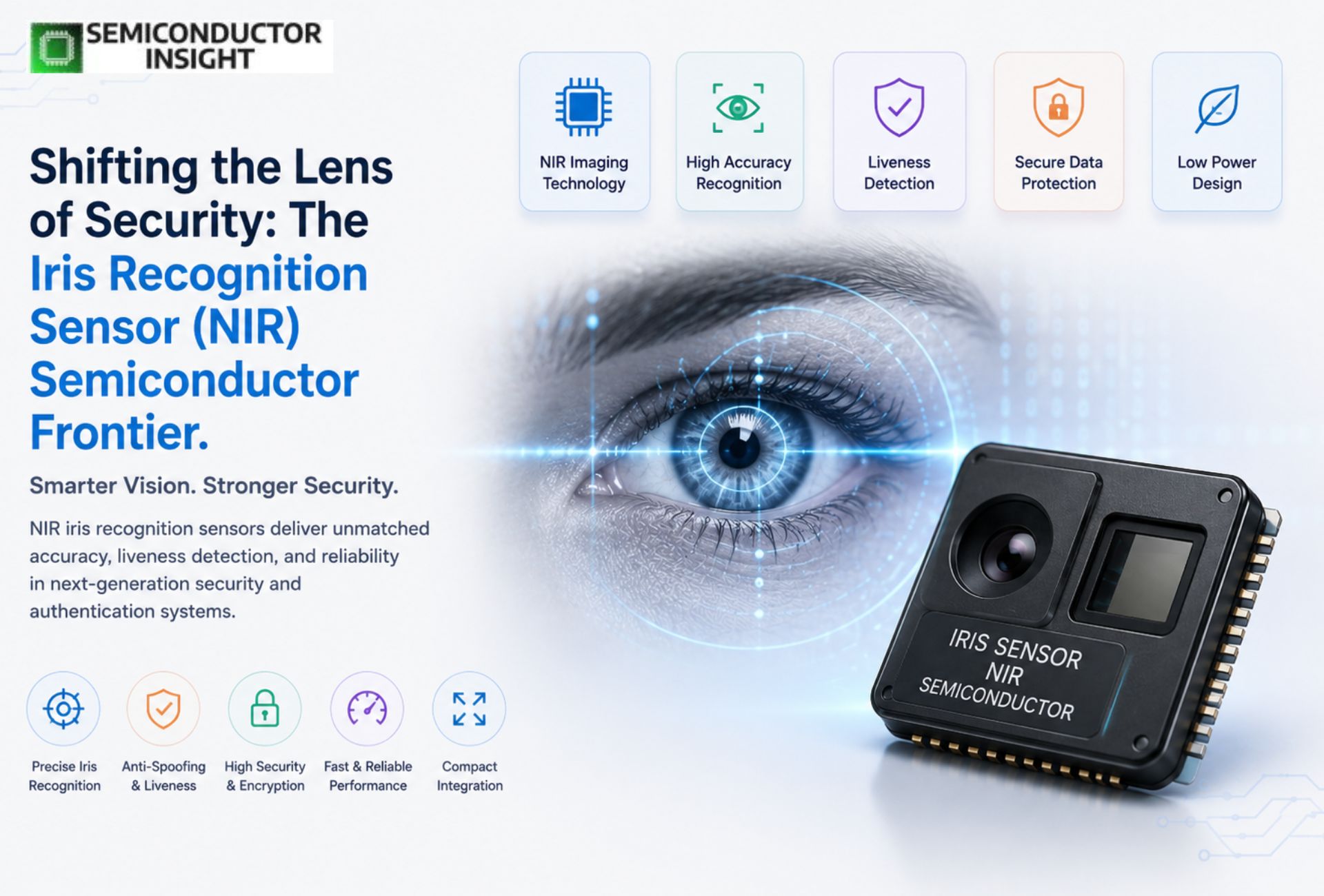
Shifting the Lens of Security: The Iris Recognition Sensor (NIR) Semiconductor Frontier
Shifting the Lens of Security: The Iris Recognition Sensor (NIR) Semiconductor Frontier
The story of biometric security is no longer about passwords or PINs; it is being rewritten inside the tiny silicon gut of near‑infrared (NIR) iris recognition sensors. These sensors sit at the crossroads of advanced imaging, semiconductor miniaturisation, and embedded processing, and they are quietly becoming essential components in smartphones, border‑control systems, and high‑security access‑control setups.
Globally, the iris‑recognition market is now valued at roughly 6 billion dollars, with the dedicated sensor segment alone expected to grow from around 1.4 billion dollars in 2025 toward 3.1 billion dollars by the early 2030s, underpinned by millions of new units being embedded into consumer and industrial devices every year.
Curious about the report? Dive into our newest updated version at no cost: https://semiconductorinsight.com/report/iris-recognition-sensor-nir-market/
Why NIR Is the Core of Modern Iris Sensors?
NIR‑based iris recognition does something that standard RGB cameras struggle with: it captures the intricate, high‑contrast pattern of the iris consistently, even in very low light or slightly off‑angle conditions.
Vendors such as Everlight have introduced NIR‑C19M‑style 810 nm infrared LEDs specifically tuned to this wavelength, because it maximises the contrast between the iris’s trabecular details and the surrounding eye while still complying with safety standards like IEC 62471. These LEDs are paired with CMOS image sensors and advanced image‑signal processors (ISP) that together convert the reflected NIR light into a clear, digitised iris template that can be matched in real time.
In practical terms, this means that an NIR iris module can authenticate a user in under one second, often at distances of 20–50 cm, depending on the lens and sensor configuration. For semiconductor designers, the challenge is to integrate all this into a footprint small enough to fit inside a smartphone bezel or a compact access‑control terminal, which is pushing the industry toward stacked packages and tighter co‑design of optics, sensors, and low‑power processors.
How Silicon Economics Are Shaping the Market?
- The iris‑recognition sensor market is not just about optical physics; it is also about die size, process nodes, and packaging economics.
- Many NIR‑based modules still use mature CMOS nodes, but newer designs are moving toward more advanced and compact imaging platforms, including sensors that share the same die or stack with ISP logic in a way reminiscent of 3D‑integrated image‑sensor architectures explored in retina‑inspired “IRIS”‑style cameras.
- This kind of integration allows manufacturers to shrink the overall module size, reduce power consumption, and improve thermal management—critical factors in handheld and wearable devices.
- On the supply side, component‑level innovations are also lowering the effective entry cost.
For example, Taiwanese and Korean LED makers have ramped up compact surface‑mount NIR‑LED families that are specifically optimised for eye tracking, biometrics, and iris recognition, with radiant intensities above 2,700 mW/Sr at drive currents under 1,000 mA, enabling designers to use fewer LEDs per module while still meeting illumination requirements.
These developments translate into more affordable sensor modules that can be deployed not only in premium smartphones but also in industrial handhelds, smart locks, and even mid‑range access‑control panels.
From Smartphones to Smart Infrastructure: Real‑World Adoption
- Real‑world adoption of NIR iris sensors is no longer confined to niche government or military installations. In India and China, several smartphone OEMs have tested or rolled out NIR‑based iris authentication in budget‑to‑mid‑range devices, using the same front‑facing cameras to double as both a selfie camera and an iris‑capture module when paired with a dual‑purpose RGB‑NIR sensor.
- Border‑control agencies in the Middle East and Asia have also accelerated the deployment of contactless iris stations at airports and land checkpoints, where the ability to authenticate passengers without physical contact or fingerprint pads has become a hygiene and throughput priority.
- In healthcare and finance, clinics and banks are integrating NIR‑iris scanners into patient‑registration and customer‑onboarding workflows, where the need for high‑accuracy, non‑contact biometric checks is growing.
- Some systems now support multi‑modal setups, fusing iris data with facial recognition or voice to create layered authentication layers that can be tuned to different risk levels.
This is pushing the sensor ecosystem to support not only faster template matching but also ‑edge encryption and privacy‑preserving templates that reduce the risk of biometric data leakage.

Comments (0)