
Semiconductor Innovations Fuelling HD Encoder Market in 2026 and in Coming Years
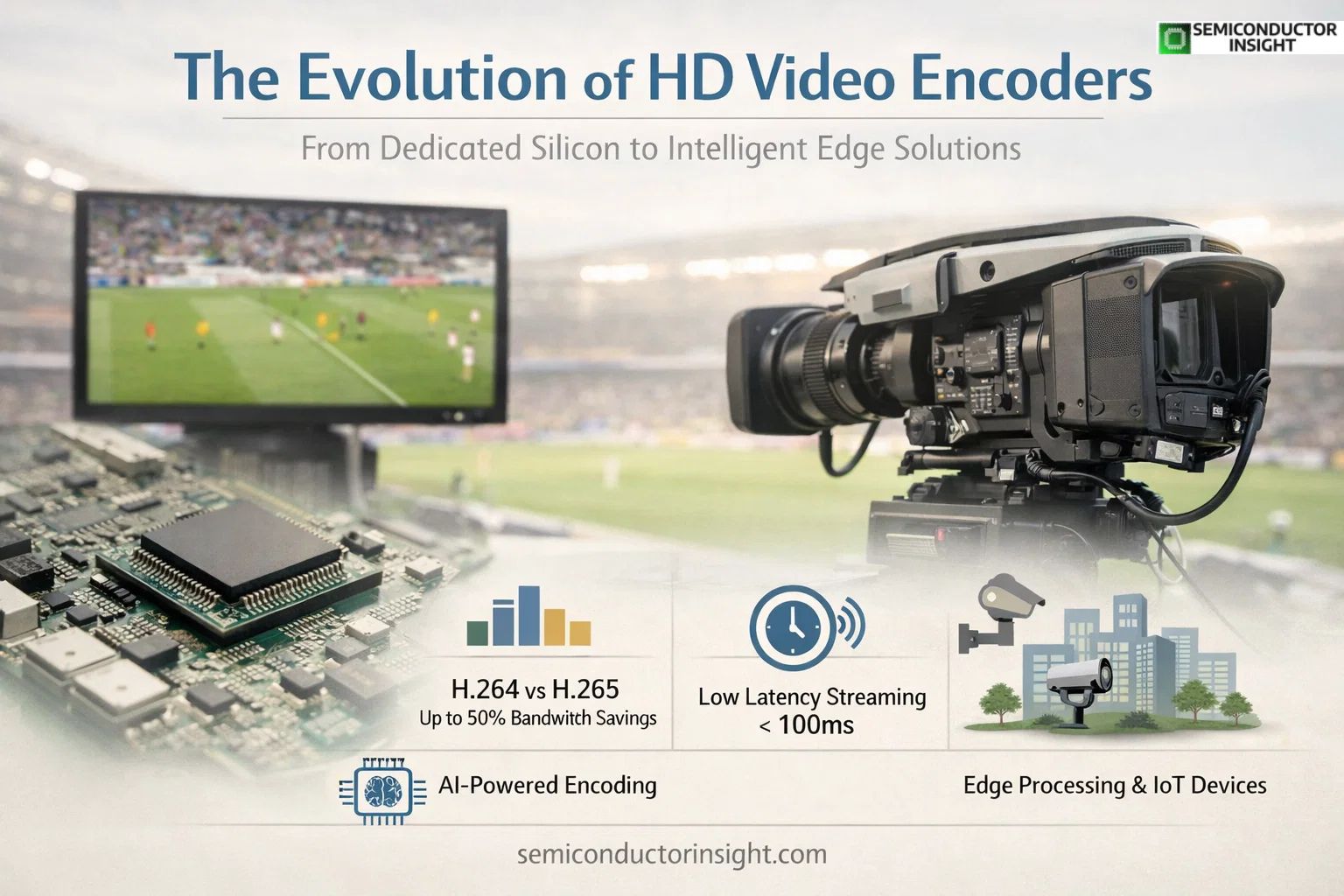
HD encoder market has quietly become one of the most critical components of the semiconductor-driven media ecosystem. Every high-definition video stream whether live sports, OTT content, or enterprise video conferencing relies on encoding technologies powered by specialized semiconductor chips. These encoders convert raw video into compressed digital formats such as H.264 and H.265, reducing bandwidth consumption while maintaining visual quality.
For instance, in April 2026,
- Renishaw, a world leader in engineering technology, has released its absolute multi-DoF (multiple degrees of freedom) optical encoder system.
- This system combines one or more of the company’s RXMA30 1.5D scales with its RESOLUTE absolute encoder readheads, which have been shown to work in the market.
- This flexible system can measure position in up to 6 degrees of freedom (6DoF), making it perfect for high-performance motion systems where speed, precision, and repeatability are very important.
The increasing demand for high-resolution video, including Full HD and beyond, has placed semiconductor-based encoders at the center of innovation. Hardware encoders, built using ASICs and FPGAs, now outperform software solutions in latency, power efficiency, and scalability key metrics for broadcasters and cloud service providers.
Encoding Silicon: From General-Purpose to Dedicated Architectures
- The evolution of HD encoders is closely tied to semiconductor design advancements. Earlier systems relied heavily on CPUs and GPUs, but today’s encoding workloads are increasingly handled by dedicated silicon.
- Modern encoder chips integrate parallel processing cores optimized for motion estimation, transform coding, and entropy encoding. For example, FPGA-based encoders can process multiple 1080p streams simultaneously with latency under 50 milliseconds, making them ideal for live broadcasting.
- In 2024, global shipments of FPGA devices exceeded 3.5 million units for video and imaging applications, with a significant portion allocated to encoding and decoding functions. Meanwhile, ASIC-based encoders are gaining traction due to their lower power consumption often consuming less than 10 watts per channel compared to 30-50 watts in GPU-based systems.
Bandwidth Economics Driving Hardware Adoption
Bandwidth remains one of the most expensive resources in video delivery. HD encoders reduce bitrate requirements significantly, directly impacting operational costs.
- For instance, efficient H.265 encoding can reduce bandwidth usage by up to 50% compared to H.264, without noticeable quality degradation. This translates into savings of several terabytes of data per month for large streaming platforms.
Telecom operators and content delivery networks (CDNs) are increasingly investing in hardware encoders to optimize network utilization. In India alone, video traffic accounted for over 70% of total mobile data usage in 2025, according to telecom regulatory data, highlighting the urgency for efficient encoding solutions.
Edge Encoding and the Semiconductor Shift
A major shift in HD encoder market is the movement toward edge-based encoding. Instead of centralized encoding in data centers, video is now processed closer to the source such as cameras, drones, and IoT devices.
This shift is driving demand for compact, energy-efficient semiconductor chips capable of real-time encoding. Edge encoders are now embedded in surveillance systems, autonomous vehicles, and smart city infrastructure.
For example, modern IP cameras with built-in HD encoders can compress and transmit video streams using less than 5 Mbps bandwidth while maintaining 1080p resolution. This capability is critical for large-scale deployments, such as urban surveillance networks with thousands of cameras.
You can freely browse our most recent updated report to learn more about it before scrolling further: https://semiconductorinsight.com/report/hd-encoder-market/
The New Age Shift in Sports Content Distribution
Live sports broadcasting has become a proving ground for HD encoder innovation. Broadcasters require ultra-low latency and high reliability, especially for global events.
During major international tournaments in 2024, broadcasters deployed FPGA-based encoders to deliver multiple HD feeds with latency below 100 milliseconds. These systems enabled real-time streaming to millions of viewers across different platforms.
Additionally, adaptive bitrate streaming enabled by advanced encoders allowed seamless viewing experiences across varying network conditions, reducing buffering rates by nearly 30% compared to earlier setups.
AI Meets Encoding: Semiconductor Integration Trends
- Artificial intelligence is increasingly being integrated into HD encoder chips. AI-powered encoding optimizes bitrate allocation by analyzing scene complexity in real time.
- For example, AI-based encoders can allocate more bits to high-motion scenes (such as sports) and fewer bits to static backgrounds, improving overall compression efficiency. This approach can enhance video quality by up to 20% at the same bitrate.
- Semiconductor companies are embedding neural processing units (NPUs) within encoder chips, enabling real-time AI inference without relying on external hardware. This integration is particularly valuable for applications like video analytics, surveillance, and content moderation.
HD encoder market is no longer just a supporting technology it has become a defining factor in the performance of modern video systems. As semiconductor innovation continues to push boundaries, encoding efficiency, latency, and intelligence will determine the competitiveness of media platforms and infrastructure providers.

Comments (0)