HD Encoder Market Insights
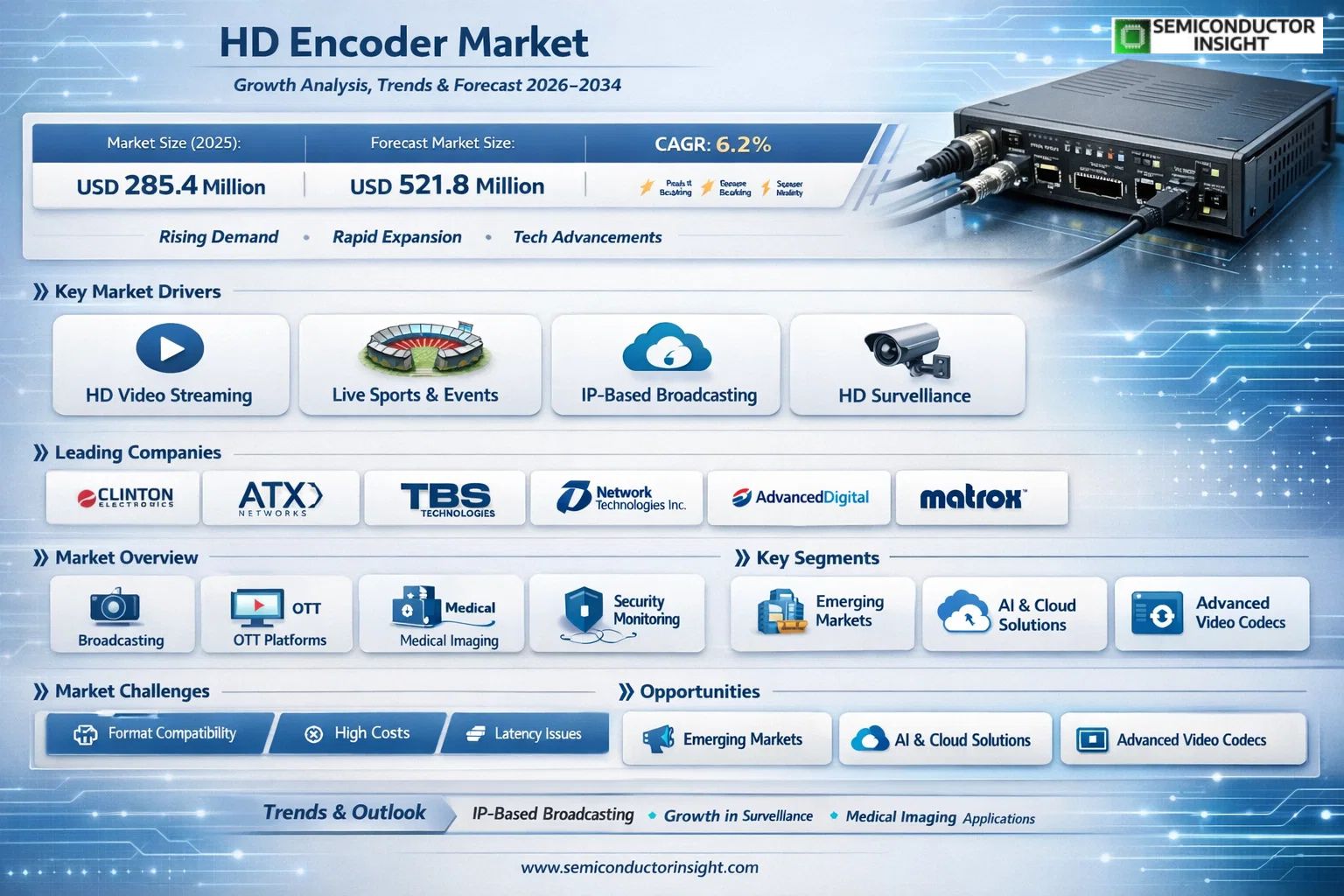
Global HD Encoder market size was valued at USD 285.4 million in 2025. The market is projected to grow from USD 304.6 million in 2026 to USD 521.8 million by 2034, exhibiting a CAGR of 6.2% during the forecast period.
HD encoders are highly specialized audio and video signal coding equipment designed to compress and transmit high-definition content with minimal bandwidth consumption while preserving exceptional image quality. HDMI remains the most widely used interface for video transmission, though HD encoders also support SDI and VGA interfaces to accommodate diverse broadcast and professional media environments. By leveraging advanced compression standards such as H.264 and H.265/HEVC, these devices enable high-definition video transmission across IP networks, satellite links, and cable infrastructures , making them indispensable across broadcasting, surveillance, healthcare, and education sectors.
The market is witnessing consistent growth driven by the accelerating global shift toward IP-based broadcasting, the rapid expansion of OTT streaming platforms, and the rising deployment of HD surveillance systems across public and private infrastructure. Security monitoring and radio and television applications collectively represent the dominant end-use segments, accounting for a significant share of overall demand. Furthermore, the growing adoption of HD encoders in medical imaging environments , where high-fidelity video transmission is critical , is opening new revenue streams. Key manufacturers operating in this space include Clinton Electronics, ATX Networks, TBS Technologies, Network Technologies, AdvancedDigital, Softel Optic, HaiweiTech, Cornet Technology, Advanced Media Technologies, and Matrox, among others, each maintaining competitive portfolios tailored to professional-grade encoding requirements.
MARKET DRIVERS
Surging Demand for High-Definition Video Streaming and Broadcast Infrastructure
Global HD encoder market is experiencing significant momentum, driven primarily by the accelerating transition from standard-definition to high-definition and ultra-high-definition content delivery across broadcast, cable, and over-the-top (OTT) platforms. As media consumption habits shift toward on-demand and live streaming services, broadcasters and content distributors are investing heavily in encoding infrastructure capable of delivering superior picture quality. The proliferation of smart televisions, connected devices, and high-bandwidth internet connections has created a robust ecosystem where HD encoding technology is no longer optional but a fundamental requirement for competitive content delivery.
Expansion of Live Sports Broadcasting and Event Streaming
Live sports broadcasting remains one of the most compelling drivers for HD encoder market, as sports events demand real-time encoding with minimal latency and maximum visual fidelity. Major sporting events, esports tournaments, and live entertainment broadcasts require dedicated hardware and software encoders capable of processing high-bitrate streams under strict delivery timelines. Broadcasters are upgrading their encoding workflows to support HEVC (H.265) and AV1 codec standards, enabling efficient compression without sacrificing visual quality. This trend is further amplified by the growing number of regional sports networks and the expansion of digital rights agreements globally.
➤ The transition to IP-based broadcast infrastructure is reshaping encoding workflows, compelling industry stakeholders to adopt software-defined and cloud-based HD encoding solutions that offer scalability, flexibility, and cost efficiency compared to traditional hardware-centric deployments.
The rapid adoption of cloud-based encoding platforms is further accelerating market expansion, as broadcasters and enterprises seek to reduce capital expenditure while maintaining high-quality output. Cloud encoding enables distributed workflows, allowing content producers to encode, transcode, and deliver HD content from geographically dispersed locations. This architectural shift is particularly relevant for news organizations, live event producers, and streaming platforms that require agile and scalable encoding pipelines capable of handling fluctuating demand without compromising delivery standards.
MARKET CHALLENGES
Complexity of Multi-Format Encoding Standards and Interoperability Issues
One of the principal challenges confronting HD encoder market is the increasing complexity introduced by the coexistence of multiple video codec standards, including H.264/AVC, H.265/HEVC, VP9, and the emerging AV1 format. Operators and content distributors must support diverse device ecosystems, each with varying levels of codec compatibility, making multi-format encoding workflows technically demanding and operationally expensive. The lack of universal standardization across delivery platforms creates significant interoperability challenges, compelling vendors to develop versatile encoding solutions that can adapt to heterogeneous environments without incurring prohibitive licensing costs or processing overhead.
Other Challenges
High Infrastructure and Licensing Costs
The deployment of professional-grade HD encoding systems involves substantial upfront investment in hardware, software licenses, and integration services. For small and mid-sized broadcasters, media companies, and regional content operators, these costs present a meaningful barrier to adoption, particularly when transitioning from legacy encoding infrastructure. Codec licensing fees, especially for HEVC, have historically been a contentious issue within the industry, creating hesitancy among adopters and slowing the pace of technology refresh cycles in cost-sensitive markets.
Latency Constraints in Real-Time Encoding Applications
Maintaining ultra-low latency in live HD encoding workflows remains a persistent technical challenge, particularly for interactive applications such as live sports betting, remote production, and real-time communications. Achieving the balance between high compression efficiency and minimal encoding delay requires sophisticated algorithmic optimization and purpose-built hardware acceleration. As viewer expectations for real-time interactivity increase, encoding solution providers face mounting pressure to deliver sub-second latency without degrading stream quality, a challenge that demands continuous research and development investment.
MARKET RESTRAINTS
Fragmented Regulatory Landscape and Codec Licensing Disputes
HD encoder market faces notable restraints stemming from a fragmented intellectual property landscape surrounding video codec technologies. Ongoing disputes and the presence of multiple patent pools governing HEVC licensing have created uncertainty for manufacturers and end-users alike, resulting in delayed product development cycles and reluctance to commit to long-term encoding infrastructure investments. Regulatory differences across regions further complicate market expansion, as broadcast standards and content delivery requirements vary significantly between North America, Europe, and Asia-Pacific, necessitating region-specific product configurations and compliance measures that increase time-to-market and operational complexity.
Constraints Imposed by Legacy Broadcast Infrastructure
A significant portion of Global broadcast industry continues to operate legacy encoding and transmission infrastructure that was designed for standard-definition or early HD workflows. Migrating these systems to modern HD encoding platforms requires extensive capital investment, workflow redesign, and technical retraining, creating inertia that restrains overall market growth. Many public broadcasters and regional operators, particularly in emerging economies, face budgetary limitations that make large-scale infrastructure upgrades challenging to justify within short planning horizons. This installed base of aging equipment acts as a structural restraint, moderating the pace at which next-generation encoding technologies achieve broad market penetration.
MARKET OPPORTUNITIES
Growth Potential in Emerging Markets Driven by Digital Broadcast Migration
Emerging economies across Asia-Pacific, Latin America, the Middle East, and Africa present substantial untapped opportunities for HD encoder market, as governments and private broadcasters accelerate digital switchover programs and invest in modernizing national broadcast infrastructure. The transition from analog to digital broadcasting mandates the deployment of compliant HD encoding systems across terrestrial, satellite, and cable networks, creating a structured demand cycle that is expected to sustain market expansion over the medium term. Rising internet penetration and mobile broadband adoption in these regions are simultaneously fueling demand for OTT-compatible encoding solutions capable of serving mobile-first audiences.
AI-Powered and Cloud-Native Encoding as a Transformational Market Opportunity
The integration of artificial intelligence and machine learning into HD encoding workflows represents one of the most significant growth opportunities in the market. AI-driven encoding solutions can dynamically optimize bitrate allocation, scene complexity analysis, and quality-of-experience parameters, enabling content providers to deliver superior HD streams at lower bandwidth costs. Cloud-native encoding architectures further amplify this opportunity by enabling elastic scalability, automated quality control, and seamless integration with content delivery networks. Vendors that successfully develop and commercialize intelligent, cloud-integrated encoding platforms are well-positioned to capture disproportionate market share as the industry transitions toward software-defined media infrastructure.
Trends
Rising Demand for High-Definition Video Transmission Drives HD Encoder Market Growth
HD encoder market is experiencing notable momentum as industries worldwide accelerate their adoption of high-definition audio and video signal coding technologies. HD encoders, which leverage interfaces such as HDMI, SDI, and VGA, are engineered to deliver high image quality and high-definition video transmission within minimal bandwidth constraints. This technical efficiency has made them indispensable across a wide range of applications, including radio and television broadcasting, educational recording, security monitoring, and medical imaging. As digital infrastructure continues to expand globally, the demand for professional-grade encoding equipment is consistently rising across both developed and emerging economies.
Other Trends
Expansion Across Broadcasting and Security Monitoring Applications
One of the most prominent trends shaping HD encoder market is the accelerating deployment of encoding solutions in radio and television broadcasting as well as security monitoring sectors. Broadcasters are increasingly transitioning from standard-definition to high-definition workflows, requiring robust encoding equipment capable of managing complex signal processing tasks. Simultaneously, the rapid expansion of IP-based surveillance infrastructure has intensified the need for HD encoders that can efficiently compress and transmit high-resolution video feeds. Security monitoring now represents one of the fastest-growing application segments, supported by rising public safety investments across North America, Europe, and the Asia-Pacific region.
Growing Adoption in Educational Recording and Medical Imaging
Educational institutions and healthcare facilities are emerging as significant end-users within HD encoder market. The shift toward digital and remote learning environments has driven educational organizations to invest in reliable HD encoding systems for lecture capture, live streaming, and content archiving. In the medical imaging domain, HD encoders are being integrated into diagnostic and surgical video systems to ensure accurate, high-fidelity visual data transmission. These niche but high-value applications are contributing to the diversification of HD encoder market’s end-user base, creating new growth avenues beyond traditional broadcasting.
Competitive Landscape and Technological Innovation Among Key Manufacturers
HD encoder market features a competitive landscape with several established global players driving technological advancement. Key manufacturers such as Clinton Electronics, ATX Networks, TBS Technologies, Matrox, Hangzhou Hikvision Digital Technology, and Advanced Media Technologies are actively investing in product development to address evolving industry requirements. Video encoder solutions continue to represent the dominant product segment, while audio encoder technologies are gaining traction as multi-format content delivery becomes increasingly prevalent. Regional markets in Asia, particularly China, are demonstrating strong growth potential, supported by expanding digital broadcasting mandates and accelerating smart city initiatives. North America remains a mature but innovation-driven market, where integration with cloud-based and IP-based streaming platforms is reshaping product development priorities across the HD Encoder industry.
COMPETITIVE LANDSCAPE
Key Industry Players
HD Encoder Market , Competitive Dynamics, Leading Manufacturers, and Strategic Positioning
Global HD Encoder market is characterized by a moderately consolidated competitive landscape, with a handful of established players commanding a significant share of total revenues. Companies such as Matrox, Hangzhou Hikvision Digital Technology, and ATX Networks have leveraged decades of expertise in video processing and signal encoding to maintain strong market positions. Matrox, in particular, is widely recognized for its high-performance hardware encoding solutions deployed across broadcast, post-production, and enterprise streaming environments. Hangzhou Hikvision Digital Technology, a global leader in video surveillance and imaging technologies, has expanded its HD encoder portfolio to serve security monitoring and smart city applications, reinforcing its dominance across Asia-Pacific and emerging markets. The competitive intensity in the HD encoder space is further shaped by ongoing innovation in compression standards , notably H.264 and H.265/HEVC , as vendors race to deliver lower-bitrate, higher-quality video transmission solutions for applications spanning radio and television broadcasting, educational recording, medical imaging, and security monitoring.
Beyond the dominant players, a robust tier of specialized and regional manufacturers contributes meaningfully to market competition. Clinton Electronics and Advanced Media Technologies have carved out strong niches in the North American market, serving broadcast and professional AV integration segments. TBS Technologies and AdvancedDigital are recognized for their cost-effective, feature-rich encoding hardware tailored to IPTV and digital broadcasting deployments. HaiweiTech and Zhiyong Electronics represent competitive Chinese manufacturers benefiting from localized production advantages and growing domestic demand for HD encoding infrastructure. Cornet Technology and Network Technologies serve niche professional and industrial segments, while Softel Optic addresses specialized optical fiber-based HD signal distribution. HOSHI and HCSTCOM round out the competitive field with targeted product offerings for regional broadcast and surveillance markets. Collectively, the top five global players accounted for an estimated majority share of total market revenues in 2025, though increasing competition from agile regional manufacturers continues to exert pressure on pricing and product differentiation strategies across all application verticals.
List of Key HD Encoder Companies Profiled
- Clinton Electronics
- ATX Networks
- TBS Technologies
- Network Technologies
- AdvancedDigital
- Softel Optic
- HaiweiTech
- Cornet Technology
- Advanced Media Technologies
- Matrox
- Zhiyong Electronics
- Hangzhou Hikvision Digital Technology
- HOSHI
- HCSTCOM
Segment Analysis:
| Segment Category | Sub-Segments | Key Insights |
| By Type |
|
Video Encoder represents the dominant segment within HD encoder market, driven by surging demand for high-definition visual content across broadcast, surveillance, and streaming industries.
|
| By Application |
|
Radio and Television holds the leading position in HD encoder market by application, reflecting the sector’s long-standing reliance on professional encoding equipment for high-quality broadcast signal delivery.
|
| By End User |
|
Broadcast & Media Companies represent the most prominent end-user segment in HD encoder market, underpinned by their continuous need for professional-grade encoding equipment to support content production and distribution workflows.
|
| By Interface Type |
|
HDMI-Based Encoders lead this segment as HDMI remains the most widely used interface for HD video signal transmission across both consumer and professional environments.
|
| By Deployment Mode |
|
Hardware-Based Encoders dominate the deployment landscape, particularly among professional broadcast, surveillance, and medical imaging users who prioritize reliability, low latency, and consistent performance in demanding operational environments.
|
Regional Analysis: HD Encoder Market
North America
North America leads in the adoption of software-defined and cloud-based HD encoding platforms, with broadcasters and streaming providers actively transitioning away from hardware-centric models. The proliferation of IP video workflows, combined with growing demand for low-latency live streaming, has made this region a primary testing ground for next-generation HD encoder architectures and codec standards such as HEVC and AV1.
The United States hosts one of the world’s most advanced media production ecosystems, encompassing major broadcast networks, streaming giants, and live sports organizations. This ecosystem creates sustained and diversified demand for HD encoder solutions across content acquisition, post-production, and distribution workflows, positioning the region as a consistent driver of market evolution and technology investment in the HD encoder segment.
Beyond traditional broadcasting, North America’s corporate sector has emerged as a significant consumer of HD encoder technology. Organizations leverage encoding solutions for internal communications, virtual conferencing, e-learning platforms, and hybrid event production. This diversification of end-user verticals strengthens market resilience and expands revenue opportunities for HD encoder vendors operating in the region.
Supportive regulatory frameworks governing digital broadcasting transitions and spectrum management have historically accelerated HD encoder adoption across North America. Continued federal and state-level investments in broadband connectivity infrastructure further enhance the operational environment for high-definition video delivery, reinforcing the region’s position as the leading contributor to Global HD encoder market landscape.
Europe
Europe represents a mature and technologically sophisticated segment of Global HD encoder market, characterized by stringent broadcasting standards, strong public broadcasting institutions, and a well-established digital television infrastructure. Countries such as Germany, the United Kingdom, France, and the Nordic nations have long been at the forefront of digital switchover initiatives, creating a stable and recurring demand for advanced HD encoding solutions. The European Broadcasting Union plays a pivotal role in shaping the region’s technical requirements, encouraging the adoption of modern encoding formats and interoperability standards. Growing investment in OTT platforms and video-on-demand services across Western Europe is further accelerating demand for scalable encoding infrastructure. Eastern Europe is emerging as an increasingly relevant market as broadcasters in countries like Poland and the Czech Republic modernize their digital transmission capabilities. The region’s focus on energy-efficient and environmentally compliant technology also influences product development priorities among HD encoder manufacturers serving European clients.
Asia-Pacific
Asia-Pacific is widely recognized as the fastest-growing regional market within Global HD encoder industry, propelled by rapid urbanization, expanding internet penetration, and an explosion in digital content consumption across populous nations including China, India, Japan, and South Korea. The region’s diverse broadcasting landscape , ranging from highly advanced markets in East Asia to rapidly digitizing economies in Southeast Asia , creates a broad and varied demand profile for HD encoding solutions. China’s domestic technology sector has produced competitive HD encoder manufacturers that cater to both local broadcasters and international clients, while India’s booming OTT market is generating substantial demand for scalable and cost-effective encoding platforms. Government-led digital broadcasting mandates across multiple Asia-Pacific countries continue to drive infrastructure upgrades that incorporate modern HD encoding technologies. The growing popularity of live streaming, esports, and user-generated content platforms across the region further amplifies market growth prospects through the forecast horizon.
South America
South America occupies a developing yet progressively significant position in Global HD encoder market, with Brazil serving as the primary growth engine due to its large population, active media sector, and ongoing transition toward digital broadcasting standards. The country’s implementation of the ISDB-T digital television standard has created sustained demand for compatible HD encoding equipment among broadcasters and content producers. Argentina, Colombia, and Chile are also demonstrating increasing interest in advanced video infrastructure as their respective media industries modernize. While economic variability across the region can temper capital investment cycles, the expanding reach of mobile internet and streaming services is gradually offsetting these challenges by stimulating demand for cloud-based encoding solutions. South America’s sports broadcasting sector, particularly around football and major international events, remains a consistent catalyst for HD encoder adoption across the region’s broadcast landscape.
Middle East & Africa
The Middle East and Africa region presents a compelling growth narrative for HD encoder market, underpinned by ambitious media modernization programs, rising digital content consumption, and significant investment in broadcasting infrastructure across key markets. In the Middle East, nations such as the United Arab Emirates, Saudi Arabia, and Qatar are investing heavily in world-class media production facilities and satellite broadcasting capabilities, creating strong demand for premium HD encoding solutions. The region’s growing appetite for live sports and entertainment content further sustains this demand. Africa, while at an earlier stage of digital broadcasting adoption, is experiencing increasing momentum driven by regulatory mandates for digital terrestrial television migration across multiple countries. As mobile broadband networks expand across sub-Saharan Africa, cloud-based and portable HD encoding platforms are gaining traction among broadcasters seeking flexible and cost-efficient video production infrastructure suited to the continent’s evolving media environment.
Report Scope
This market research report provides a comprehensive analysis of HD encoder market, covering the forecast period 2026–2034. It offers detailed insights into market dynamics, technological advancements, competitive landscape, and key trends shaping the industry.
Key focus areas of the report include:
- Market Overview: The report begins with an overview outlining its current market scenario, key growth indicators, and industry transformation drivers. It discusses macroeconomic factors, demand–supply balance, regulatory landscape, and the strategic role of HD encoders in powering advancements across industries such as radio and television, security monitoring, medical imaging, and educational recording.
- Market Size & Forecast: Historical data and future projections for revenue, unit shipments, and market value across major regions and segments.
- Segmentation Analysis: Detailed breakdown by product type, technology, application, and end-user industry to identify high-growth segments and investment opportunities.
- Regional Insights: Insights into market performance across North America, Europe, Asia-Pacific, Latin America, and the Middle East & Africa, including country-level analysis where relevant.
- Competitive Landscape: Profiles of leading market participants, including their product offerings, R&D focus, manufacturing capacity, pricing strategies, and recent developments such as mergers, acquisitions, and partnerships.
- Technology Trends & Innovation: Assessment of emerging technologies, integration of AI/IoT, HD encoder design trends, fabrication techniques, and evolving industry standards.
- Market Drivers & Restraints: Evaluation of factors driving market growth along with challenges, supply chain constraints, regulatory issues, and market-entry barriers.
- Stakeholder Insights: Insights for component suppliers, OEMs, system integrators, investors, and policymakers regarding the evolving ecosystem and strategic opportunities.
Primary and secondary research methods are employed, including interviews with industry experts, data from verified sources, and real-time market intelligence to ensure the accuracy and reliability of the insights presented.
FREQUENTLY ASKED QUESTIONS:
What is the current market size of HD encoder market?
-> Global HD Encoder Market was valued at USD 285.4 million in 2025 and is expected to reach USD 521.8 million by 2034, growing at a CAGR of 6.2% during the forecast period.
Which key companies operate in HD encoder market?
-> Key players include Clinton Electronics, ATX Networks, TBS Technologies, Network Technologies, AdvancedDigital, Softel Optic, HaiweiTech, Cornet Technology, Advanced Media Technologies, Matrox, Zhiyong Electronics, Hangzhou Hikvision Digital Technology, HOSHI, and HCSTCOM, among others. In 2025, Global top five players held approximately % of the market share in terms of revenue.
What are the key growth drivers?
-> Key growth drivers include rising demand for high-definition video transmission, expanding applications in radio and television, security monitoring, medical imaging, and educational recording, as well as advancements in HDMI, SDI, and VGA interface technologies that enable high image quality with minimal bandwidth consumption.
Which region dominates HD encoder market?
-> North America represents a significant market, with the U.S. market size estimated at USD million in 2025. Asia is also a major contributor, with China projected to reach USD million during the forecast period, reflecting strong regional demand across broadcasting, surveillance, and medical sectors.
What are the emerging trends in HD encoder market?
-> Emerging trends include adoption of advanced video encoding technologies, growth of the Video Encoder segment (projected to reach USD million by 2034 with a % CAGR), integration of HD encoders in IP-based broadcasting and cloud streaming platforms, and increasing use in security monitoring and medical imaging applications.

Get Sample Report PDF for Exclusive Insights
Report Sample Includes
- Table of Contents
- List of Tables & Figures
- Charts, Research Methodology, and more...
 Download Sample Report PDF