
Semiconductor Industry Transformation Boosting Passive Components Market
Modern electronics would simply not function without passive components. While semiconductors often receive the spotlight for processing power, passive components quietly stabilize circuits, manage electrical flow, and ensure reliable device performance.
As semiconductor technology advances into smaller, faster, and more complex designs, the Passive Components Market is evolving alongside it, becoming a critical element in modern electronic systems ranging from consumer gadgets to large-scale data infrastructure.
What is the Silent Infrastructure behind Semiconductor Circuits? Let’s See Below
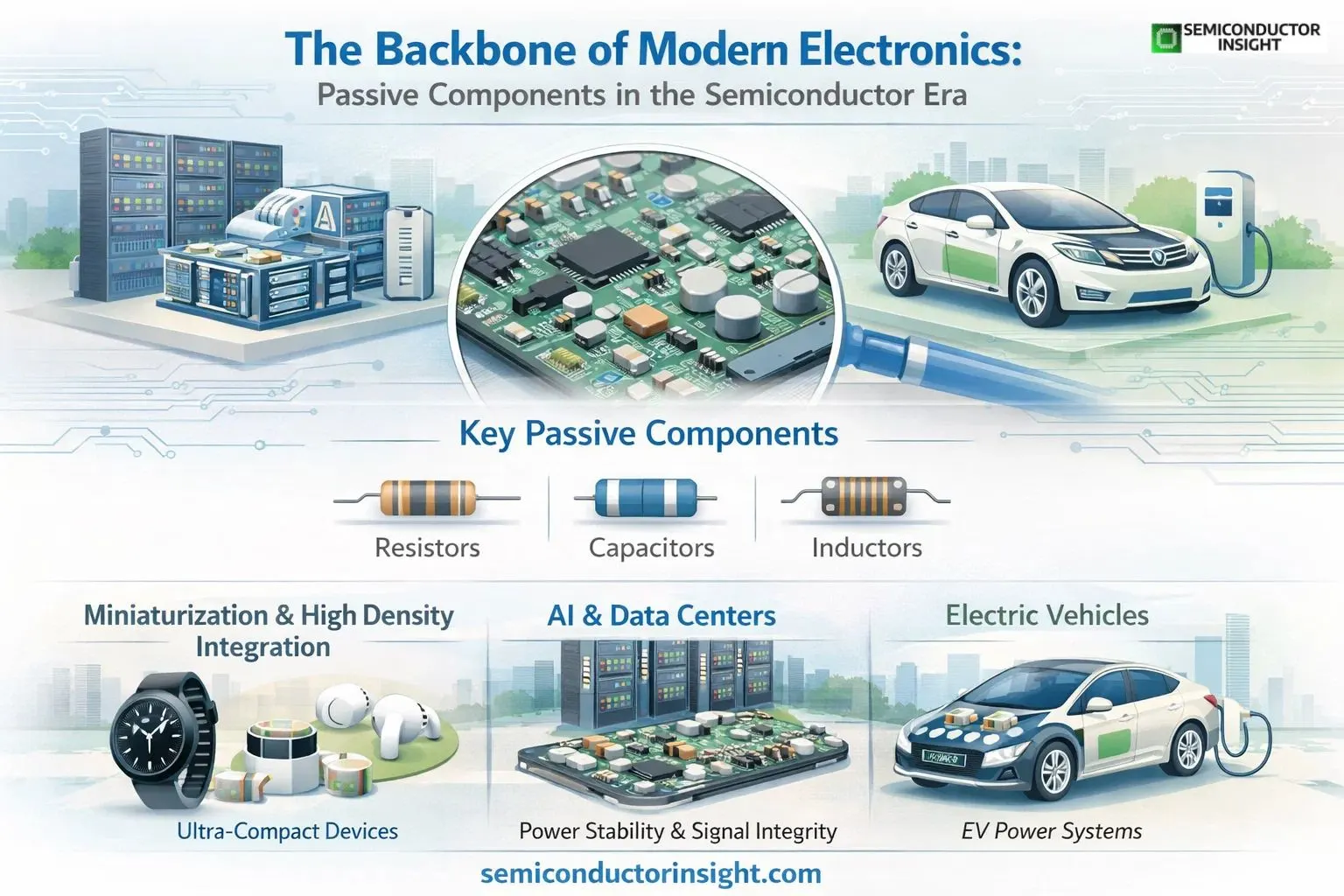
In semiconductor-driven electronics, passive components act as the backbone that enables circuits to operate efficiently. These components do not amplify signals or generate energy but instead regulate voltage, store electrical charge, and filter signals within electronic circuits.
Three fundamental elements dominate the market:
- Resistors
- Capacitors
- Inductors
Each serves a specific role in semiconductor environments. For instance, multilayer ceramic capacitors (MLCCs) stabilize voltage fluctuations in high-performance processors, while resistors control current flow within microchips. Inductors are often used in power supply modules to regulate energy transfer in integrated circuits.
In smartphones, hundreds of MLCC capacitors are embedded within the motherboard to maintain power stability. A single flagship smartphone can contain more than 1,000 tiny capacitors, illustrating how essential passive components are to semiconductor functionality.
Miniaturization and High Density Circuit Integration
- One of the most significant shifts in the passive components ecosystem is the push toward miniaturization. Semiconductor devices are becoming smaller and more powerful, which requires passive components to shrink while maintaining reliability.
- Manufacturers are now producing ultra-compact components measuring less than 0.5 millimetres. These microscopic elements are used in compact electronics such as smart watches, wireless ear buds, and advanced medical wearable.
- A widely discussed example comes from next-generation smartphones where manufacturers integrate ultra-thin MLCC capacitors designed specifically for high density printed circuit boards. These components allow engineers to pack more functionality into limited board space without sacrificing electrical stability.
- This trend highlights how passive components are evolving to match semiconductor scaling.
Electric Vehicles Transforming Circuit Requirements
The automotive industry has emerged as a major consumer of passive components, particularly with the rapid expansion of electric vehicles.
EV power systems require a large number of capacitors and inductors to regulate energy between batteries, inverters, and control units. These components help manage high voltage environments and protect semiconductor power modules.
For example, modern EV battery management systems rely on precision resistors and ceramic capacitors to monitor temperature and voltage within battery packs. Power conversion modules also require specialized inductors capable of handling high current loads.
Reports from automotive engineering journals suggest that a single electric vehicle can contain several thousand passive components, significantly higher than traditional combustion vehicles.
You Can Go Through Our Latest Updated Insights Here: https://semiconductorinsight.com/report/passive-components-market/
Passive Components in AI Servers and Data Infrastructure
The expansion of artificial intelligence infrastructure has introduced new circuit requirements that heavily depend on passive components.
AI servers used in hyperscale data centers rely on high performance processors and graphics chips that consume massive amounts of energy. Passive components help regulate power delivery to these chips and ensure stable signal transmission.
Advanced server boards include dense arrays of capacitors placed near processors to smooth voltage fluctuations during heavy computing loads. Without this electrical stability, semiconductor processors could experience errors or overheating.
Data center hardware designers increasingly focus on power stability and signal integrity, making passive components essential for supporting AI workloads.
Material Science Innovation Shaping Component Performance
Material science has become a major driver of innovation in passive component manufacturing. Engineers are experimenting with advanced ceramic materials, conductive polymers, and specialized alloys to improve durability and electrical performance.
Multilayer ceramic capacitors, for example, use alternating layers of ceramic and metal electrodes stacked together in microscopic structures. This design allows high capacitance in extremely small packages.
In power electronics, metal composite inductors are gaining attention because they can operate efficiently at higher frequencies and temperatures. These characteristics are particularly valuable for semiconductor power modules used in electric vehicles and industrial automation systems.
The use of advanced materials is allowing passive components to perform reliably in increasingly demanding environments.
Supply Chain Strategies and Component Sourcing
- Passive components may appear simple compared with semiconductors, but their supply chains are highly complex. The manufacturing process requires specialized materials such as ceramic powders, conductive metals, and precision fabrication equipment.
- During global electronics shortages in recent years, many device manufacturers realized how critical these components were. Even small shortages of capacitors or resistors could delay the production of smartphones, laptops, and automotive electronics.
- As a result, companies have begun diversifying their supply networks and increasing inventory buffers for essential passive components. Electronics manufacturers are also working closely with suppliers to ensure stable component availability.
- This shift highlights the growing strategic importance of the electronics supply chain within semiconductor ecosystems.
Edge Electronics and the Rise of Smart Devices
Another emerging trend shaping the Passive Components Market is the rapid growth of edge electronics. Smart home systems, wearable technology, industrial sensors, and connected appliances all rely on compact circuit boards filled with passive components.
For example, smart thermostats contain numerous resistors and capacitors that manage signal conditioning and power regulation. Industrial IoT sensors use miniature inductors to support wireless communication modules.
As billions of connected devices continue entering the market, the demand for reliable passive components is expanding rapidly. These components may be physically small, but they play a crucial role in enabling modern electronic intelligence.

Comments (0)