
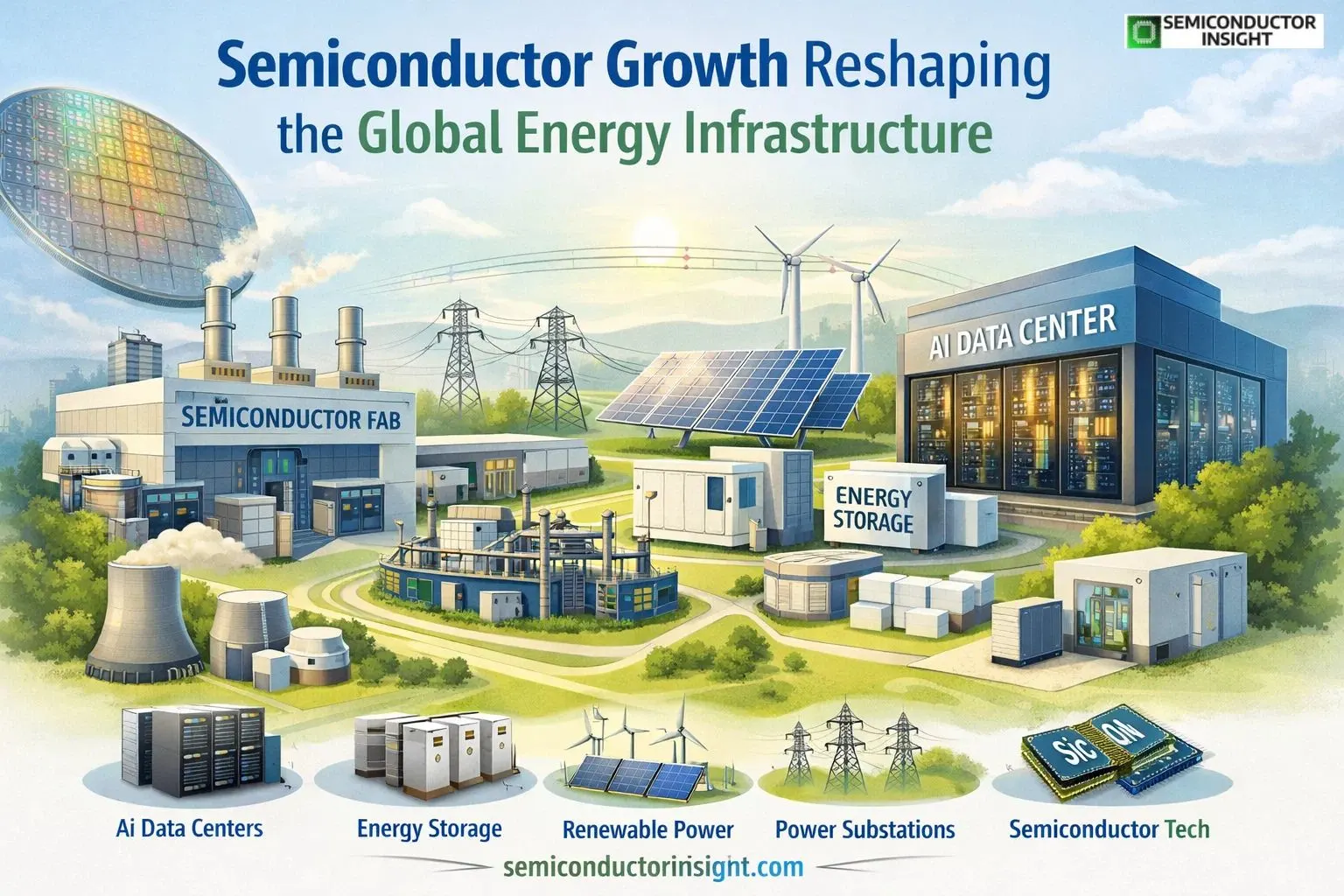
Semiconductor Growth Is Reshaping the Global Energy Infrastructure Market
The semiconductor industry has quietly become one of the most electricity-intensive technology sectors in the world. Advanced chip manufacturing plants, AI training clusters, and hyperscale data centers require massive amounts of stable power infrastructure. As semiconductor workloads become heavier, the energy backbone supporting them has evolved into a strategic industry of its own.
Modern AI servers now operate at unprecedented power densities. A single server rack that previously consumed around 5-10 kW can now demand 30-100 kW depending on GPU intensity. Large AI clusters built around high-performance chips may exceed 100 kW per rack, forcing operators to redesign electrical distribution systems entirely.
This shift is reshaping how utilities, infrastructure developers, and chip manufacturers collaborate. Power delivery, cooling systems, and grid stability are no longer secondary engineering considerations they are now core design parameters in semiconductor infrastructure planning.
Semiconductor Manufacturing Facilities as Energy Hubs
Advanced semiconductor fabrication plants are among the most energy-dependent industrial facilities ever built. A leading-edge fab requires uninterrupted electricity for lithography machines, cleanroom air filtration, wafer processing, and advanced cooling systems.
For example, extreme ultraviolet (EUV) lithography tools used in advanced chip production operate continuously and rely on stable electrical supply to maintain nanometer-scale manufacturing precision. Even minor fluctuations can halt production and damage expensive wafers.
Because of this, modern semiconductor fabs are built with multi-layer energy infrastructure including:
- On-site substations
- Dedicated transmission lines
- Redundant backup power systems
- Industrial-scale energy storage
Large manufacturing clusters in Taiwan, South Korea, the United States, and Europe are increasingly developing integrated energy ecosystems where fabs, substations, and power management systems operate as a single infrastructure network.
The Silent Role of Power Semiconductors inside Energy Systems
Interestingly, the semiconductor industry is not only consuming electricityit is also enabling the infrastructure that delivers it.
Power electronics are the technological bridge between electricity generation and digital infrastructure. Wide-bandgap semiconductors such as silicon carbide (SiC) and gallium nitride (GaN) have become essential components in modern energy systems because they reduce energy losses during power conversion.
These devices are widely used in:
- High-efficiency power converters
- Grid-scale energy storage systems
- Electric vehicle charging infrastructure
- Data center power distribution units
- Renewable energy inverters
As electrical systems transition toward higher efficiency targets above 97%, advanced power semiconductors are replacing traditional silicon-based designs in many applications.
In other words, semiconductors are both the engine and the regulator of modern energy infrastructure.
AI Data Centers Creating New Power Ecosystems
One of the most visible intersections between semiconductors and energy infrastructure is the rapid expansion of AI data centers. These facilities host high-performance processors used for training large AI models, simulation workloads, and cloud computing.
Global electricity consumption from data centers is projected to rise dramatically during the coming decade as AI computing expands worldwide. Estimates suggest energy demand from these facilities could nearly double before 2030.
To support this surge, energy companies and infrastructure providers are building new power assets dedicated specifically to digital infrastructure.
Recent developments illustrate this trend:
- Large utilities are planning tens of gigawatts of additional electricity capacity specifically for data centers supporting AI workloads.
- Industrial equipment providers have signed multi-billion-dollar agreements to supply power modules and cooling infrastructure for hyperscale facilities.
- Former coal power plant sites are being redeveloped into massive data center campuses with multi-gigawatt electricity generation capacity.
These developments show how semiconductor demand is directly shaping national energy planning strategies.
You Can Freely Surf Our Latest Updated Related Report Here: https://semiconductorinsight.com/report/ai-data-center-server-battery-backup-unit-bbu-market/
Microgrids and Dedicated Energy Systems for Chip Infrastructure
Another emerging design concept in the energy infrastructure ecosystem is the development of localized power networks, often called microgrids. Instead of relying entirely on regional power grids, semiconductor fabs and AI campuses increasingly deploy dedicated energy systems.
These systems typically include:
- Solar or wind power installations
- Battery storage systems
- Backup natural gas turbines
- Intelligent grid-management software
Such hybrid energy ecosystems help ensure stable power supply while reducing operational risks from grid congestion or power outages. In several cases, technology companies are even exploring advanced nuclear micro-reactors to power future computing infrastructure.
For instance, advanced reactor developers are working with major technology companies to deploy small modular nuclear reactors capable of powering large data center clusters within the next decade.
This approach could redefine how semiconductor infrastructure sources electricity.
The Emerging AI-Energy Feedback Loop
A new industrial dynamic is forming between semiconductors and electricity systems. AI chips require enormous computing power, which increases electricity demand. That demand then drives new investment in energy infrastructure, which in turn supports larger computing clusters.
This feedback loop is becoming one of the most important structural shifts in the digital economy.
Researchers studying power systems have begun examining ways to coordinate data center workloads with grid stability. Some models suggest AI computing facilities could even act as flexible energy loads that help balance renewable electricity supply.
The result is an evolving technological ecosystem where computing infrastructure and power infrastructure are designed together.

Comments (0)