

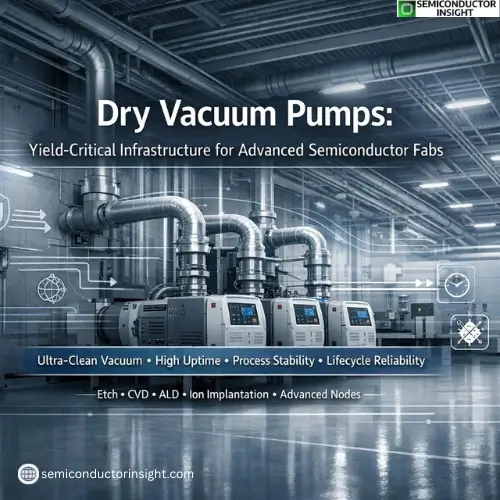
Semiconductor Dry Vacuum Pump Market Review: Stability, Efficiency, and Long-Term Demand
In semiconductor fabrication, some of the most critical technologies operate far from view. Dry vacuum pumps fall squarely into this category. While lithography tools and process chambers often receive the spotlight, dry vacuum pumps quietly maintain the ultra-clean, stable vacuum environments that allow every wafer process to function correctly.
As device geometries shrink and process steps multiply, the reliability of vacuum systems has shifted from a utility concern to a yield-critical infrastructure decision.
What Defines a Semiconductor Dry Vacuum Pump?
In contrast to oil-sealed systems, dry vacuum pumps function without lubricants in the pumping chamber, eliminating back streaming and particle contamination risks. This makes them indispensable in semiconductor environments where even trace impurities can compromise wafer integrity.
These pumps are designed to handle:
- Aggressive process gases
- High throughputs under continuous operation
- Thermal and chemical stress across etch, CVD, ALD, and ion implantation steps
Their role extends beyond gas removal; they stabilize pressure conditions that directly influence process uniformity and device performance.
Fabrication Complexity Is Driving Structural Demand
The expansion of advanced nodes, 3D NAND architectures, and heterogeneous integration has significantly increased the number of vacuum-dependent steps per wafer. As a result, each new fab now deploys hundreds to thousands of dry vacuum pumps, often configured in redundant networks.
This demand is reinforced by:
- Longer tool uptime expectations
- Stricter contamination thresholds
- Increased use of corrosive and by-product-heavy gases
Dry vacuum pumps are no longer purchased as standalone components they are evaluated as lifecycle assets.
Market Summary with an Investor Focus
From an investment perspective, the semiconductor dry vacuum pump market benefits from structural resilience rather than short-term volume swings.
Key characteristics include:
- Strong correlation with fabrication construction and capacity expansion cycles
- Long replacement timelines driven by preventive maintenance strategies
- High switching costs due to tool qualification and process validation
Even during semiconductor downturns, vacuum pump demand remains supported by maintenance, upgrades, and node migration activity, making this market less volatile than front-end tools.
Competitive Landscape and Strategic Positioning
The market is led by a concentrated group of suppliers with deep semiconductor process expertise. Major players include:
- Edwards Vacuum (Atlas Copco Group) – Known for integrated dry pump platforms optimized for advanced logic and memory fabrications
- ULVAC, Inc. – Strong presence in Asia with pumps tailored for deposition and etch processes
- Pfeiffer Vacuum (Busch Group) – Focuses on high-efficiency, low-footprint systems
- Ebara Corporation – Supplies robust dry pumps for high-throughput fabrications
- Leybold – Emphasizes reliability and global service networks
Strategic priorities across these companies increasingly revolve around energy efficiency, predictive maintenance, and digital integration.
Recent Market Situations Shaping Demand
Several developments are influencing near-term and mid-term market direction:
- Accelerated fab investments in Asia Pacific and the U.S.
- Government-backed semiconductor manufacturing incentives
- Customer preference for pump platforms compatible with multiple process generations
At the same time, fabrications are requesting standardized pump architectures that simplify spare parts management and reduce downtime.
Don’t Forget to Surf Our Updated Report for More Detailed Analysis:
https://semiconductorinsight.com/report/semiconductor-dry-vacuum-pump-market/
Technology Evolution inside the Pump Room
Innovation in this market is practical rather than experimental. Manufacturers are refining:
- Rotor coatings for longer service life
- Improved exhaust gas handling to reduce abatement load
- Smart sensors for vibration, temperature, and performance tracking
These upgrades support predictive maintenance models, allowing fabrications to minimize unplanned shutdowns and protect yield.
Environmental and Energy Considerations
Energy consumption has become a growing concern, especially as fabs aim to reduce operational footprints. Dry vacuum pump suppliers are responding with:
- Lower power consumption per unit throughput
- Heat recovery compatibility
- Designs that reduce exhaust treatment requirements
Sustainability, once a secondary factor, is now embedded in procurement decisions.
Opportunities for New and Emerging Competitors
While entry barriers remain high, opportunities exist for suppliers that can:
- Offer regionally localized service capabilities
- Develop pumps optimized for specific process steps
- Integrate digital diagnostics compatible with fab automation systems
Partnerships with tool OEMs and subsystem integrators are emerging as a viable route to market entry.
Strategic Market Outlook
Looking ahead, the semiconductor dry vacuum pump market will continue to expand in parallel with advanced manufacturing complexity rather than unit shipment growth. Its future is tied to reliability, lifecycle performance, and deep process alignment.

Comments (0)