

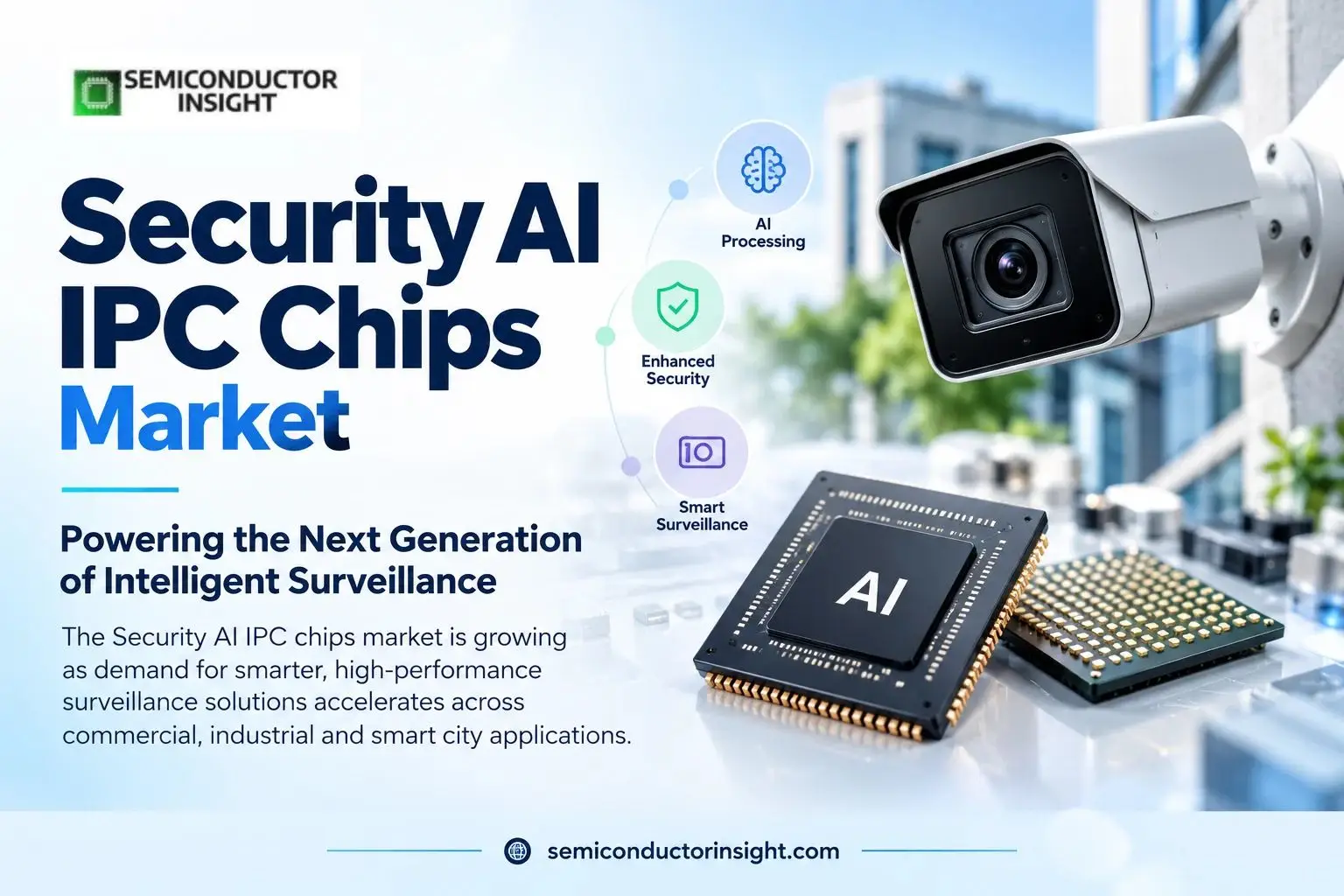
Security AI IPC Chips Market as Smart Factories Integrate On-Device Intelligence and Tamper-Resistant Systems
Security AI IPC Chips Market covers semiconductor processors and supporting chipsets used in industrial personal computers designed for intelligent surveillance, access control, intrusion detection and industrial cybersecurity. These components combine AI inference, image processing, connectivity and secure computing to analyse information close to where it is generated.
AI-enabled industrial PCs may handle video and sensor inputs locally, reducing response times and network traffic, in contrast to traditional computer systems that broadcast every data stream to a central server. In 2026, demand is increasingly connected to smart factories, transport infrastructure, connected buildings and critical facilities where security systems must operate continuously and protect sensitive information.
Why Security Processing Is Moving Closer to the Device?
- Industrial security systems increasingly need to recognise unusual behaviour, detect unauthorised access and interpret video feeds without waiting for cloud-based processing.
- Dedicated AI accelerators, CPUs with integrated neural processing units and graphics processors help industrial computers perform these tasks locally.
- The World Economic Forum’s Global Cybersecurity Outlook 2026 reports that 87% of surveyed respondents identified AI-related vulnerabilities as the fastest-growing cyber risk during 2025.
- The finding highlights why AI performance and system protection must be developed together rather than treated as separate purchasing decisions.
The Chip Architecture behind Real-Time Protection
Three capabilities are particularly relevant to this market. First, AI inference engines process video and sensor information for applications such as perimeter monitoring and object recognition. Second, integrated image-processing functions improve the handling of multiple camera streams. Third, hardware security features help protect firmware, credentials and system integrity.
Industrial PCs may use x86 processors, Arm-based system-on-chips, dedicated AI accelerators or combinations of these components. Selection depends on camera resolution, the number of simultaneous streams, model complexity, operating temperature, power consumption and the expected service life of the equipment.
Hardware Trust Is Becoming a Design Requirement
Secure boot, cryptographic key storage, firmware verification and hardware roots of trust are increasingly important for connected industrial computing. These features help establish whether a device is running authorised software and whether its platform integrity can be verified.
In March 2026, the US National Institute of Standards and Technology published guidance on hardware-enabled security for 5G system platform integrity. Its discussion of hardware roots of trust and remote attestation is relevant to industrial security architectures that require verifiable computing platforms, although the publication specifically addresses 5G infrastructure.
For chip designers, the implication is practical: AI performance alone may not be sufficient when equipment is deployed in sensitive facilities or connected to operational technology networks.
Where Industrial AI Chips Are Finding Applications
Smart manufacturing is an important application area. AI-enabled industrial PCs can analyse production-line footage, identify unauthorised entry and flag unexpected activity around machinery. In logistics, similar platforms can support restricted-zone monitoring, vehicle recognition and automated access checkpoints.
- Transport hubs and commercial buildings also use edge computing for camera analytics and access management.
- Processing selected information locally can reduce the need to transmit continuous high-resolution footage, although privacy protection still depends on system configuration, retention policies and access controls.
A typical deployment follows this sequence:
Sensor or camera input → Local AI inference → Security-event classification → Alert or controlled response → Logged review by an operator.
This workflow can improve response speed, but automated decisions still require testing, appropriate human oversight and reliable fallback controls.
Energy Efficiency and Longevity Shape Purchasing Decisions
Industrial computers often remain installed for years, making chip availability and platform stability important alongside computing performance. A processor that supports several camera streams but generates excessive heat may require more elaborate cooling, increase enclosure costs or limit deployment options.
Manufacturers therefore evaluate performance per watt, thermal design, extended product availability and support for operating systems and security updates. The Canadian Centre for Cyber Security’s guidance on securing AI at the network edge recommends testing systems under abnormal conditions, segmenting operational networks and maintaining independent safety controls where AI failure could have serious consequences.
Stay connected for additional in-depth information right here: https://semiconductorinsight.com/report/security-ai-ipc-chips-market/
The Companies and Technologies to Watch
- The wider industrial computing ecosystem includes Intel, AMD, NVIDIA, NXP Semiconductors and Texas Instruments, alongside specialist industrial PC manufacturers and embedded-computing suppliers.
- Their roles differ: some provide general-purpose processors, others supply AI acceleration, embedded processing or supporting connectivity and security technologies.
- Because Security AI IPC Chips Market is a narrowly defined category rather than a consistently reported semiconductor classification, a reliable global market share or CAGR cannot be established from these sources alone.
- Supplier comparisons should distinguish chip revenue from complete industrial PC sales and integrated security-system revenue.
What Will Separate Competitive Platforms
The strongest platforms will combine dependable AI inference with verified firmware, long-term component support, manageable power consumption and compatibility with industrial networks.
As surveillance and operational security become more intelligent, chip selection will increasingly influence not only detection performance but also data handling, system resilience and the ability to maintain secure equipment throughout its working life.

Comments (0)