Security AI IPC Chips Market Insights
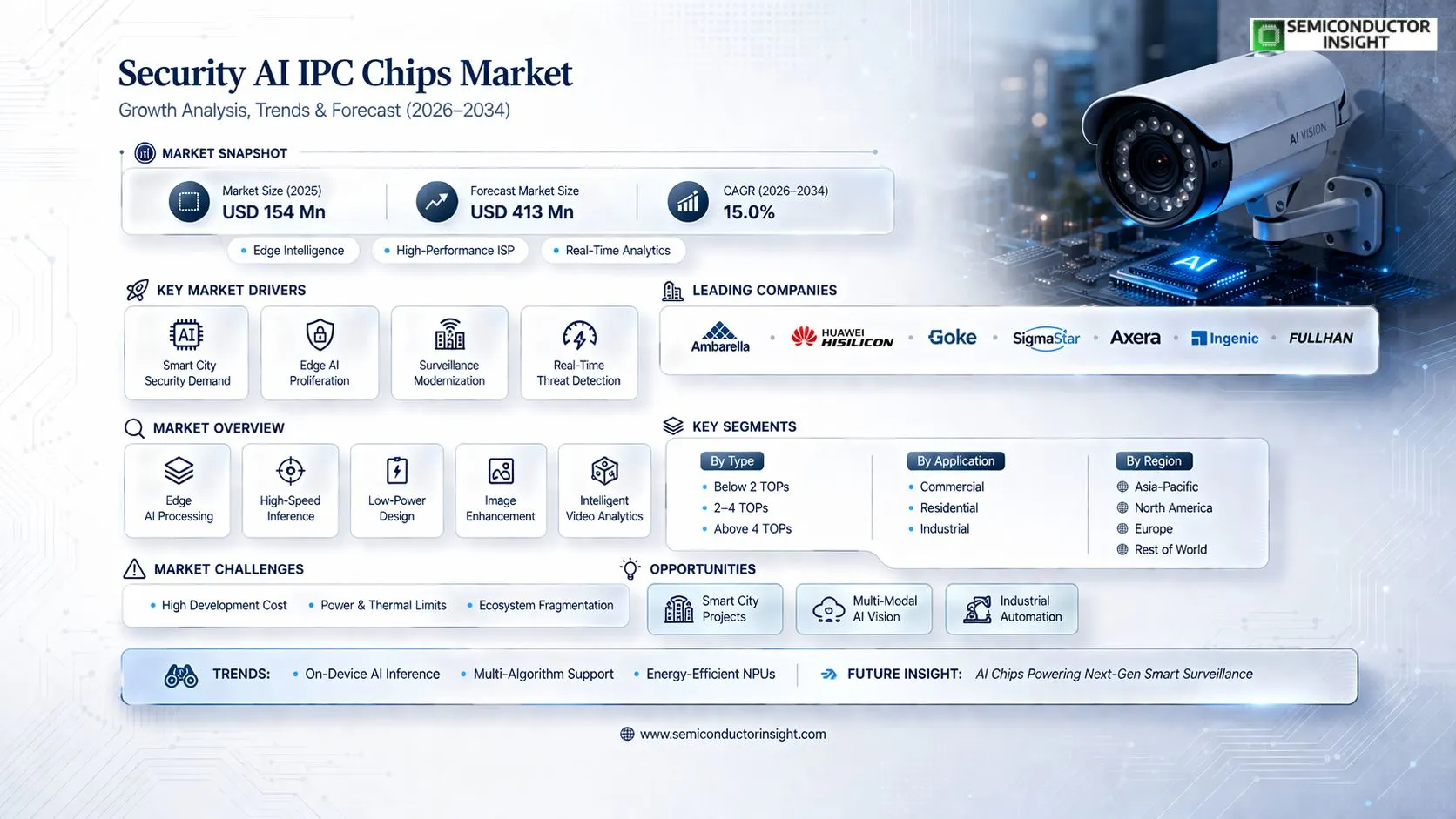
Global Security AI IPC Chips market size was valued at USD 154 million in 2025. The market is projected to grow from USD 177 million in 2026 to USD 413 million by 2034, exhibiting a CAGR of 15.0% during the forecast period.
Security AI IPC chips are high-performance integrated circuits designed specifically for the security monitoring field, integrating advanced image processing and artificial intelligence technologies. This type of chip not only has the functions of traditional IPC chips, such as high-definition video encoding, image signal processing (ISP), and network transmission, but also integrates a dedicated deep learning accelerator, which can efficiently perform complex image recognition and intelligent analysis tasks at the hardware level. It can automatically optimize various shooting scenes, provide clearer and more natural image quality, and support a variety of intelligent applications, such as target detection, face recognition, behavior analysis, and abnormal event alarm.
The market is experiencing rapid growth due to several factors, including escalating demand for smart city infrastructure and proactive security solutions worldwide. Furthermore, advancements in edge computing capabilities are driving adoption because they allow for real-time analytics without constant cloud connectivity. Initiatives by key players in the market are also expected to fuel market growth. For instance, leading companies like Ambarella continue to launch new generations of AI vision processors with improved power efficiency for battery-powered cameras. Huawei HiSilicon’s Kirin series chips have also been adapted for specialized surveillance applications in certain regions. Other significant players operating in the market with a wide range of portfolios include Goke Microelectronics, SigmaStar Technology (a subsidiary of MediaTek), Shanghai ASR Microelectronics, Axera Semiconductor, Zhuhai Eeasy Technology (EEasyTech), Ingenic Semiconductor, and Fullhan Microelectronics.
MARKET DRIVERS
Escalating Demand for Intelligent Video Surveillance
The core driver for Security AI IPC Chips market is Global transition from passive recording to proactive, intelligent security systems. Industries demand real-time analytics for threat detection,recognizing faces, anomalous behaviors, or unattended objects. This creates immense demand for chips that provide on-device AI processing at the network edge, reducing bandwidth and latency for security operations. The evolution of smart cities and critical infrastructure protection is fundamentally reliant on these advanced semiconductors.
Advancements in Semiconductor and Neural Processing
Technological progress in chip architecture, particularly the integration of specialized Neural Processing Units (NPUs) alongside traditional CPUs, is a key enabler. These designs allow Security AI IPC Chips to execute complex convolutional neural networks (CNNs) efficiently within strict power and thermal budgets of cameras and access devices. This enables higher-resolution video analysis and multi-algorithm support without compromising device form factor, directly fueling market adoption.
➤ The convergence of 5G connectivity and edge AI is creating a paradigm shift, making distributed, intelligent security networks not just feasible but operationally essential.
Furthermore, stringent global data privacy regulations are accelerating the shift to edge processing. By analyzing video data locally within the Security AI IPC Chip, sensitive information is not transmitted to the cloud, mitigating privacy risks and compliance challenges. This data sovereignty advantage is becoming a critical purchasing criterion, further propelling the market for these specialized processors.
MARKET CHALLENGES
High Development Cost and Complexity
A primary challenge in Security AI IPC Chips market is the significant R&D investment and design complexity required. Integrating high-performance AI accelerators with image signal processors (ISPs) and video codecs into a single, cost-effective system-on-chip (SoC) is a formidable engineering task. This creates high barriers to entry and can lead to longer development cycles, potentially slowing the pace of innovation and product iteration for chip vendors and security OEMs alike.
Other Challenges
Fragmented Ecosystem and Integration Hurdles
The market ecosystem involves chip designers, algorithm providers, camera manufacturers, and software developers. A lack of standardization can lead to compatibility issues, forcing developers to optimize AI models for specific chipsets. This fragmentation increases integration time and cost, posing a significant challenge for widespread and seamless deployment of security solutions.
Power and Thermal Constraints
Deploying Security AI IPC Chips in edge devices like compact cameras or battery-powered sensors imposes strict power budgets. Balancing high-performance AI inference with low power consumption and effective thermal management remains a persistent technical challenge, often limiting the complexity of algorithms that can be run continuously on-device.
MARKET RESTRAINTS
Global Semiconductor Supply Chain Volatility
Security AI IPC Chips market remains susceptible to broader semiconductor industry disruptions. Geopolitical tensions, material shortages, and concentrated manufacturing capacity can lead to supply constraints, extended lead times, and price volatility. These factors can delay product launches for security device manufacturers and increase overall system costs, restraining market growth in the short to medium term despite strong underlying demand.
Longer Product Lifecycles in Security Infrastructure
Unlike consumer electronics, professional security and surveillance infrastructure often has deployment lifecycles spanning 5 to 10 years. This slower refresh rate for installed hardware can temper the adoption velocity of the latest generations of Security AI IPC Chips, as end-users seek to maximize ROI on existing systems before investing in new, AI-capable edge devices.
MARKET OPPORTUNITIES
Expansion Beyond Traditional Surveillance
The application scope for Security AI IPC Chips is rapidly expanding into new verticals. Beyond video surveillance, these chips enable intelligent analytics in retail for customer behavior insights, in industrial settings for operational safety and predictive maintenance, and in smart home devices for personalized automation. This diversification represents a significant growth vector for the market, moving from pure security to broader operational intelligence.
Integration of Multi-Modal AI Sensing
A major opportunity lies in developing Security AI IPC Chips that can process and fuse data from multiple sensors,not just video, but audio, radar, lidar, and thermal imaging. Chips capable of this multi-modal sensor fusion will enable next-generation contextual awareness and more robust security systems, opening up premium market segments in critical infrastructure and autonomous systems security.
Democratization via Chip-as-a-Service Models
Emerging business models, where AI processing capabilities are offered via subscription or cloud-managed services tied to the chip hardware, present a compelling opportunity. This lowers the initial cost barrier for device makers and allows for continuous remote updates of AI models, creating recurring revenue streams for chip vendors and ensuring the long-term value and relevance of deployed Security AI IPC Chips.
Security AI IPC Chips Market Trends
Convergence of High-Performance Imaging and On-Device Intelligence
Current market analysis indicates a clear trend toward the integration of specialized AI accelerators directly into Security AI IPC chips. These systems-on-chip (SoCs) are moving beyond basic encoding and network functions. The integration of dedicated neural processing units (NPUs) allows for complex tasks like facial recognition, object classification, and anomaly detection to be processed at the edge. This architectural shift reduces latency, conserves bandwidth, and enhances privacy for security applications by keeping sensitive data local. Industry movement is focused on increasing the efficiency and computational power of these integrated NPUs, measured in tera-operations per second (TOPs), to handle more sophisticated deep learning models directly on the camera.
Other Trends
Segmentation by Computational Capability
Security AI IPC Chips market is evolving with clear segmentation based on processing power. Chips are categorized by their AI computational capabilities, such as Below 2TOPs, 2TOPs-4TOPs, and Above 4TOPs. This segmentation directly corresponds to application complexity. Lower-TOPs chips serve basic intelligent monitoring in residential settings, while mid-range solutions power commercial and public space analytics. High-performance chips above 4TOPs are increasingly deployed in industrial and critical infrastructure for demanding multi-channel analysis and real-time behavioral recognition, driving demand in specific verticals.
Diversification Across Application Verticals
Adoption of Security AI IPC chips is expanding beyond traditional surveillance into diverse commercial, residential, and industrial segments. In commercial settings, chips enable smart retail analytics and access control. Residential use is growing for smart home security with proactive alerting. The industrial segment utilizes these chips for operational safety monitoring, quality inspection on production lines, and perimeter security for critical facilities. This diversification is pushing manufacturers to develop more specialized and robust chip variants to meet distinct environmental and reliability requirements of each sector.
Geographic Market Development and Supply Chain Dynamics
The competitive landscape for Security AI IPC Chips is dynamic, with key manufacturers like Ambarella, Huawei HiSilicon, and SigmaStar Technology driving innovation. Regional market dynamics show significant activity and differing growth trajectories. Supply chain development and regional manufacturing capabilities are influencing market access and product availability. Industry focus remains on enhancing chip performance, optimizing power efficiency for always-on devices, and providing comprehensive developer tools to speed up the deployment of AI-driven security solutions across global markets.
COMPETITIVE LANDSCAPE
Key Industry Players
A Dynamic Market Poised for Intelligent Growth
Global Security AI IPC Chips market is defined by a competitive landscape where established semiconductor leaders coexist with specialized fabless chip designers. Ambarella, a U.S.-based pioneer in computer vision solutions, is a dominant force, leveraging its advanced neural network processors to capture significant market share. The market structure is notably consolidated among the top five players, which commanded a substantial collective revenue share as of 2025. Chinese manufacturers, led by Huawei HiSilicon and Fullhan Microelectronics, have rapidly ascended by offering cost-efficient, high-performance chips tailored for the massive domestic surveillance market and expanding internationally. This creates a bifurcated competitive dynamic between global innovators and regionally powerful, vertically-integrated suppliers.
Beyond the market leaders, several significant niche players contribute to technological diversity and application-specific innovation. Companies such as SigmaStar Technology and Axera Semiconductor are key contenders, focusing on integrating superior ISP capabilities with deep learning accelerators for edge AI processing in security cameras. Meanwhile, firms like Ingenic Semiconductor and Shanghai ASR Microelectronics provide critical solutions across different compute tiers, from below 2TOPs for entry-level devices to above 4TOPs for high-end analytics. The competitive intensity is driving rapid iteration in energy efficiency, AI algorithm support, and multi-sensor fusion capabilities, compelling all players to continuously advance their product portfolios to maintain relevance in this high-growth sector.
List of Key Security AI IPC Chips Companies Profiled
- Ambarella Inc.
- Huawei HiSilicon
- Goke Microelectronics Co., Ltd.
- SigmaStar Technology Ltd.
- Shanghai ASR Microelectronics Co., Ltd.
- Axera Semiconductor Co., Ltd.
- Zhuhai Eeasy Technology Co., Ltd.
- Ingenic Semiconductor Co., Ltd.
- Fullhan Microelectronics Co., Ltd.
- Rockchip Electronics Co., Ltd.
- NovaTek Microelectronics Corp.
- Vimicro Corporation
- Altek Corporation
- Eyenix Co., Ltd.
- NovuMind Inc.
Segment Analysis:
| Segment Category | Sub-Segments | Key Insights |
| By Type |
|
Mid-Range Performance (2TOPs-4TOPs) chips are the leading segment for Security AI IPC applications. These chips balance robust computational power for intensive analytics like facial recognition with cost-effectiveness and manageable power consumption.
|
| By Application |
|
Commercial security applications represent the most mature and demanding segment, driving product development and premium feature integration.
|
| By End User |
|
Security Camera OEMs are the pivotal end-user segment, acting as the primary channel for chip integration and determining feature sets for the broader market.
|
| By Integration Level |
|
Fully Integrated SoC Solutions are the leading architectural approach, as they combine video processing, AI acceleration, and network functions into a single chip.
|
| By Core AI Function |
|
Video Content Analytics represents the foundational and most pervasive core function, underpinning nearly all security AI applications and driving broad-based demand.
|
Regional Analysis: Security AI IPC Chips Market
Asia-Pacific
The region’s unparalleled electronics ecosystem provides integrated supply chains from wafer fabrication to final product assembly, creating a decisive cost and time-to-market advantage for Security AI IPC Chips. Close collaboration between chip designers and camera OEMs fosters specialized, application-specific chip architectures.
Massive government-led investments in safe city and intelligent surveillance projects create a consistent, high-volume demand pipeline for AI-enabled security hardware, directly boosting the market for sophisticated IPC chips capable of real-time analytics at the edge.
Intense competition among numerous players, from established giants to agile startups, accelerates the pace of innovation in chip power efficiency and AI performance. This dynamic environment also exerts strong downward pressure on costs, democratizing access to Security AI IPC technology.
National-level initiatives and funding aimed at achieving technological sovereignty in semiconductors and leadership in artificial intelligence provide a stable, long-term growth environment for companies operating within Security AI IPC Chips market, de-risking major R&D investments.
North America
North America remains a critical region defined by high-value innovation and early adoption of premium security solutions within Security AI IPC Chips market. The region is home to leading fabless semiconductor companies and AI software firms that drive the architectural evolution of these chips towards more powerful and efficient edge AI processing. Demand is primarily driven by the need for sophisticated homeland security, critical infrastructure protection, and the commercial sector’s emphasis on loss prevention and operational intelligence. The maturity of the market means a strong focus on chips that enable advanced features like behavioral analytics and high-density facial recognition in challenging environments. A robust venture capital ecosystem continuously fuels startups exploring novel applications of Security AI IPC technology, from drones to autonomous retail.
Europe
The European market for Security AI IPC Chips is heavily shaped by stringent data privacy regulations, such as GDPR, which influence chip design priorities towards on-device processing and enhanced data security features. Demand is strong across several verticals, including transportation security, retail analytics, and industrial automation, where compliance and precision are paramount. The region shows a balanced approach, with significant demand for high-performance chips in professional security installations and a growing interest in energy-efficient solutions for smart home ecosystems. Collaborative research initiatives between academia and industry, particularly in countries like Germany and the UK, contribute to advancements in low-power AI inference and reliable operation, key for the widespread deployment of intelligent security networks.
South America
Security AI IPC Chips market in South America is in a growth phase, primarily fueled by increasing urbanization and rising concerns over public and commercial security in major metropolitan areas. While cost sensitivity is a significant factor, there is growing recognition of the long-term value offered by AI-powered surveillance over traditional systems. The market’s evolution is characterized by a gradual shift from importing finished security products to adopting modular solutions that allow for local integration. This creates opportunities for chip providers offering scalable and flexible architectures. Growth is uneven but promising in sectors like banking, retail, and large-scale public infrastructure projects where security modernization is a key priority.
Middle East & Africa
The Middle East & Africa region presents a bifurcated market dynamic for Security AI IPC Chips. The Gulf Cooperation Council (GCC) countries are high-growth hotspots, driven by visionary smart city projects, mega-events, and significant investments in next-generation public safety infrastructure, demanding the latest in AI-enabled security technology. In contrast, other parts of the region often prioritize robust and cost-effective solutions suitable for basic surveillance needs in challenging environments. Across the region, there is a universal emphasis on the durability and reliability of security hardware, influencing demand for chips that can perform consistently under extreme climatic conditions. This diverse landscape requires chip manufacturers to offer a strategic portfolio catering to both cutting-edge and essential-use applications.
Report Scope
This market research report provides a comprehensive analysis of the Security AI IPC Chips Market , covering the forecast period 2026–2034. It offers detailed insights into market dynamics, technological advancements, competitive landscape, and key trends shaping the industry.
Key focus areas of the report include:
- Market Overview: The report begins with an overview outlining its current market scenario, key growth indicators, and industry transformation drivers. It discusses macroeconomic factors, demand–supply balance, regulatory landscape, and the strategic role of semiconductors in powering advancements across industries such as automotive, telecommunications, consumer electronics, and industrial automation.
- Market Size & Forecast: Historical data and future projections for revenue, unit shipments, and market value across major regions and segments.
- Segmentation Analysis: Detailed breakdown by product type, technology, application, and end-user industry to identify high-growth segments and investment opportunities.
- Regional Insights: Insights into market performance across North America, Europe, Asia-Pacific, Latin America, and the Middle East & Africa, including country-level analysis where relevant.
- Competitive Landscape: Profiles of leading market participants, including their product offerings, R&D focus, manufacturing capacity, pricing strategies, and recent developments such as mergers, acquisitions, and partnerships.
- Technology Trends & Innovation: Assessment of emerging technologies, integration of AI/IoT, semiconductor design trends, fabrication techniques, and evolving industry standards.
- Market Drivers & Restraints: Evaluation of factors driving market growth along with challenges, supply chain constraints, regulatory issues, and market-entry barriers.
- Stakeholder Insights: Insights for component suppliers, OEMs, system integrators, investors, and policymakers regarding the evolving ecosystem and strategic opportunities.
Primary and secondary research methods are employed, including interviews with industry experts, data from verified sources, and real-time market intelligence to ensure the accuracy and reliability of the insights presented.
FREQUENTLY ASKED QUESTIONS:
What is the current market size of Security AI IPC Chips Market?
-> Global Security AI IPC Chips Market was valued at USD 154 million in 2025 and is projected to reach USD 413 million by 2034, growing at a CAGR of 15.0% during the forecast period.
Which key companies operate in Security AI IPC Chips Market?
-> Key players include Ambarella, Huawei HiSilicon, Goke Microelectronics, SigmaStar Technology, Shanghai ASR Microelectronics, Axera Semiconductor, Zhuhai Eeasy Technology, Ingenic Semiconductor, and Fullhan Microelectronics, among others.
What are the key growth drivers?
-> Key growth drivers include rising demand for intelligent security monitoring, integration of dedicated deep learning accelerators for complex AI tasks, and the need for automated scene optimization and advanced image processing.
Which region dominates the market?
-> The report provides detailed regional analysis covering North America, Europe, Asia-Pacific, Latin America, and the Middle East & Africa. U.S. market size is estimated at USD million in 2025, while China is a key market to reach USD million.
What are the emerging trends?
-> Emerging trends include the proliferation of chips with higher computing power (TOPs segments), support for diverse intelligent applications like face recognition and behavior analysis, and technological advancements in hardware-level deep learning acceleration.

Get Sample Report PDF for Exclusive Insights
Report Sample Includes
- Table of Contents
- List of Tables & Figures
- Charts, Research Methodology, and more...
 Download Sample Report PDF