

Rugged Smartphone and Tablets Market Accelerating Digital Adoption across Field Operations
Rugged smartphones and tablets are no longer niche tools reserved for specialized sectors. They have become essential operational assets across industries where standard consumer devices fail under pressure. Built to withstand drops from heights of up to 1.8 meters, operate in temperatures ranging from -20°C to 60°C, and resist water immersion up to 1.5 meters for 30 minutes, these devices are engineered for reliability in extreme conditions.
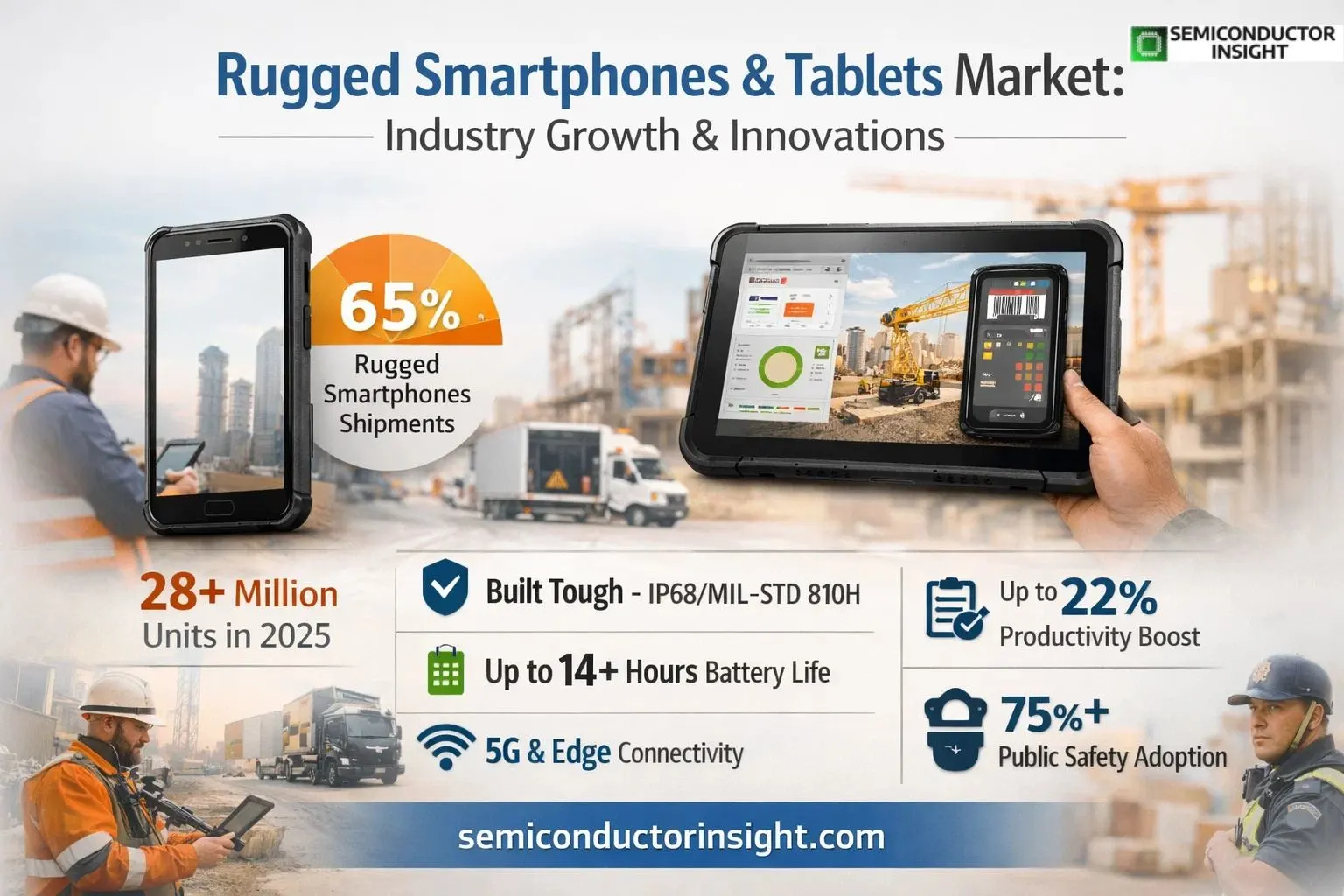
In 2025, global shipments of rugged mobile devices crossed 28 million units, with smartphones accounting for nearly 65% of total volume. Tablets contributed around 9 million units, driven by increased adoption in logistics, defence, and utilities. This growth reflects a broader shift toward durable digital infrastructure in field operations.
The Backbone of Field Workforce Digitization
Industries such as construction, mining, oil and gas, and emergency services are rapidly transitioning to digital workflows. Rugged devices serve as the backbone of this transformation by enabling real-time data access, reporting, and communication.
For example, construction firms deploying rugged tablets have reported productivity improvements of up to 22%, primarily due to faster data entry and reduced device downtime. Similarly, logistics companies using rugged smartphones for route optimization have reduced delivery errors by nearly 18%, while improving on-time performance metrics.
The integration of barcode scanners, GPS modules, thermal imaging, and push-to-talk communication features into a single rugged device is eliminating the need for multiple tools, streamlining operations and reducing equipment costs by approximately 15-20% per workforce unit.
Engineering That Goes beyond Durability
- The rugged device ecosystem is evolving beyond physical toughness. Modern devices now incorporate advanced semiconductor technologies that enhance performance without compromising resilience.
- Chipsets built on 6nm and 7nm architectures are being integrated into rugged smartphones, offering processing speeds exceeding 2.4 GHz, while maintaining energy efficiency for longer battery life. Many rugged tablets now support batteries above 8,000 mAh, enabling continuous operation for over 12-14 hours in demanding environments.
- Additionally, devices are designed to meet military-grade standards such as MIL-STD-810H, ensuring resistance to shock, vibration, humidity, and dust ingress. IP68 and IP69K ratings have become standard benchmarks, reinforcing the shift toward highly specialized semiconductor packaging and sealing technologies.
Expanding Footprint Across Critical Sectors
Healthcare, public safety, and transportation are emerging as major adopters of rugged devices. In emergency medical services, rugged tablets enable instant access to patient records and real-time communication with hospitals, reducing response times by an average of 25%.
Public safety agencies are equipping personnel with rugged smartphones featuring secure communication systems and biometric authentication. Over 70% of law enforcement units in developed regions have integrated rugged mobile solutions into their daily operations.
In transportation, rugged tablets are being deployed in fleet management systems. More than 45% of large fleet operators now rely on rugged devices for vehicle diagnostics, route planning, and compliance tracking.
You Can Freely Surf Our Latest Updated Report Here: https://semiconductorinsight.com/report/rugged-smartphone-and-tablets-market/
The Role of 5G and Edge Connectivity
- The rollout of 5G networks is significantly enhancing the capabilities of rugged devices. With data speeds exceeding 1 Gbps and latency reduced to under 10 milliseconds, rugged smartphones and tablets are enabling real-time analytics and remote monitoring in previously inaccessible locations.
- Edge computing integration is another breakthrough. Rugged devices equipped with edge processing capabilities can analyze data locally, reducing dependency on centralized systems. This is particularly valuable in mining and oil exploration, where connectivity can be inconsistent.
- For instance, mining operations using rugged edge-enabled tablets have improved operational efficiency by 17%, while reducing data transmission costs by nearly 30%.
Lifecycle Value and Cost Efficiency
While rugged devices typically cost 2 to 3 times more than consumer-grade smartphones, their total cost of ownership is significantly lower over time. Studies indicate that rugged devices last 4-5 years on average, compared to 1.5-2 years for standard devices in harsh environments.
Device failure rates are also dramatically lower, with rugged devices showing less than 4% annual failure, compared to over 18% for non-rugged alternatives used in similar conditions. This translates into reduced replacement costs, minimal downtime, and improved operational continuity.
Innovation Pipeline and Customization Trends
Customization is becoming a defining trend in the rugged device segment. Manufacturers are offering industry-specific configurations, including explosion-proof designs for oil refineries, antimicrobial coatings for healthcare, and sunlight-readable displays with brightness levels exceeding 1,000 nits for outdoor use.
Artificial intelligence is also making its way into rugged devices. AI-powered diagnostics, predictive maintenance alerts, and voice-assisted workflows are enhancing usability and efficiency. Early deployments have shown up to 19% reduction in operational errors when AI-assisted features are utilized.
Rugged smartphones and tablets are evolving into highly sophisticated, semiconductor-driven platforms that combine durability with advanced computing capabilities. As industries continue to digitize operations in challenging environments, these devices are not just supporting workflows they are redefining how work gets done on the ground.

Comments (0)