
Robot-Mounted Machine Vision Camera Market Fuels Real-World Deployments and Technological Shifts
In the age of Industry 4.0, robot-mounted machine vision cameras are no longer optional add-ons they’re core enablers of automation, precision, and quality control across major manufacturing hubs worldwide. These systems pair robotic manipulators with advanced imaging to give machines the ability to see, interpret, and react to complex environments, dramatically improving outcomes in electronics, automotive, pharmaceuticals, and particularly semiconductor production where micro-defect detection and wafer inspection are mission-critical.
Robot-mounted solutions are essential for automated semiconductor testing, assembly inspection, and real-time calibration because, in contrast to independent cameras, they work closely with manipulators and AI processing to support quick judgments on the factory floor.
Semiconductor Manufacturing Driving Industry Expansion
1. Quality Assurance in Wafer Inspection
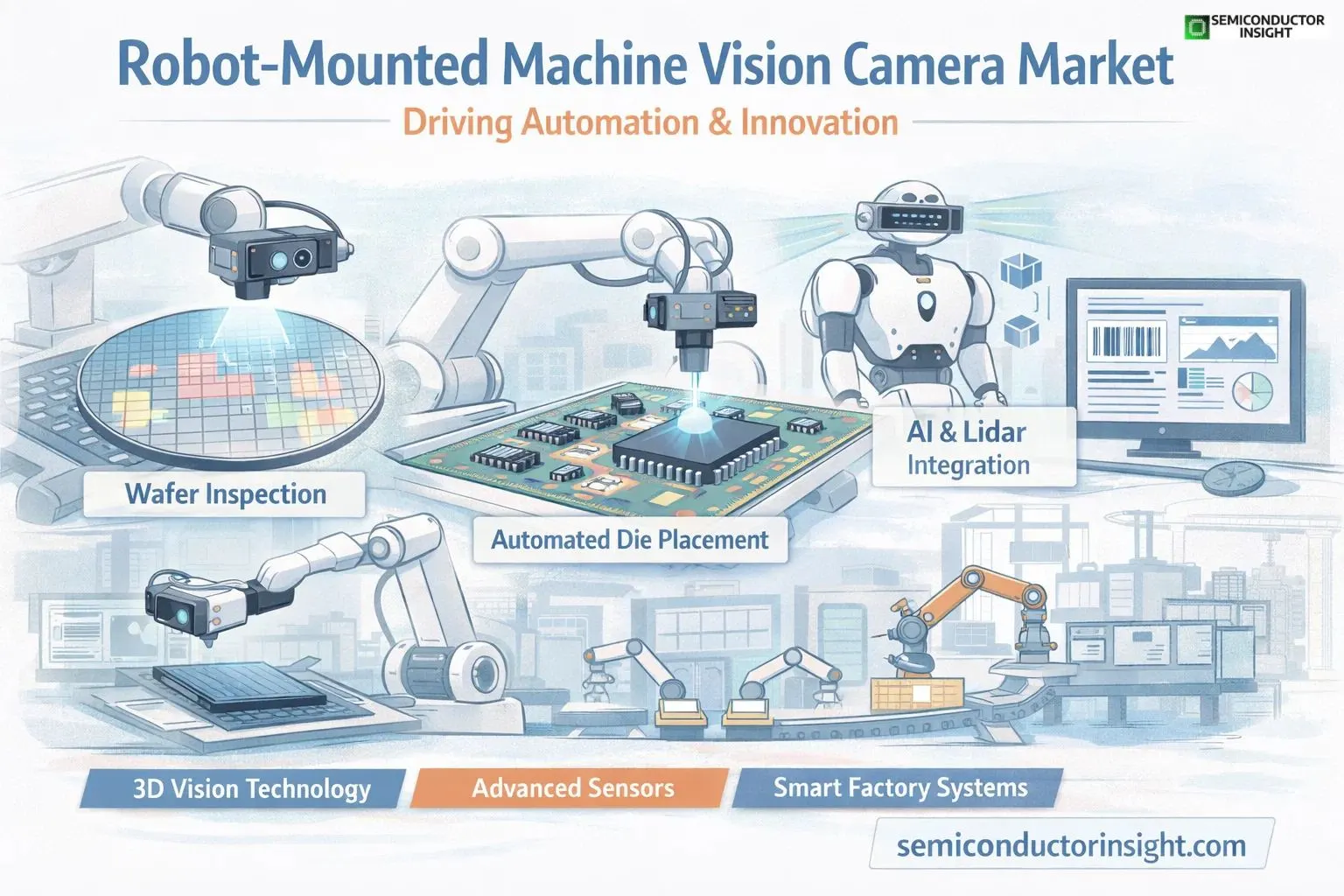
Machine vision cameras mounted on robotic gantries can examine wafers at high speeds, identifying surface anomalies, pattern breaks, and particle contamination tasks previously reliant on slower, manual optical systems. These vision systems often employ 3D imaging and AI-powered analytics to detect irregularities below the human eye’s threshold.
2. Automated PCB and Die Placement
Advanced cameras guide robotic arms to place dies with sub-micron accuracy a critical requirement in semiconductor assembly. This kind of precision directly improves throughput and reduces error rates.
3. Sample Handling and Traceability
Integrated vision systems capture unique identifiers and measurement data at each production stage, feeding back into analytic systems that ensure compliance with industry standards.
The machine vision landscape is shifting fast with new strategic developments that impact robot-mounted deployments:
4· Vision Tech Spinouts and Funding: In a major industry update, RealSense a key developer of depth-sensing vision cameras completed its spin-out from Intel and raised $50 million in funding to drive AI-enhanced robotics solutions globally. Its cameras, including the advanced D555 depth model, are now embedded in a significant share of autonomous mobile robots and humanoids worldwide.
5· Convergence of Vision and Lidar: Vision technology is increasingly paired with lidar systems, as evidenced by Ouster’s acquisition of StereoLabs, which positions the company at the forefront of Physical AI solutions combining cameras and lidar to enable robots that interact intelligently with the physical world.
6· Advanced Sensors in Action: Companies like Zivid AS are pushing 3D vision camera capabilities for applications such as mixed-SKU depalletizing and high-speed pick-and-place solutions directly relevant to smart factories and industrial robotics at scale.
Lastly before we wrap up, don’t forget to look at our most recent exclusive report for in-depth insights: https://semiconductorinsight.com/report/robot-mounted-machine-vision-camera-market/
Advanced Intelligent Systems Driving Industry Evolution
- AI-enabled anomaly detection allows cameras to distinguish between acceptable variations and true defects without human intervention.
- 3D imaging technologies are closing the gap on complex object recognition, enabling robotic systems to navigate and manipulate objects with unprecedented spatial understanding.
- Edge computing integration ensures real-time processing without bottlenecks, crucial in high-throughput semiconductor fabs and automated inspection lines.
Industrial Smart Factory Transformation Success
Imagine a smart factory floor where an autonomous robot equipped with a high-resolution vision camera examines each silicon wafer as it’s processed. Integrated with AI algorithms, the system not only flags defects but captures metadata that predicts when a particular fabrication tool needs calibration reducing downtime and waste. This sort of intelligent inspection loop exemplifies how machine vision and robotics interplay to set new standards in productivity and quality.
As industries push toward higher automation and more stringent quality requirements especially in semiconductor manufacturing robot-mounted machine vision cameras will continue to shift from supporting actors to central protagonists. With strong market growth, strategic corporate developments, and continuous technology advancements, this sector offers fertile ground for innovators, manufacturers, and automation leaders alike.

Comments (0)