
MARKET INSIGHTS
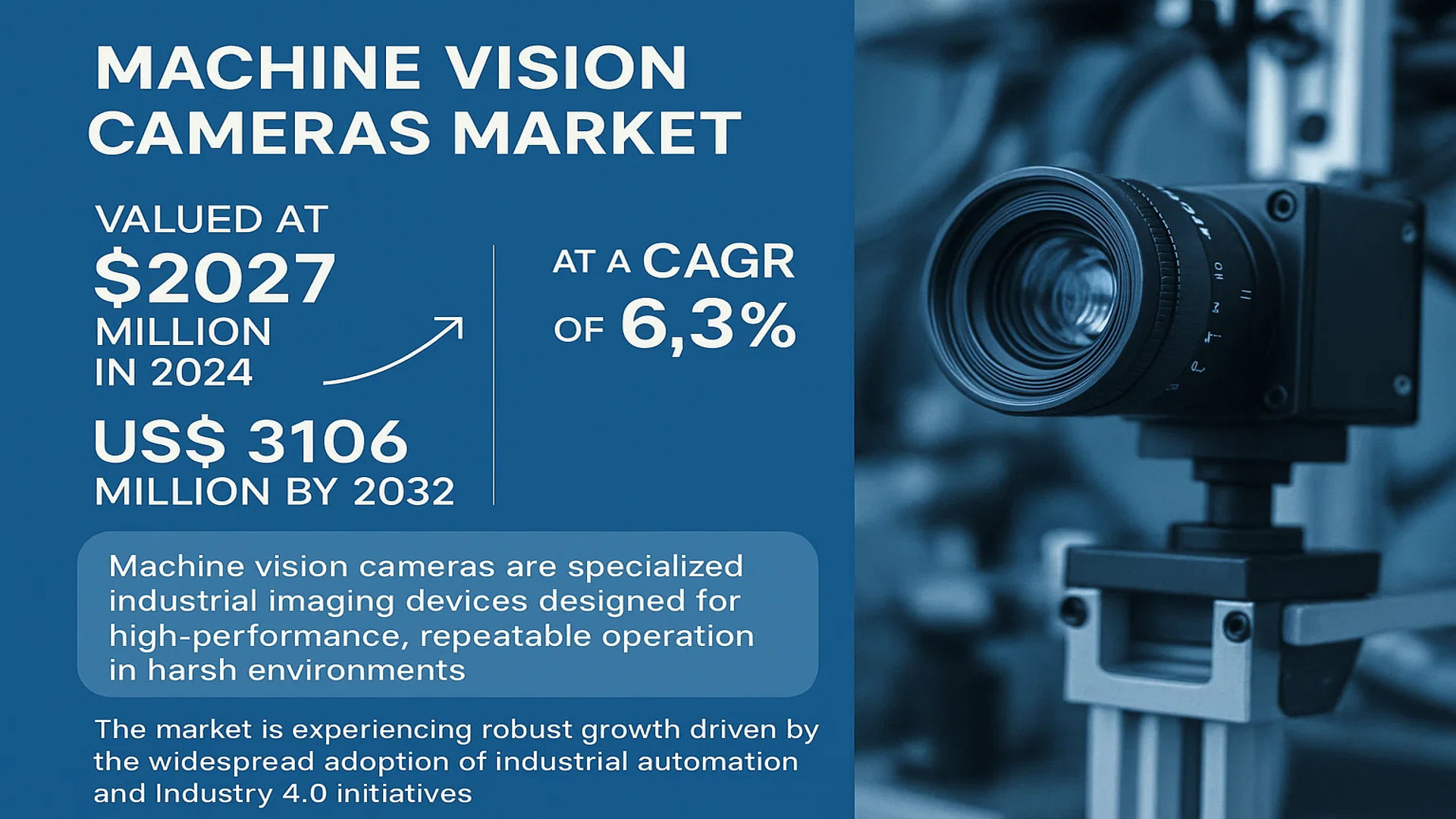
The global Machine Vision Cameras Market was valued at 2027 million in 2024 and is projected to reach US$ 3106 million by 2032, at a CAGR of 6.3% during the forecast period.
Machine Vision Cameras are specialized industrial imaging devices designed for high-performance, repeatable operation in harsh environments. These cameras are a core component of machine vision systems, converting optical signals into ordered electrical signals to enable automated inspection, measurement, and robot guidance. They are engineered for robustness and reliability, distinguishing them from standard commercial cameras.
The market is experiencing robust growth driven by the widespread adoption of industrial automation and Industry 4.0 initiatives. This expansion is further fueled by the integration of artificial intelligence (AI) and deep learning, which significantly enhance defect detection accuracy and system adaptability. Furthermore, the rising demand for 3D vision systems and high-resolution, high-speed cameras for precision applications in sectors like automotive and electronics is a major contributor. Key players such as Basler AG, Cognex Corporation, and Teledyne FLIR operate in this market with extensive portfolios, continuously innovating to meet evolving industrial demands.
MARKET DYNAMICS
MARKET DRIVERS
Increased Adoption of Industrial Automation and Industry 4.0 to Drive Market Growth
The global push toward industrial automation and smart manufacturing is significantly accelerating demand for machine vision cameras. As manufacturers worldwide embrace Industry 4.0 principles, these cameras have become indispensable for quality control, robotic guidance, and predictive maintenance. Automated assembly lines increasingly rely on vision systems for precision tasks, with robotics integration growing at an unprecedented rate. The manufacturing sector’s transformation toward fully automated facilities has created a robust demand environment where machine vision cameras serve as the eyes of automated systems, enabling real-time decision-making and process optimization. This trend is particularly strong in automotive and electronics manufacturing, where precision and consistency are critical for maintaining competitive advantage and meeting stringent quality standards.
Integration of Artificial Intelligence and Deep Learning Technologies to Boost Market Expansion
The integration of artificial intelligence and deep learning algorithms into machine vision systems represents a fundamental shift in capabilities and applications. AI-enhanced vision systems can now recognize complex patterns, detect subtle anomalies, and adapt to new defects without manual reprogramming. This technological evolution has dramatically improved defect detection accuracy in environments with high variability, making machine vision cameras more versatile across different industries. The ability to process images in real-time with AI-driven analysis allows manufacturers to implement immediate corrective actions on production lines, reducing waste and improving overall efficiency. These advancements have expanded machine vision applications beyond traditional inspection tasks into areas such as predictive maintenance, process optimization, and even creative problem-solving within manufacturing environments.
Growing Demand for Quality Inspection and Defect Detection Across Industries to Fuel Market Growth
Across multiple sectors, there is increasing emphasis on quality assurance and defect detection, driving substantial demand for machine vision cameras. In industries where product quality directly impacts safety and performance, such as automotive, aerospace, and medical devices, vision systems have become essential components of manufacturing processes. The electronics industry particularly relies on high-resolution vision systems for inspecting miniature components and complex circuit boards, where human inspection is neither feasible nor reliable. The pharmaceutical industry has also adopted machine vision for ensuring packaging integrity and label accuracy, complying with strict regulatory requirements. This widespread adoption across diverse industries creates a sustained growth trajectory for machine vision cameras as manufacturers seek to enhance product quality while maintaining production efficiency.
MARKET CHALLENGES
High Implementation and Maintenance Costs Pose Significant Challenges to Market Penetration
While machine vision technology offers substantial benefits, the significant investment required for implementation presents a major challenge, particularly for small and medium-sized enterprises. The total cost of ownership includes not only the cameras themselves but also associated components such as lighting systems, lenses, processing units, and specialized software. Additionally, integration with existing manufacturing systems often requires custom engineering solutions, further increasing implementation expenses. Maintenance costs also contribute to the total expenditure, as vision systems require regular calibration, software updates, and occasional hardware replacements. These financial barriers can delay adoption decisions and limit market penetration in cost-sensitive segments, particularly in developing regions where capital expenditure constraints are more pronounced.
Other Challenges
Technical Complexity and Integration Difficulties
The technical complexity of machine vision systems presents substantial implementation challenges. Integrating vision systems with existing manufacturing equipment requires specialized expertise in both hardware configuration and software development. Variations in lighting conditions, product appearance, and environmental factors can affect system performance, necessitating continuous adjustments and optimizations. Many organizations struggle with the technical expertise required to maintain and troubleshoot these systems, leading to extended downtime and reduced operational efficiency when issues arise.
Environmental and Operational Constraints
Machine vision cameras often operate in challenging industrial environments characterized by extreme temperatures, vibrations, dust, and electromagnetic interference. These conditions can affect camera performance and reliability, requiring specially designed hardware that withstands harsh operational conditions. Additionally, vision systems must accommodate variations in product appearance, lighting changes, and unexpected obstacles, creating ongoing challenges for system reliability and accuracy across different operational scenarios.
MARKET RESTRAINTS
Shortage of Skilled Professionals and Technical Expertise to Limit Market Growth
The rapid advancement of machine vision technology has created a significant gap between technological capabilities and available expertise. There is a growing shortage of professionals with the multidisciplinary skills required to design, implement, and maintain sophisticated vision systems. This expertise deficit encompasses knowledge of optics, imaging technologies, software development, and industrial automation processes. The complexity of modern vision systems requires specialists who can bridge these domains, but such professionals are scarce in the job market. This skills shortage affects not only end-users but also manufacturers and system integrators, potentially delaying projects and limiting the effective utilization of advanced vision capabilities. The situation is particularly challenging in emerging markets where technical education infrastructure hasn’t kept pace with technological advancements.
Compatibility and Standardization Issues to Restrain Market Expansion
The lack of universal standards and compatibility between different vision system components creates significant integration challenges. Various manufacturers use proprietary interfaces, communication protocols, and software architectures, making it difficult to mix components from different suppliers. This incompatibility forces users to choose between being locked into a single vendor’s ecosystem or facing complex integration projects. The absence of industry-wide standards also means that systems often require custom programming and configuration, increasing implementation time and costs. These compatibility issues become particularly problematic when upgrading existing systems or integrating new vision technology with legacy manufacturing equipment, creating barriers to adoption and limiting market growth across diverse industrial environments.
Data Processing and Management Challenges to Hinder Market Development
Modern high-resolution machine vision cameras generate enormous amounts of data that must be processed, analyzed, and stored efficiently. The computational requirements for real-time image processing can be substantial, particularly with high-speed cameras capturing thousands of frames per second. Many manufacturing facilities lack the infrastructure to handle this data volume effectively, leading to processing bottlenecks and delayed decision-making. Additionally, managing and storing vision data for quality records and process analysis creates further challenges regarding data storage capacity and retrieval efficiency. These data management issues become more pronounced as camera resolutions increase and applications become more complex, potentially limiting the adoption of advanced vision systems in environments with limited IT infrastructure.
MARKET OPPORTUNITIES
Emerging Applications in Non-Traditional Sectors to Create New Growth Opportunities
Beyond traditional manufacturing applications, machine vision cameras are finding new opportunities in sectors such as agriculture, logistics, retail, and healthcare. In agricultural technology, vision systems are being used for crop monitoring, yield prediction, and automated harvesting. The logistics industry employs vision technology for package sorting, inventory management, and autonomous guided vehicles. Retail applications include customer behavior analysis, inventory tracking, and automated checkout systems. Healthcare applications range from surgical assistance and medical device manufacturing to pharmaceutical packaging and laboratory automation. These emerging applications represent significant growth potential as vision technology adapts to diverse requirements and environments beyond conventional industrial settings.
Advancements in 3D Vision and Multi-Sensor Systems to Open New Market Frontiers
The evolution of 3D vision technology and multi-sensor systems creates substantial opportunities for market expansion. Three-dimensional vision capabilities enable applications that were previously impossible with traditional 2D imaging, including volumetric measurement, bin picking, and complex surface inspection. The integration of multiple sensor types, including thermal, hyperspectral, and depth-sensing technologies, allows vision systems to capture comprehensive information about objects and environments. These advanced capabilities are particularly valuable in automotive manufacturing, aerospace, and electronics industries where complex geometries and critical measurements require sophisticated inspection solutions. The continuous improvement in 3D imaging technology and sensor fusion algorithms positions machine vision cameras for expanded applications in quality control and process automation.
Development of Compact and Edge-Computing Enabled Vision Systems to Drive Future Growth
The trend toward miniaturization and edge computing capabilities presents significant opportunities for market growth. Compact vision systems with integrated processing power enable deployment in space-constrained environments and mobile applications. Edge computing capabilities allow vision systems to process images locally, reducing latency and enabling real-time decision-making without relying on cloud connectivity. This is particularly important for applications requiring immediate response, such as robotic guidance and safety systems. The development of smart cameras with built-in artificial intelligence processors further enhances these capabilities, allowing complex vision tasks to be performed directly at the edge. These technological advancements open new application possibilities while making vision technology more accessible and easier to implement across various industries.
MACHINE VISION CAMERAS MARKET TRENDS
Integration of Artificial Intelligence and Deep Learning to Emerge as a Pivotal Trend
The integration of Artificial Intelligence (AI) and deep learning algorithms is fundamentally transforming the capabilities and applications of machine vision cameras. This trend moves beyond traditional rule-based programming, enabling systems to learn from vast datasets and recognize complex patterns with unprecedented accuracy. In high-variability manufacturing environments, AI-powered vision systems can now detect subtle defects and anomalies that were previously indistinguishable, achieving accuracy rates exceeding 99.5% in certain applications. Furthermore, these systems possess self-learning capabilities, allowing them to adapt to new product variations or defect types without requiring manual reprogramming, which significantly reduces downtime and maintenance costs. The shift towards real-time analysis is another critical aspect, as AI-driven processing enables immediate decision-making on the production line, facilitating instantaneous corrective actions and enhancing overall operational efficiency.
Other Trends
Accelerated Adoption of Industrial Automation and Smart Manufacturing
The global push towards Industry 4.0 and smart factories is driving unprecedented demand for machine vision cameras as a core enabling technology. These cameras are integral to automated quality control, robotic guidance, and predictive maintenance systems that form the backbone of modern manufacturing. The automotive and electronics sectors, in particular, are leading this adoption, utilizing vision systems for intricate assembly verification and precision measurement tasks. The proliferation of collaborative robots (cobots) further amplifies this trend, as they require advanced vision capabilities to safely and effectively interact with human workers and their environment. This widespread automation is not merely about replacing human labor but enhancing human capabilities and ensuring consistent, high-quality output in increasingly complex production processes.
Advancement and Proliferation of 3D Vision Technology
While 2D imaging remains fundamental, the market is experiencing significant growth in 3D vision systems that provide depth perception and volumetric analysis. This technology is revolutionizing applications that require precise dimensional measurement, surface inspection, and complex object handling. In automotive manufacturing, for instance, 3D vision cameras enable robots to perform accurate bin-picking operations and verify the assembly of components with complex geometries. The semiconductor industry relies on these systems for wafer inspection and chip placement verification where nanometer-level precision is mandatory. The advancement of stereo vision, laser triangulation, and structured light techniques has made 3D systems more robust and cost-effective, expanding their adoption beyond traditional high-end applications into more mainstream industrial settings.
Miniaturization and Edge Computing Integration
The trend towards miniaturization and the integration of processing power at the edge is reshaping camera design and functionality. Modern machine vision cameras are becoming increasingly compact while incorporating powerful onboard processors, evolving into what are termed smart cameras or vision sensors. This integration eliminates the need for separate processing units, reducing system complexity, installation time, and overall costs. Edge computing capabilities allow for real-time image processing directly within the camera, minimizing latency and reducing the bandwidth requirements for data transmission. This is particularly crucial in high-speed applications or in environments where data security and processing immediacy are paramount. The development of these compact, powerful systems is opening new application areas in tight spaces and enabling more distributed vision intelligence across the factory floor.
COMPETITIVE LANDSCAPE
Key Industry Players
Companies Leverage Technological Innovation and Strategic Partnerships to Secure Market Position
The global machine vision cameras market exhibits a fragmented yet competitive structure, characterized by the presence of established multinational corporations, specialized technology providers, and emerging innovators. While no single entity dominates the market entirely, several key players have carved out significant shares through technological leadership, extensive product portfolios, and robust global distribution networks. The competitive intensity is further heightened by continuous advancements in imaging technology, including the integration of artificial intelligence, 3D vision, and high-speed imaging capabilities.
Basler AG and Cognex Corporation are widely recognized as frontrunners in this space. Basler’s strength lies in its comprehensive range of area scan and line scan cameras, alongside its development of powerful software development kits (SDKs) that simplify integration for OEMs and end-users. Cognex, conversely, has built a formidable reputation not just with its cameras but with its complete machine vision solutions, including sophisticated vision software and deep learning tools, making it a preferred partner for complex industrial automation projects, particularly in the automotive and electronics sectors.
Meanwhile, technology giants like Sony exert considerable influence through their mastery of sensor technology. Sony’s image sensors are a critical component in many machine vision cameras offered by other manufacturers, giving it a foundational role in the market’s supply chain. Its own branded cameras leverage this internal expertise to deliver high-performance products known for exceptional image quality and reliability.
Other significant players, including Teledyne FLIR and Omron, are strengthening their positions through strategic acquisitions and focused R&D investments. Teledyne’s acquisition of FLIR Systems significantly expanded its thermal imaging and sensor technology portfolio, allowing it to address a broader spectrum of industrial applications. Omron integrates its vision cameras seamlessly with its extensive automation and robotics products, offering customers a unified and highly efficient system solution.
The competitive dynamics are also shaped by regional specialists and companies focusing on niche applications. Firms are increasingly investing in developing smart cameras with embedded processing to capitalize on the trend towards edge computing and decentralized analysis. This strategic focus on innovation, coupled with expansion into high-growth regions like Asia-Pacific, is expected to be a primary driver for market share acquisition in the coming years.
List of Key Machine Vision Camera Companies Profiled
- Basler AG (Germany)
- Teledyne FLIR (U.S.)
- Sony Corporation (Japan)
- TKH Group (Netherlands)
- Cognex Corporation (U.S.)
- Toshiba Teli Corporation (Japan)
- Baumer Holding AG (Switzerland)
- Hikvision (China)
- Dahua Technology (China)
- IDS Imaging Development Systems GmbH (Germany)
- Jai A/S (Denmark)
- Daheng Image (China)
- Omron Corporation (Japan)
- National Instruments (U.S.)
- Ximea GmbH (Germany)
Segment Analysis:
By Type
Area Scan Camera Segment Dominates the Market Due to Versatility in High-Resolution 2D Imaging Applications
The market is segmented based on type into:
- Area Scan Camera
- Line Scan Camera
By Application
Manufacturing Segment Leads Due to Critical Role in Automated Quality Control and Inspection
The market is segmented based on application into:
- Manufacturing
- Medical and Life Sciences
- Security and Surveillance
- Intelligent Transportation System
- Others
By Technology
CCD Technology Segment Holds Significant Share Due to High Image Quality and Sensitivity
The market is segmented based on technology into:
- CCD (Charge-Coupled Device)
- CMOS (Complementary Metal-Oxide-Semiconductor)
By Interface
GigE Interface Segment Prevails Due to Cost-Effectiveness and Long-Distance Capabilities
The market is segmented based on interface into:
- GigE (Gigabit Ethernet)
- USB
- Camera Link
- CoaXPress
Regional Analysis: Machine Vision Cameras Market
Asia-Pacific
The Asia-Pacific region is the dominant force in the global machine vision cameras market, accounting for over 45% of total revenue share. This leadership is fueled by massive manufacturing hubs in China, Japan, and South Korea, where the aggressive adoption of Industry 4.0 and automation is non-negotiable for maintaining competitive advantage. China’s “Made in China 2025” initiative, in particular, has accelerated the integration of smart vision systems in electronics, automotive, and semiconductor production lines. While cost-competitive solutions are highly sought after, there is a clear and growing trend toward investing in more sophisticated AI-powered and 3D vision systems to tackle complex quality assurance tasks. The region’s vast consumer electronics sector, responsible for producing billions of units annually, creates an insatiable demand for high-speed, high-resolution cameras for micro-defect detection.
North America
Characterized by technological innovation and high-value manufacturing, North America is a significant and mature market. The region, particularly the United States, is a pioneer in the development and early adoption of advanced machine vision technologies, including deep learning integration and sophisticated 3D imaging. Strong investments in reshoring manufacturing capabilities and modernizing existing industrial infrastructure are key growth drivers. The presence of major automotive and aerospace OEMs, alongside a robust semiconductor industry, demands vision systems capable of extreme precision and reliability. Furthermore, stringent quality standards and high labor costs make automation through machine vision not just an option but a necessity for maintaining operational efficiency and product quality.
Europe
Europe’s market is driven by a strong industrial base, particularly in Germany, which is at the forefront of the Industry 4.0 movement. The region exhibits a high demand for machine vision cameras that comply with strict EU regulations and standards, emphasizing safety, precision, and increasingly, energy efficiency. European manufacturers are leaders in high-end engineering sectors like automotive, pharmaceuticals, and precision machinery, which require the most advanced vision solutions for tasks such as robotic guidance and meticulous inspection. The market is characterized by a preference for high-performance, reliable cameras from established European vendors, though competition from global players is intense. Innovation in smart cameras with embedded processing is particularly strong here.
South America
The South American market for machine vision cameras is in a developing phase, presenting a landscape of potential amidst challenges. Growth is primarily driven by the automotive and food and beverage packaging industries in countries like Brazil and Argentina. However, market expansion is often tempered by economic volatility, which can delay large-scale capital investments in advanced automation equipment. While there is a recognition of the benefits of machine vision for quality control, adoption is frequently limited to more basic 2D inspection systems due to budget constraints. The long-term outlook remains positive as regional manufacturing seeks to improve its global competitiveness, which will inevitably require greater automation.
Middle East & Africa
This region represents an emerging market with growth potential concentrated in specific sectors and nations. The adoption of machine vision cameras is primarily seen in the pharmaceutical packaging, food processing, and security and surveillance applications, particularly in more economically developed countries like Israel, Turkey, and the UAE. Large-scale infrastructure projects and a gradual push toward industrial diversification, such as in Saudi Arabia, are creating new opportunities. However, the market’s development is constrained by a currently limited manufacturing base and a reliance on imported technology. Investment in vision systems is often project-specific rather than part of a broad industrial strategy, but this is expected to evolve over the coming decade.
Report Scope
This market research report provides a comprehensive analysis of the global and regional Machine Vision Cameras markets, covering the forecast period 2025–2032. It offers detailed insights into market dynamics, technological advancements, competitive landscape, and key trends shaping the industry.
Key focus areas of the report include:
- Market Size & Forecast: Historical data and future projections for revenue, unit shipments, and market value across major regions and segments.
- Segmentation Analysis: Detailed breakdown by product type, technology, application, and end-user industry to identify high-growth segments and investment opportunities.
- Regional Outlook: Insights into market performance across North America, Europe, Asia-Pacific, Latin America, and the Middle East & Africa, including country-level analysis where relevant.
- Competitive Landscape: Profiles of leading market participants, including their product offerings, R&D focus, manufacturing capacity, pricing strategies, and recent developments such as mergers, acquisitions, and partnerships.
- Technology Trends & Innovation: Assessment of emerging technologies, integration of AI/IoT, semiconductor design trends, fabrication techniques, and evolving industry standards.
- Market Drivers & Restraints: Evaluation of factors driving market growth along with challenges, supply chain constraints, regulatory issues, and market-entry barriers.
- Stakeholder Analysis: Insights for component suppliers, OEMs, system integrators, investors, and policymakers regarding the evolving ecosystem and strategic opportunities.
Primary and secondary research methods are employed, including interviews with industry experts, data from verified sources, and real-time market intelligence to ensure the accuracy and reliability of the insights presented.
FREQUENTLY ASKED QUESTIONS:
What is the current market size of Global Machine Vision Cameras Market?
-> Machine Vision Cameras Market was valued at 2027 million in 2024 and is projected to reach US$ 3106 million by 2032, at a CAGR of 6.3% during the forecast period.
Which key companies operate in Global Machine Vision Cameras Market?
-> Key players include Basler AG, Teledyne FLIR, Sony, Cognex Corporation, and Omron, among others.
What are the key growth drivers?
-> Key growth drivers include increased adoption of industrial automation, integration of AI and deep learning, demand for high-precision inspection, and advancements in 3D vision technology.
Which region dominates the market?
-> Asia-Pacific is the largest and fastest-growing market, driven by manufacturing expansion in China, Japan, and South Korea, while North America remains a significant market due to high industrial automation adoption.
What are the emerging trends?
-> Emerging trends include miniaturization of cameras, edge computing integration, high-speed imaging for electronics manufacturing, and the development of smart cameras with embedded AI capabilities.

Get Sample Report PDF for Exclusive Insights
Report Sample Includes
- Table of Contents
- List of Tables & Figures
- Charts, Research Methodology, and more...
 Download Sample Report PDF





