
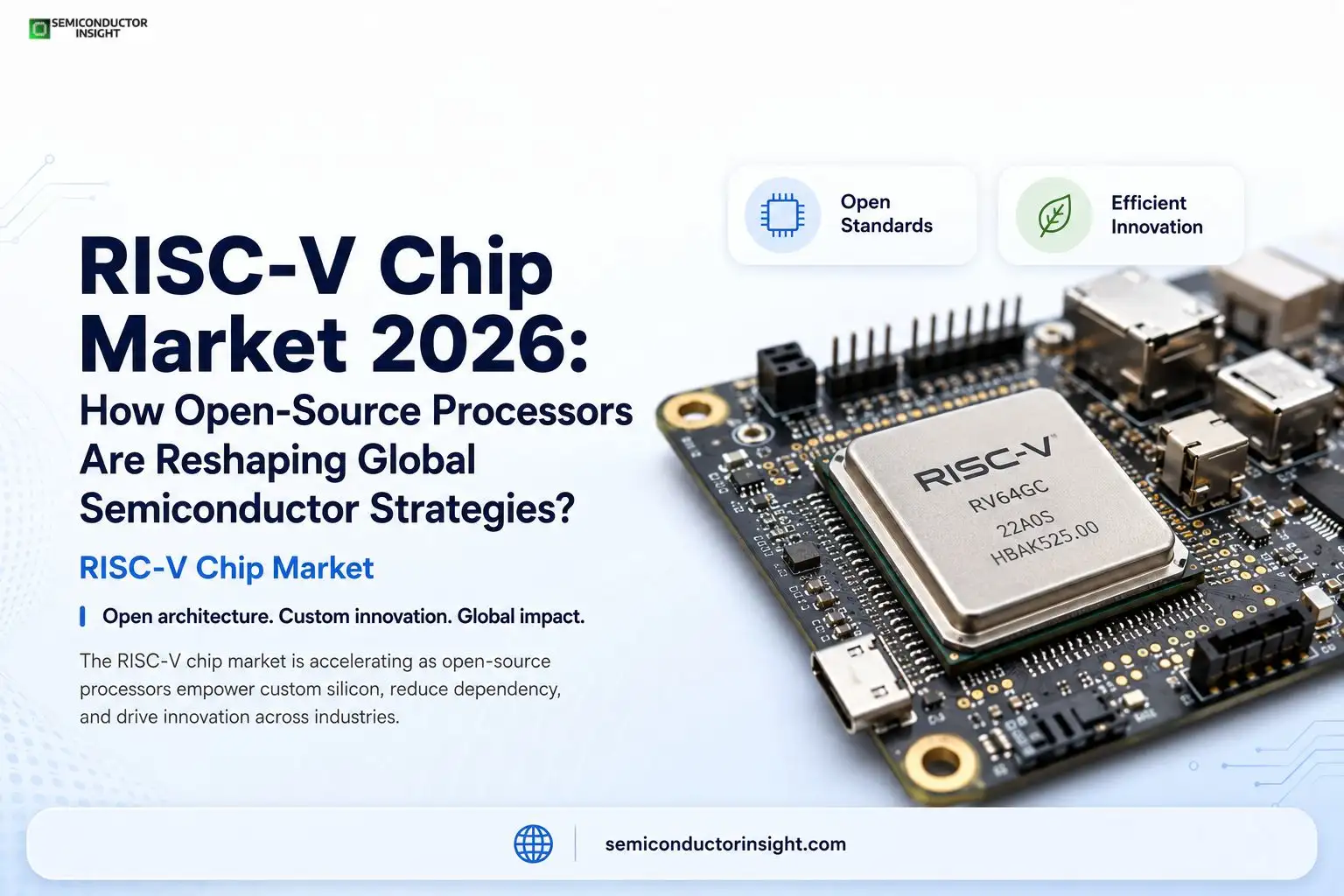
RISC-V Chip Market 2026: How Open-Source Processors Are Reshaping Global Semiconductor Strategies?
RISC-V Chip Market refers to the global ecosystem involved in the design, development, manufacturing, and commercialization of semiconductor chips based on the RISC-V (Reduced Instruction Set Computer-Five) open-standard instruction set architecture (ISA).
Around 2010, research at the University of California, Berkeley produced RISC-V, the fifth generation of reduced instruction set computer systems that had been developed there since the early 1980s.
RISC-V International, a non-profit organisation with thousands of members based in Switzerland, oversees the global standard that began as an academic effort to investigate open alternatives. With the freedom to incorporate unique extensions for certain workloads, this open instruction set architecture enables designers to create processors without paying traditional licensing fees.
Early prototypes in 2013 and 2014 laid the groundwork for 32-bit, 64-bit, and even 128-bit implementations. By the mid-2010s, industry interest accelerated as companies sought ways to tailor silicon for efficiency.
The architecture supports everything from tiny microcontrollers to high-performance applications through modular extensions for vector processing, security, and more. This modularity stands out compared to fixed proprietary designs, letting teams optimise at the hardware level for power, area, or specialised tasks.
Curious about the report? Dive into our newest updated version at no cost: https://semiconductorinsight.com/report/risc-v-chip-market/
Tracing the Journey from University Labs to Commercial Shipping Volumes
- Development teams at Berkeley released initial specifications openly, fostering collaboration that grew beyond academia. By 2015, stewardship moved to the foundation that later became RISC-V International.
- Early adopters included startups and research groups experimenting with Linux-capable cores. Real momentum built as commercial entities like SiFive introduced development boards such as the HiFive series, which reached developers in dozens of countries and demonstrated practical viability for embedded systems.
- Today, billions of RISC-V cores have shipped in various forms. One notable example involves smart watches using Andes Technology cores that have moved beyond prototypes into mass production, exceeding one million units, delivering strong battery life for GPS and biometric features. These deployments highlight how the architecture supports real consumer products rather than remaining theoretical.
Diverse Applications Taking Shape in Everyday and Advanced Systems
RISC-V cores appear across consumer electronics, industrial automation, and connectivity solutions. In wearables and IoT devices, low-power implementations handle sensor data and wireless tasks efficiently. Automotive developers explore the architecture for domain controllers and advanced driver assistance, valuing the ability to integrate custom instructions for safety-critical functions.
Edge computing benefits from vector extensions that accelerate machine learning inference without excessive energy draw. Google’s work on open-sourced neural processing units based on RISC-V points to potential in always-on, low-power AI platforms. Storage controllers and networking gear also incorporate the design for optimised data movement. These varied uses show the architecture’s adaptability as systems demand more specialisation.
Geopolitical Dynamics Influencing Worldwide Implementation Strategies
International tensions have drawn attention to open architectures. In China, national initiatives promote RISC-V to advance domestic semiconductor capabilities, with alliances and policy guidance encouraging its use in everything from consumer chips to higher-performance designs. Companies there have developed cores like the Xuantie series for AI and general computing.
European programs, including the European Processor Initiative, incorporate RISC-V for supercomputing, automotive, and AI accelerators to build regional strengths. The United States maintains active participation through companies and research, with discussions in policy circles about balancing innovation benefits against security considerations. This global spread reflects how nations view open standards as tools for technological resilience.
Software Support Expanding to Match Hardware Advances
- A strong software story accompanies the hardware progress. Operating system ports, including Linux distributions, run natively on RISC-V systems, with tools like QEMU enabling emulation and development. Compiler improvements and debugging support from vendors have matured, making the platform more accessible for production code.
- Projects such as the RISC-V Software Ecosystem initiative bring together industry players to align tools for data centres, consumer devices, and automotive needs. Recent profiles define common instruction sets that software can reliably target, reducing fragmentation. These efforts help bridge the gap between custom hardware and robust application development.
Notable Contributors Advancing Core Technology and Ecosystems
SiFive has delivered families of processor IP targeting performance, intelligence, and automotive segments, with recent cores emphasising vector and matrix capabilities for AI workloads. Andes Technology focuses on efficient embedded solutions, powering commercial products while expanding into higher-performance domains.
Other participants include academic efforts like the XiangShan processor from the Chinese Academy of Sciences and collaborations involving major technology firms contributing extensions or reference designs. This distributed innovation model allows smaller teams to build on shared foundations while adding value in their niches.
Synergies with Artificial Intelligence and Edge Processing Trends
AI applications particularly suit RISC-V because designers can add accelerators or vector units tailored to neural network operations. Edge scenarios benefit from the architecture’s power efficiency, enabling on-device processing that reduces latency and data transfer needs. Examples include reference platforms for low-power vision and audio tasks that integrate tightly with the base instruction set.
As industries shift toward distributed intelligence, the open nature supports rapid experimentation with new extensions for matrix multiplication or custom data types. This positions RISC-V well for the growing intersection of hardware and machine learning models running closer to data sources.
Policy Environments and Collaboration Frameworks Worldwide
- Government strategies in multiple regions reference open architectures in broader technology plans.
- Initiatives aim to foster local design talent and reduce single-vendor dependencies. International working groups and alliances help standardise extensions while allowing regional priorities to shape implementations.
- Academic and industry partnerships continue to drive research into areas like security features and high-performance computing.
- These frameworks support knowledge exchange while addressing concerns around intellectual contributions and supply chain diversity.
- The overall environment encourages measured growth alongside ongoing dialogue on responsible development.
RISC-V’s trajectory illustrates how open collaboration can accelerate semiconductor evolution. With expanding real-world use, maturing software, and active global participation, the architecture contributes to a more customizable and resilient computing landscape heading into the latter part of the decade. Continued focus on practical deployments and ecosystem depth will determine how widely it integrates into future systems.

Comments (0)