

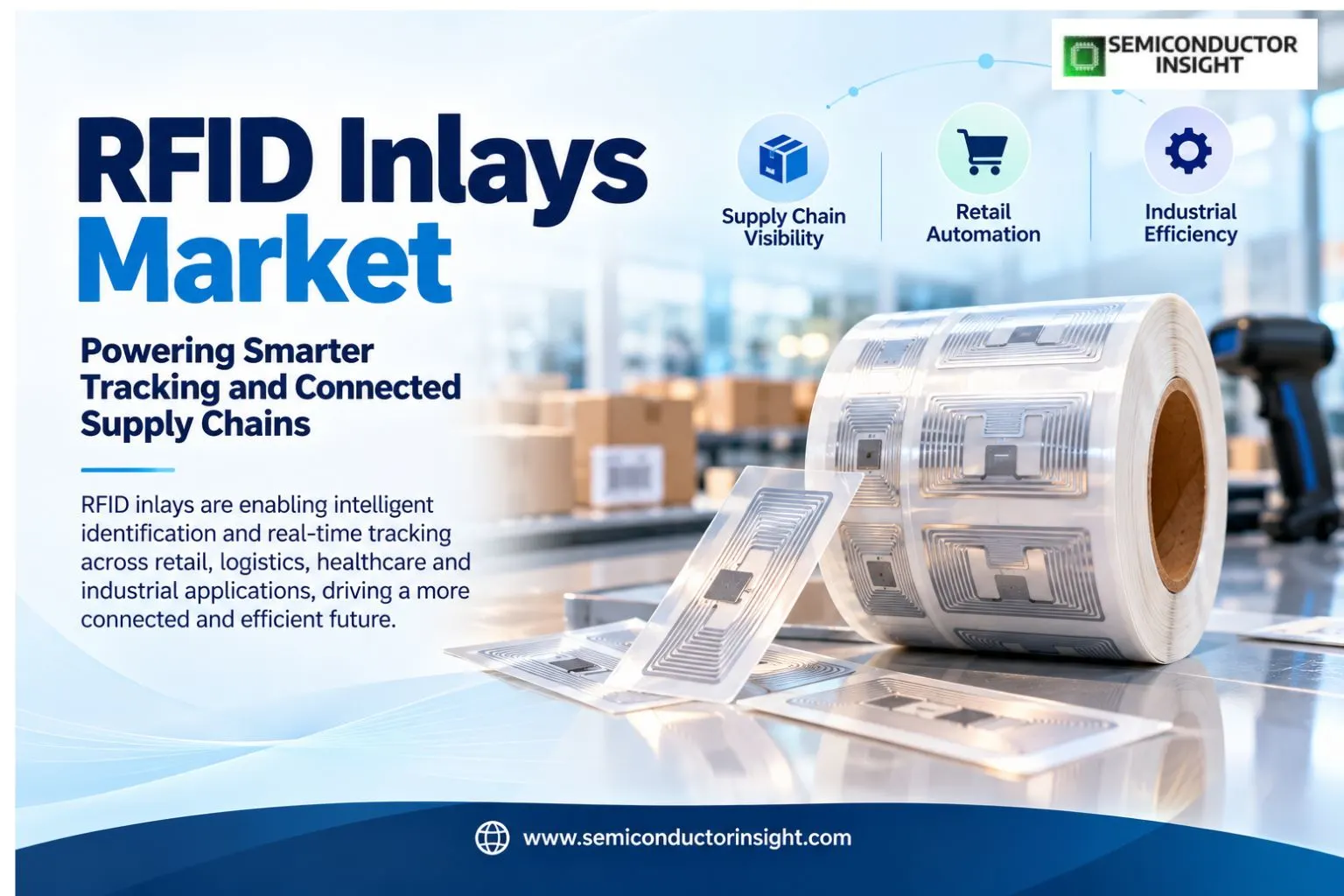
RFID Inlays Market 2026: From 50 Billion Passive Tags to Smaller and Smarter Identification Systems
An RFID inlay looks deceptively simple. It combines an integrated circuit with an antenna and is normally converted into a label, tag, card or embedded identification component. Yet this thin layer is becoming increasingly important as companies move from identifying boxes and pallets to tracking individual products.
The scale is already substantial. Auburn University’s RFID Lab says the industry has expanded to more than 50 billion passive UHF tags annually, making consistent manufacturing quality a critical part of deployment economics.
That volume is pushing RFID inlays market toward a new question: how can manufacturers deliver millions or billions of tags while making each one smaller, more reliable and better suited to difficult materials?
The Technology Stack behind a Modern Inlay
The basic architecture can be represented as:
RF signal → antenna → RFID IC → stored identifier → reader → enterprise software → product visibility
- For RAIN RFID, the antenna and chip operate in the UHF spectrum.
- Avery Dennison states that its RAIN RFID inlays can provide read ranges of up to 10 meters, although actual performance depends heavily on the tag design, reader configuration, tagged material and operating environment.
- The identifier is also becoming more useful. GS1 describes EPC as the bridge between GS1 identification and RAIN RFID, allowing products to receive serialized identities that support visibility and traceability.
- EPCIS can then communicate information about what happened to an item, when, where and why.
Miniaturization Is Opening New Product Categories
One of the clearest technology shifts is the reduction in inlay footprint.
Avery Dennison’s AD Minidose U9, for example, uses a 12 × 22 mm antenna and provides 96-bit EPC memory. Its smaller U9XM variant uses the same 22 × 12 mm footprint while increasing EPC memory to 256 bits.
That matters because traditional larger inlays can be difficult to integrate into cosmetics, jewelry, healthcare products, electronics and other compact merchandise.
The direction is straightforward:
- Large-format tags → compact inlays → miniature antennas → more difficult products become RFID-addressable
Gen2X Pushes Performance beyond Basic Identification
The next stage is not only about shrinking the antenna. RFID systems increasingly need to identify products reliably in dense and difficult environments.
- Impinj’s Gen2X technology is designed as a standards-compatible enhancement to RAIN RFID, with capabilities aimed at improving tag readability, reducing communication errors and supporting difficult-to-tag products. The company says Gen2X can help accelerate inventory cycles by up to 2× in supported deployments.
Avery Dennison began integrating Impinj Gen2X chips across its M8 inlay portfolio in 2025, extending the technology into retail, apparel, logistics and asset-tagging applications.
You can freely browse our most recent updated report to learn more about it before scrolling further: https://semiconductorinsight.com/report/rfid-inlays-market/
Fresh Food Has Become a Major Testing Ground
- A particularly notable 2026 development is the expansion of RFID into fresh food.
- Avery Dennison launched its AD IdentiFresh inlay series in February 2026 for bakery, meat, deli and produce applications.
- The company positions the technology around real-time inventory visibility, freshness management and waste reduction.
- This is significant because food introduces conditions that differ sharply from apparel.
- Moisture, packaging materials, density and product geometry can all influence RF performance.
- The market is therefore moving toward application-specific inlays rather than one universal RFID design.
India Adds Manufacturing Momentum
India is becoming an important manufacturing location for RFID inlays as local deployment expands.
- In April 2025, Avery Dennison opened its first RFID inlay and label production facility in India, located in Pune. The facility was described as the company’s first ARC-certified RFID inlay manufacturing operation in India and introduced the AD Cobra inlay for the local market.
Local manufacturing can shorten lead times and support regional customization, particularly as Indian retailers, manufacturers and logistics operators increase their use of item-level identification.
Certification Is Becoming a Manufacturing Differentiator
RFID inlay performance cannot be judged simply from antenna dimensions or chip specifications.
Auburn University’s ARC programme benchmark-tests inlays against detailed specifications based on particular use cases. Its quality certification also examines whether manufacturers can consistently reproduce performance across millions of tags.
The current approved lists demonstrate the breadth of the technology. ARC-approved products now span compact designs such as 20 × 10 mm inlays as well as much larger formats around 94 × 24 mm, using chips from suppliers including NXP and Impinj.
Sustainability Is Moving Into Antenna Engineering
Another emerging direction involves the physical construction of the inlay itself.
Avery Dennison’s Pure portfolio uses aluminum antennas and PET-free designs, with the company reporting a 70-90% lower carbon footprint compared with traditional etched antenna manufacturing for specified products.
This creates a new development path where RFID innovation is measured not only by read distance and memory, but also by material consumption and manufacturing footprint.
From Retail Tags to a Connected Product Layer
RFID inlays market is consequently expanding beyond the traditional apparel label. GS1 notes growing use of RAIN RFID across industries including apparel, rail, aerospace, construction, defense, electronics and healthcare.
The next wave is being shaped by a simple progression:
Identify → Serialize → Locate → Authenticate → Trace → Automate
That progression explains why the inlay itself is receiving greater engineering attention. As RFID moves deeper into food, healthcare, logistics, industrial assets and compact consumer products, the winning designs will need to combine tiny form factors, reliable RF performance, standardized identification and scalable manufacturing.

Comments (0)