
Reclaim Wafers Market Rewriting the Economics of Semiconductor Manufacturing
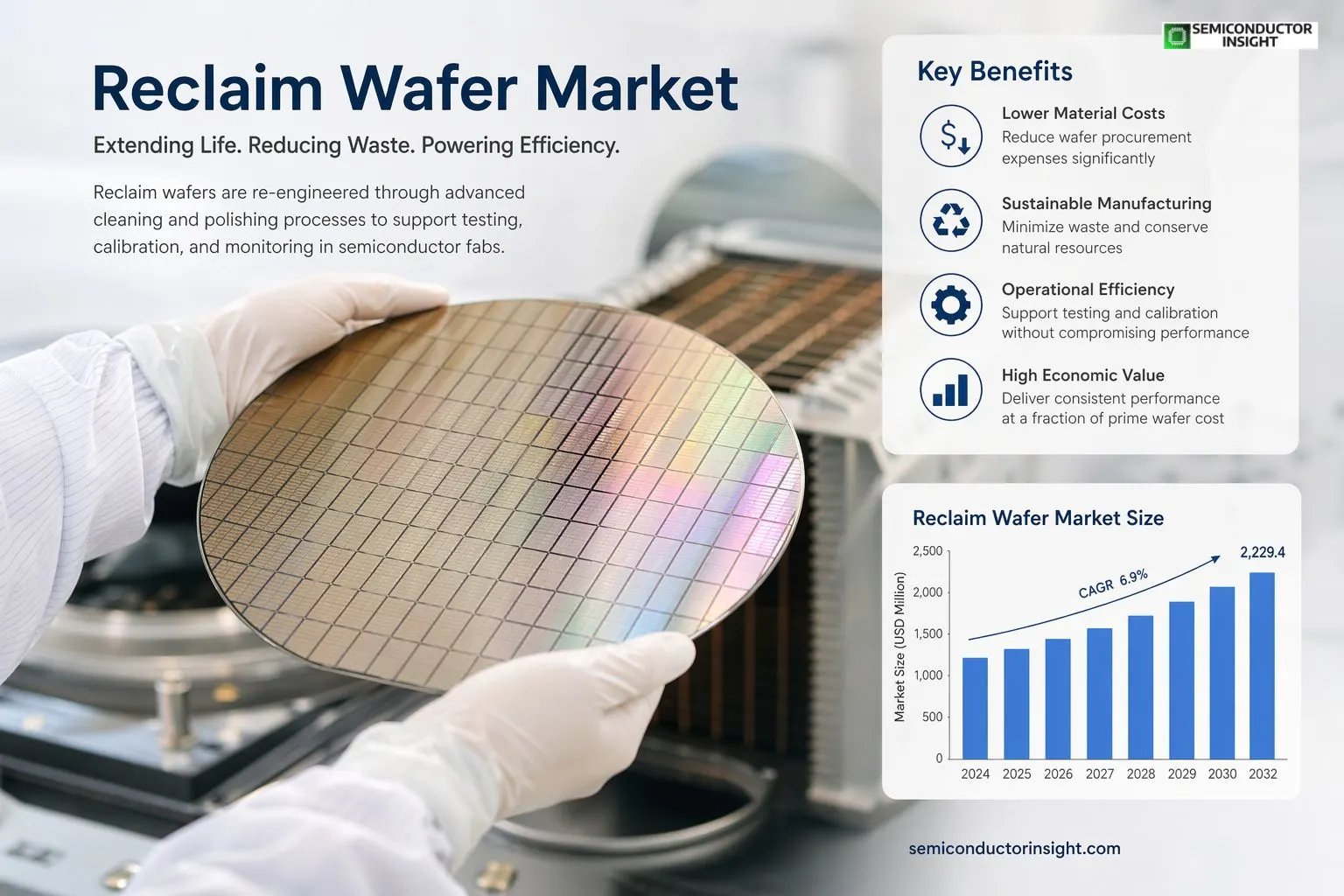
Reclaim wafers market refers to the ecosystem involved in collecting, processing, refurbishing, and resupplying used semiconductor wafers for reuse in manufacturing and testing applications. Reclaim wafers are typically silicon wafers that have already undergone one or more fabrication cycles but are restored through specialized cleaning, polishing, and surface treatment processes to meet industry usability standards again.
In the world of semiconductor fabrication, perfection has always been the benchmark. Yet, not every wafer needs to be flawless to deliver value. Reclaim wafers once used in production or testing are now being re-engineered to serve again, quietly reshaping how fabs operate.
Instead of discarding used silicon wafers, manufacturers are extending their lifecycle through advanced polishing, cleaning, and surface restoration processes. This transformation is not just about cost savings; it represents a deeper shift toward smarter resource utilization in an industry where material precision meets operational intensity.
Check out the full report for extended market insights: https://semiconductorinsight.com/report/reclaim-wafer-market/
What Makes a Reclaim Wafer Valuable Again?
- A reclaim wafer begins its second life after undergoing multiple restoration steps. These include stripping residual films, removing surface defects, and restoring flatness through chemical mechanical polishing.
- Reclaim wafers, in contrast to prime wafers, are usually utilised for monitoring, process testing, and equipment calibration rather than final chip manufacturing. Consistency, not perfection, is what makes them valuable.
- In high-volume fabs, thousands of wafers are required daily for non-device processes. Reclaim wafers fill this demand efficiently, reducing reliance on newly manufactured silicon while maintaining process reliability.
The Economics behind Reuse That Engineers Actually Care About
The semiconductor industry operates on razor-thin margins when it comes to material efficiency. A single 300 mm prime silicon wafer can cost between $100 to $500 depending on specifications and supply conditions.
Reclaim wafers, on the other hand, are significantly more economical. In large fabrication facilities, integrating reclaim wafers into routine processes can reduce material procurement costs by millions of dollars annually.
For example, a fab running 50,000 wafer starts per month may allocate a notable portion of its operations to monitor wafers and test cycles. Using reclaimed wafers for these steps minimizes waste while maintaining throughput efficiency.
The Reclaim Process
The restoration process typically follows these sequential steps to achieve a usable, Grade A surface:
- Sorting: Visual and technical inspection to group wafers by type, thickness, and resistivity while preventing metallic cross-contamination.
- Stripping: Using chemical baths (often sulfuric acid and hydrogen peroxide) to remove deposited films, oxides, and photoresists.
- Grinding/Lapping: Mechanical removal of deeper patterns or scratches, which naturally reduces the total thickness of the wafer.
- Polishing: A final Chemical Mechanical Planarization (CMP) step to restore a smooth, mirror-like finish.
- Final Cleaning & Inspection: Rigorous RCA cleaning to remove residual particles and metallic traces, followed by a final quality check.
Inside the Global Push toward Circular Semiconductor Manufacturing
Sustainability is no longer a peripheral goal it is becoming embedded in fab strategies worldwide. Semiconductor manufacturing consumes vast amounts of water, chemicals, and energy, making reuse initiatives increasingly critical.
Reclaim wafers are emerging as a practical solution within this broader circular manufacturing model. Instead of treating used wafers as waste, fabs are building internal or outsourced reclaim loops that feed cleaned wafers back into operations.
Governments and industry bodies have also started emphasizing resource efficiency. Environmental guidelines and green manufacturing initiatives are encouraging fabs to adopt reclaim processes as part of their sustainability commitments.
High-Impact Production Methods Gaining Industry Traction
Leading semiconductor manufacturers are already integrating reclaim wafers into their daily operations. Companies like Intel and TSMC have long relied on reclaim wafers for equipment testing and process validation.
In advanced nodes, where extreme precision is required, reclaim wafers help stabilize tools before actual production begins. This reduces variability and improves yield outcomes.
Additionally, foundries working with multiple clients use reclaim wafers extensively to ensure contamination-free transitions between production runs, enhancing overall fab hygiene and efficiency.
Environmental Impact That Goes Beyond Simple Recycling
- Reclaim wafers contribute to sustainability in more ways than just reuse.
- By extending the lifecycle of silicon wafers, fabs reduce the need for energy-intensive crystal growth and wafer slicing
- Producing a single silicon wafer involves high-temperature furnaces and precision engineering, consuming significant energy.
- Reclaiming wafers helps offset this footprint, making semiconductor manufacturing more environmentally balanced.
- Water usage is another critical factor. Reclaim processes, while still resource-intensive, typically consume less water than producing new wafers from raw silicon.
Where Innovation Meets Practicality in Everyday Fab Operations
What makes reclaim wafers truly impactful is their seamless integration into existing workflows. Engineers do not need to redesign processes or compromise on quality. Instead, they gain a flexible, cost-effective resource that supports routine operations.
From tool qualification to process monitoring, reclaim wafers are now embedded in the daily rhythm of semiconductor fabs. Their role may not always be visible, but their impact is undeniable.
The Subtle Shift That Signals a Larger Industry Transformation
The growing adoption of reclaim wafers reflects a broader mindset shift within the semiconductor industry. Efficiency is no longer just about speed and scale it is about intelligent resource use.
As fabs continue to expand globally and demand for chips rises across industries, reclaim wafers are becoming an essential component of sustainable growth.
What began out as a way to save money is now becoming a key part of a strategy that supports both operational excellence and environmental responsibility in modern semiconductor manufacturing.

Comments (0)