
Real Time Signal Conditioning Enhancing Catalytic Combustion Type Gas Sensor Market in Industrial Safety
Catalytic combustion type gas sensors deliver dependable detection of flammable gases through a time-tested yet continuously refined principle of controlled oxidation. Known also as pellistors, these devices rely on microscopic ceramic beads that host a precious-metal catalyst and a platinum heating coil, enabling flameless combustion that converts gas presence into a measurable electrical signal.
Engineers value them for their robustness across oil refineries, mining operations, chemical plants, and confined-space monitoring where early warning of combustible vapors can prevent major incidents.
You Can Go Through Our Latest Updated Insights Here: http://semiconductorinsight.com/report/catalytic-combustion-gas-sensor-market/
Foundational Principles of Flameless Combustion Detection
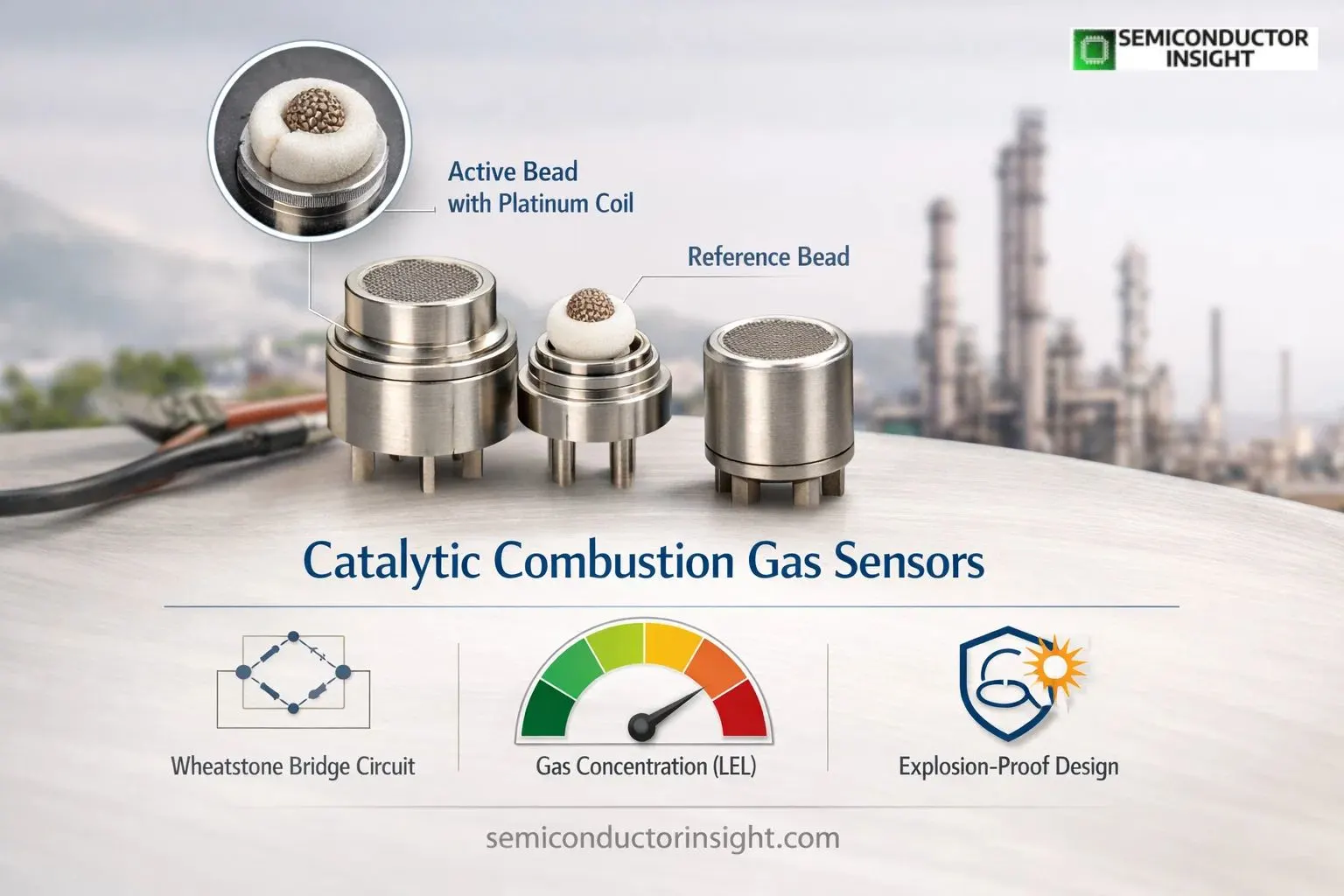
- At the core sits a matched pair of ceramic beads roughly one millimeter in diameter. The active bead carries a finely dispersed catalyst such as platinum or palladium while the reference compensator bead remains inert.
- Both beads contain embedded platinum wire coils heated electrically to approximately 450 degrees Celsius. When combustible gas molecules reach the active bead in the presence of oxygen, they oxidize on the catalyst surface, releasing a small but precise amount of heat.
- This raises the bead temperature by only a few degrees Celsius yet enough to alter the platinum coil’s electrical resistance.
- The reference bead, shielded from the reaction, tracks only ambient temperature changes.
- The resulting resistance difference feeds directly into a Wheatstone bridge circuit that outputs a voltage signal proportional to gas concentration, typically expressed as a percentage of the lower explosive limit.
Advanced Pellistor Bead Construction and Material Science
Modern bead fabrication begins with a porous ceramic matrix engineered for high gas permeability similar to fired clay. Catalyst and metal salts form a specialized dough that undergoes controlled baking to create an extremely stable, high-surface-area structure. This porosity allows rapid diffusion while the embedded platinum coil provides both heating and resistance measurement.
Recent laboratory work has introduced nanostructured core-shell designs using materials like palladium on attapulgite clay, achieving effective methane oxidation at temperatures as low as 300 degrees Celsius with a sensitivity of 0.7 microvolts per part per million and a detection limit around 36 parts per million. Such refinements reduce power consumption and extend operational life in demanding field conditions.
Wheatstone bridge Circuits Powered by Semiconductor Electronics
- The bridge circuit itself represents an elegant marriage of classical sensor physics and contemporary semiconductor technology.
- Platinum coils form two arms of the bridge while precision resistors complete the loop.
- Any imbalance caused by combustion heat produces a differential voltage that semiconductor-based amplifiers and analog-to-digital converters process in real time.
- Microcontroller units handle temperature compensation, linearization, and digital output, enabling seamless integration into distributed control systems or portable instruments.
- This semiconductor layer ensures stable readings across wide ambient temperature swings from minus 50 degrees Celsius to plus 85 degrees Celsius in standard models and up to 150 degrees Celsius in high-temperature variants.
Key Performance Specifications Drawn from Engineering Data
Technical documentation from established manufacturers and independent testing highlights consistent benchmarks. Response times commonly reach T90 values of 12 seconds or less, with some models recording T50 below 6 seconds. Sensors reliably cover 0 to 100 percent LEL ranges for over 200 different flammable gases and vapors when sufficient oxygen is present.
Full-scale accuracy holds across methane, propane, hydrogen, and heavier hydrocarbons provided ambient oxygen stays above approximately 10 volume percent. Explosion-proof sintered metal frits protect the hot beads while allowing gas entry, satisfying stringent hazardous-area certifications.
Regulatory Calibration Protocols and Field Maintenance Insights
OSHA guidance stresses regular performance verification using NIST-traceable calibration gases to counteract any gradual drift or poisoning effects. Daily bump tests for portable units and scheduled full calibrations for fixed installations maintain traceability.
Technicians apply correction factors when target gases differ from the calibration standard, ensuring readings reflect true concentrations. These protocols, rooted in decades of industrial safety practice, keep sensors responsive even after prolonged exposure in aggressive environments.
Mitigation Approaches for Catalyst Deactivation in Field Use
Several practical strategies help preserve long-term performance:
- Selecting poison-resistant catalyst formulations that tolerate trace silicones or sulfur compounds common in petrochemical streams.
- Incorporating protective filters or sintered barriers that slow contaminant ingress without compromising response speed.

Comments (0)