Catalytic Combustion Type Gas Sensor Market, Trends, Business Strategies 2026-2034

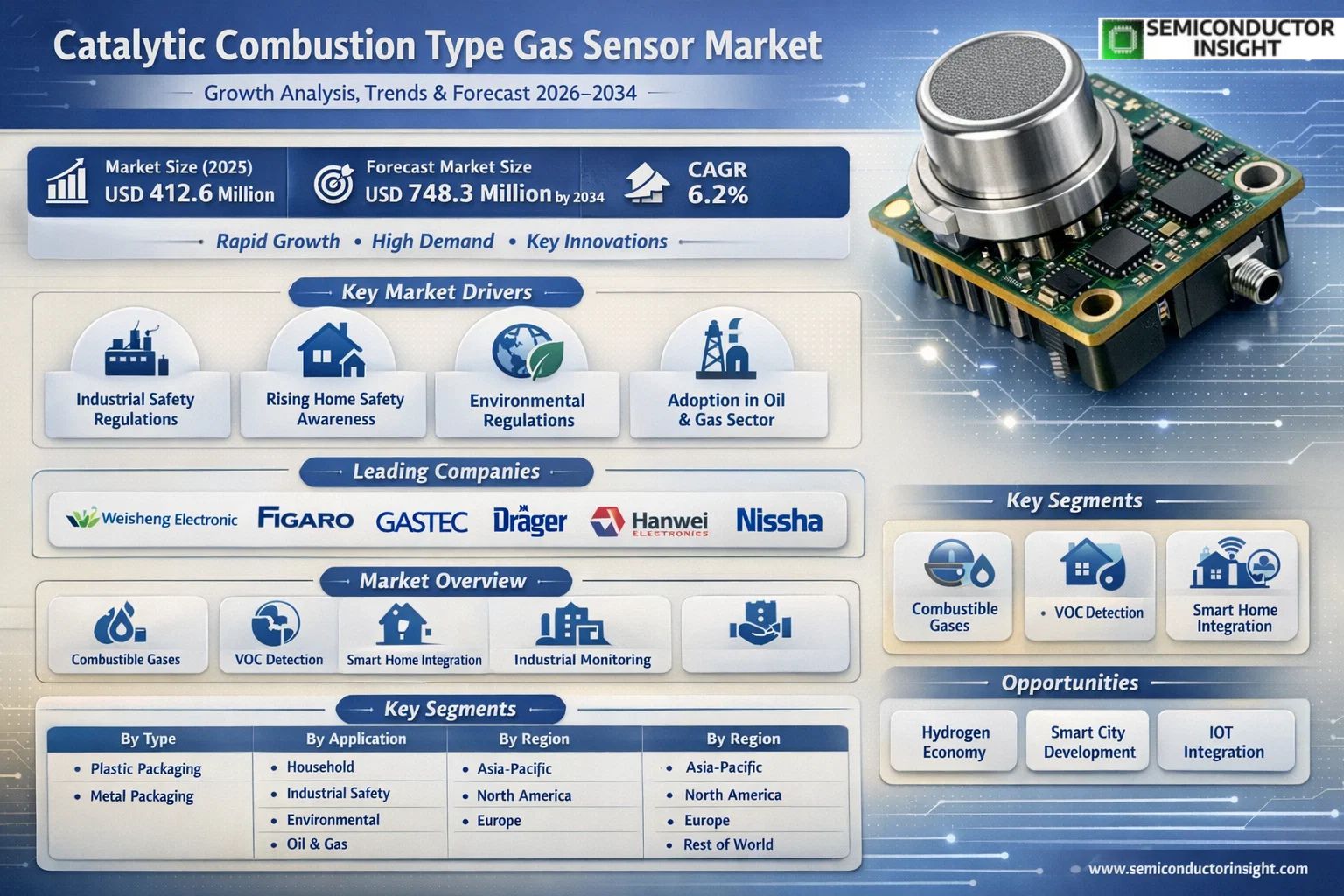
Global Catalytic Combustion Type Gas Sensor Market was valued at USD 412.6 million in 2025 and is expected to reach  USD 748.3 million by 2034,  growing at a CAGR of 6.2% during the forecast period.

PDF Icon Download Sample Report PDF
  • Quick Dispatch

    All Orders

  • Secure Payment

    100% Secure Payment

Price range: $1,500.00 through $4,250.00

Clear

Catalytic Combustion Type Gas Sensor Market Insights

Global Catalytic Combustion Type Gas Sensor market size was valued at USD 412.6 million in 2025. The market is projected to grow from USD 437.8 million in 2026 to USD 748.3 million by 2034, exhibiting a CAGR of 6.2% during the forecast period.

A catalytic combustion gas sensor is a sensor that uses the thermal effect principle of catalytic combustion to detect combustible gases or volatile organic compounds (VOCs). Operating on the principle that combustible gases oxidize on a catalytically active surface and generate heat proportional to their concentration, these sensors offer measurable advantages including good selectivity, high sensitivity, fast response speed, and reliable long-term stability. They are broadly categorized by packaging type into plastic packaging and metal packaging variants, and serve a wide spectrum of end-use applications spanning household safety, industrial safety monitoring, and environmental detection.

The market is witnessing steady expansion driven by stringent industrial safety regulations, rising adoption in oil and gas facilities, and growing awareness of combustible gas hazards in residential settings. Furthermore, increasing deployment in smart home safety systems and the integration of these sensors into IoT-enabled gas detection platforms are opening new growth avenues. Key manufacturers actively shaping the competitive landscape include Weisheng Electronic, Figaro Engineering Inc., GASTEC, Draeger, Hanwei Electronics Group, SGX Sensortech, Nissha, and KOMYO RIKAGAKU KOGYO K.K., among others.
y

MARKET DRIVERS

Rising Industrial Safety Regulations Fueling Adoption of Catalytic Combustion Type Gas Sensors

Stringent occupational health and safety regulations across industries such as oil and gas, petrochemicals, mining, and manufacturing have emerged as a primary growth driver for the catalytic combustion type gas sensor market. Regulatory frameworks mandating continuous monitoring of flammable and combustible gases in hazardous environments have compelled facility operators to deploy reliable detection systems. Catalytic combustion sensors, known for their sensitivity to a broad range of hydrocarbons and combustible gases, are particularly well-suited to meet these compliance requirements. Governments across North America, Europe, and Asia-Pacific have progressively tightened workplace safety standards, directly accelerating procurement cycles for fixed and portable gas detection equipment.

Expanding Oil, Gas, and Petrochemical Industries Creating Sustained Demand

The continued expansion of upstream and downstream oil and gas activities globally has sustained robust demand for catalytic combustion type gas sensors. Refineries, storage terminals, pipeline networks, and offshore platforms require continuous leak detection and atmosphere monitoring to prevent explosive incidents. The petrochemical sector, which handles large volumes of volatile organic compounds and combustible gases, represents one of the highest-value application segments. As new refinery capacities come online across the Middle East, Southeast Asia, and Africa, deployment of catalytic bead sensors and pellistor-based detection systems is scaling proportionately. This sectoral growth directly underpins market expansion across the forecast period.

The catalytic combustion type gas sensor market benefits significantly from the fact that these sensors offer a cost-effective, proven detection mechanism for flammable gases across a lower explosive limit (LEL) range of 0–100%, making them an industry-standard solution in hazardous area classifications.

Beyond regulatory and sectoral factors, the growing integration of catalytic combustion sensors into smart building management systems and industrial IoT platforms is reinforcing market momentum. End-users increasingly demand sensors that can transmit real-time data to centralized monitoring dashboards, and catalytic combustion technology is being adapted accordingly with digital output capabilities. This convergence of legacy detection technology with modern connectivity infrastructure broadens the addressable market and supports unit volume growth across both new installations and replacement cycles.

MARKET CHALLENGES

Sensor Poisoning and Drift Remain Key Technical Challenges in the Catalytic Combustion Type Gas Sensor Market

One of the most persistent technical challenges facing the catalytic combustion type gas sensor market is the susceptibility of catalytic bead sensors to poisoning and inhibition. Exposure to substances such as silicones, sulfur compounds, lead, and halogenated hydrocarbons can permanently degrade the catalytic activity of the sensing element, leading to false readings or sensor failure. In industrial environments where such contaminants are present, maintenance costs and sensor replacement frequency increase substantially. Additionally, sensor drift over time necessitates regular calibration, which adds operational burden for end-users managing large fleets of detection devices. Manufacturers continue to invest in poison-resistant catalyst formulations, though fully eliminating this vulnerability remains technically challenging.

Other Challenges


Competition from Alternative Detection Technologies

catalytic combustion gas sensor market faces intensifying competition from infrared (IR) gas sensors and electrochemical detection technologies. Infrared sensors, in particular, offer immunity to catalyst poisoning and can operate effectively in oxygen-depleted environments , conditions under which catalytic combustion sensors may fail to function reliably. As IR sensor costs continue to decline due to manufacturing scale and component improvements, end-users in demanding applications are increasingly evaluating IR-based alternatives. This competitive pressure challenges catalytic combustion sensor vendors to differentiate on cost, response time, and ease of integration.

Supply Chain and Raw Material Constraints

Catalytic combustion sensors rely on platinum-group metals, including platinum and palladium, as catalytic elements. These materials are subject to global supply volatility and price fluctuations driven by mining output, geopolitical factors, and industrial demand from automotive and electronics sectors. Sustained elevated prices for platinum-group metals can compress manufacturer margins and, in some cases, create component availability constraints. Smaller sensor manufacturers with limited procurement leverage are particularly exposed to this supply chain risk, which can affect production planning and pricing stability.

MARKET RESTRAINTS

High Maintenance Requirements and Total Cost of Ownership Restraining Market Penetration

While catalytic combustion type gas sensors offer a relatively low upfront acquisition cost compared to some alternative technologies, their total cost of ownership can be significantly higher when accounting for mandatory calibration schedules, periodic replacement of sensing elements, and the risk of unplanned failure due to poisoning. In large industrial facilities operating hundreds of fixed-point detectors, these recurring maintenance obligations translate into considerable ongoing expenditure. For cost-sensitive end-users in emerging markets or small-to-medium enterprises, this lifecycle cost profile can act as a restraint on adoption rates, particularly when lower-maintenance alternatives are available at comparable or modestly higher initial price points.

Operational Limitations in Oxygen-Deficient and Extreme Environmental Conditions

Catalytic combustion sensors require the presence of sufficient oxygen to sustain the catalytic oxidation reaction that underlies their detection mechanism. In confined spaces or process environments where oxygen concentrations are reduced , such as inert gas blanketing applications, certain storage vessels, or specific chemical processing areas , catalytic combustion sensors may produce unreliable or suppressed readings. This fundamental operational constraint limits their applicability in a subset of industrial scenarios, effectively capping the addressable market for this sensor type. Extreme temperatures and high humidity can further affect sensor performance and longevity, adding additional application boundaries that restrain overall market reach within the broader catalytic combustion type gas sensor market.

MARKET OPPORTUNITIES

Growth in Hydrogen Economy and Emerging Fuel Applications Opening New Avenues for Catalytic Combustion Gas Sensors

The accelerating global transition toward hydrogen as a clean energy carrier presents a significant growth opportunity for the catalytic combustion type gas sensor market. Hydrogen fueling stations, electrolysis facilities, hydrogen storage infrastructure, and fuel cell vehicle maintenance environments all require rigorous flammable gas monitoring due to hydrogen’s wide flammability range and high diffusivity. Catalytic combustion sensors capable of detecting hydrogen are finding increasing deployment in these emerging infrastructure segments. As government-backed hydrogen programs expand across Europe, Japan, South Korea, and the United States, demand for reliable, cost-effective combustible gas detection solutions is expected to scale commensurately, providing a sustained new demand stream for sensor manufacturers.

Urbanization and Smart City Infrastructure Development Broadening Application Scope

Rapid urbanization across Asia-Pacific, Latin America, and Africa is driving substantial investment in smart city infrastructure, including intelligent building management systems, underground utility networks, and public safety monitoring frameworks. Within these deployments, combustible gas detection for natural gas distribution networks, parking structures, and commercial kitchens represents a growing application base for catalytic combustion type gas sensors. Municipal gas utilities modernizing their leak detection capabilities and construction of high-density residential and commercial developments are creating incremental demand. Sensor manufacturers that develop compact, low-power, and network-compatible catalytic combustion sensor modules are well-positioned to capture share in this expanding urban infrastructure segment over the coming years.

Catalytic Combustion Type Gas Sensor Market Trends

Rising Demand for Industrial Safety Driving Catalytic Combustion Type Gas Sensor Market Growth

The Catalytic Combustion Type Gas Sensor Market is witnessing a notable upward trajectory, primarily driven by intensifying industrial safety regulations across global manufacturing, oil and gas, and chemical processing sectors. Governments and regulatory bodies worldwide have tightened workplace safety standards, compelling industries to deploy reliable combustible gas detection systems. Catalytic combustion gas sensors, known for their high sensitivity, fast response speed, and good stability, have emerged as a preferred solution for detecting combustible gases and volatile organic compounds (VOCs) in hazardous environments. Industrial end-users are increasingly prioritizing real-time gas monitoring infrastructure, positioning this sensor technology as a critical component in safety management systems across heavy industries.

Other Trends

Expansion in Household Safety Applications

Growing consumer awareness regarding domestic gas leakage hazards has spurred significant demand within the household safety segment of the Catalytic Combustion Type Gas Sensor Market. As residential infrastructure expands in emerging economies across Asia and the Middle East, the adoption of home safety devices integrated with catalytic combustion sensors is accelerating. Manufacturers are responding by developing compact, cost-effective sensor modules suitable for smoke detectors, gas alarms, and smart home systems. The integration of these sensors with IoT-enabled home automation platforms further broadens their residential appeal, opening new revenue streams for market participants beyond their traditional industrial base.

Technological Advancements Enhancing Sensor Performance

Continuous innovation in sensor design and materials is a prominent trend reshaping the Catalytic Combustion Type Gas Sensor Market. Leading manufacturers, including Figaro Engineering Inc., Draeger, SGX Sensortech, and Hanwei Electronics Group, are investing in miniaturization, improved catalytic bead formulations, and enhanced selectivity mechanisms to reduce cross-sensitivity issues. These advancements allow sensors to more accurately differentiate between target gases in complex industrial atmospheres. Furthermore, developments in packaging technologies , particularly metal packaging solutions known for superior durability , are gaining traction in applications requiring prolonged operational lifecycles in harsh environmental conditions.

Asia-Pacific Emerging as a High-Growth Regional Market

The Asia-Pacific region, led by China, Japan, South Korea, and Southeast Asian nations, represents one of the most dynamic growth areas within the Catalytic Combustion Type Gas Sensor Market. Rapid industrialization, expanding chemical manufacturing capacities, and government-driven environmental monitoring initiatives are collectively fueling regional demand. China, in particular, has seen increased domestic production activity from key players such as Weisheng Electronic and Hanwei Electronics Group, reinforcing the region’s dual role as both a major producer and consumer. Simultaneously, stricter environmental regulations targeting VOC emissions across Asia are prompting broader adoption of catalytic combustion sensor solutions in both industrial safety and environmental monitoring applications.

COMPETITIVE LANDSCAPE

Key Industry Players

Catalytic Combustion Type Gas Sensor Market , Competitive Dynamics and Strategic Positioning of Leading Manufacturers

Global catalytic combustion type gas sensor market is characterized by a moderately consolidated competitive environment, where a handful of established players command a significant portion of overall revenue. Leading companies such as Draeger, Figaro Engineering Inc., and Hanwei Electronics Group have leveraged decades of sensor technology expertise, robust R&D capabilities, and extensive distribution networks to maintain dominant market positions. Draeger, a globally recognized safety technology brand, continues to set benchmarks in industrial gas detection solutions, while Figaro Engineering Inc. remains a pioneer in the development of high-sensitivity catalytic bead sensors tailored for both household and industrial safety applications. Hanwei Electronics Group, one of the largest gas sensor manufacturers in China, plays a pivotal role in the Asia-Pacific segment, particularly as demand from industrial safety and environmental monitoring applications accelerates. These market leaders are actively investing in miniaturization, enhanced selectivity, and IoT-integrated smart sensor platforms to maintain competitive differentiation in an increasingly technology-driven landscape.

Beyond the top-tier players, a number of specialized and regionally significant manufacturers contribute to the competitive intensity of the catalytic combustion type gas sensor market. SGX Sensortech and KOMYO RIKAGAKU KOGYO K.K. have carved out strong niches through precision engineering and application-specific sensor designs suited for volatile organic compound (VOC) detection and industrial process monitoring. Weisheng Electronic and GASTEC are also notable contributors, offering competitive product portfolios that address diverse end-user requirements across household safety, petrochemical, and mining sectors. The competitive landscape is further shaped by strategic partnerships, capacity expansions, and ongoing product innovation aimed at improving response speed, long-term stability, and cross-sensitivity resistance , key performance parameters that increasingly influence procurement decisions among industrial clients and OEM integrators worldwide.

List of Key Catalytic Combustion Type Gas Sensor Companies Profiled

Segment Analysis:

Segment Category Sub-Segments Key Insights
By Type
  • Plastic Packaging
  • Metal Packaging
Metal Packaging holds a leading position in the catalytic combustion type gas sensor market owing to its superior structural durability and resistance to harsh environmental conditions.

  • Metal-encased sensors are preferred in demanding industrial environments where exposure to extreme temperatures, moisture, and mechanical stress is common, ensuring long-term sensor reliability and accuracy.
  • The robust shielding provided by metal packaging reduces electromagnetic interference, which is critical in settings with heavy machinery and electrical equipment, thereby maintaining consistent gas detection performance.
  • Metal packaging also supports tighter sealing standards, making it suitable for hazardous area classifications and compliance with international safety certifications such as ATEX and IECEx.

Plastic Packaging is gaining traction in cost-sensitive and lightweight applications, particularly in consumer and residential safety devices, where design flexibility and lower manufacturing costs are prioritized over extreme ruggedness.

By Application
  • Household
  • Industrial Safety
  • Other
Industrial Safety represents the dominant application segment for catalytic combustion type gas sensors, driven by the critical need for continuous monitoring of combustible and volatile organic gases in complex industrial settings.

  • Industries such as oil and gas, petrochemicals, mining, and chemical manufacturing rely heavily on these sensors to detect explosive gas concentrations, prevent workplace accidents, and comply with stringent occupational health and safety regulations.
  • The high sensitivity and fast response speed of catalytic combustion sensors make them indispensable for real-time leak detection systems and automated shutdown mechanisms in high-risk industrial facilities.
  • Growing emphasis on worker safety, evolving regulatory frameworks globally, and the integration of gas detection systems with smart industrial control platforms are further propelling adoption across the industrial safety application domain.

Household applications are emerging as a significant growth area, fueled by rising consumer awareness about indoor gas hazards such as LPG and natural gas leaks, as well as increasing penetration of smart home safety ecosystems.

By End User
  • Oil & Gas Industry
  • Chemical & Petrochemical Industry
  • Residential & Commercial Buildings
  • Environmental Monitoring Agencies
Oil & Gas Industry stands as the foremost end-user segment, consistently commanding the highest demand for catalytic combustion type gas sensors due to the inherently hazardous nature of hydrocarbon-rich operational environments.

  • Upstream exploration and drilling sites, midstream pipeline networks, and downstream refining facilities all require robust and reliable gas detection infrastructure, positioning catalytic sensors as a foundational safety technology across the entire oil and gas value chain.
  • Continuous efforts to modernize aging infrastructure and automate safety monitoring in refineries and offshore platforms are creating sustained demand for advanced catalytic combustion sensor solutions with enhanced durability and connectivity.
  • Stringent compliance requirements from regulatory bodies such as OSHA, EPA, and international equivalents compel oil and gas operators to invest in certified gas detection systems, further cementing the segment’s leading status.

Chemical & Petrochemical Industry is another major end-user group, requiring precise detection of a wide array of flammable and toxic gases inherent to their complex manufacturing and processing operations.

By Technology Integration
  • Standalone Catalytic Combustion Sensors
  • IoT-Enabled & Networked Sensors
  • Wireless Gas Detection Systems
IoT-Enabled & Networked Sensors are rapidly emerging as the leading technology integration segment, reflecting the broader digital transformation occurring across industrial and residential safety markets.

  • The integration of catalytic combustion sensors with IoT platforms enables real-time remote monitoring, predictive maintenance alerts, and seamless data logging, significantly enhancing overall safety management efficiency for facility operators.
  • Cloud-connected sensor networks allow centralized oversight of multiple hazardous zones simultaneously, reducing the need for manual inspection rounds and enabling faster emergency response through automated alarm escalation protocols.
  • Growing adoption of Industry 4.0 practices and smart building management systems is accelerating the transition from conventional standalone sensors to interconnected, data-driven gas detection architectures across diverse end-user verticals.

Standalone Catalytic Combustion Sensors continue to maintain relevance in regions and applications where connectivity infrastructure is limited or where simplicity and cost-effectiveness take precedence over advanced digital features.

By Detection Gas Type
  • Combustible Gases (LPG, Natural Gas, Methane)
  • Volatile Organic Compounds (VOCs)
  • Hydrogen
Combustible Gases (LPG, Natural Gas, Methane) constitute the dominant detection category, as these gases represent the most prevalent and widely regulated flammable hazards across both residential and industrial environments globally.

  • The widespread use of LPG and natural gas for cooking, heating, and industrial energy generation makes the detection of these combustible gases a fundamental safety requirement, driving sustained and broad-based demand for catalytic combustion sensor solutions.
  • Methane detection is particularly critical in mining operations and landfill monitoring, where accumulation of combustible gas can pose severe explosion risks, necessitating reliable and highly sensitive catalytic sensors capable of operating in confined and challenging spaces.
  • Increasing global adoption of natural gas as a cleaner energy alternative to coal and oil is expanding the infrastructure footprint for gas distribution networks, in turn creating new and growing deployment opportunities for combustible gas detection sensors along pipelines, storage facilities, and end-use premises.

Volatile Organic Compounds (VOCs) detection is gaining increasing strategic importance, particularly in environmental monitoring and indoor air quality management applications, as regulatory scrutiny over VOC emissions intensifies across developed and emerging economies alike.

Regional Analysis: Catalytic Combustion Type Gas Sensor Market

Asia-Pacific

Asia-Pacific stands as the dominant region in Global catalytic combustion type gas sensor market, driven by its expansive industrial base, rapid urbanization, and increasingly stringent workplace safety regulations. Countries such as China, Japan, South Korea, and India are at the forefront of demand, supported by thriving oil and gas, chemical processing, mining, and manufacturing sectors that require continuous gas leak detection and hazardous environment monitoring. China, in particular, has witnessed accelerated adoption of catalytic combustion type gas sensors owing to its massive industrial infrastructure and government-led safety mandates enforced across high-risk facilities. Japan and South Korea contribute significantly through advanced semiconductor and electronics manufacturing environments where precise gas detection is a non-negotiable operational requirement. India’s growing petrochemical and energy sectors further amplify regional demand. The Asia-Pacific catalytic combustion type gas sensor market also benefits from cost-competitive local manufacturing capabilities and increasing investments in smart industrial safety systems. As regulatory frameworks continue to tighten across the region, end-users are prioritizing reliable, durable, and accurate sensor solutions, reinforcing Asia-Pacific’s leadership position throughout the 2026–2034 forecast period.
Industrial Safety Regulations
Governments across Asia-Pacific are continuously reinforcing occupational health and safety standards, compelling industries to adopt advanced gas detection technologies. Regulatory bodies in China, Japan, and South Korea mandate compliance with workplace safety protocols in hazardous environments, creating sustained and growing demand for catalytic combustion type gas sensors in facilities handling flammable or explosive gases.
Manufacturing & Industrial Expansion
The region’s extensive manufacturing ecosystem, spanning chemicals, petrochemicals, semiconductors, and heavy industries, generates consistent demand for catalytic combustion type gas sensors. Industrial expansion initiatives across China and India are creating new deployment opportunities, while established markets in Japan and South Korea continue upgrading legacy sensor infrastructure with more reliable and accurate detection solutions.
Energy Sector Growth
Asia-Pacific’s rapidly growing oil, gas, and energy sectors are key end-users of catalytic combustion type gas sensors. Expanding refinery capacities in China and India, coupled with offshore exploration activities in Southeast Asia, necessitate robust gas monitoring solutions. The transition toward cleaner fuels and LNG infrastructure further broadens application scope for high-performance catalytic gas detection technologies across the region.
Technological Advancements & Local Manufacturing
Asia-Pacific benefits from a strong local manufacturing base capable of producing cost-effective catalytic combustion type gas sensors without compromising quality. Regional players are increasingly integrating IoT connectivity and smart diagnostics into sensor designs, aligning with broader Industry 4.0 adoption trends. This technological progression enhances product competitiveness and enables the region to cater to both domestic and export market demand.

North America
North America represents a mature yet consistently evolving market for catalytic combustion type gas sensors, underpinned by well-established oil and gas industries, chemical manufacturing facilities, and robust occupational safety regulatory frameworks. The United States remains the primary contributor to regional demand, with the Occupational Safety and Health Administration (OSHA) enforcing stringent guidelines for gas detection in confined spaces and hazardous industrial environments. Canada’s active mining and energy extraction sectors further supplement regional market activity. The catalytic combustion type gas sensor market in North America is also influenced by growing investments in infrastructure modernization and the expansion of natural gas distribution networks. End-users across utilities, petrochemicals, and aerospace industries are increasingly adopting advanced sensor solutions featuring wireless connectivity and predictive maintenance capabilities, positioning the region as a hub for technological innovation in gas detection systems throughout the forecast period.

Europe
Europe holds a significant share of the catalytic combustion type gas sensor market, supported by rigorous environmental and workplace safety legislation enforced by bodies such as the European Agency for Safety and Health at Work (EU-OSHA) and ATEX directives governing explosive atmosphere equipment. Germany, the United Kingdom, France, and the Netherlands are key markets, driven by their robust chemical, automotive, and energy industries. The region’s commitment to industrial decarbonization and the gradual transition toward hydrogen energy systems is creating new application opportunities for catalytic combustion type gas sensors capable of detecting hydrogen and other flammable gases. European manufacturers are also at the forefront of developing next-generation sensor technologies that meet evolving regulatory requirements while offering enhanced sensitivity, durability, and integration with industrial automation platforms, reinforcing the region’s prominence in Global market landscape.

South America
South America presents a growing opportunity landscape for the catalytic combustion type gas sensor market, primarily driven by expanding oil and gas exploration activities in Brazil, Argentina, and Colombia. Brazil’s pre-salt offshore fields and Argentina’s shale gas development projects demand reliable gas monitoring solutions to ensure worker safety and regulatory compliance in challenging environments. The region’s mining sector, particularly in Chile and Peru, also represents an emerging application domain for catalytic combustion type gas sensors. While economic volatility and infrastructure limitations have historically constrained market growth, increasing foreign investments in energy and industrial projects are gradually overcoming these barriers. As regional governments strengthen workplace safety standards and environmental regulations, the adoption of advanced gas detection technologies is expected to gain meaningful momentum across South America during the 2026–2034 period.

Middle East & Africa
The Middle East & Africa region represents a strategically important market for catalytic combustion type gas sensors, shaped primarily by the region’s vast hydrocarbon reserves and extensive oil and gas production infrastructure. Gulf Cooperation Council (GCC) countries, particularly Saudi Arabia, the UAE, and Qatar, are major consumers of gas detection solutions deployed across refineries, petrochemical complexes, LNG facilities, and upstream exploration sites. Ongoing mega-projects and diversification of industrial activities under national economic transformation programs are broadening deployment opportunities for catalytic combustion type gas sensors. Africa’s growing mining sector, especially in South Africa and West Africa, further contributes to regional demand. Although infrastructure development and regulatory enforcement remain uneven across parts of the continent, rising awareness of industrial safety standards and increasing participation of international energy companies are expected to steadily drive market growth throughout the forecast period.

Report Scope

This market research report provides a comprehensive analysis of the Catalytic Combustion Type Gas Sensor Market, covering the forecast period 2026–2034. It offers detailed insights into market dynamics, technological advancements, competitive landscape, and key trends shaping the industry.

Key focus areas of the report include:

  • Market Overview: The report begins with an overview outlining its current market scenario, key growth indicators, and industry transformation drivers. It discusses macroeconomic factors, demand–supply balance, regulatory landscape, and the strategic role of catalytic combustion gas sensors in powering advancements across industries such as industrial safety, environmental monitoring, home safety, and automotive.
  • Market Size & Forecast: Historical data and future projections for revenue, unit shipments, and market value across major regions and segments.
  • Segmentation Analysis: Detailed breakdown by product type (Plastic Packaging, Metal Packaging), application (Household, Industrial Safety, Other), and end-user industry to identify high-growth segments and investment opportunities.
  • Regional Insights: Insights into market performance across North America, Europe, Asia-Pacific, Latin America, and the Middle East & Africa, including country-level analysis where relevant.
  • Competitive Landscape: Profiles of leading market participants, including their product offerings, R&D focus, manufacturing capacity, pricing strategies, and recent developments such as mergers, acquisitions, and partnerships.
  • Technology Trends & Innovation: Assessment of emerging technologies, integration of AI/IoT, sensor design trends, fabrication techniques, and evolving industry standards.
  • Market Drivers & Restraints: Evaluation of factors driving market growth along with challenges, supply chain constraints, regulatory issues, and market-entry barriers.
  • Stakeholder Insights: Insights for component suppliers, OEMs, system integrators, investors, and policymakers regarding the evolving ecosystem and strategic opportunities.

Primary and secondary research methods are employed, including interviews with industry experts, data from verified sources, and real-time market intelligence to ensure the accuracy and reliability of the insights presented.

FREQUENTLY ASKED QUESTIONS:

What is the current market size of the Catalytic Combustion Type Gas Sensor Market?

-> Global Catalytic Combustion Type Gas Sensor Market was valued at USD 412.6 million in 2025 and is expected to reach  USD 748.3 million by 2034,  growing at a CAGR of 6.2% during the forecast period.

Which key companies operate in the Catalytic Combustion Type Gas Sensor Market?

-> Key players include Weisheng Electronic, Figaro Engineering Inc., GASTEC, Draeger, Hanwei Electronics Group, SGX Sensortech, Nissha, and KOMYO RIKAGAKU KOGYO K.K., among others. In 2025, Global top five players held approximately % of the market in terms of revenue.

What are the key growth drivers?

-> Key growth drivers include rising demand for industrial safety monitoring, increasing awareness of home safety, stringent environmental regulations, and the widespread adoption of catalytic combustion gas sensors for detecting combustible gases and volatile organic compounds (VOCs). The sensors’ advantages of good selectivity, high sensitivity, fast response speed, and good stability further accelerate market adoption.

Which region dominates the Catalytic Combustion Type Gas Sensor Market?

-> Asia is a significant market, with China projected to reach USD million by the forecast period. North America, particularly the U.S. market estimated at USD million in 2025, also holds a substantial share of Global market.

What are the emerging trends in the Catalytic Combustion Type Gas Sensor Market?

-> Emerging trends include integration of IoT-enabled gas detection systems, miniaturization of sensor technologies, growing adoption in environmental monitoring applications, and increased use of catalytic combustion sensors in smart home safety solutions. The Plastic Packaging segment is also projected to reach USD million by 2034, growing at a notable CAGR over the next six years.

Catalytic Combustion Type Gas Sensor Market, Trends, Business Strategies 2026-2034

Get Sample Report PDF for Exclusive Insights

Report Sample Includes

  • Table of Contents
  • List of Tables & Figures
  • Charts, Research Methodology, and more...

PDF Icon Download Sample Report PDF
SKU: 9f96b8160070
Category:
License Type

Corporate License, Excel License, PDF and Excel Databook License

Download Sample Report

Table of Content

1 Introduction to Research & Analysis Reports
1.1 Catalytic Combustion Type Gas Sensor Market Definition
1.2 Market Segments
1.2.1 Segment by Type
1.2.2 Segment by Application
1.3 Global Catalytic Combustion Type Gas Sensor Market Overview
1.4 Features & Benefits of This Report
1.5 Methodology & Sources of Information
1.5.1 Research Methodology
1.5.2 Research Process
1.5.3 Base Year
1.5.4 Report Assumptions & Caveats
2 Global Catalytic Combustion Type Gas Sensor Overall Market Size
2.1 Global Catalytic Combustion Type Gas Sensor Market Size: 2025 VS 2034
2.2 Global Catalytic Combustion Type Gas Sensor Market Size, Prospects & Forecasts: 2021-2034
2.3 Global Catalytic Combustion Type Gas Sensor Sales: 2021-2034
3 Company Landscape
3.1 Top Catalytic Combustion Type Gas Sensor Players in Global Market
3.2 Top Global Catalytic Combustion Type Gas Sensor Companies Ranked by Revenue
3.3 Global Catalytic Combustion Type Gas Sensor Revenue by Companies
3.4 Global Catalytic Combustion Type Gas Sensor Sales by Companies
3.5 Global Catalytic Combustion Type Gas Sensor Price by Manufacturer (2021-2026)
3.6 Top 3 and Top 5 Catalytic Combustion Type Gas Sensor Companies in Global Market, by Revenue in 2025
3.7 Global Manufacturers Catalytic Combustion Type Gas Sensor Product Type
3.8 Tier 1, Tier 2, and Tier 3 Catalytic Combustion Type Gas Sensor Players in Global Market
3.8.1 List of Global Tier 1 Catalytic Combustion Type Gas Sensor Companies
3.8.2 List of Global Tier 2 and Tier 3 Catalytic Combustion Type Gas Sensor Companies
4 Sights by Type
4.1 Overview
4.1.1 Segment by Type – Global Catalytic Combustion Type Gas Sensor Market Size Markets, 2025 & 2034
4.1.2 Plastic Packaging
4.1.3 Metal Packaging
4.2 Segment by Type – Global Catalytic Combustion Type Gas Sensor Revenue & Forecasts
4.2.1 Segment by Type – Global Catalytic Combustion Type Gas Sensor Revenue, 2021-2026
4.2.2 Segment by Type – Global Catalytic Combustion Type Gas Sensor Revenue, 2027-2034
4.2.3 Segment by Type – Global Catalytic Combustion Type Gas Sensor Revenue Market Share, 2021-2034
4.3 Segment by Type – Global Catalytic Combustion Type Gas Sensor Sales & Forecasts
4.3.1 Segment by Type – Global Catalytic Combustion Type Gas Sensor Sales, 2021-2026
4.3.2 Segment by Type – Global Catalytic Combustion Type Gas Sensor Sales, 2027-2034
4.3.3 Segment by Type – Global Catalytic Combustion Type Gas Sensor Sales Market Share, 2021-2034
4.4 Segment by Type – Global Catalytic Combustion Type Gas Sensor Price (Manufacturers Selling Prices), 2021-2034
5 Sights by Application
5.1 Overview
5.1.1 Segment by Application – Global Catalytic Combustion Type Gas Sensor Market Size, 2025 & 2034
5.1.2 Household
5.1.3 Industrial Safety
5.1.4 Other
5.2 Segment by Application – Global Catalytic Combustion Type Gas Sensor Revenue & Forecasts
5.2.1 Segment by Application – Global Catalytic Combustion Type Gas Sensor Revenue, 2021-2026
5.2.2 Segment by Application – Global Catalytic Combustion Type Gas Sensor Revenue, 2027-2034
5.2.3 Segment by Application – Global Catalytic Combustion Type Gas Sensor Revenue Market Share, 2021-2034
5.3 Segment by Application – Global Catalytic Combustion Type Gas Sensor Sales & Forecasts
5.3.1 Segment by Application – Global Catalytic Combustion Type Gas Sensor Sales, 2021-2026
5.3.2 Segment by Application – Global Catalytic Combustion Type Gas Sensor Sales, 2027-2034
5.3.3 Segment by Application – Global Catalytic Combustion Type Gas Sensor Sales Market Share, 2021-2034
5.4 Segment by Application – Global Catalytic Combustion Type Gas Sensor Price (Manufacturers Selling Prices), 2021-2034
6 Sights Region
6.1 By Region – Global Catalytic Combustion Type Gas Sensor Market Size, 2025 & 2034
6.2 By Region – Global Catalytic Combustion Type Gas Sensor Revenue & Forecasts
6.2.1 By Region – Global Catalytic Combustion Type Gas Sensor Revenue, 2021-2026
6.2.2 By Region – Global Catalytic Combustion Type Gas Sensor Revenue, 2027-2034
6.2.3 By Region – Global Catalytic Combustion Type Gas Sensor Revenue Market Share, 2021-2034
6.3 By Region – Global Catalytic Combustion Type Gas Sensor Sales & Forecasts
6.3.1 By Region – Global Catalytic Combustion Type Gas Sensor Sales, 2021-2026
6.3.2 By Region – Global Catalytic Combustion Type Gas Sensor Sales, 2027-2034
6.3.3 By Region – Global Catalytic Combustion Type Gas Sensor Sales Market Share, 2021-2034
6.4 North America
6.4.1 By Country – North America Catalytic Combustion Type Gas Sensor Revenue, 2021-2034
6.4.2 By Country – North America Catalytic Combustion Type Gas Sensor Sales, 2021-2034
6.4.3 United States Catalytic Combustion Type Gas Sensor Market Size, 2021-2034
6.4.4 Canada Catalytic Combustion Type Gas Sensor Market Size, 2021-2034
6.4.5 Mexico Catalytic Combustion Type Gas Sensor Market Size, 2021-2034
6.5 Europe
6.5.1 By Country – Europe Catalytic Combustion Type Gas Sensor Revenue, 2021-2034
6.5.2 By Country – Europe Catalytic Combustion Type Gas Sensor Sales, 2021-2034
6.5.3 Germany Catalytic Combustion Type Gas Sensor Market Size, 2021-2034
6.5.4 France Catalytic Combustion Type Gas Sensor Market Size, 2021-2034
6.5.5 U.K. Catalytic Combustion Type Gas Sensor Market Size, 2021-2034
6.5.6 Italy Catalytic Combustion Type Gas Sensor Market Size, 2021-2034
6.5.7 Russia Catalytic Combustion Type Gas Sensor Market Size, 2021-2034
6.5.8 Nordic Countries Catalytic Combustion Type Gas Sensor Market Size, 2021-2034
6.5.9 Benelux Catalytic Combustion Type Gas Sensor Market Size, 2021-2034
6.6 Asia
6.6.1 By Region – Asia Catalytic Combustion Type Gas Sensor Revenue, 2021-2034
6.6.2 By Region – Asia Catalytic Combustion Type Gas Sensor Sales, 2021-2034
6.6.3 China Catalytic Combustion Type Gas Sensor Market Size, 2021-2034
6.6.4 Japan Catalytic Combustion Type Gas Sensor Market Size, 2021-2034
6.6.5 South Korea Catalytic Combustion Type Gas Sensor Market Size, 2021-2034
6.6.6 Southeast Asia Catalytic Combustion Type Gas Sensor Market Size, 2021-2034
6.6.7 India Catalytic Combustion Type Gas Sensor Market Size, 2021-2034
6.7 South America
6.7.1 By Country – South America Catalytic Combustion Type Gas Sensor Revenue, 2021-2034
6.7.2 By Country – South America Catalytic Combustion Type Gas Sensor Sales, 2021-2034
6.7.3 Brazil Catalytic Combustion Type Gas Sensor Market Size, 2021-2034
6.7.4 Argentina Catalytic Combustion Type Gas Sensor Market Size, 2021-2034
6.8 Middle East & Africa
6.8.1 By Country – Middle East & Africa Catalytic Combustion Type Gas Sensor Revenue, 2021-2034
6.8.2 By Country – Middle East & Africa Catalytic Combustion Type Gas Sensor Sales, 2021-2034
6.8.3 Turkey Catalytic Combustion Type Gas Sensor Market Size, 2021-2034
6.8.4 Israel Catalytic Combustion Type Gas Sensor Market Size, 2021-2034
6.8.5 Saudi Arabia Catalytic Combustion Type Gas Sensor Market Size, 2021-2034
6.8.6 UAE Catalytic Combustion Type Gas Sensor Market Size, 2021-2034
7 Manufacturers & Brands Profiles
7.1 Weisheng Electronic
7.1.1 Weisheng Electronic Company Summary
7.1.2 Weisheng Electronic Business Overview
7.1.3 Weisheng Electronic Catalytic Combustion Type Gas Sensor Major Product Offerings
7.1.4 Weisheng Electronic Catalytic Combustion Type Gas Sensor Sales and Revenue in Global (2021-2026)
7.1.5 Weisheng Electronic Key News & Latest Developments
7.2 Figaro Engineering Inc.
7.2.1 Figaro Engineering Inc. Company Summary
7.2.2 Figaro Engineering Inc. Business Overview
7.2.3 Figaro Engineering Inc. Catalytic Combustion Type Gas Sensor Major Product Offerings
7.2.4 Figaro Engineering Inc. Catalytic Combustion Type Gas Sensor Sales and Revenue in Global (2021-2026)
7.2.5 Figaro Engineering Inc. Key News & Latest Developments
7.3 GASTEC
7.3.1 GASTEC Company Summary
7.3.2 GASTEC Business Overview
7.3.3 GASTEC Catalytic Combustion Type Gas Sensor Major Product Offerings
7.3.4 GASTEC Catalytic Combustion Type Gas Sensor Sales and Revenue in Global (2021-2026)
7.3.5 GASTEC Key News & Latest Developments
7.4 Draeger
7.4.1 Draeger Company Summary
7.4.2 Draeger Business Overview
7.4.3 Draeger Catalytic Combustion Type Gas Sensor Major Product Offerings
7.4.4 Draeger Catalytic Combustion Type Gas Sensor Sales and Revenue in Global (2021-2026)
7.4.5 Draeger Key News & Latest Developments
7.5 Hanwei Electronics Group
7.5.1 Hanwei Electronics Group Company Summary
7.5.2 Hanwei Electronics Group Business Overview
7.5.3 Hanwei Electronics Group Catalytic Combustion Type Gas Sensor Major Product Offerings
7.5.4 Hanwei Electronics Group Catalytic Combustion Type Gas Sensor Sales and Revenue in Global (2021-2026)
7.5.5 Hanwei Electronics Group Key News & Latest Developments
7.6 SGX Sensortech
7.6.1 SGX Sensortech Company Summary
7.6.2 SGX Sensortech Business Overview
7.6.3 SGX Sensortech Catalytic Combustion Type Gas Sensor Major Product Offerings
7.6.4 SGX Sensortech Catalytic Combustion Type Gas Sensor Sales and Revenue in Global (2021-2026)
7.6.5 SGX Sensortech Key News & Latest Developments
7.7 Nissha
7.7.1 Nissha Company Summary
7.7.2 Nissha Business Overview
7.7.3 Nissha Catalytic Combustion Type Gas Sensor Major Product Offerings
7.7.4 Nissha Catalytic Combustion Type Gas Sensor Sales and Revenue in Global (2021-2026)
7.7.5 Nissha Key News & Latest Developments
7.8 KOMYO RIKAGAKU KOGYO K.K.
7.8.1 KOMYO RIKAGAKU KOGYO K.K. Company Summary
7.8.2 KOMYO RIKAGAKU KOGYO K.K. Business Overview
7.8.3 KOMYO RIKAGAKU KOGYO K.K. Catalytic Combustion Type Gas Sensor Major Product Offerings
7.8.4 KOMYO RIKAGAKU KOGYO K.K. Catalytic Combustion Type Gas Sensor Sales and Revenue in Global (2021-2026)
7.8.5 KOMYO RIKAGAKU KOGYO K.K. Key News & Latest Developments
8 Global Catalytic Combustion Type Gas Sensor Production Capacity, Analysis
8.1 Global Catalytic Combustion Type Gas Sensor Production Capacity, 2021-2034
8.2 Catalytic Combustion Type Gas Sensor Production Capacity of Key Manufacturers in Global Market
8.3 Global Catalytic Combustion Type Gas Sensor Production by Region
9 Key Market Trends, Opportunity, Drivers and Restraints
9.1 Market Opportunities & Trends
9.2 Market Drivers
9.3 Market Restraints
10 Catalytic Combustion Type Gas Sensor Supply Chain Analysis
10.1 Catalytic Combustion Type Gas Sensor Industry Value Chain
10.2 Catalytic Combustion Type Gas Sensor Upstream Market
10.3 Catalytic Combustion Type Gas Sensor Downstream and Clients
10.4 Marketing Channels Analysis
10.4.1 Marketing Channels
10.4.2 Catalytic Combustion Type Gas Sensor Distributors and Sales Agents in Global
11 Conclusion
12 Appendix
12.1 Note
12.2 Examples of Clients
12.3 DisclaimerList of Tables
Table 1. Key Players of Catalytic Combustion Type Gas Sensor in Global Market
Table 2. Top Catalytic Combustion Type Gas Sensor Players in Global Market, Ranking by Revenue (2025)
Table 3. Global Catalytic Combustion Type Gas Sensor Revenue by Companies, (US$, Mn), 2021-2026
Table 4. Global Catalytic Combustion Type Gas Sensor Revenue Share by Companies, 2021-2026
Table 5. Global Catalytic Combustion Type Gas Sensor Sales by Companies, (K Units), 2021-2026
Table 6. Global Catalytic Combustion Type Gas Sensor Sales Share by Companies, 2021-2026
Table 7. Key Manufacturers Catalytic Combustion Type Gas Sensor Price (2021-2026) & (US$/Unit)
Table 8. Global Manufacturers Catalytic Combustion Type Gas Sensor Product Type
Table 9. List of Global Tier 1 Catalytic Combustion Type Gas Sensor Companies, Revenue (US$, Mn) in 2025 and Market Share
Table 10. List of Global Tier 2 and Tier 3 Catalytic Combustion Type Gas Sensor Companies, Revenue (US$, Mn) in 2025 and Market Share
Table 11. Segment by Type – Global Catalytic Combustion Type Gas Sensor Revenue, (US$, Mn), 2025 & 2034
Table 12. Segment by Type – Global Catalytic Combustion Type Gas Sensor Revenue (US$, Mn), 2021-2026
Table 13. Segment by Type – Global Catalytic Combustion Type Gas Sensor Revenue (US$, Mn), 2027-2034
Table 14. Segment by Type – Global Catalytic Combustion Type Gas Sensor Sales (K Units), 2021-2026
Table 15. Segment by Type – Global Catalytic Combustion Type Gas Sensor Sales (K Units), 2027-2034
Table 16. Segment by Application – Global Catalytic Combustion Type Gas Sensor Revenue, (US$, Mn), 2025 & 2034
Table 17. Segment by Application – Global Catalytic Combustion Type Gas Sensor Revenue, (US$, Mn), 2021-2026
Table 18. Segment by Application – Global Catalytic Combustion Type Gas Sensor Revenue, (US$, Mn), 2027-2034
Table 19. Segment by Application – Global Catalytic Combustion Type Gas Sensor Sales, (K Units), 2021-2026
Table 20. Segment by Application – Global Catalytic Combustion Type Gas Sensor Sales, (K Units), 2027-2034
Table 21. By Region – Global Catalytic Combustion Type Gas Sensor Revenue, (US$, Mn), 2025 & 2034
Table 22. By Region – Global Catalytic Combustion Type Gas Sensor Revenue, (US$, Mn), 2021-2026
Table 23. By Region – Global Catalytic Combustion Type Gas Sensor Revenue, (US$, Mn), 2027-2034
Table 24. By Region – Global Catalytic Combustion Type Gas Sensor Sales, (K Units), 2021-2026
Table 25. By Region – Global Catalytic Combustion Type Gas Sensor Sales, (K Units), 2027-2034
Table 26. By Country – North America Catalytic Combustion Type Gas Sensor Revenue, (US$, Mn), 2021-2026
Table 27. By Country – North America Catalytic Combustion Type Gas Sensor Revenue, (US$, Mn), 2027-2034
Table 28. By Country – North America Catalytic Combustion Type Gas Sensor Sales, (K Units), 2021-2026
Table 29. By Country – North America Catalytic Combustion Type Gas Sensor Sales, (K Units), 2027-2034
Table 30. By Country – Europe Catalytic Combustion Type Gas Sensor Revenue, (US$, Mn), 2021-2026
Table 31. By Country – Europe Catalytic Combustion Type Gas Sensor Revenue, (US$, Mn), 2027-2034
Table 32. By Country – Europe Catalytic Combustion Type Gas Sensor Sales, (K Units), 2021-2026
Table 33. By Country – Europe Catalytic Combustion Type Gas Sensor Sales, (K Units), 2027-2034
Table 34. By Region – Asia Catalytic Combustion Type Gas Sensor Revenue, (US$, Mn), 2021-2026
Table 35. By Region – Asia Catalytic Combustion Type Gas Sensor Revenue, (US$, Mn), 2027-2034
Table 36. By Region – Asia Catalytic Combustion Type Gas Sensor Sales, (K Units), 2021-2026
Table 37. By Region – Asia Catalytic Combustion Type Gas Sensor Sales, (K Units), 2027-2034
Table 38. By Country – South America Catalytic Combustion Type Gas Sensor Revenue, (US$, Mn), 2021-2026
Table 39. By Country – South America Catalytic Combustion Type Gas Sensor Revenue, (US$, Mn), 2027-2034
Table 40. By Country – South America Catalytic Combustion Type Gas Sensor Sales, (K Units), 2021-2026
Table 41. By Country – South America Catalytic Combustion Type Gas Sensor Sales, (K Units), 2027-2034
Table 42. By Country – Middle East & Africa Catalytic Combustion Type Gas Sensor Revenue, (US$, Mn), 2021-2026
Table 43. By Country – Middle East & Africa Catalytic Combustion Type Gas Sensor Revenue, (US$, Mn), 2027-2034
Table 44. By Country – Middle East & Africa Catalytic Combustion Type Gas Sensor Sales, (K Units), 2021-2026
Table 45. By Country – Middle East & Africa Catalytic Combustion Type Gas Sensor Sales, (K Units), 2027-2034
Table 46. Weisheng Electronic Company Summary
Table 47. Weisheng Electronic Catalytic Combustion Type Gas Sensor Product Offerings
Table 48. Weisheng Electronic Catalytic Combustion Type Gas Sensor Sales (K Units), Revenue (US$, Mn) and Average Price (US$/Unit) & (2021-2026)
Table 49. Weisheng Electronic Key News & Latest Developments
Table 50. Figaro Engineering Inc. Company Summary
Table 51. Figaro Engineering Inc. Catalytic Combustion Type Gas Sensor Product Offerings
Table 52. Figaro Engineering Inc. Catalytic Combustion Type Gas Sensor Sales (K Units), Revenue (US$, Mn) and Average Price (US$/Unit) & (2021-2026)
Table 53. Figaro Engineering Inc. Key News & Latest Developments
Table 54. GASTEC Company Summary
Table 55. GASTEC Catalytic Combustion Type Gas Sensor Product Offerings
Table 56. GASTEC Catalytic Combustion Type Gas Sensor Sales (K Units), Revenue (US$, Mn) and Average Price (US$/Unit) & (2021-2026)
Table 57. GASTEC Key News & Latest Developments
Table 58. Draeger Company Summary
Table 59. Draeger Catalytic Combustion Type Gas Sensor Product Offerings
Table 60. Draeger Catalytic Combustion Type Gas Sensor Sales (K Units), Revenue (US$, Mn) and Average Price (US$/Unit) & (2021-2026)
Table 61. Draeger Key News & Latest Developments
Table 62. Hanwei Electronics Group Company Summary
Table 63. Hanwei Electronics Group Catalytic Combustion Type Gas Sensor Product Offerings
Table 64. Hanwei Electronics Group Catalytic Combustion Type Gas Sensor Sales (K Units), Revenue (US$, Mn) and Average Price (US$/Unit) & (2021-2026)
Table 65. Hanwei Electronics Group Key News & Latest Developments
Table 66. SGX Sensortech Company Summary
Table 67. SGX Sensortech Catalytic Combustion Type Gas Sensor Product Offerings
Table 68. SGX Sensortech Catalytic Combustion Type Gas Sensor Sales (K Units), Revenue (US$, Mn) and Average Price (US$/Unit) & (2021-2026)
Table 69. SGX Sensortech Key News & Latest Developments
Table 70. Nissha Company Summary
Table 71. Nissha Catalytic Combustion Type Gas Sensor Product Offerings
Table 72. Nissha Catalytic Combustion Type Gas Sensor Sales (K Units), Revenue (US$, Mn) and Average Price (US$/Unit) & (2021-2026)
Table 73. Nissha Key News & Latest Developments
Table 74. KOMYO RIKAGAKU KOGYO K.K. Company Summary
Table 75. KOMYO RIKAGAKU KOGYO K.K. Catalytic Combustion Type Gas Sensor Product Offerings
Table 76. KOMYO RIKAGAKU KOGYO K.K. Catalytic Combustion Type Gas Sensor Sales (K Units), Revenue (US$, Mn) and Average Price (US$/Unit) & (2021-2026)
Table 77. KOMYO RIKAGAKU KOGYO K.K. Key News & Latest Developments
Table 78. Catalytic Combustion Type Gas Sensor Capacity of Key Manufacturers in Global Market, 2024-2026 (K Units)
Table 79. Global Catalytic Combustion Type Gas Sensor Capacity Market Share of Key Manufacturers, 2024-2026
Table 80. Global Catalytic Combustion Type Gas Sensor Production by Region, 2021-2026 (K Units)
Table 81. Global Catalytic Combustion Type Gas Sensor Production by Region, 2027-2034 (K Units)
Table 82. Catalytic Combustion Type Gas Sensor Market Opportunities & Trends in Global Market
Table 83. Catalytic Combustion Type Gas Sensor Market Drivers in Global Market
Table 84. Catalytic Combustion Type Gas Sensor Market Restraints in Global Market
Table 85. Catalytic Combustion Type Gas Sensor Raw Materials
Table 86. Catalytic Combustion Type Gas Sensor Raw Materials Suppliers in Global Market
Table 87. Typical Catalytic Combustion Type Gas Sensor Downstream
Table 88. Catalytic Combustion Type Gas Sensor Downstream Clients in Global Market
Table 89. Catalytic Combustion Type Gas Sensor Distributors and Sales Agents in Global Market

List of Figures
Figure 1. Catalytic Combustion Type Gas Sensor Product Picture
Figure 2. Catalytic Combustion Type Gas Sensor Segment by Type in 2025
Figure 3. Catalytic Combustion Type Gas Sensor Segment by Application in 2025
Figure 4. Global Catalytic Combustion Type Gas Sensor Market Overview: 2025
Figure 5. Key Caveats
Figure 6. Global Catalytic Combustion Type Gas Sensor Market Size: 2025 VS 2034 (US$, Mn)
Figure 7. Global Catalytic Combustion Type Gas Sensor Revenue: 2021-2034 (US$, Mn)
Figure 8. Catalytic Combustion Type Gas Sensor Sales in Global Market: 2021-2034 (K Units)
Figure 9. The Top 3 and 5 Players Market Share by Catalytic Combustion Type Gas Sensor Revenue in 2025
Figure 10. Segment by Type – Global Catalytic Combustion Type Gas Sensor Revenue, (US$, Mn), 2025 & 2034
Figure 11. Segment by Type – Global Catalytic Combustion Type Gas Sensor Revenue Market Share, 2021-2034
Figure 12. Segment by Type – Global Catalytic Combustion Type Gas Sensor Sales Market Share, 2021-2034
Figure 13. Segment by Type – Global Catalytic Combustion Type Gas Sensor Price (US$/Unit), 2021-2034
Figure 14. Segment by Application – Global Catalytic Combustion Type Gas Sensor Revenue, (US$, Mn), 2025 & 2034
Figure 15. Segment by Application – Global Catalytic Combustion Type Gas Sensor Revenue Market Share, 2021-2034
Figure 16. Segment by Application – Global Catalytic Combustion Type Gas Sensor Sales Market Share, 2021-2034
Figure 17. Segment by Application -Global Catalytic Combustion Type Gas Sensor Price (US$/Unit), 2021-2034
Figure 18. By Region – Global Catalytic Combustion Type Gas Sensor Revenue, (US$, Mn), 2025 & 2034
Figure 19. By Region – Global Catalytic Combustion Type Gas Sensor Revenue Market Share, 2021 VS 2025 VS 2034
Figure 20. By Region – Global Catalytic Combustion Type Gas Sensor Revenue Market Share, 2021-2034
Figure 21. By Region – Global Catalytic Combustion Type Gas Sensor Sales Market Share, 2021-2034
Figure 22. By Country – North America Catalytic Combustion Type Gas Sensor Revenue Market Share, 2021-2034
Figure 23. By Country – North America Catalytic Combustion Type Gas Sensor Sales Market Share, 2021-2034
Figure 24. United States Catalytic Combustion Type Gas Sensor Revenue, (US$, Mn), 2021-2034
Figure 25. Canada Catalytic Combustion Type Gas Sensor Revenue, (US$, Mn), 2021-2034
Figure 26. Mexico Catalytic Combustion Type Gas Sensor Revenue, (US$, Mn), 2021-2034
Figure 27. By Country – Europe Catalytic Combustion Type Gas Sensor Revenue Market Share, 2021-2034
Figure 28. By Country – Europe Catalytic Combustion Type Gas Sensor Sales Market Share, 2021-2034
Figure 29. Germany Catalytic Combustion Type Gas Sensor Revenue, (US$, Mn), 2021-2034
Figure 30. France Catalytic Combustion Type Gas Sensor Revenue, (US$, Mn), 2021-2034
Figure 31. U.K. Catalytic Combustion Type Gas Sensor Revenue, (US$, Mn), 2021-2034
Figure 32. Italy Catalytic Combustion Type Gas Sensor Revenue, (US$, Mn), 2021-2034
Figure 33. Russia Catalytic Combustion Type Gas Sensor Revenue, (US$, Mn), 2021-2034
Figure 34. Nordic Countries Catalytic Combustion Type Gas Sensor Revenue, (US$, Mn), 2021-2034
Figure 35. Benelux Catalytic Combustion Type Gas Sensor Revenue, (US$, Mn), 2021-2034
Figure 36. By Region – Asia Catalytic Combustion Type Gas Sensor Revenue Market Share, 2021-2034
Figure 37. By Region – Asia Catalytic Combustion Type Gas Sensor Sales Market Share, 2021-2034
Figure 38. China Catalytic Combustion Type Gas Sensor Revenue, (US$, Mn), 2021-2034
Figure 39. Japan Catalytic Combustion Type Gas Sensor Revenue, (US$, Mn), 2021-2034
Figure 40. South Korea Catalytic Combustion Type Gas Sensor Revenue, (US$, Mn), 2021-2034
Figure 41. Southeast Asia Catalytic Combustion Type Gas Sensor Revenue, (US$, Mn), 2021-2034
Figure 42. India Catalytic Combustion Type Gas Sensor Revenue, (US$, Mn), 2021-2034
Figure 43. By Country – South America Catalytic Combustion Type Gas Sensor Revenue Market Share, 2021-2034
Figure 44. By Country – South America Catalytic Combustion Type Gas Sensor Sales, Market Share, 2021-2034
Figure 45. Brazil Catalytic Combustion Type Gas Sensor Revenue, (US$, Mn), 2021-2034
Figure 46. Argentina Catalytic Combustion Type Gas Sensor Revenue, (US$, Mn), 2021-2034
Figure 47. By Country – Middle East & Africa Catalytic Combustion Type Gas Sensor Revenue, Market Share, 2021-2034
Figure 48. By Country – Middle East & Africa Catalytic Combustion Type Gas Sensor Sales, Market Share, 2021-2034
Figure 49. Turkey Catalytic Combustion Type Gas Sensor Revenue, (US$, Mn), 2021-2034
Figure 50. Israel Catalytic Combustion Type Gas Sensor Revenue, (US$, Mn), 2021-2034
Figure 51. Saudi Arabia Catalytic Combustion Type Gas Sensor Revenue, (US$, Mn), 2021-2034
Figure 52. UAE Catalytic Combustion Type Gas Sensor Revenue, (US$, Mn), 2021-2034
Figure 53. Global Catalytic Combustion Type Gas Sensor Production Capacity (K Units), 2021-2034
Figure 54. The Percentage of Production Catalytic Combustion Type Gas Sensor by Region, 2025 VS 2034
Figure 55. Catalytic Combustion Type Gas Sensor Industry Value Chain
Figure 56. Marketing Channels

