
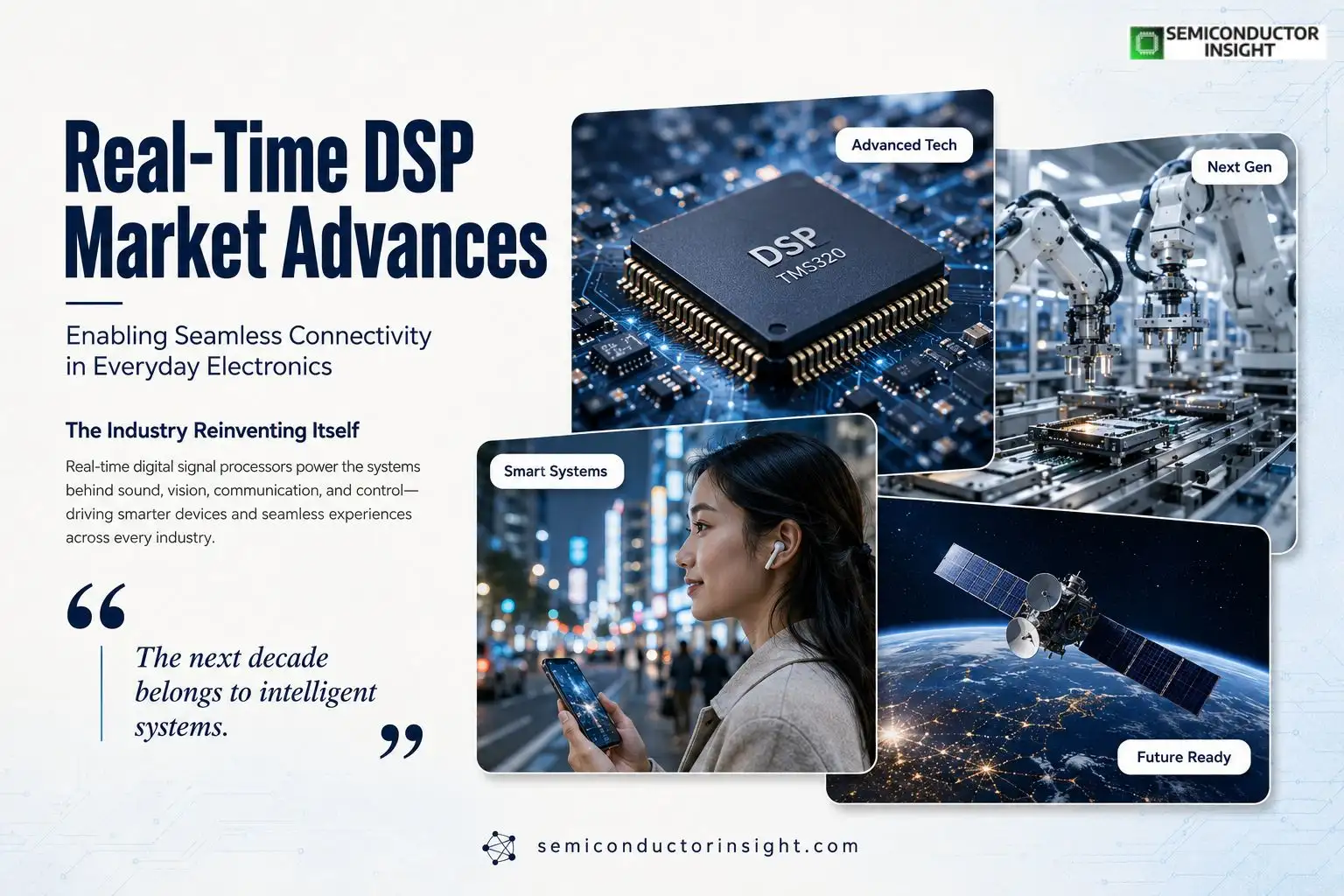
Real-Time DSP Market Advances Enabling Seamless Connectivity in Everyday Electronics
Real-time digital signal processors serve as specialized engines within the semiconductor world. They handle continuous streams of data from the analog realm turning them into actionable digital outputs with minimal delay.
These processors are superior to general-purpose chips when it comes to doing repetitive mathematical processes like multiply-accumulate activities, which are the foundation of filtering convolution and frequency analysis. Their architectures often feature Harvard-style memory setups allowing simultaneous access to instructions and data which proves essential for meeting strict timing requirements in live environments.
- Texas Instruments has long pioneered this space with its TMS320 series.
- These chips power everything from mobile audio enhancements to advanced radar systems in vehicles.
- Analog Devices contributes strong options through families like SHARC which deliver high floating-point performance suited for professional audio and imaging.
- Such processors appear in satellites where DSP technology replaced racks of analog components reducing weight and boosting reliability as seen in models like SES-12 with significant DSP-enabled capacity.
Signal Flow in Real-Time Systems
Incoming analog signals are converted and passed to a DSP core where algorithms such as FFT or adaptive filtering run; the processed results are then returned to the analog domain or routed to digital interfaces. This conversion processing output loop runs continuously, producing imperceptible latency in real-time applications from voice calls to video streams.
Key processor families used in these roles include TI’s TMS320C6000 series, notable for high MIPS and VLIW architecture (up to ~8000 MIPS in top configurations), and ADI’s SHARC line, known for floating-point precision (hundreds to thousands of MFLOPS).
These figures come from manufacturer specifications and academic sources; actual deployment depends on product design but these processors support billions of consumer devices across phones, cameras, and appliances.
Take a Quick Glance at Our In-Depth Analysis Report: https://semiconductorinsight.com/report/real-time-dsp-market/
Audio and Vision Excellence through DSP
In audio realms real-time DSP delivers noise cancellation in headphones echo suppression during conferences and high-fidelity sound synthesis. Vision systems rely on it for real-time image enhancement object detection and stabilization in cameras or autonomous setups. Recent instances include automotive audio SoCs from TI offering 32 to 80 GFLOPS for immersive in-cabin experiences while handling radar inputs simultaneously.
- Smart Ecosystem Lighting Leaders and Real-Time Integration
Certain lighting brands stand out when embedding responsive controls that sync with broader home networks often leveraging DSP capabilities for instant audio-visual feedback or sensor fusion. Philips Hue systems demonstrate strong compatibility through bridges that coordinate dynamic scenes with voice commands and other devices creating seamless environments where lighting reacts in real time to user presence or media playback. Their Matter-enabled bulbs further simplify connections across ecosystems allowing fluid interactions with speakers and displays that benefit from underlying DSP processing for synchronized effects.
- Satellite and Infrastructure Deployments
Communications satellites showcase DSP value by processing hundreds of channels onboard. Airbus-built units for SES operators incorporated DSP for a notable portion of payload handling which cut complexity and power draw. On the ground base stations use similar technology for 5G signal modulation ensuring reliable data rates across expanding networks.
- Medical and Industrial Case Examples
Healthcare benefits from real-time DSP in imaging equipment where fast Fourier transforms help generate clear scans during procedures. Industrial settings apply it for vibration analysis in machinery or precise motor control maintaining operational stability. Educational labs and research often use development kits based on popular DSP platforms to prototype these solutions demonstrating versatility from lab benches to factory floors.
Input Sampling → Parallel MAC Operations in DSP Core → Algorithm Execution (Filter/Transform) → Low-Latency Output → System Feedback Loop. This cycle repeats thousands of times per second supporting demanding workloads without interruption.
Embedded Systems and Consumer Reach
- Portable devices integrate DSP cores for battery-friendly performance.
- Hearing aids apply noise reduction algorithms in real time while disk drives use them for signal recovery.
- Broader adoption appears in consumer electronics where daily interactions with phones and televisions depend on these capabilities for smooth operation.
- Government and university resources continue exploring extensions into areas like biomedical signal monitoring highlighting ongoing innovation.
Real-time DSP market solutions keep transforming how devices interpret and respond to the world around us. From foundational audio clarity to advanced vision tasks and responsive smart environments these semiconductor components deliver the speed and efficiency that modern applications demand. Their presence in satellites vehicles and daily gadgets underscores a foundation for continued progress in signal-centric technologies.

Comments (0)