
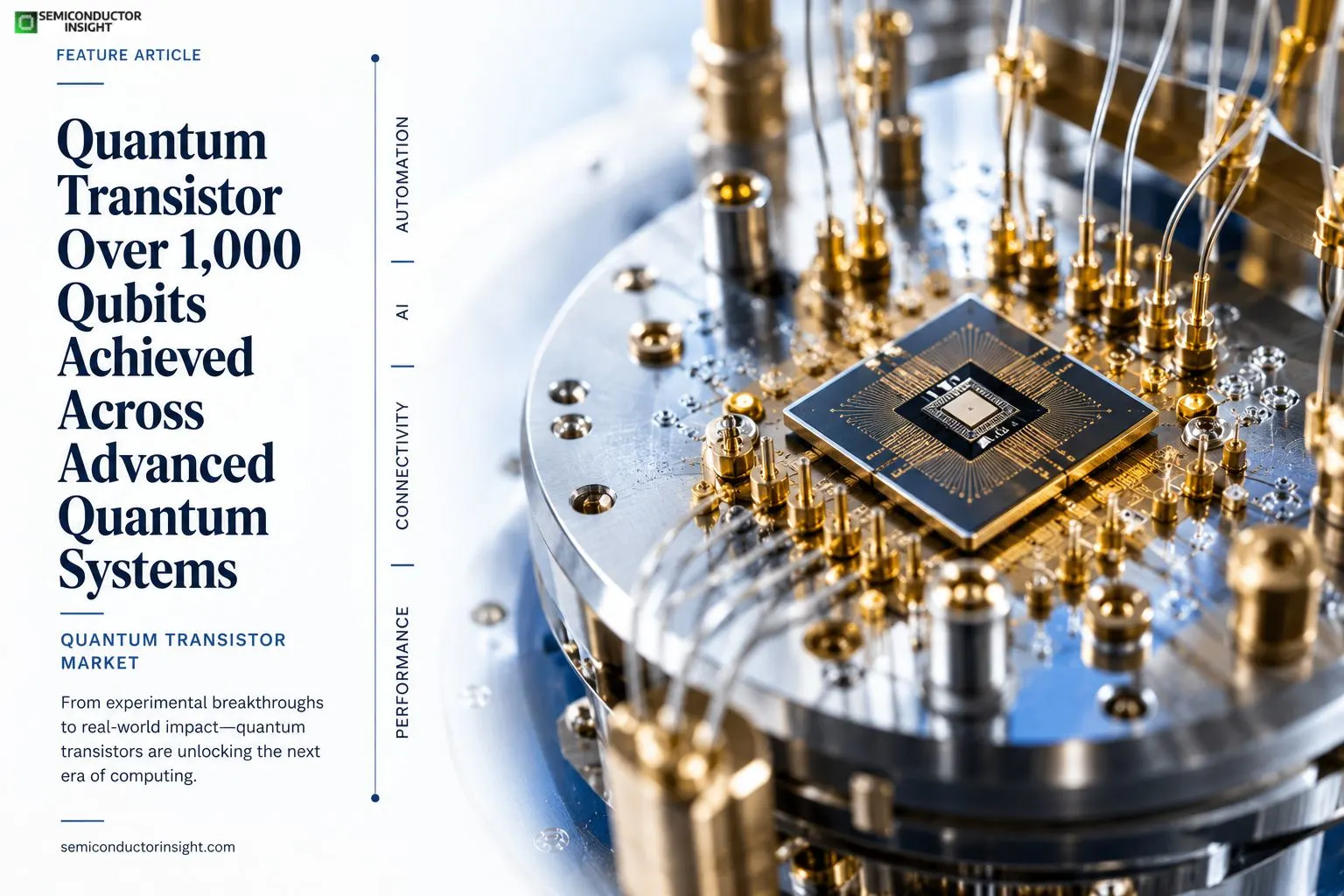
Quantum Transistor Market 2026 Over 1,000 Qubits Achieved Across Advanced Quantum Systems
Quantum computing is steadily moving beyond theoretical research and entering a phase where hardware innovation is becoming the primary focus. At the center of this evolution lies Quantum Transistor Market, a specialized segment of semiconductor technology that seeks to control and manipulate quantum states with unprecedented precision.
Whereas regular transistors manipulate binary information, quantum transistors are built to interact with quantum particles. This will allow future computer systems to address problems that are beyond the scope of classical processors.
Why Quantum Transistors Matter in the Semiconductor Roadmap
For many years, semiconductor advancement has largely depended on making transistors smaller and more efficient. However, as physical scaling begins to reach practical limits, the industry is now looking toward quantum devices that use principles such as superposition and quantum tunnelling to unlock new performance possibilities.
This evolution marks a clear shift in the technology path, moving from conventional transistors to FinFET architectures, then to gate-all-around devices, followed by quantum components, quantum transistors, and eventually scalable quantum processors. The transition is generating strong interest from semiconductor manufacturers, research laboratories, national governments, and cloud computing providers, all of whom are exploring the potential of next-generation computing advantages.
Inside a Quantum Transistor
Unlike conventional switching devices, quantum transistors manipulate individual electrons, photons, or quantum states to control information flow.
Simplified Operating Structure
Quantum Input State
↓
State Manipulation Layer
↓
Quantum Gate Control
↓
↓
Quantum Output State
Researchers are currently exploring several approaches, including silicon spin qubits, superconducting circuits, quantum dots, and photonic architectures.
The Materials Race Redefining Device Engineering
One of the most fascinating developments in Quantum Transistor Market is the search for materials capable of maintaining quantum coherence for longer durations.
- Silicon quantum dots
- Gallium arsenide structures
- Superconducting materials
- Diamond nitrogen-vacancy centers
- Two-dimensional materials
- Topological materials
Advanced material engineering is becoming just as important as transistor design itself, creating opportunities across the semiconductor supply chain.
Quantum Foundries Enter the Spotlight
Traditional chip fabrication facilities are increasingly adapting capabilities for quantum hardware experimentation.
Material Suppliers
↓
Quantum Device Fabrication
↓
Cryogenic Packaging
↓
Quantum Hardware Testing
↓
Cloud-Based Quantum Access
↓
Enterprise Applications
Organizations such as IBM, Intel, Google, and several university-led research centers have expanded investments in dedicated quantum fabrication infrastructure.
Top Factors Influencing Industry Growth
- Recent breakthroughs have highlighted the pace of innovation within the sector.
- In 2025 and 2026, researchers demonstrated improved silicon-based quantum devices capable of operating with enhanced stability. Multiple institutions reported advances in spin-based transistor control, while semiconductor manufacturers expanded collaborations with national laboratories to accelerate quantum chip development.
- Several cloud platforms now provide access to quantum hardware environments, allowing developers and researchers to test algorithms without owning specialized infrastructure.
Beyond Computing Applications
While quantum computing continues to attract the most attention, quantum transistors have the potential to impact a far wider range of industries. In healthcare, they may support molecular simulation, while in energy they could accelerate advanced material discovery.
Financial services may use them for portfolio optimization, logistics for route optimization, aerospace for complex system modeling, and cybersecurity for quantum-safe communications. The expanding range of use cases is also drawing interest from industries beyond the semiconductor sector, encouraging broader participation and innovation.
You Can Freely Surf Our Latest Updated Report Here: https://semiconductorinsight.com/report/quantum-transistor-market/
Research Hubs Creating the Next Wave of Innovation
Innovation in quantum transistors increasingly originates from collaborative ecosystems involving universities, government laboratories, semiconductor firms, and startup accelerators.
Academic Research
↓
Prototype Development
↓
Device Validation
↓
Pilot Fabrication
↓
Commercial Integration
↓
Industrial Deployment
This interconnected model is accelerating technology transfer and shortening the journey from laboratory discovery to practical implementation.
A Semiconductor Segment Built on Scientific Breakthroughs
Quantum Transistor Market represents one of the most technically ambitious areas within modern electronics. Rather than focusing solely on smaller chips, researchers are pursuing entirely new methods of processing information.
As quantum hardware ecosystems mature, advances in transistor architecture, materials science, cryogenic engineering, and fabrication technologies will collectively determine how quickly quantum devices transition from research laboratories into real-world semiconductor platforms.

Comments (0)