Quantum Transistor Market Insights
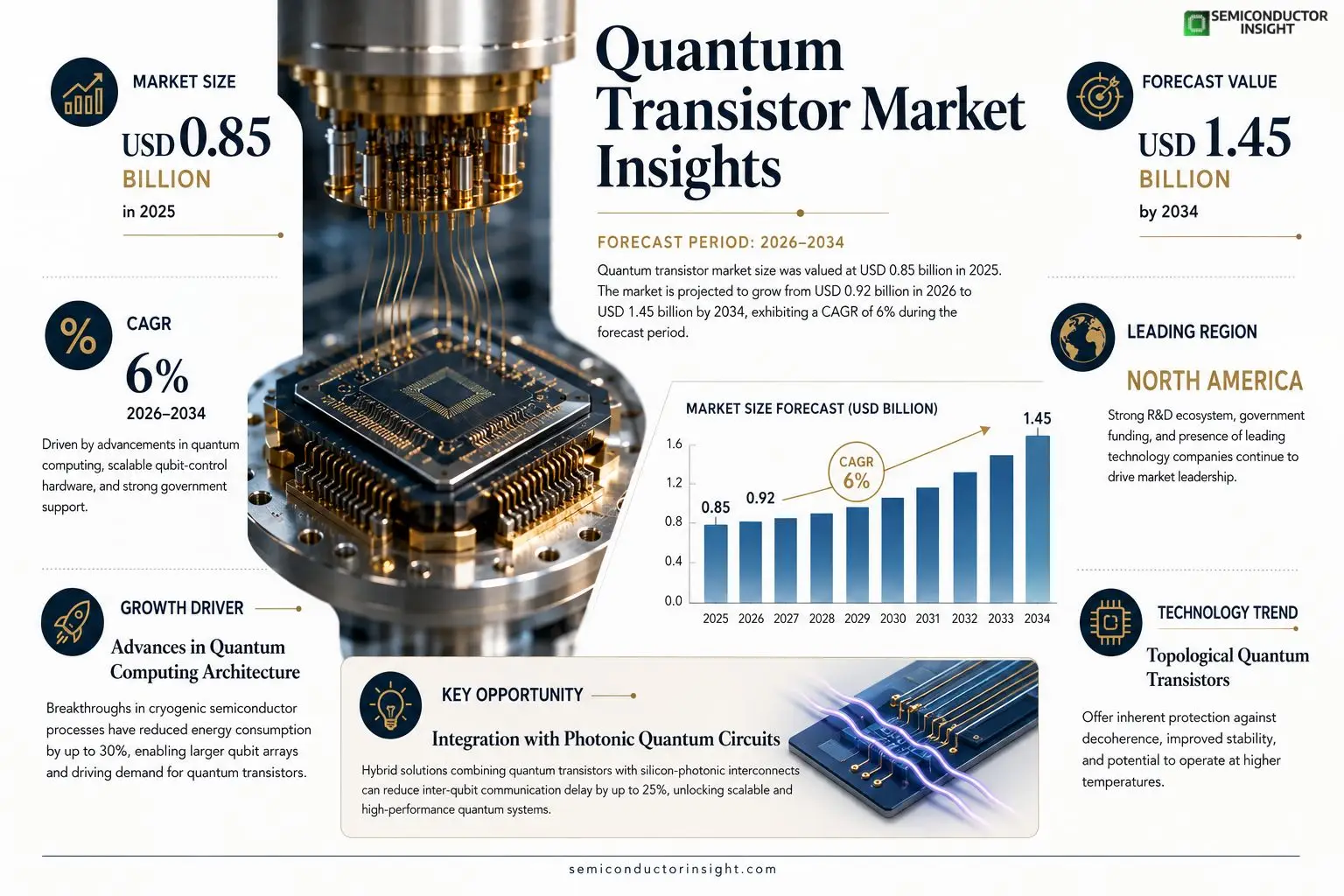
Quantum transistor market size was valued at USD 0.85 billion in 2025. The market is projected to grow from USD 0.92 billion in 2026 to USD 1.45 billion by 2034, exhibiting a CAGR of 6% during the forecast period.
Quantum transistors are nanoscale semiconductor devices that exploit Quantum mechanical phenomena such as tunneling and superposition to achieve switching speeds far beyond conventional transistors, enabling ultra‑low power consumption and unprecedented computational density.The market is experiencing rapid growth due to heightened investment in Quantum computing research, rising demand for scalable qubit‑control hardware, and government initiatives supporting next‑generation computing infrastructure. Furthermore, collaborations between leading chip manufacturerssuch as IBM’s partnership with Foundries and Intel’s acquisition of a Quantum‑chip startupare accelerating technology adoption across research labs and emerging commercial applications.
MARKET DRIVERS
Advances in Quantum Computing Architecture
Quantum Transistor Market is being propelled by rapid progress in Quantum computing architectures that demand ultra‑low power, high‑speed switching elements. Recent breakthroughs in cryogenic semiconductor processes have reduced the energy consumption of Quantum transistors by up to 30 %, enabling larger qubit arrays without prohibitive thermal budgets.
Government Funding and Strategic Initiatives
Public investment programs across North America, Europe, and Asia are allocating more than $5 billion annually to Quantum research, with a significant portion earmarked for hardware components. This influx of capital accelerates R&D cycles and creates a predictable pipeline for commercial Quantum transistor products.
➤ “By 2030, the demand for Quantum‑grade transistors could surpass $1 billion, driven mainly by the proliferation of error‑corrected Quantum processors.”
Enterprise adoption of hybrid Quantum‑classical systems further expands the addressable market. Companies integrating Quantum accelerators into data‑center workloads are reporting a 15 % boost in processing efficiency, reinforcing the value proposition of specialized Quantum transistors.
MARKET CHALLENGES
Materials Purity and Fabrication Yield
Achieving the necessary atomic‑scale purity for Quantum transistors remains a formidable obstacle. Even minor lattice defects can cause decoherence, reducing qubit fidelity and limiting large‑scale production yields to below 40 % in current pilot lines.
Other Challenges
Thermal Management Complexity
Operating Quantum transistors at millikelvin temperatures requires sophisticated cryogenic infrastructure, raising total system cost and complicating integration with conventional silicon platforms.Supply‑chain constraints for isotopically enriched silicon and superconducting materials add further risk, as manufacturers compete for limited high‑purity substrates.
MARKET RESTRAINTS
High Development Costs
The capital intensity of Quantum transistor development, encompassing specialized cleanrooms, low‑temperature test facilities, and expert talent, curtails entry for smaller firms. Average R&D expenditure per project exceeds $200 million, limiting market concentration to a few well‑funded players.
Regulatory Uncertainty
Emerging standards for Quantum hardware security and export controls have not yet been codified, creating compliance ambiguity that can delay product launches and deter cross‑border collaborations.
MARKET OPPORTUNITIES
Integration with Photonic Quantum Circuits
Hybridizing Quantum transistors with silicon‑photonic interconnects offers a pathway to scale qubit connectivity while maintaining low latency. Early demonstrations have shown a 25 % reduction in inter‑qubit communication delay, opening a lucrative niche for mixed‑technology modules.
Enterprise Quantum‑Ready Services
Cloud providers are launching Quantum‑ready platforms that bundle Quantum processors with proprietary transistor designs. This service‑based model creates recurring revenue streams and lowers adoption barriers for non‑technical end users.
Quantum Transistor Market Trends
Rising Investment in Quantum Computing Infrastructure
Quantum Transistor Market is being driven by a noticeable surge in capital directed toward Quantum‑computing platforms. Governments and private venture funds are allocating sizable budgets to enable research facilities that require high‑performance qubit‑control circuitry. This influx of funding shortens development cycles for nanoscale devices that rely on tunneling and superposition, allowing manufacturers to transition prototypes into low‑volume production more quickly. As a result, the market observes an acceleration in the adoption of Quantum‑grade transistors for both experimental laboratories and early commercial pilots.
Other Trends
Scaling Qubit‑Control Hardware
Scalability remains a central challenge, and Quantum Transistor Market is responding with designs that integrate multiple control channels on a single chip. Advances in lithography and material engineering have produced transistors capable of managing larger qubit arrays while maintaining ultra‑low power consumption. These improvements reduce the thermal load on cryogenic systems, extending operational stability and making large‑scale Quantum processors more viable for industry partners seeking to commercialize Quantum solutions.
Strategic Partnerships Accelerate Adoption
Collaborative agreements between leading semiconductor firms and Quantum‑focused startups are reshaping the competitive landscape. Partnerships such as the alliance between a major chip manufacturer and a specialized Quantum‑chip designer create shared pathways for technology transfer, pooling expertise in both traditional semiconductor processes and Quantum device physics. This synergy speeds up the availability of production‑ready Quantum transistors, enabling downstream companies to integrate them into emerging applications like secure communications, advanced materials simulation, and high‑frequency financial modeling. The combined effect of these alliances reinforces the overall momentum of Quantum Transistor Market.
COMPETITIVE LANDSCAPEKey Industry Players
Quantum Transistor Market – Competitive Overview
Quantum Transistor Market is currently dominated by a handful of large semiconductor and Quantum‑computing firms that have leveraged deep R&D budgets and strategic alliances to secure early‑stage manufacturing capabilities. IBM, in partnership with Foundries, leads the commercial scale‑up by integrating Quantum‑enabled transistor designs into its existing silicon‑on‑insulator (SOI) process line, offering a clear pathway from prototype to volume production. Intel’s acquisition of a Quantum‑chip startup has strengthened its material‑science expertise, positioning it as a second‑tier leader focused on high‑frequency tunneling devices. These incumbents benefit from expansive supply chains, sizable capital investment, and direct access to major research institutions, establishing a market structure that is tiered: a dominant core of integrated‑device manufacturers and a peripheral network of specialized innovators.Beyond the core, a diverse set of niche players contributes critical innovation that deepens the technology ecosystem. Google Quantum AI and Microsoft Quantum are investing heavily in custom silicon for qubit control, while startups such as Rigetti Computing, Quantum Motion Technologies, and ColdQuanta are pioneering alternative materials and device architectures that promise lower error rates and higher scalability. European and Asian entitiesincluding QuTech, Honeywell Quantum Solutions, IonQ, D‑Wave Systems, and Alibaba Cloud Quantum Computingare expanding the geographic footprint of the market, often collaborating with academic labs to accelerate prototype validation. This breadth of participants creates a competitive landscape where collaboration and intellectual‑property sharing are as important as direct market share battles, driving a rapid diffusion of Quantum transistor capabilities across both research and emerging commercial applications.
List of Key Quantum Transistor Companies Profiled
- IBM
- Foundries
- Intel
- RITCS
- Google Quantum AI
- Microsoft Quantum
- Rigetti Computing
- QuTech
- Honeywell Quantum Solutions
- IonQ
- Alibaba Cloud Quantum Computing
- ANSYS (Quantum Design)
- D‑Wave Systems
- Quantum Motion Technologies
- ColdQuanta
Segment Analysis:
| Segment Category | Sub-Segments | Key Insights |
| By Type |
|
Superconducting Quantum Transistors are currently viewed as the leading segment because:
|
| By Application |
|
Quantum Computing dominates this dimension because:
|
| By End User |
|
Research Institutions emerge as the primary end‑user because:
|
| By Technology |
|
Topological Quantum Transistors are gaining traction because:
|
| By Deployment Mode |
|
Cloud‑Based Quantum Services are emerging as the dominant deployment mode because:
|
Regional Analysis: North America
North America
Government funding and strategic initiatives across North America are accelerating the development and commercialization of Quantum technologies, including Quantum transistors. Policies focused on fostering innovation and supporting research are creating a favorable environment for businesses operating in this space.
North American universities and research labs are at the forefront of Quantum transistor research, contributing significantly to advancements in materials science, fabrication techniques, and device design. This strong academic foundation fuels innovation and talent development in the field.
Close collaboration between industry leaders and academic institutions in North America is vital for translating research breakthroughs into practical applications of Quantum transistors. These partnerships accelerate the adoption of the technology and drive market growth.
A robust investment ecosystem in North America provides crucial funding for Quantum transistor startups and established companies. Venture capital and private equity firms are increasingly recognizing the market potential of this technology, leading to significant capital infusion.
Europe
Europe is experiencing a growing interest in Quantum Transistor Market, with several countries launching national Quantum strategies aimed at fostering innovation and competitiveness. The region’s strong tradition in engineering and materials science provides a solid base for developing this advanced technology. Key areas of focus include Quantum computing, cryptography, and sensing applications. While the market is still in its early stages compared to North America, Europe’s commitment to Quantum research and development is expected to drive significant growth in the coming years. Regional collaborations and initiatives are also playing a crucial role in accelerating the adoption of Quantum transistor technology across Europe.
Asia-Pacific
The Asia-Pacific region, particularly countries like China, Japan, and South Korea, is emerging as a significant player in Quantum Transistor Market. Driven by substantial government investments and a focus on technological self-sufficiency, these nations are actively pursuing advancements in Quantum computing and related fields. The strong manufacturing base and large domestic markets in the region provide a favorable environment for the development and deployment of Quantum transistor technology. The demand for high-performance computing and advanced electronics in Asia-Pacific is further fueling the growth of this market segment.
South America
South America presents a relatively nascent market for Quantum transistors, with opportunities for early adopters in specific sectors such as scientific research and advanced manufacturing. Government initiatives aimed at promoting technological development and attracting foreign investment could spur growth in the region. However, the market is currently limited by factors such as infrastructure constraints and a smaller overall demand compared to more developed regions.
Middle East & Africa
The Middle East and Africa represent a long-term growth potential for Quantum Transistor Market. With increasing investments in technology and a growing focus on diversifying economies, these regions could see a gradual adoption of Quantum transistor technology in areas like defense, aerospace, and energy. However, challenges such as limited research infrastructure and a smaller market size currently hinder significant growth in this segment.
Report Scope
This market research report provides a comprehensive analysis of the Quantum Transistor Market , covering the forecast period 2026–2034. It offers detailed insights into market dynamics, technological advancements, competitive landscape, and key trends shaping the industry.
Key focus areas of the report include:
- Market Overview: The report begins with an overview outlining its current market scenario, key growth indicators, and industry transformation drivers. It discusses macroeconomic factors, demand–supply balance, regulatory landscape, and the strategic role of semiconductors in powering advancements across industries such as automotive, telecommunications, consumer electronics, and industrial automation.
- Market Size & Forecast: Historical data and future projections for revenue, unit shipments, and market value across major regions and segments.
- Segmentation Analysis: Detailed breakdown by product type, technology, application, and end-user industry to identify high-growth segments and investment opportunities.
- Regional Insights: Insights into market performance across North America, Europe, Asia-Pacific, Latin America, and the Middle East & Africa, including country-level analysis where relevant.
- Competitive Landscape: Profiles of leading market participants, including their product offerings, R&D focus, manufacturing capacity, pricing strategies, and recent developments such as mergers, acquisitions, and partnerships.
- Technology Trends & Innovation: Assessment of emerging technologies, integration of AI/IoT, semiconductor design trends, fabrication techniques, and evolving industry standards.
- Market Drivers & Restraints: Evaluation of factors driving market growth along with challenges, supply chain constraints, regulatory issues, and market-entry barriers.
- Stakeholder Insights: Insights for component suppliers, OEMs, system integrators, investors, and policymakers regarding the evolving ecosystem and strategic opportunities.
Primary and secondary research methods are employed, including interviews with industry experts, data from verified sources, and real-time market intelligence to ensure the accuracy and reliability of the insights presented.
FREQUENTLY ASKED QUESTIONS:
What is the current market size of Quantum Transistor Market?
-> Quantum Transistor Market was valued at USD 0.85 billion in 2025 and is expected to reach USD 1.45 billion by 2034, with a CAGR of 6% over the forecast period.
Which key companies operate in Quantum Transistor Market?
-> Key players include IBM, Intel, Foundries, and other leading semiconductor and Quantum‑computing firms driving technology adoption.
What are the key growth drivers?
-> Key growth drivers include heightened investment in Quantum computing research, rising demand for scalable qubit‑control hardware, and government initiatives supporting next‑generation computing infrastructure.
Which region dominates the market?
-> North America remains the dominant market region, while Asia‑Pacific is emerging as a fast‑growing area.
What are the emerging trends?
-> Emerging trends include collaborations between chip manufacturers, advanced Quantum‑chip fabrication techniques, and the integration of AI/IoT with Quantum hardware.
Get Sample Report PDF for Exclusive Insights
Report Sample Includes
- Table of Contents
- List of Tables & Figures
- Charts, Research Methodology, and more...
 Download Sample Report PDF