

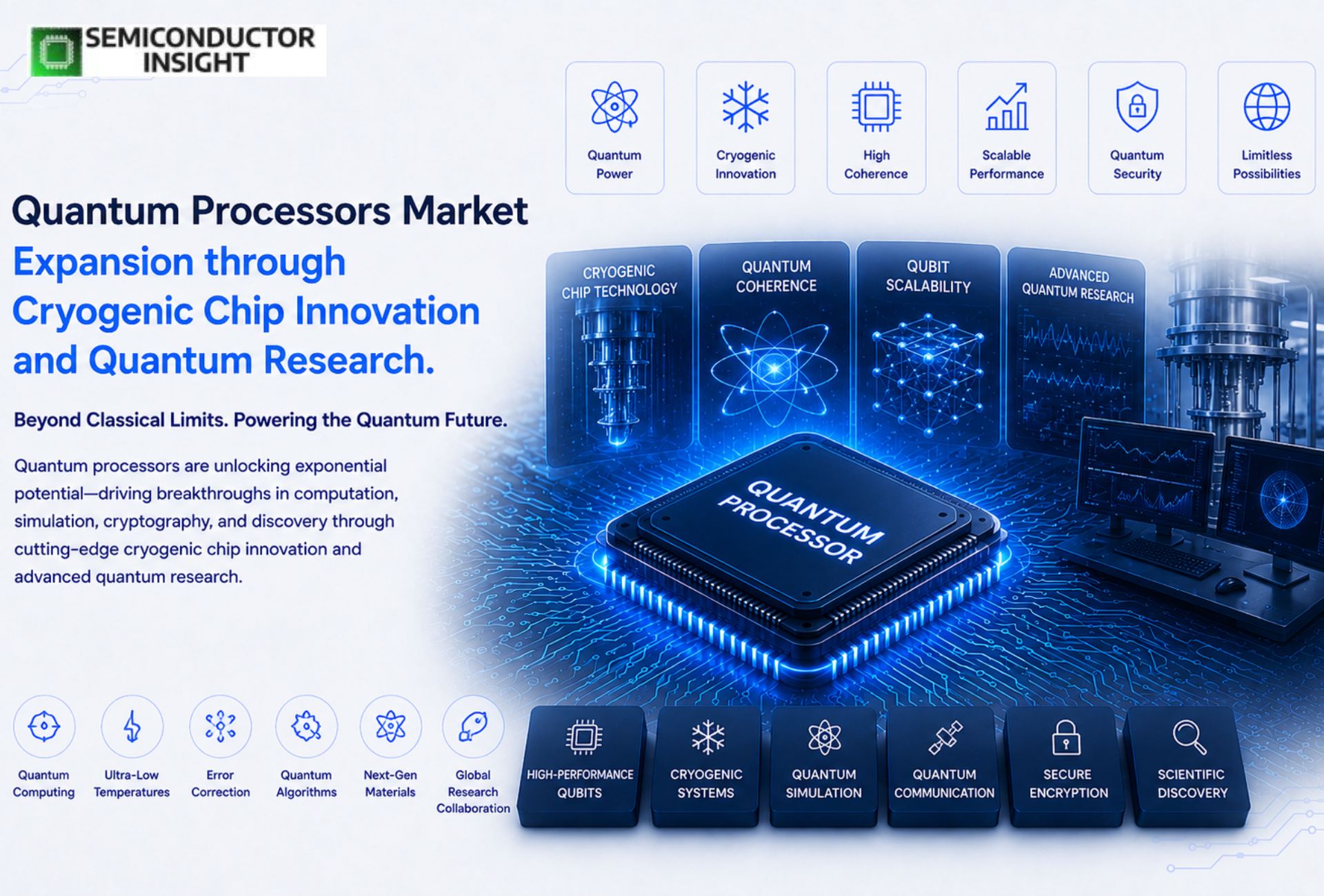
Quantum Processors Market Expansion through Cryogenic Chip Innovation and Quantum Research
Quantum computing is no longer confined to university laboratories and theoretical physics discussions. The technology has entered a new commercial phase where semiconductor companies, cloud providers, governments, and research institutions are investing heavily in quantum processor development.
As industries search for computing systems capable of solving highly complex calculations beyond the reach of traditional architectures, quantum processors market is rapidly becoming one of the most closely watched segments within advanced semiconductor technologies.
Quantum processors use qubits that can represent several states at once, in contrast to traditional processors that rely on binary bits. This makes it possible for quantum systems to do some computations with exceptional efficiency, particularly in applications related to optimisation, molecular simulation, cryptography, and artificial intelligence. Global IT firms are currently vying to develop scalable and reliable quantum devices that can handle realistic workloads.
One of the biggest milestones came when IBM introduced its Condor quantum processor featuring more than 1,000 qubits. This development highlighted how semiconductor engineering is moving toward larger and more advanced quantum architectures. Similarly, Google continues expanding its superconducting quantum research initiatives.
Governments are also intensifying support for quantum hardware programs. The National Quantum Initiative and the European Quantum Flagship have accelerated funding for quantum research, semiconductor fabrication partnerships, and quantum workforce development.
China has also invested significantly in quantum communication networks and quantum processor research facilities as part of its broader semiconductor independence strategy.
Quantum processor development is increasingly tied to national technology competitiveness because advanced computing power now influences cyber security, defense systems, pharmaceutical research, and industrial innovation capabilities.
Why Cryogenic Engineering Has Become a Core Semiconductor Conversation?
One of the most technically demanding aspects of quantum processor development involves temperature control. Many superconducting quantum processors operate at temperatures colder than outer space, often near 15 millikelvin. Maintaining these conditions requires highly specialized cryogenic systems integrated with semiconductor hardware infrastructure.
- This requirement has created new opportunities for semiconductor companies involved in low-temperature electronics, advanced packaging, and signal control systems. Cryogenic engineering is no longer considered a niche research field. It is becoming an essential layer of future quantum computing infrastructure.
- Research organizations are now designing compact cryogenic semiconductor components capable of reducing noise and improving qubit stability. These systems are critical because quantum states remain extremely sensitive to environmental interference. Even small fluctuations in temperature or electromagnetic activity can disrupt calculations.
Several quantum computing laboratories are also working on modular processor designs to improve scalability. Instead of relying on a single large chip, engineers are exploring interconnected quantum modules capable of communicating through photonic or microwave links.
You can freely browse our most recent updated related report to learn more about it before scrolling further: https://semiconductorinsight.com/report/superconducting-quantum-chip-market/
Quantum Processors Are Entering the Cloud Computing Ecosystem
- A major shift in the semiconductor landscape involves the growing availability of quantum computing through cloud platforms. Rather than purchasing expensive experimental hardware, researchers and enterprises can now access quantum processors remotely.
- Microsoft, Amazon Web Services, and IBM have all expanded cloud-based quantum services that allow developers to experiment with quantum algorithms through online platforms.
- This cloud integration is broadening the commercial ecosystem surrounding quantum processors. Universities, pharmaceutical companies, logistics providers, and financial institutions are increasingly testing optimization models and simulation workloads on experimental quantum systems.
According to data published by the International Energy Agency and multiple academic computing studies, global data center electricity demand is rising rapidly due to AI and high-performance computing workloads.
- Although large-scale practical deployment is still in the early stages of development, quantum computing experts anticipate that some future workloads could eventually cut computational complexity and energy usage for specialised jobs.
- Cloud accessibility is also helping train a new generation of quantum software developers and semiconductor engineers who will likely shape the next phase of commercial quantum adoption.
Semiconductor Supply Chains Are Adapting to Quantum Research Needs
Quantum processor fabrication requires extremely precise materials engineering. Semiconductor manufacturers are experimenting with superconducting metals, trapped ion technologies, silicon spin qubits, and photonic architectures to improve performance and stability.
- This has increased demand for ultra-pure materials, advanced lithography systems, and highly specialized fabrication environments. Semiconductor foundries are paying closer attention to quantum-compatible manufacturing capabilities because future commercial demand may depend on scalable production techniques.
- The semiconductor industry is also exploring how existing CMOS manufacturing processes can support quantum chip development. Silicon-based quantum approaches are attracting attention because they may allow quantum devices to leverage portions of the established semiconductor supply chain.
Meanwhile, startups across North America, Europe, and Asia are developing alternative processor architectures designed to overcome qubit instability limitations. Photonic quantum systems, neutral atom processors, and topological qubits are becoming active areas of research investment.
The Semiconductor Industry Is Preparing for a Long-Term Quantum Transition
Despite rapid innovation, experts continue emphasizing that quantum processors are still in a developmental phase. Error correction, qubit coherence, and hardware scalability remain major technical hurdles.
However, the pace of investment indicates that governments and semiconductor companies view quantum computing as a long-term strategic priority rather than a short-term experiment. In 2025, global public and private quantum technology investments crossed several billion dollars, according to government-backed innovation programs and university research tracking initiatives.
The semiconductor sector increasingly recognizes that future computing infrastructure may combine classical processors, AI accelerators, and quantum systems within hybrid architectures. This transition could redefine how industries approach scientific computing, cybersecurity, industrial simulation, and advanced analytics over the next decade.

Comments (0)